TPMs are measured by things going right across teams they don't manage. When a multi-team program ships on time, the engineers get the delivery credit and the product managers get the roadmap credit. Your self-assessment has to reconstruct the coordination, the risk calls, and the planning decisions that made it possible — after the fact, from memory, on a deadline.
Why Self-Assessments Are Hard for Technical Program Managers
Technical program managers create conditions for delivery. You write the plans, track the dependencies, surface the risks before they become incidents, and hold accountability threads across teams that don’t report to you. When the program ships, it looks easy — because you anticipated the problems that didn’t materialize and resolved the conflicts before anyone noticed them. Success in a TPM role is, by design, invisible.
The attribution problem is particularly acute. A TPM coordinates across six teams, but the output — a shipped feature, a completed migration, a met deadline — is attributed to those teams’ engineering managers. Your contribution is the infrastructure of the program itself: the RAID log that caught a dependency three weeks before it blocked, the Jira dependency map that kept six teams aligned, the stakeholder update that prevented an executive escalation. These are real contributions, but they require active translation into performance review language.
There’s also the technical credibility challenge. TPMs who can speak the engineering language fluently — who can read a technical design, evaluate a risk estimate, or understand why a migration is taking longer than planned — deliver fundamentally more value than those who can’t. But demonstrating that credibility in a self-assessment requires naming the technical decisions you understood, influenced, or challenged. Vague claims about “technical leadership” carry no weight.
The goal: name the specific programs, dependencies, and risks you managed; quantify the delivery outcomes you influenced; and make your coordination and planning decisions legible as the cause rather than a coincidence of the success.
How to Structure Your Self-Assessment
The Three-Part Formula
What I did → Impact it had → What I learned or what’s next
For TPMs, “what I did” should describe the program or initiative, the specific coordination or planning mechanisms you put in place, and the decisions you drove. “Impact it had” should connect your work to delivery outcomes — timeline, scope, quality, stakeholder confidence. “What’s next” should name the next level of program complexity or organizational scope you’re targeting.
Phrases That Signal Seniority
| Instead of this | Write this |
|---|---|
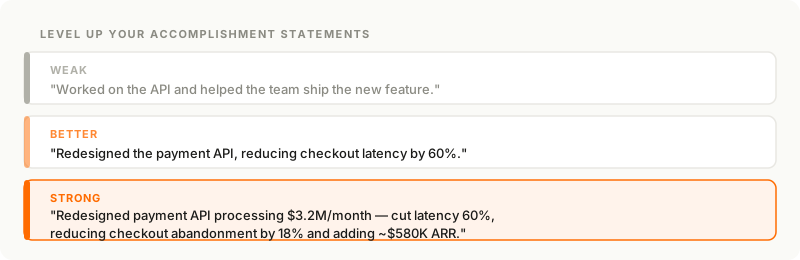
| "I managed the program" | "I designed and owned the program structure for a 7-team, 14-month initiative, creating the dependency map, RAID log, and milestone framework that kept teams aligned through 3 major scope changes without missing the final delivery date" |
| "I tracked dependencies" | "I identified a cross-team dependency that would have blocked 4 weeks of engineering work 6 weeks in advance, negotiated a resolution sequence with 2 engineering managers, and tracked it to completion — preventing a delay that would have pushed our launch past the regulatory deadline" |
| "I communicated with stakeholders" | "I designed a tiered stakeholder communication system — weekly Confluence status updates, bi-weekly executive summaries, and an always-current Jira dashboard — that reduced ad hoc status requests from executives to near zero across a 9-month program" |
| "I improved our processes" | "I introduced a dependency-first kickoff format for all new cross-team programs, replacing the previous feature-first approach; the first 3 programs using this format identified critical path blockers in the first meeting that previously weren't surfacing until week 6" |
Program Delivery & Execution Self-Assessment Phrases
On-time & In-scope Delivery
- "I led program delivery for our platform reliability initiative, a seven-team, nine-month program that shipped on schedule with all committed scope. I maintained the program's Jira milestone structure through three scope change requests, negotiated scope trade-offs with product leadership twice, and identified the one de-scope decision that preserved the launch date without sacrificing any of the outcomes engineering had committed to."
- "I owned program management for our compliance infrastructure upgrade — a hard-deadline program driven by a regulatory requirement — and delivered it 11 days ahead of the compliance date. I built the delivery schedule in a Gantt chart format shared with legal and engineering, ran weekly risk reviews using the RAID log, and made two timeline adjustments that, if delayed, would have pushed us into the compliance window."
- "When a key engineering team was pulled for an emergency project mid-program, I restructured the delivery sequence within 48 hours, negotiated a six-week scope deferral with product, and re-baselined the Jira plan to keep the non-deferred scope on track. The program shipped within two weeks of the original date despite losing 30% of planned engineering capacity for six weeks."
- "I maintained a program-level milestone cadence across six teams using a shared Confluence dashboard, with every team's milestone status updated weekly. When two teams fell behind simultaneously in month four, I identified the shared root cause — a Terraform module dependency neither team had surfaced — and facilitated a joint resolution that recovered both timelines."
Delivery Metrics & Tracking
- "I built a program health scorecard in Confluence that tracked milestone completion rate, open risk count, and dependency status across all teams weekly. The scorecard reduced the time I spent in status-gathering meetings by 4 hours per week and gave engineering managers a shared view of program health that reduced inter-team misalignment significantly."
- "I established a practice of weekly program retrospectives at key milestones — not just at program close — which allowed us to adapt our delivery approach mid-program twice based on real-time learning. One of those adaptations, a change to our code freeze protocol, prevented a 3-week delay that our post-program retrospective confirmed would otherwise have been inevitable."
Cross-team Coordination Self-Assessment Phrases
Dependency Management
- "I mapped and managed 47 cross-team dependencies across a 9-team program using a structured dependency register in Jira. I surfaced 8 critical-path dependencies more than 6 weeks before their risk window and resolved all but one without impacting the program timeline. The one unresolvable dependency I escalated to VP level with a full options analysis, enabling a scope decision that protected the launch date."
- "I identified a circular dependency between two teams' API contracts that neither team had recognized — because each team was looking only at their own deliverable. I organized a joint technical session, facilitated the resolution, and updated both teams' Jira milestones to reflect the agreed sequencing. Left unresolved, this would have caused a three-week delay."
- "I introduced a dependency-first kickoff format for cross-team programs, requiring all teams to map their dependencies and critical path assumptions before any delivery planning begins. The first three programs using this format identified blocking dependencies in the kickoff meeting that, in prior programs, weren't surfacing until mid-delivery."
- "I tracked 23 external vendor dependencies across two programs this year, establishing SLA-based escalation triggers for each one. In two cases, I escalated vendor delays proactively to our procurement team with enough lead time to negotiate accelerated delivery, preventing program delays on both occasions."
Alignment Across Organizations
- "I drove alignment between the engineering, product, and legal organizations on a data residency compliance program that had been stalled for two months due to unclear ownership. I designed a RACI matrix in Confluence, facilitated a leadership alignment session, and established a decision escalation path that allowed the program to move from stalled to active within one week."
- "I coordinated across four engineering teams and two external partners to deliver a partner API integration on a committed external deadline. I built the integration timeline in Gantt format, ran weekly cross-org syncs, and served as the technical translation layer between our engineering teams and the partner's non-technical account management team."
Risk & Dependency Management Self-Assessment Phrases
Risk Identification & Mitigation
- "I maintained a living RAID log for every program I ran this year, updating risk probability and impact scores weekly and reviewing the top 5 risks at each program sync. In three cases, a risk I had flagged and was actively tracking materialized as an issue — and in each case, the documented mitigation plan was executed within 48 hours, a response speed that was only possible because the plan existed before the risk materialized."
- "I identified a personnel risk three months before it would have become a program crisis: two engineers who held critical knowledge on our data migration program both had planned departures in the same month. I coordinated a structured knowledge transfer plan in Confluence and cross-trained two additional engineers in advance. Both engineers departed on schedule and the program continued without disruption."
- "I built a risk quantification model for our infrastructure consolidation program that expressed technical risks in business impact terms — potential revenue impact, compliance exposure, and customer-facing downtime — rather than purely technical terms. This translation allowed senior leadership to make prioritization decisions about risk mitigation investment based on business value rather than technical intuition."
- "I introduced a red/amber/green program status framework with explicit definitions in Confluence, replacing a subjective verbal status reporting approach that was producing false-green statuses. The first month of honest status reporting surfaced three issues that had been underreported — and resolving them with adequate lead time was only possible because the new framework made them visible."
Scope Control
- "I managed scope on a nine-month program through eleven change requests. I created a change request process in Confluence that required each request to include an impact assessment on timeline, cost, and team capacity. Of the eleven requests, I recommended accepting four, deferring five, and declining two — and the program shipped within one week of the original committed date."
Stakeholder Communication Self-Assessment Phrases
Executive Communication
- "I designed an executive status reporting cadence for our largest program — a bi-weekly Confluence summary page and a monthly in-person review — that gave senior leadership consistent visibility without requiring them to attend working-level syncs. Executive escalations during the program dropped to zero after the first month, a direct result of the proactive transparency."
- "When our program hit a significant risk event, I sent a proactive update to three VPs within four hours — including a clear description of what happened, the business impact, the mitigation plan, and the revised timeline — rather than waiting for the next scheduled update. All three VPs responded with appreciation for the transparency and two offered support resources the program ultimately used."
- "I translated complex technical program risks into business impact language for quarterly OKR reviews, framing infrastructure migration risks not as 'service dependencies' but as 'potential $X revenue impact if unresolved by [date].' This framing consistently produced faster executive decisions on resource prioritization than technical framing had in prior quarters."
- "I created a program dashboard in Jira that was accessible to all stakeholders — engineering, product, legal, and finance — without requiring me to produce manual status reports. The dashboard reduced my weekly reporting overhead by 5 hours and gave stakeholders real-time visibility that reduced the volume of status questions in Slack by approximately 60%."
Working-level Communication
- "I established a program-wide communication protocol using Slack that defined expected response times for different message types and established a weekly Confluence digest for asynchronous updates. Team members on the program reported lower meeting load and higher clarity about what was expected of them each week."
Process & Tooling Self-Assessment Phrases
Process Design
- "I designed a cross-team program kickoff methodology that I've now run on four programs, combining a dependency mapping exercise in Miro, a risk brainstorm against a RAID log template in Confluence, and a milestone sequencing session in Jira. Programs that use this kickoff format have a measurably better track record on dependency identification than those that use the ad hoc approach we used previously."
- "I audited the OKR-to-program alignment process for the engineering organization and identified a structural gap: programs were being resourced based on OKR text rather than engineering capacity analysis. I proposed and implemented a capacity-validation step in the OKR planning process, which prevented two programs from being committed to the roadmap without adequate engineering resources for the first time in four planning cycles."
- "I introduced a program retrospective template in Confluence that captures learnings at three levels: delivery mechanics, technical decisions, and stakeholder dynamics. The template has been used in six retrospectives and has produced a growing library of reusable program management patterns that our TPM team now references when designing new programs."
Tooling & Automation
- "I built a Jira automation that generates a weekly dependency status summary and posts it to the relevant Slack channel every Monday morning without manual intervention. The automation runs for six active programs and saves an estimated 3 hours per week of manual status aggregation across the TPM team."
- "I standardized our program Confluence page structure across the TPM team, creating templates for program charters, RAID logs, decision logs, and stakeholder maps. Onboarding a new program to our standard tooling went from taking half a day to under an hour, and new TPMs joining the team reported being productive on program tracking within their first week."
Strategic Impact Self-Assessment Phrases
Org-level Contributions
- "I led the development of the engineering organization's program management maturity model, assessing our current state across five dimensions and producing a 12-month improvement roadmap. The model was presented to the VP of Engineering and has been adopted as the framework for TPM team development and hiring decisions."
- "I identified a pattern of programs being chartered without adequate engineering input on technical feasibility, resulting in commitments that engineering couldn't honor. I proposed and implemented a technical feasibility review gate in our program intake process. In the first two quarters, three proposed programs were re-scoped before commitment, avoiding delivery failures that would otherwise have damaged stakeholder trust."
- "I contributed to the annual engineering planning process by building a program portfolio view in Asana that visualized all committed programs against engineering team capacity. This view identified three capacity conflicts that were invisible in the OKR-level planning view, enabling leadership to make resourcing decisions proactively rather than reactively."
- "I established our TPM team's first formal program review process, including a peer review step for RAID logs and milestone plans on programs above a defined complexity threshold. The process has reviewed 8 programs since its introduction and identified significant risks or structural issues in 3 of them before the programs launched."
How Prov Helps Technical Program Managers Track Their Wins
TPM work is continuous and largely invisible — a risk you caught before it became an incident, a dependency you resolved before it blocked a team, an executive escalation you prevented with a proactive update. Each of these is a real win, but none of them show up in a delivery report because the whole point is that nothing went wrong. By review time, the wins that didn’t become problems are the hardest ones to remember and articulate.
Prov captures these moments in 30 seconds — the RAID log entry that predicted the Q3 incident, the kickoff session that surfaced a blocking dependency four weeks early, the scope negotiation that kept the program on track. When your review arrives, you’re working from a timestamped record of the year’s decisions rather than trying to reconstruct a program from a Jira history that only shows what shipped, not what you prevented. Prov is coming soon on iOS.
Ready to Track Your Wins?
Free to start, no account, no sign-up. Available on the App Store now.
Download on iOS Free to start, no account needed