The most important question in a TPM performance review is not "did the program ship?" It's "would this program have shipped without this person — and would it have shipped better, faster, or with fewer casualties because of how they led it?"
How to Write Effective Technical Program Manager Performance Reviews
The central challenge in writing a TPM review is attribution. Programs succeed and fail for many reasons, and the TPM’s contribution is rarely the proximate cause of either outcome. A program that delivered on time may have done so because the engineering team was exceptional, the scope was well-defined before the TPM arrived, or the technical risk was lower than expected. A program that slipped may have slipped despite genuinely excellent program management, because a third-party dependency failed or an organizational decision changed the requirements mid-flight. Reviews that judge only outcomes will misattribute performance in both directions.
The better approach evaluates the quality of the TPM’s inputs: early risk identification, dependency mapping accuracy, the clarity and completeness of stakeholder communication, and whether the TPM built team velocity or just observed it. A TPM who identified a critical integration risk in week two, escalated with a concrete mitigation proposal, and drove the team to resolve it before it became a blocker has delivered exceptional program management value even if the program ultimately slipped for unrelated reasons. That work belongs in the review.
Distinguish between program management and project coordination. Project coordination is administrative — tracking tasks in Jira, scheduling meetings, sending status updates. Program management is strategic — identifying risks before they become blockers, navigating organizational dependencies, managing stakeholder expectations proactively, and designing program structures that allow teams to move faster. Strong TPM reviews reward program management, not coordination volume. A TPM who sends fifty status emails a week but never identifies a risk before it manifests is a coordinator, not a program manager. Your review language should reflect that distinction.
Finally, evaluate the TPM’s impact on team velocity and capability. The best TPMs leave programs healthier than they found them — engineering teams have clearer processes, stakeholders have better-calibrated expectations, cross-team dependencies are better understood and managed. The worst TPMs add process overhead without adding clarity. Velocity trends, retrospective data, and honest input from engineering leads are the most reliable signals of which category you’re assessing.
How to Use These Phrases
For Managers
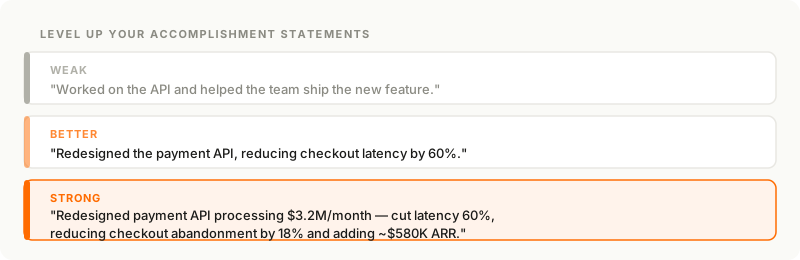
TPM review phrases are most credible when they name specific programs, risks identified, decisions influenced, or velocity improvements quantified. Generic phrases (“managed cross-functional stakeholders effectively”) could describe anyone. Specific phrases (“identified a dependency on the Auth team in week one of a six-week program, negotiated a parallel workstream that eliminated the three-week blocking risk”) describe a person and a decision. Invest in the specificity.
For Employees
If you’re a TPM writing a self-assessment, work through the “Exceeds” phrases in each competency and ask: do I have a concrete story for this? Not “did I do this” but “can I tell a specific story about when I did this and what resulted?” The difference between a good self-assessment and a great one is almost entirely specificity — and TPMs who capture their wins in real time rather than reconstructing from memory at review time consistently write stronger self-assessments.
Rating Level Guide
| Rating | What it means for Technical Program Manager |
|---|---|
| Exceeds Expectations | Identified and resolved program risks before they became blockers; increased team velocity through structural improvements; built organizational trust and cross-team capability |
| Meets Expectations | Delivered programs against plan with appropriate stakeholder communication; managed dependencies effectively; maintained program health through normal operating conditions |
| Needs Development | Risk identification primarily reactive; stakeholder communication inconsistent or late; program overhead exceeds program value added |
Program Delivery & Execution Performance Review Phrases
Exceeds Expectations
- Consistently brings technical credibility to program management — a background in engineering allows this TPM to understand the root cause of technical risks, participate meaningfully in architectural discussions, and earn the trust of engineering teams who rarely extend it to program managers without demonstrated technical fluency.
- Proactively built a program kickoff playbook that has reduced the ramp time on new programs by an estimated three weeks — the playbook covers charter development, dependency mapping, stakeholder identification, and RAID log setup in a format that engineering leads can complete independently.
- Consistently delivers programs that engineering and product teams describe as "the best-run programs we've been part of" — every program this period had a clear charter, defined milestones, maintained RAID logs, and produced post-program retrospectives that improved subsequent program design.
- Proactively restructured the delivery approach for a high-visibility migration program at week three when early signals indicated the original plan was unachievable — the revised approach, delivered through a clear stakeholder communication, maintained confidence while resetting expectations before the original deadline became a public miss.
- Independently identified that the program's critical path was underestimated by four weeks due to an undocumented dependency between two services, and drove the schedule recovery process that ultimately delivered the program one week past the original date rather than the five-week slip that would have occurred without intervention.
- Drives execution excellence by distinguishing between program pace and program health — consistently surfaces leading indicators of delivery risk (engineering throughput trends, open RAID items, unresolved scope questions) rather than tracking completion percentages against a Gantt chart.
- Demonstrates an unusual ability to maintain program momentum through organizational uncertainty — during a period of leadership transition and OKR reprioritization, kept two concurrent programs on track by maintaining team focus and shielding the engineering team from ambiguity until decisions were finalized.
Meets Expectations
- Delivers programs against plan with acceptable variance — milestone slippage is communicated proactively, scope changes are documented and approved through appropriate channels, and final delivery is within the agreed tolerance band.
- Maintains program documentation consistently in Confluence and Jira — charters, milestone plans, RAID logs, and decision records are current and accessible to all program participants.
- Manages program cadence effectively — the right people are in the right meetings at the right frequency, and ceremony overhead is proportionate to program complexity and risk.
- Tracks program health metrics and reports them accurately — velocity, milestone completion rates, and risk counts are reported without spin in a way that gives stakeholders an honest picture of program status.
- Manages scope change requests through a structured process — changes are evaluated against program goals, impacts are assessed across all teams, and decisions are documented before implementation begins.
Needs Development
- Program delivery predictability needs improvement — milestone revisions have been frequent this period without corresponding improvements to estimation or scope management practices; developing a more rigorous milestone-setting approach that incorporates historical velocity data and dependency risk would improve forecast accuracy.
- Would benefit from developing stronger program documentation habits — RAID logs and decision records are currently maintained reactively rather than proactively, which means risk items are sometimes recorded after they've already affected the program rather than in time to prevent them.
- Program overhead needs calibration — the meeting and reporting cadence on current programs exceeds what the engineering teams describe as valuable; working with key stakeholders to identify the minimum viable ceremony footprint would free up engineering time and improve the program's perceived value-to-cost ratio.
- Post-program retrospectives are not consistently conducted — programs close without capturing what worked, what didn't, and what should be done differently next time; establishing a lightweight close-out practice would compound the team's program management institutional knowledge.
Cross-team Coordination Performance Review Phrases
Exceeds Expectations
- Consistently builds the cross-team relationships needed to resolve dependencies before they affect delivery — engineering leads from partner teams describe this TPM as someone who "actually understands our constraints and comes with solutions, not just requests."
- Proactively developed a dependency mapping framework for a complex platform migration involving seven engineering teams — the framework identified three previously undocumented interdependencies in the first week, enabling the program to be restructured before work began rather than after the first integration failure.
- Independently navigated a priority conflict between two senior engineering teams competing for the same infrastructure resource — facilitated a technical trade-off discussion, documented the decision with explicit rationale, and produced a sequencing plan that both teams agreed to without escalation to VP level.
- Drives cross-team coordination by creating shared context rather than managing bilateral relationships in isolation — the weekly cross-team sync format they designed gives all program participants visibility into each other's progress, blocking issues, and upcoming needs, dramatically reducing the number of surprise dependencies.
Meets Expectations
- Manages cross-team dependencies effectively — dependencies are documented, owners are identified, and status is tracked with enough regularity that surprises are rare and resolved quickly when they occur.
- Builds productive working relationships with engineering teams across the organization — partner teams respond to requests and engage with the program process in ways that indicate trust and mutual respect.
- Facilitates cross-team decision-making at the working level — most cross-team conflicts are resolved through facilitated technical discussion rather than escalation, which preserves speed and maintains engineering ownership of technical decisions.
- Communicates cross-team coordination needs to all program participants with adequate lead time — teams have sufficient notice to plan for dependencies rather than being surprised by integration requests.
- Maintains an accurate view of each participating team's capacity and commitments — program planning reflects realistic team availability rather than treating all teams as fully available for program work regardless of their other commitments.
Needs Development
- Cross-team dependency management needs development — several integration risks this period were identified after they had already affected delivery; building a more systematic dependency mapping practice using Jira and structured cross-team syncs would surface these risks earlier in the program lifecycle.
- Would benefit from investing more in relationship-building with engineering teams outside the immediate program scope — escalation response time from partner teams suggests that those relationships lack the trust and context that would produce faster resolution when dependencies become blocking.
- Cross-team coordination approach currently produces more meetings than clarity — restructuring the coordination model to reduce ceremony overhead while improving information flow would improve the program's standing with engineering partners and reduce the friction of cross-team collaboration.
- Cross-team decision accountability needs improvement — decisions made in coordination meetings are not consistently documented or followed up; team members frequently re-litigate decisions that were previously resolved because there is no authoritative record to reference.
Risk & Dependency Management Performance Review Phrases
Exceeds Expectations
- Consistently operates as the program's institutional memory — key technical decisions, architectural trade-offs, and stakeholder commitment changes are documented as they occur; when disputes arise or context is needed months later, the program record is authoritative and trusted by all parties.
- Proactively developed a risk identification workshop process for program kickoff that systematically surfaces assumptions, dependencies, and threat scenarios in the first week of every new program — two programs this period avoided significant delays because risks were identified and mitigated before work began rather than after the first integration failure.
- Consistently identifies program risks earlier than any other stakeholder — the RAID log is updated with new risk items before they appear in engineering team retrospectives, and risk mitigations are proposed alongside risk identification rather than weeks later.
- Proactively developed a risk scoring framework for a multi-team platform program that gave the program steering committee a quantified view of risk exposure and enabled resource allocation decisions to be made two months before the issues would have manifested in delivery metrics.
- Independently identified a regulatory dependency that had been overlooked in the program charter — by catching it four months before the launch date, the team had sufficient time to complete compliance review without delaying the launch, avoiding what would otherwise have been a six-week slip.
- Drives risk culture across programs by modeling honest risk disclosure — maintains RAID logs that reflect genuine uncertainty rather than optimistic assumptions, which gives stakeholders confidence that the program's reported health is accurate and earns trust that accelerates future escalation response.
- Demonstrates exceptional skill in distinguishing between risks that require escalation and risks that can be managed at the program level — escalations are made at the right organizational level with the right framing, and the track record of resolved escalations has built significant organizational trust in this TPM's judgment.
Meets Expectations
- Maintains a current and accurate RAID log that captures risks, assumptions, issues, and dependencies throughout the program lifecycle — the log is a genuine working document, not a compliance artifact.
- Escalates risks with sufficient lead time for the organization to respond — leadership is not surprised by issues that were visible in the RAID log, and escalations include a clear problem statement and proposed resolution path.
- Tracks dependency status actively and flags when downstream team commitments are at risk — the program's dependency exposure is understood and communicated before it affects the critical path.
- Reviews and updates risk assessments regularly rather than setting them at program kickoff and leaving them unchanged — risk likelihood and impact assessments reflect current program conditions rather than initial estimates.
- Distinguishes clearly between risks (potential future problems) and issues (active problems) in RAID log management — the difference in urgency and ownership is communicated to stakeholders, enabling appropriate response calibration for each category.
Needs Development
- Risk identification needs to become more proactive — several significant risks this period appeared in the RAID log after they had already affected the program; developing habits of structured risk review at key program milestones and regular RAID log updates would shift the team from reactive problem-solving to preventive risk management.
- Risk escalation judgment needs development — some issues that required organizational intervention were managed at the program level too long before being elevated, extending their impact; developing clearer personal criteria for escalation thresholds would improve response time on high-impact risks.
- Dependency management would benefit from greater depth — current tracking captures direct dependencies between program teams, but second-order dependencies (dependencies of dependencies) have produced surprises; building a more comprehensive dependency map early in program setup would reduce integration-related schedule risk.
- Mitigation planning is underdeveloped relative to risk identification — risks are identified and logged but mitigation strategies are not consistently defined; ensuring every high-likelihood, high-impact risk has an explicit mitigation plan would improve the program's resilience to anticipated problems.
Stakeholder Communication Performance Review Phrases
Exceeds Expectations
- Consistently demonstrates that the best stakeholder communication is preemptive rather than reactive — key stakeholders rarely need to ask for status because this TPM has anticipated their questions and answered them before they arise, which frees executive attention for decisions rather than status-gathering.
- Proactively redesigned the program steering committee to operate as a decision-making body rather than a status-report audience — the shift from information sharing to structured decision-making has reduced the number of steering sessions required per program while increasing the quality and speed of decisions made in each one.
- Consistently produces stakeholder communications that engineering teams describe as accurate and executives describe as clear — the weekly program status email they developed calibrates technical depth by audience tier and has become the template other TPMs in the organization use.
- Proactively redesigned the program steering committee meeting format to focus on decisions and risk rather than status recaps — reduced meeting duration by 40%, increased the proportion of time spent on consequential decisions, and improved stakeholder satisfaction with the program governance model.
- Independently managed a highly visible scope reduction conversation with executive stakeholders — presented the trade-off analysis clearly, recommended a specific path with explicit rationale, and gained alignment in a single session that other stakeholders had estimated would require multiple weeks of negotiation.
- Drives stakeholder trust by delivering difficult news accurately and early — never presents an optimistic program picture to preserve short-term comfort at the expense of long-term credibility; the result is a stakeholder community that trusts the program's status reporting and responds quickly when issues are raised.
- Demonstrates exceptional ability to translate between technical and business language — engineering concerns that would require two meetings to explain become one-paragraph stakeholder updates; business priority changes that would create engineering confusion become clear, contextualized requirements changes.
Meets Expectations
- Communicates program status to stakeholders consistently and accurately — updates are on a predictable cadence, reflect current program reality, and give business stakeholders the information they need to make downstream plans.
- Calibrates communication depth and format to the audience — executive updates are strategic-level summaries while engineering team communications include the technical context needed for implementation decisions.
- Manages difficult stakeholder conversations constructively — scope reductions, schedule changes, and resource constraints are communicated directly and with enough context for stakeholders to understand the trade-offs.
- Ensures that stakeholder decisions and commitments are documented and confirmed — verbal agreements from steering committee meetings are followed up with written confirmation that creates a clear record and prevents later misalignment.
- Prepares steering committee materials with enough context that attendees can make decisions in the meeting rather than needing a follow-up session — decision documents include the relevant background, options, trade-offs, and a recommended path.
Needs Development
- Stakeholder communication needs to become more proactive — program status is currently shared primarily in response to stakeholder requests rather than on a push cadence; establishing a regular, lightweight status rhythm would reduce interruption to the delivery team and improve stakeholder confidence in program health.
- Communication calibration needs development — current stakeholder updates are written at a uniform technical depth that is appropriate for engineering participants but creates confusion for business stakeholders; developing audience-segmented communication templates would improve the effectiveness of status updates across all stakeholder groups.
- Would benefit from developing greater confidence in delivering difficult program news — current practice tends to qualify bad news in ways that understate severity; stakeholders who receive optimistic status updates early and realistic assessments late lose confidence in the program's reporting; honest, direct communication with appropriate context builds more durable trust.
- Decision documentation needs improvement — verbal decisions made in stakeholder meetings are frequently not captured in writing, which produces re-litigation of resolved issues and erodes the efficiency of future decision-making sessions.
Process & Strategic Impact Performance Review Phrases
Exceeds Expectations
- Consistently improves the programs and teams they work with beyond the immediate delivery objective — three engineering teams this period describe improved clarity in their sprint planning, better cross-team communication, and faster decision-making as direct outcomes of working with this TPM on a complex program.
- Proactively identified a systematic gap in how the organization handles cross-team dependency management and designed a lightweight process improvement that has since been adopted by four other TPMs — the work was done outside formal program scope and represents genuine organizational investment.
- Independently developed an OKR alignment framework for multi-team programs that has reduced the frequency of mid-program priority conflicts by giving program participants a shared understanding of how their work connects to company-level goals — the framework is now referenced in the TPM team's program kickoff checklist.
- Drives strategic clarity by ensuring that every program decision is traceable to business outcomes — teams working with this TPM rarely ask "why are we building this?" because the strategic context is woven into program communications, kickoff documents, and milestone definitions from the first day.
- Demonstrates rare ability to improve organizational processes without creating overhead — process improvements introduced on programs are adopted voluntarily by teams who find them genuinely valuable, not complied with because they were mandated.
Meets Expectations
- Delivers process improvements alongside program delivery — teams leave programs with better tooling, clearer documentation, or improved ways of working that persist after the program closes.
- Connects program work to company OKRs in kickoff documentation and stakeholder communications — participants understand why the program is a priority and what success looks like in business terms, not just technical delivery terms.
- Contributes to the TPM team's collective knowledge — participates in team retrospectives and shares lessons learned from programs in ways that improve the team's overall practice.
- Uses Asana, Jira, Confluence, and RAID logs in ways that make program knowledge accessible beyond the immediate program team — documentation quality is sufficient for someone who joins the program mid-flight to get up to speed without requiring one-on-one onboarding.
- Identifies and champions process improvements that benefit program health without waiting to be asked — the TPM practice improves between programs as well as during them, because this leader invests in infrastructure and templates that compound over time.
Needs Development
- Strategic impact needs development beyond delivery execution — programs are delivered competently, but the engineering teams and stakeholders who participated do not describe improved ways of working or enhanced clarity as outcomes; investing in process design and knowledge transfer would increase the TPM's organizational impact beyond the immediate program deliverable.
- Would benefit from developing a stronger connection between program work and strategic business context — OKRs and business rationale are present in program documentation but are not consistently woven into day-to-day team communication; teams sometimes lose sight of why delivery decisions matter, which reduces motivation and the quality of autonomous decision-making.
- Contribution to TPM team practice development needs growth — current focus is appropriately on owned program delivery, but investing in sharing lessons learned, contributing to team templates, and participating in cross-TPM knowledge exchanges would increase organizational influence and career trajectory.
- Program-to-program learning transfer needs development — knowledge generated on one program (about team dynamics, technical architecture, stakeholder preferences, and estimation accuracy) is not systematically carried forward into the next program; building a personal knowledge management practice would accelerate ramp-up on new programs and improve quality over time.
How Prov Helps Build the Evidence Behind Every Review
Technical Program Managers produce an enormous volume of consequential work that is structurally invisible in retrospect. The risk identified in week two, the dependency conversation that prevented a six-week slip, the stakeholder alignment meeting that converted a potential blocker into a resolved decision — none of this ends up in Jira tickets or delivery dashboards. By December, the only thing that’s easily visible is whether programs shipped on time.
Prov solves the capture problem. TPMs who log wins in real time — a risk called early, a cross-team conflict resolved, a process improvement adopted by the broader team — build a rich, timestamped record of their most consequential work throughout the year. Prov transforms those rough notes into polished accomplishment statements and organizes them into a permanent career record. When review season arrives, the full picture of what you actually did — not just what shipped — is already documented and ready to tell.
Ready to Track Your Wins?
Free to start, no account, no sign-up. Available on the App Store now.
Download on iOS Free to start, no account needed