Concrete examples of technical program manager achievements you can adapt for your performance review, resume, or next promotion case.
Why TPMs Have the Hardest Performance Reviews in Tech
You shipped a 14-team program on time. You caught the dependency that would have cost two months. You translated the CTO's ambiguous mandate into a roadmap three engineering orgs could actually execute against. And when review time comes, you write "coordinated cross-functional delivery" and wonder why it doesn't feel like enough.
The structural problem with TPM performance reviews is that your best work is counterfactual. The crisis that didn't happen. The re-plan that absorbed a slip before it cascaded. The architecture decision that got made in week 3 instead of week 14 because you forced the conversation early. These contributions are nearly impossible to quantify in the moment — which is exactly why you need to be deliberate about capturing them when they happen, not reconstructing them eleven months later.
There's also a scope problem. TPMs often manage programs that touch many teams, none of which report to them. Your influence is lateral and persuasive, not positional. But reviewers — especially those less familiar with the TPM function — sometimes conflate "didn't write code" with "didn't make technical contributions." The best TPM self-reviews make the technical depth explicit: the architecture tradeoffs you informed, the oncall patterns you noticed, the infra decisions you accelerated by structuring the right decision framework.
What gets you promoted are documented accomplishments with measurable impact.
Technical Program Manager Accomplishment Categories
| Competency | What Reviewers Look For |
|---|---|
| Program Delivery | Do you ship large, complex programs on time and in scope? |
| Cross-functional Coordination | Can you align many teams with different incentives toward one goal? |
| Risk & Dependency Management | Do you see problems before they become crises? |
| Process & Operational Excellence | Do you leave the org more effective than you found it? |
| Stakeholder Communication | Do executives trust your status and judgment? |
| Technical Depth & Partnership | Do engineers treat you as a peer, not overhead? |
Program Delivery Accomplishments
Milestone & Launch Management
- "Delivered a 9-team, 18-month platform migration on schedule, coordinating 140+ engineering milestones with zero critical-path slips in the final 90 days."
- "Launched a real-time data pipeline serving 4M daily users on the committed date after replanning twice in response to infrastructure changes, maintaining stakeholder confidence throughout."
- "Managed the end-to-end launch of a payment processing system upgrade across 3 regions, achieving go-live with zero P1 incidents in the first 30 days."
- "Delivered a compliance-driven API migration affecting 80+ internal consumers 3 weeks ahead of the regulatory deadline."
- "Coordinated a same-day global launch of a security feature across iOS, Android, and web platforms — the first coordinated multi-platform launch in the org's history."
- "Managed a $6M infrastructure modernization program across 6 engineering teams, delivered within 4% of budget and 2 weeks of the original timeline."
- "Orchestrated a data center migration affecting 47 internal services, completing cutover with 99.97% uptime during a 72-hour maintenance window."
- "Executed a replatforming of the core authentication service used by 12M accounts, with a phased rollout that kept incident rate below SLA throughout a 6-week migration window."
- "Led the program to integrate an acquired company's services into the core platform in 4 months — half the originally scoped timeline — by aggressively parallelizing workstreams."
Scope & Timeline
- "Reduced program scope by 30% in week 4 by identifying 18 requirements that were deferred features from a prior initiative, not launch blockers — saving an estimated 11 engineer-weeks."
- "Recovered a 6-week schedule slip by restructuring the dependency graph, identifying 4 workstreams that could run in parallel rather than sequentially, with no added headcount."
- "Defined a phased delivery plan that enabled the business to go live with 70% of features while engineering completed the remaining 30%, accelerating revenue recognition by one quarter."
- "Negotiated a scope change with the executive sponsor that preserved the launch date when a new regulatory requirement was introduced 8 weeks before go-live."
- "Broke a 24-month program into 4 independently shippable increments, enabling the org to capture business value 14 months earlier than the original big-bang delivery plan."
- "Identified that the MVP scope had grown 40% from the original charter over 3 months of untracked additions; re-baselining recovered 8 weeks of schedule."
Cross-functional Coordination Accomplishments
Team Alignment
- "Aligned 11 engineering teams across 4 org structures on a shared API contract, resolving 3 months of competing proposals in a single structured design review I facilitated."
- "Created and maintained a cross-team program plan spanning 7 engineering orgs, product, legal, and security — the single source of truth used in every executive review for 12 months."
- "Unified 4 teams working on overlapping infrastructure components into a coordinated workstream, eliminating duplicate efforts estimated at 6 engineer-months of redundant work."
- "Established a weekly cross-team sync attended by 14 tech leads, increasing cross-team blocking issue resolution time from 9 days to 2 days."
- "Coordinated design alignment between 3 independently operating product engineering teams, producing a shared component library that reduced duplicated UI work by an estimated 25%."
- "Drove agreement on a shared data schema between the data platform, product analytics, and ML teams after 4 months of misalignment — unblocking 3 downstream initiatives simultaneously."
- "Organized and ran a 2-day technical summit with 30 engineers and 6 PMs to align on the multi-year infrastructure strategy, producing a written decision log adopted by org leadership."
Dependency Unblocking
- "Identified and unblocked 23 cross-team dependencies over a 6-month program — average resolution time 3.4 days, compared to an org baseline of 12 days."
- "Resolved a 6-week blocking dependency between the platform team and a product team by brokering a temporary API contract, enabling both teams to progress in parallel."
- "Negotiated shared infrastructure capacity between 3 competing teams during a resource-constrained quarter, enabling all 3 to hit their commitments without escalation to VP level."
- "Unblocked an external vendor dependency 4 weeks ahead of schedule by facilitating a technical working session between internal engineers and the vendor's solutions team."
- "Proactively mapped third-party dependencies for a platform migration and established a vendor review cadence that prevented 2 late-stage integration failures."
Risk & Dependency Management Accomplishments
Risk Identification & Mitigation
- "Identified a single-point-of-failure in the proposed architecture 10 weeks before launch; facilitating an alternative design review added 2 weeks to the schedule but prevented what would have been a complete system outage on day one."
- "Flagged a data residency compliance risk in the EU deployment plan 6 weeks before go-live, enabling the legal and engineering teams to implement a mitigation that avoided a regulatory breach."
- "Maintained a living risk register across a 14-team program — 9 of 12 tracked risks were resolved before materializing, and none became P0 incidents."
- "Identified that the program's testing timeline assumed parallel capacity that was already committed to another initiative; re-sequencing the plan avoided a 5-week slip."
- "Ran a pre-mortem with 6 tech leads 8 weeks before a major launch, surfacing 14 risk items — 4 of which required immediate mitigation actions."
- "Tracked third-party API deprecation timelines across 8 services and proactively scheduled migration work 6 months before end-of-life, preventing emergency engineering work."
- "Identified that two teams were making incompatible schema changes to a shared database; brokering a joint design session prevented a production data corruption scenario."
Incident & Escalation
- "Led the cross-team response to a P0 production incident affecting 800K users, coordinating 9 on-call engineers across 3 time zones to full resolution in 4 hours and 22 minutes."
- "Ran the post-mortem process for a major service degradation, producing a 23-action remediation plan — 100% of high-priority actions completed within 30 days."
- "Reduced the average time-to-escalate for cross-team blockers from 8 days to 1.5 days by establishing a clear escalation protocol across the program."
- "Managed a go/no-go decision for a high-risk launch with conflicting input from 6 teams, synthesizing the technical risk assessment and presenting a clear recommendation to the VP that was accepted."
- "Coordinated a rollback of a phased feature launch affecting 2.1M users in under 2 hours after an anomalous error rate pattern was detected, limiting customer impact to less than 0.3% of the user base."
Process & Operational Excellence Accomplishments
SDLC & Agile Practices
- "Introduced a technical design review gate that caught architectural issues before sprint start; defect escape rate dropped 38% in the first two quarters."
- "Established a quarterly planning cadence across 5 engineering teams, replacing ad-hoc roadmap conversations with a structured process that reduced planning overhead by an estimated 30%."
- "Redesigned the release process for a high-frequency service, reducing deploy cycle time from 5 days to same-day while maintaining rollback capability."
- "Implemented a dependency review as a standing agenda item in sprint planning across 4 teams; cross-team blockers surfaced in sprint-zero instead of mid-sprint for the first time."
- "Standardized the incident retrospective process across 7 teams, improving mean time to completed post-mortem from 18 days to 5 days."
- "Introduced a lightweight RFC (Request for Comments) process for cross-team technical decisions, reducing verbal-only architecture decisions from the majority to under 10% of major choices."
Tooling & Metrics
- "Built a program health dashboard in Jira + Confluence used by 6 engineering directors in weekly reviews, replacing 3 separate manually-updated trackers."
- "Implemented DORA metrics tracking across 4 teams, giving leadership the first quantitative baseline for engineering throughput in the org's history."
- "Created a dependency tracking system in Notion that became the standard used by all TPMs in the org — adopted by 8 colleagues within 2 months."
- "Established SLA tracking for cross-team review requests; average review turnaround decreased from 11 days to 4 days within one quarter of measurement."
- "Designed a sprint capacity model that accounted for oncall rotation, leave, and tech debt allocation — reducing sprint commitment miss rate from 35% to 11% across participating teams."
Stakeholder Communication Accomplishments
Executive Reporting
- "Authored weekly executive status reports for a $9M program read by 3 VPs and the CTO — consistently described as the clearest updates in the portfolio across 4 consecutive quarters."
- "Presented program status and risk tradeoffs to the executive steering committee 12 times over an 18-month program, securing 4 scope change approvals and 2 budget increases without re-baselining the overall timeline."
- "Translated a complex infrastructure migration into a 1-page business impact summary that enabled a non-technical CFO to approve a $1.2M investment in a single review cycle."
- "Built the quarterly business review framework for the platform engineering org — adopted across 6 teams and used in every QBR for 3 consecutive quarters."
- "Produced a go/no-go assessment for a high-visibility launch that synthesized technical, legal, and operational readiness into a clear executive recommendation — decision made in the same meeting."
Status & Communication
- "Maintained a public program status page in Confluence with weekly updates, reducing ad-hoc status requests to the TPM team by an estimated 60%."
- "Ran a structured weekly cross-functional sync for a 9-team program that consistently ended in under 45 minutes, reducing total meeting load across the program by 3 hours per week per team."
- "Established a program communication charter defining who gets what updates and how — cited by 3 engineering managers as reducing inbox noise significantly."
- "Managed an all-hands communication plan for a major platform change affecting 200+ internal developers, achieving 95% awareness before rollout date."
- "Rebuilt trust with a skeptical senior stakeholder after a prior program failure by establishing weekly 1:1 updates and a shared risk log, resulting in their becoming an active program sponsor."
Technical Depth & Partnership Accomplishments
Architecture Partnership
- "Partnered with the principal engineer to define the distributed tracing strategy for a microservices migration, producing the architectural decision record that guided 6 teams over 14 months."
- "Identified a missing disaster recovery requirement during architecture review; working with the infra team to add it added 3 weeks to the program but enabled the product to meet enterprise customer SLAs."
- "Facilitated a technical design review across 5 teams to resolve competing database partitioning approaches, driving consensus on an approach that reduced projected storage costs by 35%."
- "Recognized that two parallel teams were building redundant caching layers and brokered a shared-infrastructure approach, saving an estimated 8 engineer-weeks and reducing future operational complexity."
- "Co-authored the technical standards document for a new event-driven platform with the staff engineer, balancing architectural purity with delivery pragmatism — adopted as the org standard."
- "Identified API backward-compatibility risks across a platform versioning project, working with tech leads to define a deprecation policy that protected existing integrations."
Technical Decision Support
- "Structured and facilitated the build-vs-buy evaluation for a data ingestion platform, producing a decision framework that incorporated TCO, time-to-market, and operational complexity — decision made 6 weeks faster than prior comparable evaluations."
- "Led a technical spike review process that reduced unbounded research work to time-boxed 2-week investigations, improving team predictability and producing documented findings for 8 architecture questions."
- "Translated a vendor contract's technical SLA terms into operational requirements the engineering team could validate against — identifying 3 terms that were untestable as written before signature."
- "Facilitated the deprecation planning for a legacy service with 14 internal consumers, building the migration timeline collaboratively with consuming teams and achieving 100% migration without a forced cutover."
- "Partnered with the security team to incorporate security review checkpoints into the SDLC, reducing the average number of security-related launch blockers from 4 per release to under 1."
How to Adapt These Examples
Plug In Your Numbers
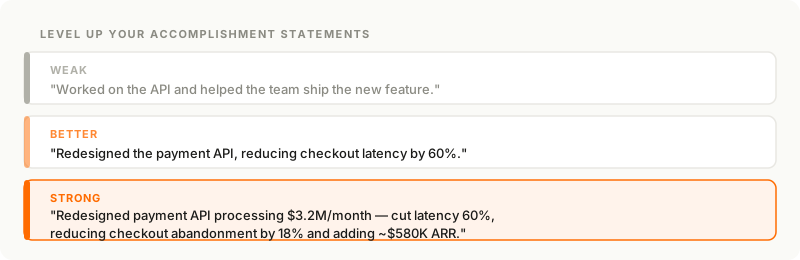
Every example above follows: [Action] + [Specific work] + [Measurable result]. Replace the numbers with yours. Team counts, timeline deltas, incident resolution times, dependency counts — these specifics are what separate a credible claim from a vague one. If you managed 6 teams, say 6. If the P0 took 4 hours to resolve, say 4 hours.
Don't Have Numbers?
TPM impact is often counterfactual — the schedule slip that didn't happen, the incident that was contained instead of catastrophic. When you can't quantify the outcome directly, quantify the inputs and use directional language: "identified before it became a critical-path blocker," "surfaced in design review rather than post-launch," "resolved without escalation to VP level." Specificity about the mechanism of impact is credible even when you can't attach a dollar figure.
Match the Level
Junior TPMs should emphasize execution quality — clean milestone tracking, fast dependency resolution, reliable status reporting. Senior TPMs should shift toward program architecture and org-level influence: defining the frameworks and processes other TPMs adopt, making the calls that determined a program's fundamental shape, representing the program to executive leadership independently. Staff and principal TPMs should show leverage at the org level — how your methods changed how the whole organization works, not just how one program ran.
Start Capturing Wins Before Next Review
The hardest part of performance reviews is remembering what you did 11 months ago. Prov captures your wins in 30 seconds — voice or text — then transforms them into polished statements like the ones above. Prov is coming soon on iOS.
Ready to Track Your Wins?
Free to start, no account, no sign-up. Available on the App Store now.
Download on iOS Free to start, no account needed