Staff engineers are measured at organizational scope, not sprint scope. Your review cycle's most important outputs were probably an RFC nobody rejected, an architecture review that prevented a six-month mistake, and a conversation that unblocked a team that wasn't yours. None of those show up in a Jira dashboard. Your self-assessment has to make them visible.
Why Self-Assessments Are Hard for Staff Engineers
At the staff level, the nature of impact changes fundamentally. You’re no longer primarily measured by code you shipped but by decisions you influenced, systems you shaped, and engineers you leveled up. The problem is that influence is hard to document after the fact. By the time your review comes around, the architectural decision you guided in January has become “how we do things” — its origin invisible, your role in it unremarked.
There’s also the scope mismatch problem. Staff engineers operate across team boundaries, and performance systems are almost always structured around individual teams. Your manager may see your impact clearly, but skip-level reviewers who are reading your self-assessment don’t have the context. You need to reconstruct not just what you did, but why it mattered at the organizational level — what would have happened without your involvement, and how many teams or engineers were affected by the decision you shaped.
The most dangerous failure mode for a staff engineer self-assessment is underselling scope. Writing “I reviewed several architecture proposals” when you reviewed eleven proposals, caught two critical flaws, and established a new review standard that three other teams adopted is not modesty — it’s leaving impact on the table. Staff-level contributions need staff-level framing.
The goal: describe your impact at the level at which you actually operated — org-level, multi-team, long-horizon — and make the counterfactual clear: what would the organization have built, shipped, or broken without your involvement?
How to Structure Your Self-Assessment
The Three-Part Formula
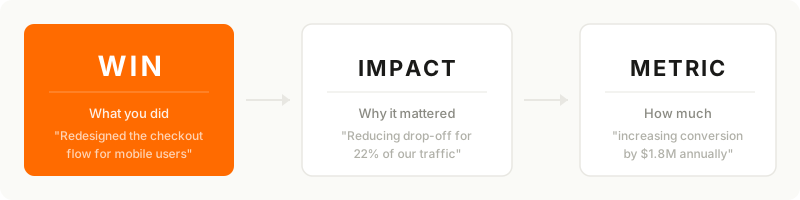
What I did → Impact it had → What I learned or what’s next
At the staff level, “what I did” should almost always name multiple teams, a specific decision or artifact (an RFC, an ADR, an architecture review), and a deliberate choice about where to invest your time. “Impact it had” should be described at organizational scope — how many teams, how much capacity recovered, how large a risk avoided. “What’s next” should name the next level of influence you’re building toward.
Phrases That Signal Seniority
| Instead of this | Write this |
|---|---|
| "I reviewed architecture proposals" | "I led architecture review for 11 cross-team proposals this half, identifying critical flaws in 2 that would have required expensive rewrites within 6 months, and establishing a new RFC template adopted by 4 teams" |
| "I helped teams with technical problems" | "I served as technical escalation point for 3 teams facing blocking decisions, facilitating alignment in each case and reducing the time-to-decision from weeks to days by providing a clear recommendation with documented tradeoffs" |
| "I worked on platform strategy" | "I authored the platform consolidation strategy that is guiding $1.2M of infrastructure investment over the next 18 months, securing buy-in from 6 engineering directors and 2 VPs through a structured ADR review process" |
| "I mentored engineers" | "I ran a structured technical growth program for 4 senior engineers targeting staff-level promotion, resulting in 2 promotions this cycle and measurable improvements in the quality of technical proposals from all 4 participants" |
Technical Vision & Architecture Self-Assessment Phrases
Architecture Decisions & RFCs
- "I authored the RFC for our event-driven inter-service communication standard, a decision that had been deferred for two years due to unresolved technical disagreement. I facilitated a structured three-session review process, documented six competing approaches with explicit tradeoffs in GitHub, and achieved consensus on a single direction that four teams are now implementing consistently."
- "I wrote the architectural decision record for our observability platform consolidation, recommending migration from three fragmented tools to a single DataDog deployment. The ADR was adopted by engineering leadership and is guiding an estimated $400k in annual infrastructure cost reduction while improving on-call diagnosis speed across all teams."
- "I identified an emerging architectural inconsistency across three teams building similar data pipeline patterns and authored an RFC to establish a shared abstraction. The RFC process surfaced two additional use cases that wouldn't have been discovered independently, and the resulting shared library has since been adopted by a fourth team."
- "I led the technical design for our multi-region active-active deployment architecture, a year-long initiative spanning six teams and three infrastructure providers. The design I authored in GitHub has served as the ground truth for all implementation decisions and has had zero material changes since initial approval — a signal that the upfront investment in thorough design was justified."
Technical Debt Strategy
- "I conducted a technical debt audit across our five highest-traffic services, categorizing debt by type and estimating its ongoing carrying cost using DataDog latency and error rate data. The resulting prioritization framework gave engineering leadership a defensible basis for dedicating 20% of engineering capacity to debt reduction in the next planning cycle."
- "I authored a Terraform module standards guide that eliminated the four most common infrastructure drift patterns our platform team had been remediating reactively. Since the guide's adoption, infrastructure-related incidents in the affected services dropped 70% over two quarters."
Cross-team Technical Leadership Self-Assessment Phrases
Technical Alignment Across Teams
- "I served as technical lead for a six-team program to migrate our legacy monolith to a set of bounded-context services. I designed the strangler-fig migration sequence in GitHub, ran weekly technical syncs, and made 14 binding technical decisions that kept teams aligned and prevented the circular dependency pattern that had blocked the previous migration attempt."
- "When two teams proposed incompatible approaches to API versioning, I organized and facilitated an alignment session, wrote a technical comparison that quantified the long-term maintenance costs of each approach, and drove consensus in one meeting rather than leaving the disagreement to fester. The decision was adopted as a cross-org standard within the same month."
- "I introduced architecture review as a first-class gate for large technical proposals across the engineering organization, designing the review process in GitHub and training six engineers as co-reviewers. In the first two quarters, the process reviewed 23 proposals and identified significant risks in 4 that would not have been caught in team-level design reviews."
- "I identified that three teams were building similar internal tooling for configuration management without awareness of each other's work. I organized a working group, facilitated three collaborative sessions using a shared architecture document, and guided the teams toward a single shared solution that replaced all three in-progress parallel efforts."
Technical Escalation & Unblocking
- "I was the technical escalation point for two teams that had been blocked for more than three weeks on an intractable database schema design problem. I spent two days doing a deep investigation, wrote a comprehensive technical analysis, and proposed a resolution that both teams accepted. The unblocking was cited by both engineering managers as preventing a quarter-long delay on their respective roadmaps."
- "I proactively identified a Terraform state management approach one team was about to adopt that would have created a serious operational risk at scale. I wrote a detailed technical note explaining the risk, proposed a safer alternative, and presented it before the team committed to implementation. The issue would have surfaced as a production incident within six months."
Engineering Org Impact Self-Assessment Phrases
Standards & Practices
- "I established our engineering organization's first formal architecture review process, writing the RFC template, the review rubric, and the decision log format in GitHub. Seven teams now use the process. In a survey of senior engineers six months post-launch, 85% reported higher confidence in cross-team technical alignment as a result."
- "I authored the DataDog observability standards guide for our engineering organization, covering SLO definition, distributed trace instrumentation, and alert severity classification. Since the guide's publication, the time to instrument a new service correctly has dropped from days to hours, and on-call false-positive rates org-wide have decreased by 35%."
- "I drove adoption of ADRs as the standard format for documenting significant technical decisions, starting with my own team and expanding to four adjacent teams over two quarters. The practice has improved onboarding quality and reduced the time engineers spend relitigating past decisions in design reviews."
Organizational Influence
- "I represented the engineering organization in three quarterly business reviews, translating technical roadmap risk into business impact language that non-technical stakeholders could evaluate and prioritize. My preparation for these sessions — including a DataDog-backed risk quantification model — was cited by the CTO as the clearest technical input the leadership team had received in that format."
- "I identified a pattern of engineering teams underinvesting in operational readiness before feature launches and proposed an Engineering Readiness Review process. The process was piloted with three teams, caught two significant operational gaps before launch, and is now being rolled out org-wide with support from the VP of Engineering."
Technical Strategy Self-Assessment Phrases
Platform & Infrastructure Strategy
- "I authored the three-year infrastructure evolution strategy for our engineering organization, covering compute platform migration, observability consolidation, and developer tooling modernization. The strategy was reviewed and approved by the engineering leadership team and is now guiding headcount and budget decisions for infrastructure investment."
- "I drove the technical due diligence process for two vendor evaluations this year, including building custom POC environments using Terraform and GitHub to validate performance claims against our real workload patterns. In both cases, my technical findings directly influenced the final vendor decision and the contract negotiation positions."
- "I identified that our Terraform state architecture would become unmanageable at our projected growth rate within 18 months and proposed a restructuring plan before the problem materialized. Executing the restructuring proactively cost three engineer-weeks; the alternative — remediation after the fact — would have been estimated at twelve or more."
Build vs. Buy Decisions
- "I led the technical evaluation for our developer platform toolchain, assessing six tools across build, test, and deploy capabilities using structured ADR comparisons in GitHub. My recommendation saved the organization an estimated $300k annually compared to the initially preferred option while delivering equivalent capability for our specific scale."
Mentorship & Leveling Up Others Self-Assessment Phrases
Senior-to-Staff Development
- "I ran a structured technical growth program for four senior engineers who were targeting staff-level impact. The program included weekly 1:1s, a reading curriculum on distributed systems and organizational influence, and opportunities to lead architecture reviews under my guidance. Two of the four were promoted to staff engineer this cycle, and all four produced materially higher-quality technical proposals by the end of the program."
- "I coached a senior engineer through their first cross-team technical initiative, helping them navigate organizational dynamics, write a credible RFC, and facilitate an alignment session with five teams. They completed the initiative successfully and were cited by their manager as having demonstrated staff-level impact for the first time."
- "I established a bi-weekly 'architecture office hours' session open to all senior and staff engineers in the organization. Attendance has averaged 12 engineers per session. Three distinct technical decisions made in these sessions were flagged by participants as decisions that would have gone worse without the forum."
- "I co-designed the staff engineering leveling rubric with the engineering leadership team, drawing on my own experience navigating the staff level to write concrete behavioral descriptions that are now used in promotion decisions. The rubric has been applied in six promotion decisions since its introduction."
Broadening Technical Capability
- "I ran three organization-wide technical talks covering distributed tracing with DataDog, Terraform module design patterns, and system resilience testing. Average attendance was 31 engineers per session. Two of the techniques I presented were subsequently adopted by teams across the organization within the same quarter."
- "I created an onboarding curriculum for new staff engineers joining the organization, covering our architecture review process, ADR standards, and the informal influence patterns that matter at this level. Two new staff engineers used the curriculum in their first month and reported it significantly accelerated their ability to contribute."
Execution on Large-scope Work Self-Assessment Phrases
Multi-team Program Execution
- "I led the technical execution of our database migration initiative, an 18-month program spanning four teams, three database technologies, and zero downtime requirements. I authored the migration sequencing plan in GitHub, maintained the program's technical risk register, and made 22 technical decisions that kept the program on track. The migration completed on schedule with no production incidents."
- "I identified mid-program that a fundamental assumption in our service mesh migration was incorrect and would cause a critical failure at scale. I halted the migration, wrote a revised technical approach, and got re-alignment across six teams in two weeks — a pace that was only possible because I had built trust with the engineering leads over the preceding months."
- "I managed the technical integration between three acquired companies' systems and our core platform — a 14-month program with no dedicated program manager. I maintained a shared technical dependency map in GitHub, ran biweekly technical syncs, and drove decisions to resolution without escalation to VP-level in 90% of cases."
Technical Risk Management
- "I developed a systematic practice of documenting and tracking technical risk across large programs using a structured risk register in GitHub, assigning probability and impact scores to each risk. On two occasions, risks I had flagged and tracked materialized as issues — and because they were documented in advance, the mitigation response was faster and less disruptive than it would have been if they had arrived as surprises."
How Prov Helps Staff Engineers Track Their Wins
Staff engineering impact accumulates slowly and lives in places that don’t show up in sprint reports: GitHub discussions, architecture review comments, a conversation that redirected a team before they built something wrong, an ADR that is now cited in four teams’ documentation. By the time review season arrives, most of those moments are invisible — absorbed into the organization’s institutional knowledge with no record of who shaped them.
Prov captures these wins at the moment they happen — the RFC you approved with a critical change, the escalation you unblocked in two days, the senior engineer whose proposal quality took a clear step forward after your coaching session. Thirty seconds of voice or text at the moment of impact becomes a year of evidence when it counts. Prov is coming soon on iOS.
Ready to Track Your Wins?
Free to start, no account, no sign-up. Available on the App Store now.
Download on iOS Free to start, no account needed