Concrete examples of staff engineer achievements you can adapt for your performance review, promotion case, or next career conversation.
Why Staff Engineers Have the Hardest Performance Reviews in Engineering
You spent the year unsticking a multi-team architecture problem that had been stalled for 8 months. You caught a design flaw that would have required a complete rewrite 18 months from now. You grew two senior engineers to the point where they're ready for promotion. And when review time comes, you write "provided technical guidance" and wonder why your manager's eyes glaze over.
The structural problem with staff engineer performance reviews is that your best work is invisible. Not because it didn't happen — but because it happened in design reviews, in one-on-ones, in the Slack thread where you reframed the problem so clearly that three teams immediately changed direction. The impact is organizational. The evidence is diffuse. You can't point to a PR, a ticket, or a deploy. You have to reconstruct the causal chain yourself.
There's also an expectations gap. At the senior level, impact is measured in features shipped. At staff, impact is measured in organizational leverage: the systems you designed that five teams depend on, the standards you set that accelerated the whole org, the engineers who grew in scope because of how you engaged with them. Reviewers who haven't operated at staff level sometimes look for the wrong signals — lines of code, project count — and miss the real ones.
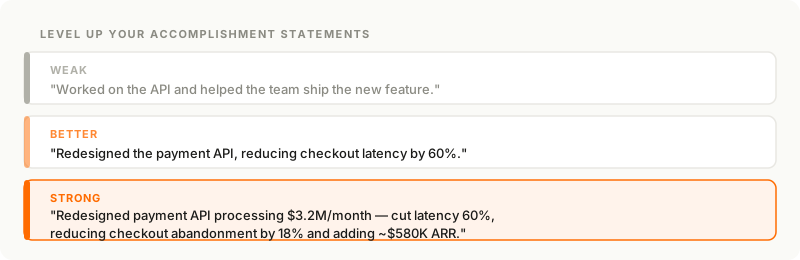
The best staff engineer self-reviews make the leverage explicit. Not "I helped with architecture" but "I designed the event-streaming architecture that replaced a synchronous call pattern across 6 services, eliminating the class of cascade failures that had caused 3 P1 incidents in the prior year." The work didn't change. The documentation of it did.
What gets you promoted are documented accomplishments with measurable impact.
Staff Engineer Accomplishment Categories
| Competency | What Reviewers Look For |
|---|---|
| Technical Strategy & Architecture | Do you set technical direction at scale — across teams, quarters, or years? |
| Cross-team Technical Leadership | Do you align engineering across team boundaries without formal authority? |
| Engineering Excellence & Standards | Do you raise the bar for everyone, not just your immediate collaborators? |
| Complex Problem Solving | Do you take on the hardest technical challenges that others avoid? |
| Organizational Impact & Influence | Do you shape how engineering works, not just what engineering ships? |
| Mentorship & Talent Development | Do you grow senior engineers — people who are already good? |
Technical Strategy & Architecture Accomplishments
Architecture & System Design
- "Designed the event-driven architecture that decoupled 6 tightly coupled services, eliminating the class of cascade failures responsible for 3 P1 incidents in the prior year — architecture has been in production 18 months with zero cascade incidents."
- "Led the architectural design for the platform's multi-region active-active deployment, enabling 99.99% SLA — a requirement for 4 enterprise contracts totaling $6M ARR that were blocked on this capability."
- "Authored the data platform architecture that unified 4 independent data pipelines into a single event mesh, reducing data latency from 4 hours to 8 minutes and eliminating 3 redundant ETL processes maintained by separate teams."
- "Designed the API gateway layer that allowed 8 downstream services to migrate from a deprecated internal RPC framework without coordinating migrations — each team migrated independently on their own timeline over 6 months."
- "Produced the technical design for the tenancy model that enabled our product's enterprise tier, supporting data isolation requirements that had been the primary blocker for 5 enterprise deals."
- "Rearchitected the search indexing pipeline from a synchronous batch process to an incremental streaming model, reducing index staleness from 6 hours to under 90 seconds for 40M documents."
- "Designed the distributed rate limiting system that replaced 4 independent per-service implementations, establishing consistent behavior across the platform and eliminating a class of abuse vectors that had required manual intervention."
- "Created the schema migration framework that allowed teams to evolve data models without coordinated downtime — adopted by 9 services in the 3 months after release."
Technical Vision & Roadmap
- "Wrote the 18-month technical strategy document for the platform organization, adopted by the VP of Engineering as the basis for headcount planning and infrastructure investment decisions for the fiscal year."
- "Identified that the engineering org's current data storage architecture would hit scaling limits within 14 months; built the business case, proposed an alternative approach, and led the migration planning — work began 9 months before the projected failure point."
- "Produced a technical deprecation roadmap for 6 legacy services, sequencing migrations to minimize team disruption and enabling the infrastructure team to decommission $180K/year in supporting cloud resources over 12 months."
- "Defined the technical standards for the company's mobile platform rebuild, establishing patterns for state management, API integration, and testing that the 3 mobile teams are now building against."
- "Authored the RFC that established the organization's observability strategy — standardizing on a single tracing and metrics stack across 14 services, enabling cross-service debugging that had previously been impossible."
- "Built the 3-year technical vision for the ML infrastructure team, distinguishing build-vs-buy decisions for 8 platform capabilities and aligning 4 team leads on a shared investment thesis."
Cross-team Technical Leadership Accomplishments
Multi-team Coordination
- "Resolved an 8-month API contract dispute between 3 teams by convening a structured design session, proposing a neutral schema, and building a migration timeline acceptable to all parties — unblocked 2 downstream product launches that had been waiting."
- "Coordinated the technical alignment for a 7-team platform migration, producing a shared dependency map and sequencing the migration order to eliminate blocking relationships — the program delivered on schedule with zero inter-team escalations in the final 10 weeks."
- "Led the cross-team technical review for the company's SOC 2 Type II certification, coordinating 6 engineering teams across 3 months to implement 23 technical controls — certification achieved on the committed date."
- "Aligned 4 independently operating product teams on a shared component library by facilitating design reviews, establishing a contribution process, and writing the initial set of shared primitives — reduced duplicated UI code by an estimated 30% within one quarter."
- "Drove technical consensus on the organization's data mesh strategy across 5 teams with competing interests, producing a written design that all teams committed to — work that had been at an impasse for 4 months resolved in 6 weeks."
- "Organized and ran a biannual architecture review across the full engineering organization, giving team leads structured exposure to cross-team technical decisions and catching 3 convergent solutions before they became 3 duplicate platforms."
- "Acted as the technical single point of contact for a 12-month acquisition integration, aligning 4 internal teams with the acquired company's engineering team on a shared integration architecture — completed on time with no data loss."
Dependency & Platform Work
- "Built the internal developer platform that abstracted Kubernetes deployment complexity for 8 product teams — reduced average deployment configuration from 400 lines of YAML to a 12-line manifest, and cut deployment errors by 70%."
- "Identified a platform capability gap (lack of async job infrastructure) that 4 teams had independently worked around with incompatible custom solutions — built the shared job queue, migrated all 4 teams, and reduced per-team maintenance burden by an estimated 6 hours per engineer per quarter."
- "Designed the feature flag infrastructure that enabled the org to decouple deployment from release for the first time — used in 40+ feature launches in the year after delivery, enabling 3 A/B tests that directly informed product decisions."
- "Established the API contract testing framework that caught breaking changes before they reached downstream consumers — adopted by 7 teams, preventing an estimated 12 breaking-change incidents per quarter based on prior year data."
- "Built the cross-service integration testing environment that allowed teams to test against realistic dependencies without coordinating shared staging environments — reduced inter-team testing coordination overhead by 4 hours per team per sprint."
Engineering Excellence & Standards Accomplishments
Standards & Review Culture
- "Established the design document review process for the engineering organization — a structured template and async review workflow that is now used for every significant technical decision across 12 teams."
- "Introduced Architecture Decision Records to the platform organization; after 12 months, the ADR library contained 34 entries and was referenced in 8 subsequent design documents as context for new decisions."
- "Wrote the engineering organization's coding standards guide for distributed systems patterns — error handling, retry logic, timeout configuration, and graceful degradation — adopted as required reading for all backend engineers."
- "Built and maintained the technical interview question bank for the backend engineering track, contributing 24 questions covering systems design, distributed systems, and data modeling — used across 60+ interviews in the trailing year."
- "Established the organization's production readiness review process, requiring teams to demonstrate observability, rollback capability, and runbook completeness before new services go live — adopted by 3 engineering teams, with zero unplanned outages on services that completed the review in the following 6 months."
- "Created the code review standards that defined expectations for PR size, comment tone, and review turnaround — after adoption across 4 teams, PR cycle time dropped from an average of 3.1 days to 1.4 days."
Reliability & Quality
- "Led the reliability initiative for the platform's core data pipeline, reducing P95 processing latency by 68% and bringing error rates from 1.4% to under 0.05% — directly enabling an SLA upgrade that unlocked 2 enterprise contract renewals."
- "Identified and resolved a class of race conditions affecting the order management system that had caused intermittent data corruption for 3 years — the root cause was a lock ordering bug across 4 services that no single team owned."
- "Designed and drove implementation of the disaster recovery strategy for the platform's primary data store, reducing RTO from 4 hours to 22 minutes and achieving RPO under 5 minutes — tested and validated in a live DR drill."
- "Introduced chaos engineering practices to the platform organization, running 6 fault injection experiments in the first quarter that identified 4 previously unknown failure modes — all addressed before they caused customer incidents."
- "Established the SLO framework across the platform organization — defining error budgets, alerting thresholds, and the review cadence — resulting in a 40% reduction in reactive on-call pages over 6 months."
- "Led the post-incident review process reform, replacing blame-focused timelines with a systems-thinking framework — after 3 months, the quality of action items improved measurably, with 78% of action items from PIRs closed within 30 days versus 31% under the prior process."
Complex Problem Solving Accomplishments
Incident & Crisis Leadership
- "Led the incident response for a P0 data corruption event affecting 200K user records — diagnosed the root cause (a migration script with a boundary condition bug), designed the repair procedure, and coordinated a 14-hour remediation with zero additional data loss."
- "Directed the engineering response to a security vulnerability in a third-party dependency used across 9 services — coordinated a coordinated 48-hour patch deployment, achieving full coverage before the public disclosure window closed."
- "Identified during an incident that the true root cause was 3 layers deeper than initial analysis suggested — the on-call team had misdiagnosed a symptom as a cause. My reanalysis prevented a recurrence that would have happened within 72 hours of the initial mitigation."
- "Designed the emergency data backfill system during a critical incident involving a dropped Kafka topic — built and validated the recovery mechanism in 6 hours, restoring data continuity for 800K affected events."
- "Led the technical postmortem for a cascading outage that affected 3 dependent services, producing a structured root cause analysis and a 9-item action plan that the engineering organization implemented over the following quarter."
- "Resolved an intermittent production issue that had evaded root cause analysis for 4 months — identified the bug as a thread-local state leak under specific connection pool saturation conditions that only manifested at production scale."
Ambiguous Problem Decomposition
- "Took ownership of a 'performance is degrading' problem that had no clear owner across 6 teams — built a systematic measurement framework, identified the source as an N+1 query pattern in a shared library, and coordinated the fix across the 4 affected consumers."
- "Decomposed a 2-year platform migration proposal into 5 independently deliverable phases, with clear rollback strategies for each — enabling the organization to begin delivering value in month 3 instead of month 24."
- "Translated a board-level requirement ('the platform must support 10x growth') into a concrete technical gap analysis and a sequenced set of investments, giving engineering leadership a specific, costed roadmap instead of a vague mandate."
- "Resolved a fundamental architectural conflict between the real-time processing team and the batch analytics team by designing a unified data model that served both access patterns — ending a 6-month technical standoff."
- "Took on the authentication service rewrite that 3 previous engineers had scoped and abandoned — identified why previous attempts had stalled (underestimated session migration complexity), proposed a phased approach, and delivered the rewrite over 4 months with zero downtime."
- "Diagnosed the root cause of a month-over-month infrastructure cost increase that finance had flagged but engineering couldn't explain — traced it to a change in a data retention policy that was triggering unnecessary reprocessing, saving $22K/month after the fix."
Organizational Impact & Influence Accomplishments
Process & Culture Change
- "Introduced the engineering organization to the concept of technical debt budgeting — allocating 20% of sprint capacity to structured debt reduction — and piloted it with 2 teams; after 2 quarters, 6 teams had adopted it and feature velocity across the org had improved by an estimated 18%."
- "Established the organization's on-call escalation and rotation standards, replacing an informal system where 3 engineers were handling 70% of pages — after rebalancing, per-engineer page volume equalized and on-call burnout complaints dropped by half."
- "Launched the organization's internal engineering blog, contributing 4 technical deep-dives and editing 9 others — the blog became a recruiting asset cited by 6 engineering candidates in the following year as a reason for applying."
- "Drove adoption of trunk-based development across 3 teams by providing a clear migration path, addressing the integration testing concerns that had previously blocked adoption — average PR cycle time dropped from 4.2 days to 1.8 days across the migrated teams."
- "Created the engineering organization's technical leveling guide — defining the specific expectations at each IC level from L3 through Staff — used in calibration discussions for 18 engineers across 4 teams in the most recent review cycle."
- "Organized the organization's first technical conference (internal, 60 engineers, 14 talks) — the event produced 3 cross-team collaboration threads that resulted in shipped improvements within 90 days."
Executive & Stakeholder Influence
- "Presented the technical risk assessment for a proposed acquisition to the executive team — my analysis identified 3 technical integration blockers that were not visible in the due diligence process and directly informed the final negotiation terms."
- "Translated a complex infrastructure scaling problem into a business impact model for the CFO, enabling a $400K infrastructure investment decision that had been blocked at the finance review stage for 3 months."
- "Advocated for — and won — a 6-week engineering investment in platform observability by connecting the investment to specific revenue risk: 4 customer-visible incidents in the prior quarter that were prolonged by insufficient telemetry."
- "Represented engineering in the vendor selection process for the company's new data warehouse, producing a technical evaluation framework that assessed 4 vendors across 18 criteria — recommendation adopted by the VP of Engineering and CPO."
- "Built and presented the business case for hiring 2 additional platform engineers by documenting the organizational leverage deficit: 8 product teams were being throttled by platform capacity, costing an estimated 4 engineer-weeks per team per quarter in blocked work."
Mentorship & Talent Development Accomplishments
Senior Engineer Development
- "Mentored 2 senior engineers through the transition from individual contribution to technical leadership — both received Staff promotions within 18 months, with promotion packets that cited their increased cross-team influence and architectural ownership."
- "Worked with a senior engineer who was technically excellent but avoided cross-team conflict — over 6 months of structured coaching, she led her first multi-team design review independently, an inflection point cited in her promotion case."
- "Ran a 10-week distributed systems study group for 6 senior engineers, covering consensus algorithms, conflict-free replicated data types, and eventual consistency — 3 participants subsequently led architecture decisions that applied these concepts."
- "Created a technical leadership curriculum for senior engineers at the staff-track, covering system design at scale, influence without authority, and communicating technical decisions to non-engineers — piloted with 4 engineers over one quarter."
- "Developed a structured design review mentorship model where I paired with a different senior engineer each quarter on a major design — transitioning from 'reviewer' to 'coach' over the course of the review process, and reducing my direct involvement as their confidence grew."
- "Provided direct feedback to a senior engineer whose written communication was limiting their organizational influence — working with them on architecture documents over 3 months, their writing clarity improved enough that their next RFC was adopted without significant revision."
- "Sponsored a senior engineer for a high-visibility cross-team project that was above her current scope — she delivered successfully and used the outcome as the primary evidence in her Staff promotion case."
Hiring & Bar Raising
- "Redesigned the staff engineer interview loop, replacing a format that consistently failed to differentiate senior from staff candidates with a structured systems design evaluation — hiring manager confidence in staff-level assessments improved measurably in the first 6 months of the new format."
- "Conducted 34 technical interviews in the trailing year, including 8 debrief-leading sessions — maintained a calibrated assessment standard that other interviewers cited as a reference point for close calls."
- "Identified a pattern of false positives in our backend interview loop — candidates who passed systems design but struggled with production thinking — and added 2 operational questions that revealed this gap; regret hire rate dropped in the following year."
- "Wrote the engineering organization's job level rubrics for L4 through Staff IC, used by 6 engineering managers for headcount planning, leveling decisions, and promotion packets."
- "Sourced and closed 2 Staff engineer hires through my professional network, reducing time-to-fill by 6 weeks each compared to agency-sourced candidates — both passed their 6-month performance reviews."
- "Created the technical take-home evaluation for the ML engineering track — a realistic system design problem with a clear rubric and worked solution — enabling consistent assessment across 4 interviewers."
How to Adapt These Examples
Plug In Your Numbers
Every example above follows: [Action] + [Specific work] + [Measurable result]. Replace the numbers with yours. Staff engineer metrics are often organizational: how many teams depended on something you built, how many engineers attended something you ran, how many incidents a system change prevented. If the impact is architectural, find the downstream metric — latency, reliability, engineering hours saved, product velocity unblocked.
Don't Have Numbers?
Much of staff engineer work is counterfactual — the crisis that didn't happen, the rewrite that won't be needed, the 18-month technical debt that was paid down before it compounded. For this kind of work, reconstruct the before-and-after: what was the state of the system or organization before your intervention, what specific actions did you take, and what is the state now? "We had 3 P1 incidents per quarter attributed to cascade failures. I designed a decoupled architecture. We have had zero cascade incidents in the 12 months since." That's a complete staff-level accomplishment without a single percentage.
Match the Level
Senior engineers are evaluated on their own technical output and direct team contribution. Staff engineers are evaluated on organizational leverage: impact that multiplied through other engineers, systems, or teams. If your entire self-assessment describes things you personally built, you are writing a senior engineer review, not a staff engineer review. At least half of your accomplishments should describe impact that required other engineers or teams to realize — standards you set, architecture others built on, engineers you developed, decisions you aligned across organizational boundaries.
Start Capturing Wins Before Next Review
The hardest part of performance reviews is remembering what you did 11 months ago. Prov captures your wins in 30 seconds — voice or text — then transforms them into polished statements like the ones above. Prov is coming soon on iOS.
Ready to Track Your Wins?
Free to start, no account, no sign-up. Available on the App Store now.
Download on iOS Free to start, no account needed