The best software engineer reviews don't read like a commit log. They answer one question: does this person make the systems and the team around them meaningfully better over time?
How to Write Effective Software Engineer Performance Reviews
The most common failure in software engineer reviews is treating them as a feature delivery report. “Shipped the payments refactor. Closed 47 tickets. Resolved 3 incidents.” This tells you almost nothing useful about the engineer. It tells you that work happened. It does not tell you whether the engineer drove that work, responded to it, or was dragged through it.
Good software engineer reviews evaluate engineering judgment — the decisions the engineer makes when no one is watching. Did they choose the right level of abstraction? Did they raise the alarm early when a design was drifting? Did they write the code review comment that actually helped a junior engineer grow, or did they just approve and move on? These behaviors are rarely captured in sprint reports, but they are exactly what separates a strong engineer from a merely productive one.
Recency bias is especially dangerous in engineering reviews. The incident that happened two weeks ago will dominate the narrative unless you deliberately pull in evidence from earlier in the review period. Build the habit of reviewing merged PRs, code review history, design doc comments, and on-call logs — not just the last sprint. Engineers who are quietly excellent at prevention rarely get credit because their most important work produces no visible artifact.
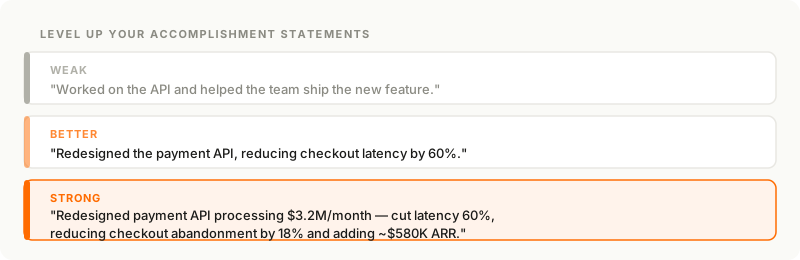
Finally, connect observations to business outcomes. “Improved test coverage” is a means. “Improved test coverage in the checkout flow, which contributed to zero regression incidents in Q4” is an outcome. Managers who write outcome-connected phrases give engineers a clearer signal about what the organization values — and engineers who understand that signal tend to direct their judgment toward higher-leverage work.
How to Use These Phrases
For Managers
Use these as starting points, not final copy. Every phrase here is a template that becomes useful only when you attach a specific example: a PR, a design doc, an incident, a conversation. Replace the generic behavior description with the concrete thing your engineer actually did.
For Employees
Use these to understand what your manager is actually evaluating beneath the surface of your work. If you see a phrase that describes behavior you’ve demonstrated but haven’t documented, you now have language to include in your self-assessment. If you see a phrase in Needs Development that resonates, treat it as a roadmap, not a verdict.
Rating Level Guide
| Rating | What it means for Software Engineers |
|---|---|
| Exceeds Expectations | Exercises independent engineering judgment at a scope above their level. Improves team-wide practices, not just their own work. Proactively identifies architectural risk and acts on it. |
| Meets Expectations | Delivers complete, production-quality work within their scope. Participates constructively in code review and design discussions. Handles on-call and operational responsibilities reliably. |
| Needs Development | Requires more scaffolding than is sustainable for their level. Work frequently needs significant rework or ongoing guidance to reach production quality. Has not yet developed the habits that prevent recurring issues. |
Technical Delivery Performance Review Phrases
Exceeds Expectations
- Consistently delivers complex, multi-service features end-to-end without requiring hand-holding through design, implementation, or rollout — including writing runbooks and coordinating deployment with platform teams.
- Proactively identifies scope and dependency risks in sprint planning before they become blockers, regularly adjusting estimates or flagging concerns early enough for the team to respond.
- Independently drives large feature work from initial design doc through production rollout, including instrumentation, rollback planning, and post-launch monitoring.
- Delivers production-ready code on first review cycle the large majority of the time, with reviewers noting the quality and completeness of test coverage and error handling.
- Regularly picks up the most technically ambiguous tasks on the team — the ones with no clear path forward — and navigates them to a clean resolution without needing sustained management involvement.
Meets Expectations
- Delivers assigned features on schedule and to scope, with work that passes code review and meets the team's quality bar for test coverage and documentation.
- Breaks large tasks into manageable units, communicates progress in standup, and flags blockers promptly rather than letting them stall the work silently.
- Participates reliably in sprint planning, provides reasonable estimates, and follows through on commitments with appropriate updates when circumstances change.
- Handles CI/CD pipeline failures and deployment issues competently, resolving most build and integration problems independently.
- Completes feature work with appropriate attention to edge cases, input validation, and error states — work does not regularly arrive in code review missing obvious handling.
Needs Development
- Would benefit from developing a more reliable estimation process — tasks frequently take significantly longer than scoped, and earlier flagging of complexity would help the team plan more accurately.
- Is developing the ability to drive features end-to-end independently; currently benefits from pairing on the design and rollout phases, which represents an opportunity to expand ownership.
- Has shown progress in completing individual tasks but needs to build the habit of considering downstream effects — changes occasionally introduce regressions that a broader review would have caught.
- Would benefit from more proactive communication when blocked; currently tends to wait for standups rather than raising blockers as they emerge, which compresses the team's response window.
Code Quality & Engineering Craft Performance Review Phrases
Exceeds Expectations
- Consistently writes code that other engineers use as a reference — the patterns, naming conventions, and structural choices in their PRs regularly get cited in team discussions about how to approach similar problems.
- Proactively improves code quality in areas they work in, leaving modules meaningfully cleaner than they found them and adding comments that explain why, not just what.
- Provides code review feedback that teaches rather than just corrects — reviewees frequently cite their comments as the most valuable technical mentorship they receive.
- Independently identifies and addresses technical debt that is actively slowing the team down, writing the design doc, building the consensus, and executing the cleanup with minimal disruption to ongoing work.
- Drives adoption of testing practices that have measurably improved the team's ability to refactor with confidence — test coverage in key modules has increased substantially under their influence.
Meets Expectations
- Writes clean, well-structured code that passes code review without significant style or quality concerns, following team conventions consistently.
- Provides constructive, specific code review comments that address real issues rather than personal preferences, and approves PRs at an appropriate pace.
- Maintains adequate test coverage for their work, including unit tests for business logic and integration tests for critical paths.
- Addresses code review feedback promptly and thoroughly, engaging with reviewer concerns rather than mechanically resolving comments.
- Recognizes and flags technical debt in areas they work in, even when it falls outside their immediate task, and contributes to the team's backlog accordingly.
Needs Development
- Would benefit from developing a more consistent testing practice — work frequently arrives in review with gaps in coverage that reviewers need to flag, which adds friction to the review cycle.
- Is developing the skill of giving actionable code review feedback; current comments sometimes lack the specificity needed for reviewees to understand what change is being requested and why.
- Has shown improvement in code structure but needs to build habits around documentation — the intent behind non-obvious design choices is often unclear without a follow-up conversation.
System Design & Architecture Performance Review Phrases
Exceeds Expectations
- Independently leads system design for significant new capabilities, producing design docs that anticipate failure modes, evaluate trade-offs explicitly, and reflect a deep understanding of the team's operational constraints.
- Consistently identifies architectural risks in proposed designs — in team design reviews, their questions regularly surface the issues that would have been painful to discover in production.
- Proactively advocates for architectural decisions that improve the long-term health of the system, making the case clearly to both technical and non-technical stakeholders when trade-offs need to be understood.
- Builds systems that are operationally excellent from day one — instrumentation, alerting, runbooks, and graceful degradation are part of the design, not afterthoughts.
- Drives cross-team alignment on shared infrastructure decisions, navigating competing priorities and constraints to reach conclusions that improve the platform for all teams involved.
Meets Expectations
- Contributes substantively to design discussions, asking clarifying questions and raising concerns about proposed approaches with appropriate technical grounding.
- Writes design docs for their own work that clearly communicate the problem, the chosen approach, and the key trade-offs considered.
- Considers scalability and operational concerns in their designs — work doesn't regularly arrive in production missing basic observability or creating obvious scaling cliffs.
- Engages constructively with architectural feedback on their designs, incorporating reviewer input and updating docs to reflect decisions made.
Needs Development
- Would benefit from developing stronger design intuition for failure modes — designs currently tend to assume the happy path and benefit from reviewers explicitly raising error scenarios.
- Is developing the ability to evaluate architectural trade-offs independently; currently relies heavily on senior engineers to frame the options before contributing a perspective.
- Has shown growth in writing design docs but needs to build the habit of grounding proposals in operational reality — designs sometimes underestimate the complexity of deployment, rollback, or monitoring.
Collaboration & Communication Performance Review Phrases
Exceeds Expectations
- Consistently elevates the quality of cross-team technical discussions — brings clarity to ambiguous requirements, synthesizes competing perspectives, and helps stakeholders reach decisions that the technical team can actually execute.
- Proactively shares knowledge across the team through well-maintained documentation, internal tech talks, and the kind of thorough code review comments that improve everyone's understanding of the system.
- Effectively navigates disagreements about technical direction, making their case with evidence and principle rather than volume, and committing fully once a decision is made.
- Builds strong working relationships with product, design, and platform counterparts — consistently cited by cross-functional partners as the engineer who makes collaboration feel productive rather than adversarial.
- Mentors junior engineers in a way that builds their independence rather than creating reliance — mentees grow visibly in their ability to solve problems on their own.
Meets Expectations
- Communicates technical constraints and risks to non-engineering stakeholders in accessible language, without oversimplifying to the point of losing important nuance.
- Participates actively and constructively in team rituals — standups, retros, and planning sessions — contributing relevant information and engaging with others' contributions.
- Documents their work at a level that allows teammates to understand, maintain, and extend it without needing to ask the original author.
- Handles code review as a two-way conversation, explaining their design choices clearly when questioned and receiving feedback without becoming defensive.
Needs Development
- Would benefit from developing stronger habits around written communication — technical decisions and context are often shared verbally but not captured in docs or PR descriptions where teammates can find them later.
- Is developing the skill of translating technical complexity for non-engineering audiences; current explanations sometimes assume a level of context that stakeholders don't have.
- Has shown improvement in receiving feedback but would benefit from working on how feedback is delivered — code review comments occasionally read as more critical than constructive, which affects how reviewees respond.
Growth & Initiative Performance Review Phrases
Exceeds Expectations
- Consistently identifies high-leverage improvements to team process and tooling — not just pointing out what's broken, but scoping, building, and shipping the fix with enough documentation that the improvement sticks.
- Proactively expands their technical scope in ways that directly benefit the team, developing expertise in areas where the team has a gap and sharing that knowledge systematically.
- Drives their own development with unusual clarity of purpose — sets specific growth goals, seeks out the experiences needed to achieve them, and reflects honestly on progress without requiring management prompting.
- Takes on responsibilities above their current level willingly and executes at a high standard — this behavior consistently provides the evidence base for their advancement.
- Independently leads initiatives — on-call improvements, hiring loop participation, cross-team projects — that represent real organizational contribution beyond their day-to-day scope.
Meets Expectations
- Demonstrates a consistent pattern of growth across the review period, expanding their comfort zone in at least one meaningful technical area and applying new skills to real work.
- Participates in team improvement efforts — contributing to retro action items, picking up process-improvement tasks, and engaging with team health discussions.
- Takes feedback from code review, 1:1s, and prior review cycles and translates it into visible behavior change over time.
- Shows appropriate curiosity about areas outside their immediate work — asks questions in design reviews, reads relevant RFCs, and engages with the broader engineering community at the organization.
Needs Development
- Would benefit from setting more explicit growth goals — development so far has been largely reactive to assigned work rather than directed toward a clear picture of the next level of capability.
- Is developing the habit of taking initiative; currently tends to wait to be assigned work rather than identifying and picking up high-value tasks independently.
- Has shown willingness to grow but needs to translate that willingness into consistent behavior change — feedback from prior cycles has been acknowledged but not yet fully reflected in day-to-day practice.
How Prov Helps Build the Evidence Behind Every Review
The phrases above only become useful when paired with specific examples — and specific examples require someone to have captured them. The most common failure mode in performance reviews isn’t that managers lack vocabulary; it’s that the vocabulary has nothing to attach to. “Proactively identifies architectural risk” is a strong phrase, but without a concrete incident to point to, it reads as filler. The engineer who led the design review that caught the cascading failure before it hit production deserves to have that story told. But if no one captured it at the time, it gets lost in the noise of everything that happened in the months since.
Prov helps engineers capture wins in real time — the rough notes from the design review that went well, the quick reflection after the incident that didn’t repeat, the follow-up from the code review comment that actually landed. Those raw notes get transformed into polished achievement language, so when review season arrives, the evidence is already there. Managers get specific examples to anchor every phrase. Engineers don’t have to excavate their memory for six months of work in a single anxious afternoon.
Ready to Track Your Wins?
Free to start, no account, no sign-up. Available on the App Store now.
Download on iOS Free to start, no account needed