The scrum master's dilemma: when the team ships on time, the team gets the credit. When the team misses, the scrum master gets the blame. Your job is to make the invisible visible — and your self-assessment is the place to do it.
Why Self-Assessments Are Hard for Scrum Masters
Scrum masters operate through influence, not execution. You don’t write the code, close the tickets, or ship the features — you create the conditions in which other people do those things well. That means the work that defines your value is precisely the work that never shows up in a sprint report: the conversation that defused a team conflict before it became a problem, the Jira workflow change that shaved two hours off every sprint ceremony, the retrospective technique that finally got the team talking honestly.
There’s a structural attribution problem too. Sprint velocity is a team metric. When it improves, it’s genuinely difficult to separate what the team would have achieved anyway from what your facilitation unlocked. That ambiguity can make you hesitant to claim credit — but hesitance reads as low impact in a performance review.
The other challenge is that scrum master effectiveness is often measured in absence: fewer escalations, fewer blocked tickets, fewer ceremony complaints. You’re measuring things that didn’t happen. Quantifying a problem that didn’t materialize is harder than quantifying one that did, but it’s essential for making your impact legible.
The goal: name the conditions you created, the friction you removed, and the team behaviors you shaped — and connect each of them to outcomes the business cares about.
How to Structure Your Self-Assessment
The Three-Part Formula
What I did → Impact it had → What I learned or what’s next
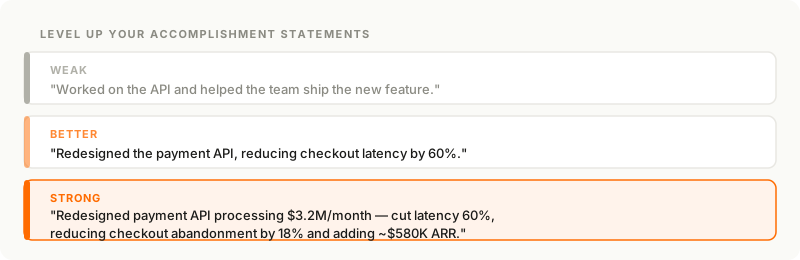
As a scrum master, “what I did” is often a process change, a facilitation technique, or a relationship built. The impact is team velocity, reduced cycle time, fewer escalations, or faster decisions. Make sure you capture all three — the technique without the outcome looks like process theater.
Phrases That Signal Seniority
| Instead of this | Write this |
|---|---|
| "I ran our ceremonies" | "I redesigned our sprint review format, reducing ceremony time by 25% while increasing stakeholder attendance by 40%" |
| "I helped remove blockers" | "I identified and escalated a cross-team dependency that had blocked three consecutive sprints, resolving it in 48 hours by facilitating a direct alignment meeting between engineering leads" |
| "I coached the team on agile" | "I introduced a two-week experiment with explicit WIP limits in Jira, which reduced context switching and improved our sprint commitment accuracy from 68% to 89%" |
| "I improved team morale" | "I restructured our retrospective format using Retrium's Start/Stop/Continue template, which increased participation from 4 to 9 team members and produced 3 action items we shipped within the next sprint" |
Sprint Delivery & Velocity Self-Assessment Phrases
Commitment Accuracy
- "I partnered with the team to improve sprint commitment accuracy from 61% to 84% over two quarters by introducing a structured story-pointing session in Jira and advocating for a sustainable pace policy that reduced over-commitment. The team now consistently finishes sprints with capacity to pull in stretch items rather than carrying work over."
- "I identified that our sprint planning sessions were consistently running long because product backlog items arrived without acceptance criteria. I introduced a Definition of Ready checklist in Confluence and worked with the product owner to enforce it, reducing planning session length by 35 minutes per sprint."
- "I facilitated a team capacity-planning approach that accounts for PTO, interview load, and support rotations — inputs that had previously been ignored at planning time. Sprint completion rate improved from 72% to 91% in the first quarter after adopting this approach."
- "When our team missed sprint goals three consecutive sprints due to mid-sprint priority shifts, I documented the pattern and brought it to leadership as a systemic issue rather than a team performance issue. The outcome was a new escalation path for mid-sprint reprioritization requests that protected focus time."
Cycle Time & Flow
- "I introduced a daily focus on aging tickets in our Jira board, flagging any item that had been in progress more than two days without a status update. This simple practice reduced average cycle time per ticket from 4.2 days to 2.8 days over one quarter."
- "I analyzed our team's Jira flow metrics and identified that the code review stage was our primary bottleneck, accounting for 38% of total cycle time. I facilitated a team conversation that led to a pairing-based review rotation, reducing review lag from an average of 18 hours to 6 hours."
- "I worked with the team to define explicit work-in-progress limits in Azure DevOps, limiting active items per engineer to two. Initial resistance gave way to measurable results: throughput improved by 22% and the number of items finishing in the same sprint they were started increased significantly."
Impediment Removal Self-Assessment Phrases
Technical & Process Blockers
- "I maintained an active impediment log in Confluence and treated every blocker as having a 48-hour resolution SLA. Over this review period, the average time an impediment sat unresolved dropped from 6.3 days to 1.8 days, a change the team cited as one of their highest-value process improvements."
- "I escalated a recurring environment instability issue that had been accepted as unavoidable for two sprints. By documenting the cumulative impact — 14 engineer-hours lost per sprint — and presenting the data to engineering leadership, I secured dedicated platform time to fix the root cause. The fix eliminated that class of blocker entirely."
- "I identified a cross-team API dependency that was blocking our team's highest-priority work and had no clear owner. I organized and facilitated an alignment session between three teams in Azure DevOps, documented the resolution path, and tracked it to completion. The dependency was resolved eight days faster than it would have been through normal escalation channels."
- "When our team repeatedly faced ambiguous requirements mid-sprint, I established a standing 30-minute product clarification session every Tuesday in Slack, creating a predictable channel for questions without disrupting deep work. Mid-sprint requirement changes dropped by 60% in the following quarter."
Organizational Impediments
- "I surfaced an organizational blocker that was invisible to leadership: our team was being pulled into three different program increment planning processes simultaneously, creating ceremony overhead of roughly 6 hours per engineer per month. I consolidated our participation into a single PI planning stream, recovering meaningful capacity."
- "I noticed that the team was receiving conflicting priorities from two stakeholders simultaneously, a pattern that was causing anxiety and reduced productivity. I facilitated a stakeholder alignment session and established a single-threaded prioritization process that eliminated the conflict. Team-reported stress in our retrospectives dropped noticeably in subsequent weeks."
Agile Coaching Self-Assessment Phrases
Team Agile Maturity
- "I coached a team that had been doing agile by the book but not by intent — ceremonies existed but weren't generating value. I introduced outcome-oriented sprint goals instead of feature lists, and within two sprints the team began making their own trade-off decisions during planning rather than waiting for product direction on every choice."
- "I identified that our retrospectives had become a complaint forum without producing change. I shifted to a structured action-tracking format using Retrium, ensuring every retrospective ended with no more than three committed actions assigned to named owners with deadlines. The ratio of actions completed to actions committed went from 40% to 85% over one quarter."
- "I introduced a team working agreement in Miro that we revisited each quarter. The agreement addressed response time expectations on Slack, meeting-free blocks, and how we handle production incidents. Two team members told me directly that the explicit agreements reduced friction they had been quietly absorbing for months."
- "I ran a series of Miro workshops to help the team internalize the value of small batch sizes over large features. After three sessions with real data from our own sprint history, the team voluntarily began breaking stories down to sub-day size — a behavior change I had been trying to nudge for a year without success."
Individual Coaching
- "I worked one-on-one with a senior engineer who was consistently over-committing and burning out. Through weekly coaching conversations I helped them articulate their estimation assumptions and build the habit of saying no to scope creep mid-sprint. Their sprint completion rate improved and their self-reported stress dropped significantly by the end of the quarter."
- "I coached a new product owner through their first three sprints, helping them write acceptance criteria that were testable and concise. The quality improvement reduced back-and-forth between engineering and product by an estimated 30% and nearly eliminated mid-sprint clarification requests."
Team Health & Culture Self-Assessment Phrases
Psychological Safety
- "I recognized that retrospective participation was skewed toward senior engineers, with junior members rarely contributing. I experimented with anonymous input collection via Retrium before switching to round-robin sharing, and participation equalized within two sprints. The shift uncovered concerns that had been invisible to leadership."
- "When a team conflict between two engineers threatened to disrupt the team's functioning, I facilitated a private mediation conversation and established shared norms for code review feedback. Both engineers told me afterward that the conversation had been overdue and that the outcome had improved their working relationship significantly."
- "I introduced a bi-weekly team health check using a simple Slack poll covering autonomy, clarity, and support. Tracking this over six months gave me early signal on team morale shifts, allowing me to address emerging issues before they became attrition risks."
Onboarding & Inclusion
- "I redesigned our team onboarding process in Confluence to include a 30-day scrum ritual guide for new engineers, explaining not just what we do but why we do it. The last two engineers who joined our team reported feeling productive within their first sprint — a notable improvement from the typical three-to-four week ramp-up."
- "I advocated for rotating the sprint review facilitation role among team members rather than owning it myself. This decision built facilitation confidence across the team and gave product stakeholders a broader view of who was contributing to delivery."
Stakeholder Communication Self-Assessment Phrases
Reporting & Visibility
- "I established a weekly sprint progress update in Confluence that went automatically to five product stakeholders, reducing ad hoc status requests from daily to near zero. The template I designed was adopted by two other scrum teams in our organization."
- "I created a sprint metrics dashboard in Jira that stakeholders could access without asking me for a report. Velocity, cycle time, and impediment counts were visible in real time. This transparency reduced escalations and built stakeholder confidence in the team's predictability."
- "I translated our team's technical impediments into business impact language for leadership — framing a platform reliability issue not as 'CI flakiness' but as 'six engineer-hours per sprint lost to non-value-adding rework, equivalent to one feature story per month.' This framing secured executive attention and budget for a fix within two weeks."
- "When our team fell behind on a milestone, I proactively drafted and sent a risk update to stakeholders before they asked, including a revised timeline, a root cause summary, and three mitigation options with tradeoffs clearly stated. The response was appreciation for the transparency rather than escalation."
Ceremony Facilitation
- "I redesigned our sprint review to be a live demonstration rather than a slide presentation, increasing stakeholder engagement scores in our post-ceremony Slack poll from 3.1 to 4.4 out of 5. Stakeholder attendance also increased from an average of 3 people to 7 over the same period."
- "I shortened our daily standup from 22 minutes average to under 12 minutes by introducing a structured parking lot system in Slack for discussions that didn't need the full team. This recovered over 2 hours of engineering time per week without reducing the team's awareness of blockers."
Continuous Improvement Self-Assessment Phrases
Process Evolution
- "I conducted a quarterly scrum health check against the Scrum Guide and identified two ceremonies we were running that weren't generating value. I proposed eliminating the mid-sprint backlog grooming session and replacing it with async Confluence comments, saving 45 minutes per sprint and receiving no objections from the team."
- "I ran a blameless process retrospective after our two largest delivery misses this year, identifying systemic contributing factors in both cases. The retrospectives produced six process changes, four of which we implemented and tracked to measurable improvement within the next quarter."
- "I piloted a kanban-style flow approach for our team's support work, keeping it separate from the sprint board in Jira. This eliminated the tension between reactive support tasks and planned sprint work, and both streams improved: sprint completion rate went up 11% and support response time went down 40%."
Tooling & Infrastructure
- "I audited our Jira configuration and identified 14 workflow states that had accumulated over two years without owners or definitions. I consolidated to 6 states with clear definitions, reducing board complexity and eliminating the most common source of status update confusion for new team members."
- "I built a Confluence-based retrospective archive that allows the team and stakeholders to see patterns across retrospectives over time. This longitudinal view has helped us identify recurring themes — like estimation accuracy and documentation debt — that individual retrospectives had never surfaced with enough force to act on."
How Prov Helps Scrum Masters Track Their Wins
Scrum masters make dozens of small, high-leverage decisions every week — a facilitation choice here, a process tweak there, a difficult conversation handled well — and none of them show up automatically in a performance system. By the time review season arrives, most of what you did is gone from memory, replaced by the most recent sprint’s noise.
Prov captures these wins in 30 seconds, voice or text, at the moment they happen. When you resolve an impediment faster than expected, restructure a ceremony that wasn’t working, or coach a team member through a difficult moment — log it immediately. At review time, your self-assessment writes itself from a year of real, timestamped evidence rather than a frantic two-hour reconstruction. Prov is coming soon on iOS.
Ready to Track Your Wins?
Free to start, no account, no sign-up. Available on the App Store now.
Download on iOS Free to start, no account needed