Concrete examples of scrum master achievements you can adapt for your performance review, resume, or LinkedIn profile.
Why Scrum Masters Struggle at Performance Review Time
You ran 52 retrospectives last year. You unblocked dependencies before they became crises. You coached a team from chaotic planning sessions to predictable sprint delivery. You rebuilt a relationship with a product owner that was on the verge of breakdown. And when your review comes around, you write "facilitated agile ceremonies" and wonder why it feels so flat.
The structural problem is that scrum master work is largely invisible by design. When you do your job well, nothing bad happens. The retrospective surfaces the issue before it festers. The impediment gets cleared in two days instead of two sprints. The stakeholder expectation gets set before the demo. The best scrum masters leave no fingerprints — which makes quantifying impact genuinely hard.
There is also a credibility gap. Scrum masters who default to ceremony descriptions ("ran standups," "managed the backlog") sound like process administrators. The scrum masters who get promoted and get the job offers are the ones who can articulate outcome — velocity trends, lead time reduction, team health scores, impediment resolution rates. Even when the numbers are directional rather than precise, specificity signals seriousness.
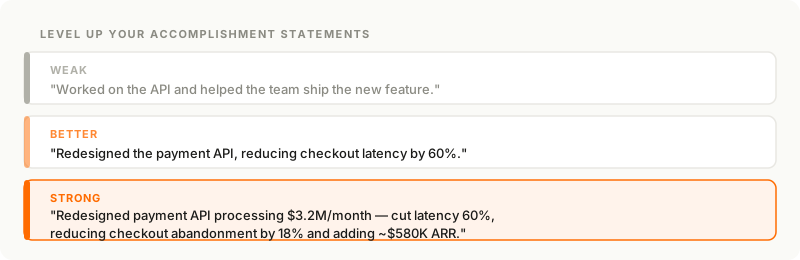
From Weak to Strong: What a Good Example Looks Like
| Level | Example | What's Missing |
|---|---|---|
| Weak | "Ran sprint ceremonies and helped remove blockers." | No specifics, no metrics, no outcome — could describe any scrum master anywhere. |
| Better | "Facilitated retrospectives that led to several process improvements and helped reduce cycle time." | Has direction, but no numbers, no tools, no mechanism of change. |
| Strong | "Introduced WIP limits in Jira capped at 2 items per developer and facilitated a retrospective series to address the root cause; average cycle time dropped from 9.4 days to 5.1 days over 6 months." | Nothing — action, tool, metric, timeframe all present. |
Scrum Master Accomplishment Categories
| Competency | What Reviewers Look For |
|---|---|
| Sprint Delivery | Do teams consistently deliver on commitments at a sustainable pace? |
| Impediment Removal | Do blockers get resolved fast, before they derail a sprint? |
| Team Velocity and Metrics | Can you demonstrate measurable improvement in throughput and predictability? |
| Agile Coaching | Do engineers and PMs on your teams understand and own the process? |
| Stakeholder Communication | Do product, leadership, and other teams have accurate expectations? |
| Continuous Improvement | Do you leave teams permanently more effective, not just temporarily better-facilitated? |
Sprint Delivery Accomplishments
- "Increased sprint commitment accuracy from 58% to 84% over two quarters by introducing a team-level capacity model in Jira that accounted for PTO, oncall rotation, and recurring non-sprint work."
- "Reduced mid-sprint scope changes by 70% by establishing a sprint goal contract with product ownership — any change required explicit sprint goal renegotiation before entering the active sprint."
- "Led the team from a rolling 6-sprint average of 42 story points to 61 story points over 8 months by introducing right-sizing workshops in Confluence that decomposed epics into consistently small, shippable stories."
- "Delivered 11 consecutive sprints with zero carryover stories after implementing a definition of done checklist in Azure DevOps enforced as a required field before moving work to the done column."
- "Reduced average story cycle time from 9.4 days to 5.1 days over 6 months by introducing WIP limits per swim lane in Jira, capping in-progress work at 2 items per developer."
- "Coordinated a release train across 3 Scrum teams to achieve simultaneous sprint-boundary deployments, eliminating 4–6 weeks of integration lag that had historically delayed each major release."
- "Recovered a sprint that was 40% off-track by day 4 by facilitating a mid-sprint replan with the product owner, redefining the sprint goal around the three highest-value items that were still achievable."
- "Maintained Definition of Ready adoption across 4 sprints, reducing stories pulled into sprint with missing acceptance criteria from 35% to under 5% by introducing a structured backlog refinement template in Confluence."
- "Helped the team achieve its first on-time release in three quarters by introducing a pre-sprint release readiness checklist and coordinating freeze windows with the platform engineering team two sprints ahead of go-live."
- "Coached the team to adopt story point estimation through structured calibration sessions in Miro; reduced planning meeting duration from 3.5 hours to 1.5 hours while improving estimation accuracy by 30%."
Impediment Removal Accomplishments
- "Reduced average impediment resolution time from 11 days to 3 days by establishing an impediment log in Jira with daily triage, clear owner assignment, and escalation triggers at the 48-hour mark."
- "Unblocked a 3-sprint dependency on the data platform team by facilitating a joint backlog refinement session between the two teams, producing a shared API contract that both teams could independently build against."
- "Resolved a 6-week cross-team integration blocker by escalating with a written impact analysis to the engineering director — the first time the team had experienced escalation-to-resolution in under a week."
- "Identified and removed a recurring impediment pattern — stories consistently blocked on QA environment availability — by working with DevOps to provision a dedicated team environment, eliminating this class of blocker entirely within one quarter."
- "Tracked 78 impediments over the course of a year; 71 were resolved before they spanned a second sprint, and none required executive escalation after implementing the daily impediment triage process."
- "Cleared a long-standing dependency on a third-party vendor sandbox environment by negotiating a dedicated test tenant through the account manager, saving the team an estimated 2–3 days of waiting per sprint."
- "Reduced time spent by developers on impediment status-chasing by building an automated Jira dashboard that surfaced blocked stories to the team in the daily standup, replacing a manual verbal check that had added 8–12 minutes to every standup."
- "Facilitated resolution of a months-long design disagreement between two senior engineers by structuring a time-boxed spike with a defined decision framework in Miro — decision reached in 2 days versus an estimated additional 3 sprints of deadlock."
- "Proactively identified an upcoming dependency on a shared testing environment before sprint planning by reviewing the Azure DevOps pipeline calendar, coordinating a reservation window with the infrastructure team — the first cycle the team ran without an environment-related mid-sprint block."
Team Velocity and Metrics Accomplishments
- "Established the team's first velocity baseline over 8 sprints after joining a team that had never tracked throughput, enabling reliable release forecasting in Jira for the first time."
- "Improved sprint predictability — the ratio of planned to delivered points — from 0.61 to 0.91 over 5 months, moving the team from unpredictable to consistently within 10% of commitment."
- "Introduced cumulative flow diagram reviews in Azure DevOps to the team's weekly process check; identified a chronic bottleneck in the code review stage that, once addressed, reduced average lead time by 31%."
- "Reduced escaped defects per sprint from an average of 4.2 to 0.8 over 3 quarters by introducing automated regression gates in the CI pipeline and adding explicit acceptance test criteria to the team's Definition of Done."
- "Implemented cycle time SLAs by story size — small (1 day), medium (3 days), large (5 days) — and visualized actuals against targets in a Jira dashboard, giving the team a weekly feedback loop on flow health."
- "Coached the team to decompose stories more consistently, reducing the standard deviation of story point estimates from 8.4 to 2.1 over 6 sprints — a signal that the team had developed a shared mental model of size."
- "Introduced sprint goal attainment as the primary metric in retrospectives rather than point velocity, shifting team conversation from throughput optimization to value delivery and reducing the frequency of estimation gaming."
- "Reduced the team's unplanned work rate from 28% of sprint capacity to 9% over two quarters by establishing a triage protocol in Jira for incoming ad-hoc requests, with a clear threshold for what justified disrupting the sprint."
- "Built a team health radar in Miro covering six dimensions — technical practices, psychological safety, clarity of purpose, process effectiveness, delivery quality, and stakeholder alignment — run quarterly, producing 18 months of longitudinal team health data."
- "Introduced DORA metrics tracking using Azure DevOps pipeline data, giving engineering leadership the first quantitative baseline for deployment frequency, lead time, change failure rate, and MTTR across the team."
Agile Coaching Accomplishments
- "Coached a team of 7 engineers from daily standups that averaged 27 minutes to focused 12-minute standups within 6 weeks by introducing a structured three-question format and a parking lot for longer discussions."
- "Grew the team's self-organization to the point where it ran sprint planning, retrospectives, and daily standups autonomously during a 3-week period when I covered a second team — with no degradation in sprint delivery."
- "Introduced story mapping in Miro to replace the team's flat backlog, resulting in the product owner and engineers sharing a common understanding of user journeys for the first time — cited by the PO as transformative in backlog conversations."
- "Coached a newly formed team of engineers with no prior Scrum experience to a functional, self-organizing state within 4 sprints, without importing practices wholesale from the prior team."
- "Facilitated 48 retrospectives over 18 months, generating 214 action items — 78% completed within the following sprint. Tracked completion rates in Confluence, making retrospective accountability visible to the team."
- "Transitioned a team from Scrum to a Kanban flow model after coaching them to recognize that their work was predominantly interrupt-driven and poorly matched to sprint cadence — delivery predictability improved measurably in the quarter following the transition."
- "Ran a two-day Scrum fundamentals workshop for 6 product managers who were new to agile collaboration, resulting in measurably faster backlog refinement sessions and fewer stories entering planning with missing acceptance criteria."
- "Coached an engineering manager through the boundary between their role and the Scrum Master role, reducing role confusion that had caused the team to escalate decisions upward rather than resolve them at the team level."
- "Introduced the team to test-driven development via a series of facilitated coding workshops in collaboration with the tech lead — test coverage increased from 34% to 71% over 3 months and defect escape rate declined accordingly."
- "Established a quarterly team retrospective separate from the sprint retrospective focused on team norms, working agreements, and longer-horizon process changes — 9 of 11 working agreement updates from these sessions remained active 6 months later."
Stakeholder Communication Accomplishments
- "Rebuilt a damaged relationship between the product owner and the engineering team by facilitating a joint working session to co-create a team charter, establishing explicit norms around scope changes, demo feedback, and planning participation."
- "Reduced the number of demo surprises — features the product owner saw for the first time at the sprint review — from an average of 3 per sprint to 0, by introducing a mid-sprint product sync for early feedback."
- "Produced a sprint progress report in Confluence consumed weekly by 3 business stakeholders, replacing 6–8 ad-hoc status requests per sprint to individual team members."
- "Facilitated 6 quarterly planning events attended by product, engineering, and design, producing written sprint-by-sprint delivery roadmaps in Jira that gave leadership 12-week forward visibility for the first time."
- "Managed expectations during a sprint in which the team absorbed a critical production incident, communicating the sprint goal impact to the product owner within 4 hours and renegotiating scope before the team was halfway through unplanned work."
- "Reduced escalations from senior stakeholders to individual engineers by establishing a single point of contact protocol — all program-level questions routed through the Scrum Master, preserving developer flow."
- "Prepared and delivered quarterly agile maturity summaries to the VP of Engineering for 3 teams, translating team-level metrics — velocity trend, impediment rate, escaped defect rate — into business-readable summaries used in portfolio reviews."
- "Ran a pre-release stakeholder alignment session before every major launch, producing a shared release readiness checklist signed off by product, QA, and operations — reducing last-minute launch holds from 4 per year to 0."
- "Built a cross-team dependency map in Miro updated before every sprint planning event and shared with 4 adjacent team Scrum Masters — identified 3 cross-team conflicts in the planning period that were resolved before entering the sprint."
Continuous Improvement Accomplishments
- "Facilitated a process improvement retrospective series across 3 Scrum teams, identifying 7 shared inefficiencies in the shared CI/CD pipeline — fixes reduced average build time from 34 minutes to 11 minutes across all three teams."
- "Drove adoption of a team-level Definition of Done that included code review, unit test coverage threshold, and documentation update — defect escape rate declined 44% in the two quarters following adoption."
- "Introduced pair programming as a team norm for stories above a complexity threshold, reducing review cycle time by 28% and increasing knowledge sharing across the team's two most siloed engineers."
- "Piloted a structured retrospective format replacing the team's freeform whiteboard sessions; action item completion rates improved from 31% to 76% within two sprints of adoption."
- "Established a cross-team Scrum Master community of practice with 6 members, producing a shared retrospective template library in Confluence and quarterly peer retrospectives — 4 process improvements adopted across at least 2 teams as a result."
- "Reduced the team's planning meeting duration from 3.5 hours to 90 minutes by introducing pre-refinement requirements: all stories entering planning had to have acceptance criteria, designs linked, and dependencies noted in Jira before the meeting."
- "Implemented a bi-weekly team learning session — 45 minutes, alternating between technical topics and process topics — credited by 5 of 7 team members in an anonymous survey as their primary source of skill growth in the quarter."
- "Coordinated a quarterly cross-team retrospective across 4 Scrum teams in the same product area, identifying and eliminating 3 inter-team handoff delays that had each been invisible to individual teams but cumulatively added 2–3 weeks to cross-team releases."
- "Wrote an agile transformation case study in Confluence documenting the team's journey from chaotic sprints to continuous delivery over 18 months; the document was adopted as onboarding material for all new engineering managers in the organization."
- "Introduced a sprint pre-mortem as a 30-minute addition to sprint planning — team identified and mitigated an average of 3 sprint risks per cycle, contributing directly to the improvement in sprint goal achievement rate over the following two quarters."
How Prov Helps Scrum Masters Track Their Wins
Scrum master impact compounds quietly. A dependency you unblocked in March. A team norm you established in June. A retrospective in September that surfaced the thing nobody had said out loud for eight months. By performance review time, most of it has faded.
Prov is a 30-second capture tool for iOS. After the retrospective that went well, after you clear the blocker that had been sitting for two weeks, after you coach a developer through their first well-run planning session — you record a rough voice or text note. Prov transforms it into a polished accomplishment statement with skills and context attached.
By review time, you have a searchable record of everything. No reconstruction. No blank-page anxiety. Just a year of evidence that you can paste, adapt, and own. Prov is coming soon on iOS.
Ready to Track Your Wins?
Free to start, no account, no sign-up. Available on the App Store now.
Download on iOS Free to start, no account needed