Sales managers are measured on team quota attainment, but their real job is everything that creates attainment: hiring, coaching, process, pipeline discipline, and culture. The self-assessment challenge is articulating the managerial levers behind the number — because attainment alone doesn't distinguish a great manager from a lucky one.
Why Self-Assessments Are Hard for Sales Managers
Sales managers operate under the harshest measurement regime in the company: quota attainment is visible, numerical, and unambiguous. If the team hits 112%, the year looks good. If the team hits 84%, the year looks bad. The entire performance conversation tends to collapse into that number, which means managers who built long-term capabilities — hired well, coached systematically, built process discipline — get evaluated on the same metric as managers who rode a lucky market or an inherited top performer.
The attribution problem runs in both directions. When the team exceeds quota, individual reps (rightly) take credit for their deals. When the team misses, the manager takes the blame. The contributions that actually separate high-performing sales managers from average ones — the 1:1 coaching that unlocked a rep’s potential, the pipeline review discipline that caught slippage early, the hiring decision that added a top performer — are invisible in the headline number.
Sales managers also face a temporal mismatch. Your best managerial investments — a new rep ramped carefully, a process change embedded over months, a culture of accountability built over a year — pay off on a timeline that doesn’t map to a review cycle. The coaching you did in January contributed to Q3 attainment, but by Q4’s review it’s been subsumed into the general success story and the specific work forgotten.
The goal: name the managerial inputs explicitly — coaching decisions, process changes, hiring choices, pipeline interventions — and connect each to a measurable team outcome.
How to Structure Your Self-Assessment
The Three-Part Formula
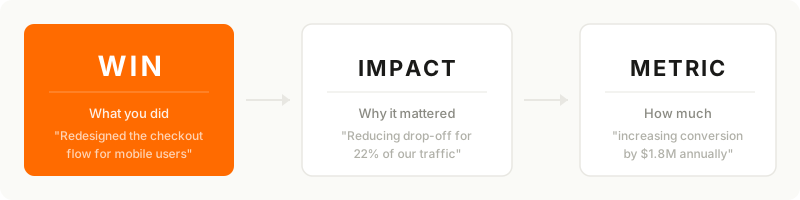
What I did → Impact it had → What I learned or what’s next
For sales managers, “what I did” should describe specific managerial actions — a coaching intervention on a struggling rep, a pipeline methodology you implemented, a hire you made and developed — not just team results. Results are the evidence; your actions are the story.
Phrases That Signal Seniority
| Instead of this | Write this |
|---|---|
| "My team hit quota" | "My team achieved [X]% of quota, driven by [specific managerial action] that improved [leading metric] by [N]% — the specific lever that differentiated our performance from the prior year" |
| "I coached my reps" | "I ran structured weekly Gong reviews with each rep, identifying [specific pattern], and the three reps I coached most intensively improved their win rates by an average of [N] points" |
| "I helped reps with their pipeline" | "I implemented a weekly pipeline review discipline using Clari that caught $[X]M in at-risk deals with sufficient lead time to recover [N]% — recovering $[X]K in revenue that would otherwise have slipped" |
| "I want to improve at forecasting" | "I'm improving forecast accuracy by calibrating my Clari stage conversion assumptions against 12 months of Salesforce historical data, targeting within-10% accuracy by Q2" |
Team Quota Attainment Self-Assessment Phrases
Performance Against Target
- "My team achieved 108% of annual quota, with 7 of 8 reps at or above 100% — the highest team attainment rate in our regional segment. I attribute this to three specific investments: a structured ramp program for our two new hires, a pipeline health review cadence that caught slippage early, and targeted deal support in Q3 when we were tracking 6 points behind pace."
- "My team finished at 94% of quota in a year when our primary competitive segment contracted by 15%. Maintaining near-plan performance in a headwind market required active pivoting — I identified two adjacent segments mid-year where our win rates were outperforming and shifted team focus and activity ratios accordingly. Without that adjustment, our forecast model suggested we would have finished at 81%."
- "I took over a team tracking at 67% of pace in Q2 and closed the year at 91%. The recovery required a structured performance intervention for two underperforming reps, a rebuild of the team's pipeline coverage ratio, and direct deal support on six transactions in Q4. Three of those six deals closed, contributing $1.8M to our year-end number."
- "My team's revenue per rep improved 23% year over year, despite headcount growing by 25%. This means our productivity per seller — not just our total output — meaningfully improved, which I attribute to the deal qualification discipline and multi-threading methodology we implemented in the second half."
Activity & Leading Metrics
- "I focused the team's activity metrics on leading indicators — qualified pipeline added per week and multi-threaded deal percentage — rather than lagging metrics like closed revenue. The shift improved our pipeline coverage ratio from 2.8x to 4.1x, which is the structural reason we closed Q4 with less end-of-quarter scramble than any quarter in the prior two years."
- "I identified that our team's biggest attainment limiter was not activity volume but deal qualification discipline — we were spending time on deals with no economic buyer access. I introduced a MEDDPICC qualification checklist reviewed in every pipeline meeting, and average deal size increased 18% as we stopped chasing low-probability, low-value deals."
Rep Coaching & Development Self-Assessment Phrases
Individual Rep Development
- "I ran structured bi-weekly Gong call reviews with each rep, focused on three coaching themes I identified from pattern analysis across the team's lost deals: economic buyer access, multi-threading, and business case articulation. The reps who engaged most consistently with this coaching improved their win rates by an average of 11 points over the year — a measurable return on coaching investment."
- "I identified a mid-level rep who had plateaued at 75–80% of quota for two consecutive years and ran a structured performance improvement process focused on pipeline creation discipline. I reviewed her prospecting approach weekly, role-played discovery calls monthly, and used LinkedIn Sales Navigator to co-build her target account list. She finished this year at 104% — her first 100%+ year in four at the company."
- "I developed two of my top reps into team lead roles, delegating deal review responsibilities and peer coaching as a development path for eventual management. Both reps have taken on formal mentorship of two junior reps each, multiplying my coaching capacity without requiring additional headcount."
- "I used Chorus call analysis to identify that our newest rep was losing deals consistently at the business case stage, not the discovery stage — a diagnostic the rep hadn't been able to articulate herself. I designed a targeted coaching plan around financial ROI conversations, ran 6 role-play sessions over 8 weeks, and she improved her Q3 win rate by 19 points on deals that reached business case stage."
- "I conducted quarterly career conversations with every rep on my team — structured discussions tied to their stated career goals, not just their quota performance. Three reps received lateral stretch opportunities as a result, and my team's voluntary attrition was zero this year against a company average of 22% for sales ICs."
Team Development & Culture
- "I redesigned our team's onboarding ramp program, extending the structured component from 30 days to 90 days and tying milestones to specific skill demonstrations rather than calendar time. Our last three new hires reached full productivity in an average of 4.2 months versus the prior 6.8-month average — a 40% reduction in ramp time that compounds across every future hire."
- "I created a peer coaching practice on my team where reps review each other's calls in pairs each week using a structured feedback template I designed. The practice has improved overall call quality, reduced my personal coaching burden, and created a team dynamic where learning is continuous rather than episodic."
Pipeline Management Self-Assessment Phrases
Pipeline Hygiene & Review
- "I implemented a weekly pipeline review discipline using Clari that gave me real-time visibility into deal health signals — engagement scores, stage velocity, and multi-thread status — rather than relying on rep self-reporting. In Q3, this visibility identified $1.4M in at-risk pipeline 6 weeks before quarter end. I deployed direct deal support on the top 4 deals and recovered $820K that the prior period's reactive approach would have lost."
- "I enforced a pipeline coverage standard of 3.5x quota minimum, maintained at all times — not just at quarter open. When coverage dropped below this threshold for any rep, I required a pipeline build plan within 48 hours. Maintaining this discipline eliminated the Q4 scramble pattern that had characterized the team's prior two years, where we closed quarters 20–30 points below Q1 pace."
- "I introduced a deal qualification audit for any opportunity above $50K that required evidence of economic buyer access, identified pain, and competitive landscape understanding before the deal could advance past stage 2 in Salesforce. The audit reduced our commit-to-close rate falloff from 68% to 44% — deals we committed to closed at materially higher rates."
- "I built a pipeline aging report that tracked deal time-in-stage velocity against historical norms, surfacing stalled deals before reps acknowledged them as at-risk. The report identified an average of 6 stalled deals per month that weren't visible in standard pipeline views — enabling proactive intervention rather than end-of-quarter discovery."
Deal Strategy & Support
- "I personally supported 18 strategic deals above $100K this year through executive sponsor introductions, customer reference calls, and deal strategy reviews. Of the 18, 13 closed — a 72% win rate on the deals I actively supported, versus the team's overall 41% win rate on deals in that size tier. This involvement is a deliberate multiplier I apply selectively to highest-value opportunities."
- "I implemented a multi-threading requirement for all enterprise deals, requiring documented contact with at least three stakeholders before a deal could be forecasted as commit. The practice reduced single-threaded deal losses — our most preventable loss reason — by 35% compared to the prior year."
Sales Process & Methodology Self-Assessment Phrases
Process Implementation
- "I introduced MEDDPICC qualification methodology to my team, replacing an informal qualification approach that varied by rep. I ran a 4-session training series, built a Salesforce opportunity template that captured every criterion, and reviewed adherence in weekly pipeline meetings. Six months post-implementation, average deal size increased 22% and our stage-to-stage conversion rates improved at every step — the compound effect of qualification discipline."
- "I designed a repeatable discovery framework for my team based on analysis of our highest-win-rate discovery calls in Gong. The framework identifies the five questions that most reliably surface economic buyer motivation and quantifies the business impact of the problem. Reps trained on the framework improved their business case quality scores in Gong by an average of 1.8 points on a 5-point scale."
- "I built a competitive displacement playbook for our top three competitors, working with PMM to develop objection handling guides and differentiation messaging. I trained the team and tracked usage via Outreach sequence data. Reps using the playbook closed competitive deals at a 28% higher rate than those who weren't, validating the methodology investment."
- "I implemented a structured close plan requirement for all Q4 strategic deals — a shared document between the rep, the customer stakeholders, and me that outlined remaining steps, timelines, and mutual commitments. Of the 12 deals that had signed close plans, 10 closed in Q4. Of the deals without them, 3 of 9 closed. The close plan process is now standard practice."
Forecasting & CRM Self-Assessment Phrases
Forecast Accuracy
- "I improved my team's forecast accuracy from ±22% variance to ±8% variance over the course of the year, bringing my monthly forecasts consistently within a range that leadership could use for resource planning decisions. I achieved this by switching from rep-stated confidence to objective deal health signals in Clari, calibrating my own assumptions against 18 months of historical stage conversion data, and requiring that every commit-category deal have a documented customer confirmation of timeline."
- "I introduced a weekly forecast call cadence with each rep that separated pipeline review (what's there) from forecast call (what's closing and why). The separation improved forecast discipline by preventing the common conflation of 'deals I'm hopeful about' with 'deals I'm committing to close.' My commit accuracy improved to 91% over the last two quarters."
- "I built a personal forecasting model in Google Sheets that adjusts rep forecasts using their individual historical close rate by stage and deal type, providing a manager-level view that is systematically less optimistic than rep self-forecasts. This model has been directionally right in 10 of the last 12 months and is now something my VP relies on for top-down planning."
CRM & Data Discipline
- "I drove Salesforce data quality on my team from a 58% opportunity field completion rate to 94% by connecting CRM hygiene directly to pipeline review eligibility — deals with incomplete data didn't get reviewed, which meant reps who wanted their deals discussed kept their records current. The cleaner data improved our forecasting accuracy and gave our RevOps team usable historical data for planning."
- "I partnered with Revenue Operations to build a custom Salesforce dashboard that surfaces my team's health metrics in a single view: coverage ratio, stage velocity, multi-thread score, and competitive presence. The dashboard replaced four separate reports I was manually compiling each week, saving 3 hours of prep time and giving me better real-time visibility."
Cross-functional Partnership Self-Assessment Phrases
Marketing & Revenue Operations
- "I established a monthly feedback loop with the PMM team, sharing field intelligence from Gong calls on messaging resonance, competitive objections, and buyer language. This input directly influenced two battlecard updates and a repositioning of our enterprise pricing story that reps reported as significantly more effective in economic buyer conversations."
- "I partnered with demand generation to define the ideal qualified lead criteria for my segment, based on analysis of our highest-converting inbound leads over 18 months. The refined criteria reduced the MQL-to-SQL conversion time by 4 days and improved pipeline quality — our AE team spent less time on leads that were structurally unlikely to convert."
- "I drove alignment between my team and customer success on expansion pipeline ownership — a longstanding ambiguity that had caused missed expansion opportunities and occasional customer confusion about relationship ownership. The clarity we established added $380K of expansion pipeline in the two quarters following the agreement."
- "I collaborated with Revenue Operations to build an accurate territory model for the year-ahead plan, contributing field intelligence about account opportunity that the model hadn't previously captured. The improved model reduced territory imbalance across my team from a 2.4x disparity (top vs. bottom territory) to 1.6x, making quota attainment more equitable and improving morale among reps who had felt unfairly disadvantaged."
How Prov Helps Sales Managers Track Their Wins
Sales managers face a specific version of the documentation problem: quota attainment is tracked automatically, but everything that creates attainment — the coaching conversation that unlocked a struggling rep, the deal intervention that recovered $800K of slippage, the process change that compounded across the team for a year — exists only in memory and calendar entries. By review time, it’s compressed into a single number that flattens the story.
Prov captures the managerial moments as they happen — a quick voice note after a coaching breakthrough, a text entry when a pipeline intervention pays off, a record of the hire who ramped faster than anyone before. Over the year, those moments build into a detailed picture of the management work behind the team’s performance. Your self-assessment stops being “my team hit 108%” and becomes the full account of what you built, coached, fixed, and led — the story that distinguishes a great manager from a lucky one. Prov is coming soon on iOS.
Ready to Track Your Wins?
Free to start, no account, no sign-up. Available on the App Store now.
Download on iOS Free to start, no account needed