QA success is defined by bugs that never reached production — which means your most important work is inherently invisible. Success looks like nothing happening. The self-assessment challenge is making prevention legible to stakeholders who only notice when things break.
Why Self-Assessments Are Hard for QA Engineers
QA engineers operate in a profession where the best outcome leaves no trace. When quality is high, nobody notices. When a critical bug reaches production, everyone notices — and often they notice QA’s absence rather than QA’s work. This asymmetry makes the job structurally difficult to document: the absence of incidents is your achievement, but absence is hard to put in a bullet point.
There’s also the prevention vs. detection framing problem. QA engineers typically know they caught a critical bug before it shipped, but by the time review season arrives, that catch has been subsumed into the general success of the release. The specific bug, its potential severity, and the investigation that found it exist only in JIRA and fading memory — unless you documented it at the time.
The automation investment paradox creates another challenge. When you spend a quarter building test infrastructure, the output is a capability rather than a shipped feature. You wrote thousands of lines of test code, built a framework, integrated it into CI/CD, and reduced flakiness by 65% — but none of that shows up in the product changelog. Articulating the compound value of that infrastructure investment requires translating engineering work into business terms that stakeholders can evaluate.
Finally, QA work is collaborative by definition — you work inside other teams’ release cycles, review other engineers’ code, and advocate for quality standards you don’t directly control. Your influence on release quality is real but distributed, which makes it easy to write self-assessments that sound supportive rather than consequential.
The goal: quantify prevention, name specific catches, and connect quality investment to business continuity and customer trust.
How to Structure Your Self-Assessment
The Three-Part Formula
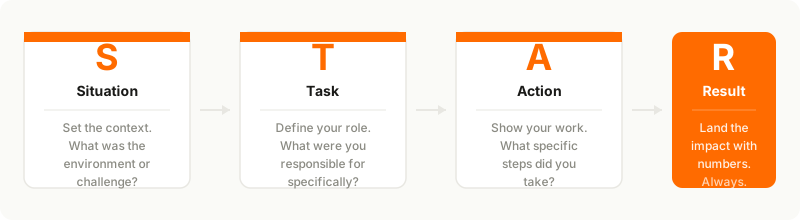
What I did → Impact it had → What I learned or what’s next
For QA engineers, “impact it had” should include both the direct outcome (prevented X bug from reaching Y users) and the broader value (maintained Z release cadence without quality regression, or eliminated N hours of manual testing per sprint). Prevention is the story — your job is to give it a number.
Phrases That Signal Seniority
| Instead of this | Write this |
|---|---|
| "I tested the feature" | "I designed and executed the test strategy for [feature], including [specific coverage areas], catching [N] critical defects before release" |
| "I wrote automation scripts" | "I built a [Playwright/Cypress/Selenium] automation suite covering [N] critical paths, reducing manual regression time from [X hours] to [Y hours] per release" |
| "I found bugs" | "I detected [N] P0/P1 defects in [release/feature] during testing — including [specific high-severity catch] — preventing production incidents that would have affected [user scope / business metric]" |
| "I want to improve test coverage" | "I'm targeting 85% critical-path automation coverage by Q3, focusing on the checkout and authentication flows that account for 70% of our P0 incident history" |
Test Strategy & Coverage Self-Assessment Phrases
Test Planning
- "I developed the test strategy for our payment system overhaul — a high-stakes release covering 14 integrated payment methods across 6 markets. I designed a risk-based coverage model that prioritized critical transaction flows, edge case handling, and failure mode validation. The release shipped with zero payment-related P0 or P1 incidents in the 90 days following launch, in a feature area responsible for 40% of our prior-year production incidents."
- "I introduced a formal test planning process for all major feature releases, requiring a documented test strategy, risk assessment, and entry/exit criteria before testing begins. The process reduced last-minute scope surprises by 60% and gave engineering and product a clear shared understanding of what 'ready to ship' means."
- "I identified a gap in our test coverage for third-party API integrations — an area responsible for two of our three worst production incidents in the prior year. I designed and implemented an integration test layer using Postman collections that now validates every critical API contract before each release."
- "I built a test coverage heatmap that visualized which product areas had strong automation coverage and which were tested only manually. The map influenced the team's test investment decisions for the following two quarters and helped me make the case for dedicating one sprint to automation coverage in our highest-risk modules."
- "I designed a data-driven test matrix for our multi-tenant platform, ensuring that permission boundaries, data isolation, and role-based access were tested across all tenant configuration combinations. This comprehensive coverage caught a data exposure edge case that manual ad-hoc testing had missed across three prior releases."
Coverage Quality
- "I audited our test suite and found that 35% of our automated tests were testing implementation details rather than user behavior, making them brittle and expensive to maintain. I refactored the suite toward behavior-driven coverage, reducing test maintenance time by 40% while increasing the suite's ability to catch real regressions."
- "I established a test coverage standard for our team that requires all new features to include unit tests, integration tests, and at least one end-to-end happy-path test before merging. Adoption is at 92%, and the features shipped under this standard have had a 45% lower post-release defect rate than those shipped before it."
Automation & Tooling Self-Assessment Phrases
Framework Development
- "I built a Playwright-based end-to-end automation framework from scratch, covering our 40 most critical user journeys across web and mobile web. The framework runs in GitHub Actions on every PR, providing automated regression coverage that previously required 16 hours of manual testing per release cycle. We now run equivalent coverage in 22 minutes with zero additional engineer time."
- "I designed a reusable test component library for our Cypress suite that reduced the time to write a new test by 70%. New automation scripts that previously took a half-day to write now take under an hour, enabling the development team to contribute to test coverage without deep Cypress expertise."
- "I migrated our legacy Selenium grid to a modern Playwright setup, eliminating a flakiness rate that had reached 28% and was causing developers to ignore test failures rather than investigate them. Post-migration flakiness is under 2%, and developer trust in the test suite has measurably improved — CI failure investigations have tripled, which means failures are now actually being fixed."
- "I built an API testing layer using Postman and Newman integrated into our CI pipeline, providing contract validation for 35 internal APIs before they reach integration environments. The layer has caught 7 breaking API changes in the six months since deployment — changes that previously would have been discovered in integration testing at high remediation cost."
CI/CD Integration
- "I integrated our test suite into the CI/CD pipeline via GitHub Actions, implementing parallel test execution that reduced total pipeline runtime from 45 minutes to 12 minutes. The faster feedback loop increased the development team's PR throughput by reducing the time they spend waiting for test results before iterating."
- "I implemented a test failure triage dashboard in DataDog that categorizes failures by type — flaky, environment, and genuine regression — saving the on-call team approximately 45 minutes of investigation time per failure event. The categorization also identified a set of environment stability issues that were masking genuine test failures."
- "I built a scheduled smoke test suite that runs against production every 30 minutes, providing continuous validation of critical user flows between deployments. The suite has caught two post-deployment regressions within minutes that would otherwise have been discovered through customer support tickets."
Defect Detection & Prevention Self-Assessment Phrases
High-Severity Catches
- "I caught a data exposure vulnerability during testing of our new export feature that would have allowed users to download records outside their permission scope. I identified it through a systematic permission boundary test case that wasn't in the original test plan — I added it based on prior pattern recognition from a similar feature. The potential regulatory and trust impact of this reaching production was significant."
- "I identified a race condition in our checkout flow during load testing that caused order duplication under concurrent submission conditions. The defect affected the most trafficked part of our product and would have been catastrophic during our peak sales period, which was 3 weeks away when I found it. We fixed it with 10 days to spare."
- "I detected a performance regression during testing that showed our search API degrading to 8-second response times under mid-level concurrency — a 16x degradation from baseline. The regression came from a dependency update that no unit test covered. Without load testing it would have reached production and affected every user during our busiest hours."
- "I found a critical authentication bypass in our SSO integration during security-focused exploratory testing. The defect would have allowed access to any account given knowledge of the account ID. I escalated immediately, documented the reproduction steps, and worked with the security team to validate the fix within 24 hours — the fastest critical-defect cycle we've had."
Defect Analysis
- "I ran a quarterly defect trend analysis using JIRA data, identifying that 45% of production bugs originated from one module with low test coverage and high recent churn. I presented the analysis to engineering leadership and used it to justify a focused automation sprint on that module. Post-sprint, defect rates from that area dropped by 55%."
- "I introduced defect escape tracking — measuring what percentage of defects found post-release were testable pre-release — giving us a quality signal beyond raw defect counts. The metric identified two recurring escape patterns and allowed us to close the gap with targeted test additions."
Release Quality Self-Assessment Phrases
Release Readiness
- "I defined and implemented release quality gates for our team — objective, automated criteria that a build must pass before it proceeds to staging and then production. The gates cover test pass rate, code coverage thresholds, and performance benchmarks. Since implementation, we've had zero production releases that failed to meet our minimum quality bar, and we've reduced hotfix frequency by 40%."
- "I served as QA lead for our platform's largest release of the year — a 14-feature bundle with a hard external deadline. I coordinated testing across three feature teams, maintained a shared test status dashboard in TestRail, and made the go/no-go recommendation with full traceability to test results. We shipped on schedule with a clean release."
- "I established a pre-release production validation protocol — a 30-minute scripted smoke test run against the production environment immediately after deployment by the on-call QA engineer. The protocol has caught two silent deployment failures within minutes, before any user was affected."
- "I drove a regression suite rationalization effort that removed 200 redundant and obsolete tests from our regression suite, reducing suite runtime by 25% while maintaining coverage of all critical paths. The audit also identified 15 gaps in critical-path coverage that I subsequently filled, making the smaller suite more comprehensive than the bloated original."
Post-Release Monitoring
- "I configured DataDog monitors for our key quality signals — error rates, p99 latency, and critical transaction failure rates — tied to alert thresholds calibrated to our SLA commitments. The monitors have fired meaningfully twice this year, each time alerting before customer support ticket volume spiked, giving us a head start on diagnosis and mitigation."
- "I introduced a 48-hour post-release quality review practice, pulling DataDog error data and JIRA bugs filed in the window to assess whether releases met quality expectations. The review has identified two releases that needed hotfixes before they became widespread customer issues."
Process Improvement Self-Assessment Phrases
Quality Process Design
- "I introduced shift-left testing practices on two of our feature teams, embedding QA input into sprint planning and design review rather than treating testing as a post-development phase. The teams using this approach had 38% fewer mid-sprint scope changes due to quality issues and shipped features with 30% lower post-release defect rates compared to teams using the traditional approach."
- "I built a risk-based testing playbook that helps QA engineers prioritize test effort based on change impact, user traffic, and historical defect density rather than treating all features as equally risky. Using the playbook, we reduced time spent on low-risk changes by 35% and redirected that capacity to high-risk areas."
- "I designed a test environment management process that reduced the frequency of environment-related test failures from 22% of all failures to under 5%. The process included environment health checks before test runs, a reservation system to prevent conflicts, and a shared status page that made environment availability visible to all QA engineers."
- "I implemented a flaky test quarantine policy — automatically quarantining tests that fail intermittently and routing them to a triage queue — that ended the practice of developers marking failing tests as 'known flaky' and ignoring them. The policy reduced active flaky tests from 67 to 8 over one quarter."
Collaboration & Advocacy Self-Assessment Phrases
Engineering Partnership
- "I embedded in two development teams' sprints this year as a quality advocate, attending daily standups, participating in technical design reviews, and raising testability concerns before implementation decisions were locked. My involvement caught three design choices that would have been difficult to test automatically, and in each case the engineer made a small modification that significantly improved testability."
- "I partnered with the backend team to add unit test coverage for our payments service, identifying 12 critical paths that had no automated test coverage. I provided test case specifications; the backend engineer wrote the unit tests. Coverage went from 31% to 67% in one sprint, and the subsequent release had zero payments-related regressions."
- "I ran a 'bug bash' across the product and engineering organization before our major annual release, recruiting 25 participants and providing structured test charters to guide exploratory testing. The event found 34 bugs in one day, including 4 high-severity issues — and it created a quality culture moment that has made the bug bash a recurring pre-release tradition."
- "I advocated for and got approval to add QA review to our definition of done, ensuring that every user story includes test coverage as part of acceptance criteria rather than as an afterthought. Since adoption, the average time from development-complete to QA-complete has decreased by 2 days because testing is planned rather than reactive."
How Prov Helps QA Engineers Track Their Wins
QA work is especially vulnerable to memory loss at review time. The critical bug you caught in February, the automation suite you built in April, the shift-left practice you advocated for in June — all of it fades under the weight of recent sprints. And the nature of prevention means there’s often no artifact beyond a JIRA ticket and a closed PR to remind you that the work happened.
Prov captures wins at the moment they occur — a 30-second voice note when you catch a P0 before release, a quick text entry when you ship a new automation framework — preserving the context that makes those moments meaningful at review time. Over the course of a year it builds a detailed record of what you prevented, built, and improved. When performance review season arrives, you have specific catches, specific metrics, and a clear picture of the quality investment you made on behalf of the team. Prov is coming soon on iOS.
Ready to Track Your Wins?
Free to start, no account, no sign-up. Available on the App Store now.
Download on iOS Free to start, no account needed