Concrete examples of QA engineer and SDET achievements you can adapt for your performance review, promotion packet, or resume.
The QA Engineer's Performance Review Problem
You caught the bug that would have taken the payment service down on Black Friday. You automated 800 test cases that used to eat 40 hours of manual regression every sprint. You pushed testing left until developers were writing tests before code. And now you're sitting in front of a blank review form writing "ensured product quality" and wondering why a year of invisible, essential work is so hard to articulate.
The fundamental problem is that QA success is defined by absence. When you do your job well, nothing bad ships. The website stays up. The data stays clean. The customers don't file support tickets. "Nothing bad happened" is the hardest kind of value to make visible, because there's no changelog entry, no shipped feature, no number that went obviously up. Your work shows up as someone else's metric — developer velocity, customer satisfaction, production incident count — and you rarely get credited for it.
There's also a second challenge specific to SDET and automation engineering roles: the depth of your technical work is invisible to most reviewers. "Refactored the Playwright test suite" tells a VP nothing. "Refactored the Playwright suite to eliminate 340 flaky tests that were blocking 6 teams' CI pipelines — cutting false-failure rate from 23% to 0.4% and recovering 8 hours of engineer time per day" tells them everything they need to know about the business value of what you did.
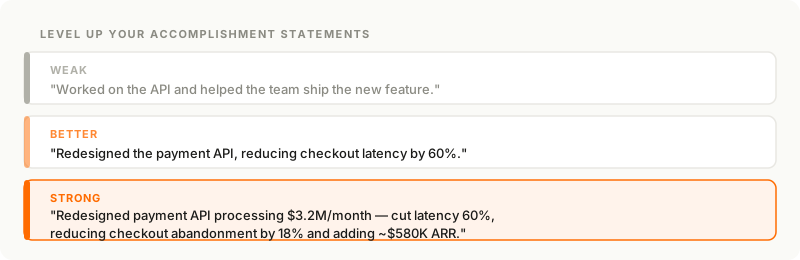
The examples below are organized by the six competencies that show up most in QA and SDET performance reviews. They're specific, measurable, and built around the format that actually lands in reviews: what you built or changed, why it was hard, and what the outcome was for the team or the business. Use them as scaffolding for your own numbers.
What gets you promoted are documented accomplishments with measurable impact.
QA Engineer Accomplishment Categories
| Competency | What Reviewers Look For |
|---|---|
| Test Strategy & Coverage | Do you catch the right bugs, not just any bugs? |
| Test Automation & Engineering | Do you build systems that scale with the team? |
| Quality Culture & Process | Do you make quality everyone's responsibility? |
| Release & Incident Management | Do you gate releases with confidence? |
| Performance & Non-functional Testing | Does your testing go beyond happy-path functional? |
| Collaboration & Technical Leadership | Do you elevate the engineers around you? |
Test Strategy & Coverage Accomplishments
Test Planning & Coverage
- "Designed the end-to-end test strategy for the checkout redesign — 4 user journeys, 18 edge cases, 3 payment integrations — catching 14 critical defects before the feature reached staging"
- "Built the risk-based test prioritization matrix that focused 80% of regression effort on the 20% of flows that accounted for 90% of historical production bugs, cutting regression time by 6 hours per cycle"
- "Achieved 94% code coverage on the payments module (up from 41%) by writing targeted unit and integration tests across 3 sprints, reducing production defects in that module by 70% in the following quarter"
- "Created the master test plan for the platform migration — mapping 600 existing test cases to 12 migration scenarios — ensuring zero regression in customer-facing functionality across a 6-month project"
- "Defined the test coverage baseline across 8 microservices that had no documented test strategy, establishing the first measurable quality benchmark for the team and giving engineering leadership a true risk map"
- "Mapped test coverage to JIRA epics for the first time, revealing that 3 high-business-value features had zero automated coverage — directly prioritizing automation work for Q2 that reduced escapes in those areas by 55%"
- "Wrote the component test specifications for the new API contract before any development started, enabling the backend team to build to spec and reducing integration defects at handoff by 80%"
- "Designed the boundary-value and equivalence partitioning test sets for the pricing engine — 240 cases — identifying a rounding error in edge-case input that would have affected invoices for customers with multi-currency accounts"
Risk-based & Exploratory Testing
- "Conducted structured exploratory testing sessions on every major release using session-based test management, discovering 23 defects in 6 months that automated tests had not caught — including 4 rated critical by the product team"
- "Developed the risk register for the Q3 platform upgrade, identifying 9 integration risks and 3 data-migration risks that were added to the engineering backlog and addressed before go-live"
- "Designed the attack surface model for the new public API, identifying 12 abuse vectors that the product team had not considered — 5 of which were addressed before launch and 7 accepted as known risks with monitoring"
- "Ran a focused exploratory charter on the third-party SSO integration the week before launch, finding a session-fixation edge case that would have allowed account takeover under specific browser conditions"
- "Introduced property-based testing using Hypothesis for the data transformation pipeline, generating 10,000+ input combinations that uncovered 6 classes of silent data corruption the unit tests had missed"
- "Led the first mutation testing exercise using Stryker on the billing module, revealing that 35% of "green" tests were not actually validating logic — prompting a targeted test-quality improvement sprint that caught 4 pre-existing bugs"
- "Performed a full regression triage after each sprint, categorizing which existing tests needed updating vs. new coverage — reducing wasted automation effort by 30% and keeping the suite aligned with current product behavior"
- "Authored the negative-path test catalog for the user onboarding flow, covering 45 error states and edge conditions that had never been formally tested — finding 8 defects in the first run"
Test Automation & Engineering Accomplishments
Framework Development
- "Built the Playwright end-to-end test framework from scratch — page object model, custom fixtures, retry logic, Allure reporting — adopted by all 4 frontend teams within one quarter and now covering 1,200+ scenarios"
- "Migrated the legacy Selenium suite (800 tests, 4 years old) to Playwright, reducing test execution time from 4.5 hours to 35 minutes and cutting flaky-test rate from 18% to under 1%"
- "Designed the API test framework using REST Assured with contract validation, data-driven test generation, and shared authentication helpers — enabling 3 backend teams to add API tests without framework expertise"
- "Built the shared test data factory that creates consistent, isolated test state for every test run, eliminating the inter-test dependency that had caused 40% of automation failures in the previous framework"
- "Introduced contract testing using Pact between 6 microservices, catching 3 breaking API changes in CI before they reached integration environments — reducing cross-team integration debugging by an estimated 12 hours per sprint"
- "Reduced the flaky test rate in the main regression suite from 23% to 0.4% by auditing 800 tests, fixing synchronization issues, and introducing retry-with-reason logging — recovering 8 hours of CI reliability per day across 6 teams"
- "Created the visual regression testing layer using Percy, establishing a pixel-level baseline for 40 UI components that catches unintentional visual changes before they reach design review"
- "Built the mobile test automation framework using Appium with cloud device execution on BrowserStack, achieving 90% coverage of critical iOS and Android flows within one quarter"
CI/CD Integration
- "Integrated the full regression suite into the GitHub Actions CI pipeline — parallelized across 8 workers — reducing total CI test time from 2.5 hours to 18 minutes and unblocking 6 teams that had been batching deployments to avoid slow feedback"
- "Configured test sharding and selective test execution based on changed files, cutting per-PR test time from 22 minutes to 6 minutes for the majority of pull requests while maintaining full coverage for high-risk changes"
- "Set up the Allure TestOps reporting dashboard integrated with JIRA, giving engineering managers real-time visibility into test results, flake rates, and coverage trends for the first time"
- "Implemented test quarantine automation that detects and isolates flaky tests without blocking pipelines, reducing developer-reported CI frustration incidents from 15/week to 2/week"
- "Built the smoke test suite that runs in under 3 minutes against every production deployment, catching 4 post-deploy regressions in the first quarter that were resolved before any customer was affected"
- "Integrated OWASP ZAP scanning into the deployment pipeline for the public API, automating the security regression that had previously required a manual 2-day engagement every quarter"
- "Set up cross-browser execution on BrowserStack in CI — Chrome, Firefox, Safari, Edge — covering the browser matrix that accounted for 98% of user traffic without adding any manual test execution"
Quality Culture & Process Accomplishments
Shift-left & Developer Testing
- "Introduced the three-amigos practice (dev, QA, product) for every story before sprint start — reducing mid-sprint scope changes by 40% and catching ambiguous acceptance criteria before a single line of code was written"
- "Partnered with 3 senior engineers to define unit test standards and coverage gates per module, increasing team-wide unit test coverage from 28% to 67% over two quarters without mandating specific test counts"
- "Embedded a QA review step in the definition of done that required developers to document their own manual test cases before marking stories complete, reducing QA handoff defects by 35% in the first sprint"
- "Ran 6 lunch-and-learn sessions on testability patterns — dependency injection, test doubles, observable side effects — that measurably improved the testability of code submitted for review by 3 backend teams"
- "Introduced TDD pairing sessions with 4 junior developers across 2 sprints, resulting in all 4 independently writing unit tests before implementation by the end of the quarter"
- "Created the developer testing guide — unit test patterns, common mocking pitfalls, integration test organization — that replaced tribal knowledge and reduced onboarding time for new engineers from 3 weeks to 1 week"
- "Established the test review checklist added to every pull request template, catching missing coverage and inadequate assertions before code reached QA — reducing back-and-forth review cycles by 25%"
- "Championed adding acceptance tests to every user story as part of refinement, shifting the team's quality ownership left and reducing the number of stories that required rework after QA by 45%"
Process & Standards
- "Designed and documented the QA process for the entire engineering org — test levels, entry/exit criteria, severity taxonomy, defect lifecycle — giving 4 teams a shared quality language for the first time"
- "Built the defect triage process with weekly cross-functional review, reducing average defect age from 34 days to 9 days and eliminating the backlog of 80+ stale bugs that had accumulated with no owner"
- "Introduced TestRail as the test management platform, migrating 1,400 test cases from spreadsheets to structured plans — enabling test run reporting and traceability to requirements that had not existed before"
- "Reduced the defect escape rate (bugs reaching production) from 8 per release to 1.5 per release over 6 months through a combination of risk-based regression planning, peer test review, and improved acceptance criteria practices"
- "Created the quality metrics dashboard (defect density, escape rate, automation coverage, flake rate) reviewed in every sprint retrospective — making quality trends visible and giving the team data to improve against"
- "Standardized severity and priority definitions across 4 product teams, reducing the time spent in triage debates from an average of 45 minutes per meeting to 10 minutes and improving consistency of SLA tracking"
Release & Incident Management Accomplishments
Release Qualification
- "Owned the release qualification process for 24 production releases in the year — zero rollbacks caused by quality escapes missed in QA, and release cycle time reduced from 3 days to 1 day through improved automation coverage"
- "Designed the release readiness scorecard (automation pass rate, open critical bugs, coverage delta, smoke test results) that gave engineering leadership a consistent, data-driven go/no-go signal across all releases"
- "Reduced regression cycle time from 5 days manual to 4 hours automated for the quarterly platform release, enabling the team to ship on the planned date for the first time in 3 quarters"
- "Built the post-release monitoring checklist and coordinated the first 30 minutes of production observation for each release, catching 2 post-deploy performance regressions before they crossed customer SLA thresholds"
- "Introduced feature flag-based testing in production on 8 features, enabling QA validation in the live environment before full rollout — catching 3 environment-specific issues that staging had not surfaced"
- "Established the UAT coordination process for 3 enterprise customers, managing 40+ tester accounts, test scripts, and bug triage in parallel — achieving sign-off 2 weeks ahead of the contractual deadline"
- "Negotiated the release freeze window and communicated clear quality gates to the product team, reducing last-minute "just one more thing" additions that had caused 4 emergency patches in the previous year"
Defect & Incident Management
- "Performed root-cause analysis on the production data corruption incident — traced the defect to a missing null check in the ETL pipeline — and wrote the regression test that now prevents the same class of bug from reaching staging"
- "Reduced average bug resolution time from 12 days to 5 days by implementing a daily defect standup with the dev team and a severity-based SLA that was tracked in the quality dashboard"
- "Maintained a defect escape rate below 1.5 bugs per release for 3 consecutive quarters, down from a baseline of 8, through systematic root-cause analysis and pattern-based prevention"
- "Audited 120 historical production incidents over 3 years to identify the top 5 defect categories — findings directly shaped the automation roadmap that reduced those categories by 65% in the following year"
- "Identified the root cause of a recurring data integrity issue (race condition in concurrent writes) that had produced 3 separate production incidents over 6 months — the fix eliminated that defect class entirely"
- "Wrote and maintained the defect prevention checklist for the 8 highest-frequency bug categories, adopted by the development team as a pre-commit reference that reduced recurrence of known bug patterns by 70%"
Performance & Non-functional Testing Accomplishments
Load & Stress Testing
- "Built the k6 load testing suite that simulated 50,000 concurrent users against the API tier — identifying the database connection pool exhaustion that would have caused a complete outage at 3x current traffic, 6 weeks before a major marketing campaign"
- "Ran the stress test program for the Black Friday preparation — 4 scenarios, 3 rounds of iteration — confirming the system could handle 8x normal peak load and giving the business confidence to run the campaign without throttling"
- "Established the performance baseline for 12 critical API endpoints using k6 and Grafana, creating the first historical performance trend data that enabled the team to detect degradation between releases"
- "Identified a memory leak in the image processing service through sustained load testing, preventing an outage that would have affected 200,000 daily active users during peak hours"
- "Reduced API p99 latency by 40% by using load test results to pinpoint and resolve N+1 query patterns in 3 high-traffic endpoints — the first time performance data had directly driven database optimization work"
- "Designed the JMeter endurance test suite (8-hour sustained load) that uncovered a slow file-handle leak in the PDF generation service that only manifested after 4+ hours of production traffic"
- "Integrated Locust performance tests into the CI pipeline for the 5 most critical endpoints, catching a 35% latency regression in a database query change before it merged to main"
Security & Accessibility Testing
- "Led the OWASP Top 10 assessment of the customer portal using ZAP and manual testing, identifying 3 medium and 1 high-severity vulnerabilities — all remediated before the enterprise security audit that followed 4 weeks later"
- "Built the automated accessibility testing layer using axe-core integrated into Playwright, scanning 40 critical pages on every CI run — catching 22 WCAG 2.1 AA violations before they reached production and reducing legal risk"
- "Conducted the manual accessibility audit of the new onboarding flow with assistive technology testing (VoiceOver, NVDA, keyboard-only navigation), producing a prioritized remediation list that the design team used to achieve WCAG AA compliance"
- "Identified a stored XSS vulnerability in the user profile page during security-focused exploratory testing — before it was found by any external party — and wrote the regression test that now runs in CI against all user-input fields"
- "Implemented the SQL injection test suite for all parameterized query surfaces using automated fuzzing, covering 180 input vectors that had never been formally tested and confirming complete protection from the injection class"
- "Set up automated HTTPS/TLS configuration scanning in the deployment pipeline, catching a misconfigured cipher suite on a new subdomain before it was indexed and before it could be flagged in a customer security audit"
- "Performed API security testing using Postman collections for all authenticated endpoints, identifying 2 IDOR (insecure direct object reference) vulnerabilities that would have allowed users to access other customers' data"
Collaboration & Technical Leadership Accomplishments
Mentorship & Enablement
- "Mentored 2 manual QA engineers into automation roles over 6 months — pairing on Playwright, reviewing their first 50 test PRs, and structuring a learning curriculum — both are now independent automation contributors"
- "Created the QA onboarding program for new hires: a 4-week curriculum covering test strategy, automation framework, CI/CD, and tooling that reduced time-to-productivity from 6 weeks to 2 weeks"
- "Ran a 3-session Playwright workshop for 8 frontend developers, resulting in 3 of them independently contributing E2E tests in the following sprint — directly expanding automation capacity without adding headcount"
- "Established the QA knowledge-sharing rotation where each team member presents a technique, tool, or finding monthly — 12 sessions run, 3 new practices adopted by the team as direct results"
- "Provided structured code review for all test PRs, leaving educational comments that improved the automation quality of the team's output measurably — average test review iteration count dropped from 3.2 to 1.4 over the year"
- "Coached a junior SDET through their first framework contribution — designing the data-driven test expansion — and presented their work to the engineering org as an example of the automation standard"
Cross-team Advocacy
- "Represented QA in the architecture review for the new event-driven system, identifying 6 testability gaps in the proposed design — changes were made before implementation, saving an estimated 3 weeks of retrofit testing work"
- "Partnered with the platform team to build the test environment provisioning automation, reducing QA environment setup time from 4 hours to 12 minutes and eliminating the shared-environment conflicts that had blocked 2 teams weekly"
- "Presented the quarterly quality metrics report to engineering leadership — escape rate, automation coverage, flake rate, DORA metrics — establishing the first executive-level quality visibility and directly influencing the Q3 headcount decision"
- "Collaborated with the security team to define the SAST/DAST integration plan for the CI pipeline, bridging the gap between security requirements and engineering workflow — implementation completed 4 weeks ahead of the compliance deadline"
- "Advocated for and secured budget approval for a TestRail + BrowserStack toolchain upgrade by presenting the ROI case: $24K/year in tooling vs. 18 hours/week in manual browser testing and environment management"
- "Served as the QA representative in the product roadmap planning process, introducing "quality effort estimates" alongside story points — giving the team a more accurate capacity model and reducing sprint overcommitment by 20%"
How to Adapt These Examples
Plug In Your Numbers
Every example above follows: [Action] + [Specific work] + [Measurable result]. Replace the numbers with yours. Pull defect escape rates from your bug tracker, automation coverage from your CI reporting tool (Allure, TestRail, or your CI dashboard), flaky test rates from GitHub Actions or Jenkins metrics, and performance numbers from your load testing reports. The before-and-after format is almost always the most powerful — even if the "before" is an estimate, name it.
Don't Have Numbers?
QA impact is often the absence of bad things, which resists clean metrics. When direct numbers aren't available, use the closest available proxy: number of critical bugs caught before production, number of regression cycles where zero escapes reached customers, number of manual test hours automated away, or the number of teams unblocked by infrastructure you built. "Maintained zero critical-severity escapes across 18 consecutive releases" is a strong statement even without a defect-rate percentage. The key is naming the before state, even qualitatively: "before I built the smoke test suite, post-deploy regressions were caught by customer support tickets; after, we caught them in the first 3 minutes."
Match the Level
Junior and mid-level QA engineers should document specific test coverage wins and automation contributions — what you built, what it caught, how it improved the team's daily workflow. Senior QA engineers should emphasize the decisions behind the work: why this test strategy over that one, what risks you prioritized and why, how you influenced the development process to shift quality left. Staff-level SDETs and QA leads should focus on org-level quality culture: the framework the whole engineering org builds on, the process you introduced that changed how teams think about quality, the engineers you leveled up, the visibility into quality you created for leadership. The higher the level, the more your accomplishments should show that you changed how the whole organization ships software, not just that you wrote good tests.
Start Capturing Wins Before Next Review
The hardest part of performance reviews is remembering what you did 11 months ago. Prov captures your wins in 30 seconds — voice or text — then transforms them into polished statements like the ones above. Prov is coming soon on iOS.
Ready to Track Your Wins?
Free to start, no account, no sign-up. Available on the App Store now.
Download on iOS Free to start, no account needed