Product marketing managers own the story but share the outcomes with product, sales, and demand generation. The self-assessment challenge is being precise about which outcomes you drove, which you enabled, and which you merely supported — because the difference is everything.
Why Self-Assessments Are Hard for Product Marketing Managers
PMMs sit at the intersection of three functions — product, marketing, and sales — which means they contribute to almost every meaningful outcome and own almost none of them exclusively. When a feature launch drives pipeline, product built the feature, demand gen ran the campaign, and sales closed the deals. What did PMM do? PMM did the positioning, wrote the messaging framework, built the sales deck, created the competitive battlecard, and trained the reps — the invisible connective tissue that made every other team’s work more effective. That contribution is real and large, but it’s structurally hard to claim.
The attribution gap is compounded by a pace problem. PMMs typically manage several launches, multiple competitive updates, and ongoing sales enablement simultaneously. Work that was critical two months ago feels distant by review time. The GTM strategy you wrote in January shaped everything that launched in Q2, but by Q4 it’s easy to forget you wrote it — or to underestimate how different Q2 would have looked without it.
PMMs also face the “I just helped” trap. Because the role is inherently collaborative, there’s a temptation to describe contributions as supporting rather than owning. But PMMs are often the ones who initiated the collaboration, defined the framework, drove the alignment, and ensured execution stayed on track. “I collaborated with sales” undersells “I built the enablement program, trained 40 reps, and tracked adoption to ensure usage.”
The goal: name the specific work you created, the decision you influenced, the outcome it produced, and whether you drove it, enabled it, or supported it — and mean the distinction precisely.
How to Structure Your Self-Assessment
The Three-Part Formula
What I did → Impact it had → What I learned or what’s next
For PMMs, “impact it had” should trace the connection: positioning work → pipeline quality → win rate. Messaging work → sales conversation quality → deal velocity. Competitive intelligence → displacement rate. Every PMM contribution has a downstream business outcome — your job in the self-assessment is to name the chain explicitly rather than leaving reviewers to infer it.
Phrases That Signal Seniority
| Instead of this | Write this |
|---|---|
| "I helped with the launch" | "I owned the GTM strategy and messaging for [launch], coordinating across product, demand gen, and sales to execute a [N]-touchpoint launch that generated [outcome]" |
| "I created sales materials" | "I built a sales enablement program for [product/segment], trained [N] reps, tracked adoption at 78%, and correlated with a [X]% improvement in [specific sales metric]" |
| "I did competitive research" | "I built competitive battlecards for our top four competitors, trained the sales team, and tracked a [X]% increase in competitive displacement rate in deals where the cards were used" |
| "I want to improve at messaging" | "I'm developing sharper economic buyer messaging by interviewing [N] CFOs this quarter, targeting a new framework that addresses the objection pattern I've identified in Gong call analysis" |
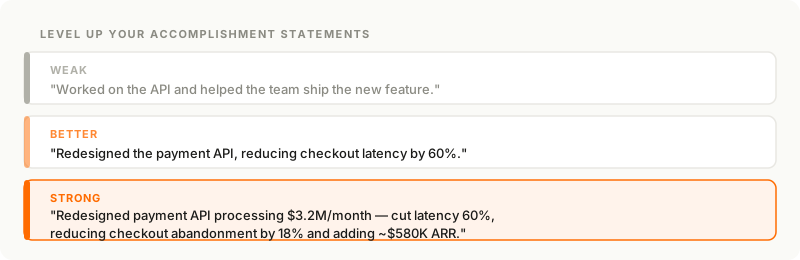
Go-to-Market Execution Self-Assessment Phrases
Launch Planning & Execution
- "I led the GTM strategy for our enterprise tier launch, defining the ICP, launch positioning, channel mix, and enablement plan across product, demand gen, and sales. The launch generated 340 qualified enterprise leads in the first 30 days — 70% above our internal target — and the enterprise segment has become our fastest-growing revenue line this year."
- "I designed and executed a six-week integrated launch for a platform expansion feature, coordinating 14 cross-functional stakeholders across three time zones. I owned the master launch calendar, drove all GTM alignment meetings, and ensured every team hit its milestone on time. The launch reached our 60-day pipeline target in 38 days."
- "I introduced a launch readiness scorecard that gave every stakeholder a shared checklist before launch day, eliminating the last-minute scrambles that had derailed two prior launches. Three launches this year went out on schedule with full asset availability — a first for the team."
- "I identified a market timing opportunity in a competitor's pricing change and coordinated an accelerated 10-day GTM push with product, comms, and sales. The speed required fast, decisive judgment on messaging tradeoffs — I owned those calls, and the resulting campaign contributed $1.2M to pipeline in its first two weeks."
GTM Strategy
- "I developed the segment-specific GTM playbooks for our SMB and mid-market launches, recognizing that a single launch approach was failing to resonate with both audiences. The segmented approach improved demo-to-opportunity conversion by 18% in mid-market and reduced the SMB sales cycle by 11 days."
- "I built our product launch framework from scratch — a repeatable process covering positioning, launch tiers, asset requirements, and success metrics — that has since been used for five consecutive launches. The framework reduced GTM planning time by 30% per launch and ensured consistent quality regardless of who owned individual launches."
Messaging & Positioning Self-Assessment Phrases
Positioning Development
- "I led a positioning overhaul for our core product after Gong call analysis revealed that 60% of lost deals cited confusion about our differentiation versus Competitor X. I ran 22 customer interviews, synthesized the findings into a new positioning framework, and cascaded it through website copy, sales decks, and one-pagers over six weeks. Win rates against Competitor X improved by 14% in the two quarters following the update."
- "I repositioned our analytics feature from a technical capability to a business outcomes story, shifting the messaging from 'real-time dashboards' to 'decisions your team can trust in 10 minutes.' The new messaging tested significantly better with economic buyers in concept testing and became the foundation for our highest-converting landing page this year."
- "I developed distinct value propositions for three buyer personas — the technical champion, the business sponsor, and the economic buyer — that had previously been served by a single generic message. Rep adoption of persona-specific messaging correlated with a 22% improvement in multi-stakeholder deal win rates."
- "I conducted a messaging audit across all customer-facing materials and identified 11 instances of contradictory claims that were creating confusion in the sales process. I unified the messaging architecture in Notion, created a single source of truth, and updated all materials within four weeks — eliminating a source of rep confusion that had appeared in 8 Gong call reviews."
Market Narrative
- "I developed our category narrative — the market problem framing that context-sets every conversation before we introduce our product. The narrative has been used in 3 investor presentations, 2 keynote talks, and all major campaign creative this year, and I attribute a significant part of our improved brand perception scores to the clarity and consistency it provides."
- "I built our 'why now' market timing story using analyst data, regulatory trends, and competitive signals, providing a framework that gave sales a compelling reason for urgency beyond product features. Reps who use the 'why now' framework consistently report shorter time-to-first-meeting in outbound sequences."
Sales Enablement Self-Assessment Phrases
Enablement Programs
- "I built and delivered a comprehensive sales enablement program for our new enterprise product, including a 60-minute interactive training, a competitive battlecard, a discovery question guide, and a customizable pitch deck. I trained 40 AEs and 12 SEs over two weeks and tracked asset usage via Highspot. Reps who completed the full program had a 31% higher win rate in enterprise deals in the following quarter."
- "I identified through Gong analysis that reps were losing deals at the technical objection stage, not the business case stage. I built a technical objection-handling guide with scripted responses and supporting evidence, delivered a 45-minute training, and tracked usage. Deals where reps used the guide had a 24% higher technical win rate."
- "I redesigned our onboarding enablement for new AEs, reducing the time from hire to first closed deal by 3 weeks. I did this by creating a structured ramp curriculum tied to specific product messaging milestones, replacing an ad-hoc 'shadow and learn' approach that varied by manager."
- "I built a deal support request process that allows sales to request custom competitive positioning for high-value deals. I personally supported 14 deals over $50K with custom materials this year, and 9 of those deals closed — a win rate 18 points above the team average for deals in that size range."
Content for Sales
- "I created a library of ROI calculators and business case templates that gave sales the economic language to navigate CFO conversations. Four templates are actively used in sales processes, and the deals where economic business cases were submitted had a 28% shorter procurement stage than those without."
- "I built competitive battlecards for our top four competitors, maintaining them on a monthly update cadence driven by win/loss data and competitive intelligence tracking in Ahrefs and G2. Sales cited battlecard relevance as 'high' or 'very high' in 85% of quarterly enablement surveys — the highest asset satisfaction score we've ever measured."
Market & Competitive Intelligence Self-Assessment Phrases
Competitive Research
- "I built a competitive intelligence system that monitors pricing changes, feature announcements, and job posting signals for our top five competitors, delivering a weekly digest to product and sales leadership. The system identified a competitor pricing reduction 10 days before we would have heard about it from the field, giving us time to prepare a counter-response that we deployed proactively."
- "I led a win/loss analysis program interviewing 30 churned and won customers over two quarters, identifying that our onboarding experience — not our product capability — was the primary driver of churn in competitive displacements. The finding redirected a product prioritization debate and resulted in a customer success investment that reduced early churn by 22%."
- "I tracked our share of voice in category conversations using Ahrefs and Google Analytics across three key search clusters, establishing a baseline and growing organic traffic to our positioning pages by 44% over the year. This metric is now included in our quarterly marketing business review."
Market Research
- "I conducted a TAM analysis for two potential expansion segments, synthesizing analyst reports, customer interviews, and field feedback into a recommendation that influenced our Q1 product roadmap prioritization. One of the two segments I recommended was added to the roadmap and is now in development."
- "I ran a customer survey with 180 respondents to validate our new positioning hypothesis before investing in full campaign execution. The survey identified one messaging element that resonated significantly better than our working hypothesis, saving us from a campaign build around a sub-optimal frame."
Content & Campaigns Self-Assessment Phrases
Campaign Execution
- "I owned the content strategy for our annual product event, including the keynote narrative, 6 breakout session briefs, and all pre-event campaign assets. The event generated 1,400 registrations — 40% above the prior year — and attributed $2.8M in pipeline, which represented 18% of our H1 pipeline target."
- "I developed an account-based content program for our top 50 target accounts, creating customized one-pagers that addressed each account's stated strategic priorities. Of the 50 accounts targeted, 23 responded to outreach that referenced the custom content — a 46% response rate versus 12% for generic outreach in the same period."
- "I built a content calendar aligned to our buyer's journey stages, ensuring we had high-quality assets for every stage from awareness through decision. The structured approach eliminated two last-minute campaign asset gaps that had caused launch delays in the prior year and improved our on-time asset delivery rate from 71% to 95%."
Content Quality & Distribution
- "I produced our annual State of the Industry report, a 24-page research-backed asset that generated 3,200 downloads in its first month and was cited in two industry publications. The report established our point of view on a category trend and contributed 380 net-new contacts to our database, all from our ICP."
- "I implemented UTM tracking and Salesforce attribution across all PMM-owned content assets, giving us for the first time a clear view of which content pieces contributed to pipeline. The data allowed me to deprioritize two low-performing asset types and reinvest that production budget into formats with demonstrated pipeline impact."
Launch Performance Self-Assessment Phrases
Measurement & Optimization
- "I established launch success metrics frameworks for every major product launch this year — defined before launch, not after — including pipeline targets, adoption milestones, win rate goals, and messaging resonance benchmarks. Post-launch reviews against these pre-defined targets gave us a disciplined way to learn and improve each successive launch."
- "I tracked messaging adoption using Highspot analytics and Gong call reviews, identifying that reps were reverting to pre-launch messaging on 40% of calls three months after a major launch. I ran a refresher training, updated the deck, and re-tracked — adoption improved to 78% and correlated with improved pipeline quality in the subsequent quarter."
- "I conducted 90-day post-launch reviews for our two largest launches this year, synthesizing win/loss data, rep feedback, and pipeline performance into a documented lessons-learned report shared with product and demand gen. Two specific findings from those reviews directly influenced the GTM approach for our next major launch."
- "I built a launch attribution model that ties PMM activities — positioning updates, sales training, campaign assets — to deal outcomes using Salesforce data. The model is imperfect but directionally valid, and it gave me the data to make the case for a 25% increase in PMM headcount by demonstrating revenue influence per PMM."
How Prov Helps Product Marketing Managers Track Their Wins
PMM work is heavily front-loaded — you do the strategy, positioning, and enablement work weeks before a launch generates measurable outcomes. By the time results arrive, the work that produced them feels distant. Without a capture habit, your self-assessment reflects launch numbers (which you share with many teams) rather than the strategy and execution decisions (which you owned) that made those numbers possible.
Prov captures wins at the moment they happen — when you finish a positioning framework, complete a round of customer interviews, or run a sales training. Those moments are your real contributions. A quick voice note captures the context that makes the contribution legible at review time: what the problem was, what you built, and what you expected to happen. When results confirm the strategy months later, you have the full story ready — not just the outcome but the PMM work that produced it. Prov is coming soon on iOS.
Ready to Track Your Wins?
Free to start, no account, no sign-up. Available on the App Store now.
Download on iOS Free to start, no account needed