The hardest part of reviewing a PM isn't finding things to say — it's figuring out what they actually owned. The PM who influenced everything but is credited for nothing has a review problem, not a performance problem. It's the reviewer's job to close that gap.
How to Write Effective Product Manager Performance Reviews
Product managers occupy a structurally awkward position for review purposes: they are accountable for outcomes they cannot unilaterally produce. The engineers write the code. The designers make it usable. The data team builds the dashboards. The PM coordinates, influences, and decides — and when things go well, every other function has a plausible claim on the outcome. Writing a good PM review requires a reviewer who understands what a PM actually controls: the quality of decisions, the clarity of direction, the efficiency of cross-functional collaboration, and the judgment applied when information is incomplete.
The most common mistake in PM reviews is evaluating shipped features as if they were PM achievements. A feature shipped is a team achievement. The PM’s contribution is the decision to build that feature over the alternatives, the discovery work that validated it was the right problem, the clarity of the specification that enabled the team to build it cleanly, and the stakeholder management that kept the work funded and prioritized. Those are the behaviors to evaluate — not the artifact.
Recency bias is particularly distorting for PMs because product cycles are long. The strategy work that shaped the roadmap happened six months ago. The customer insight that informed the current quarter’s bet was discovered in a discovery sprint that already feels ancient. Reviewers should actively reconstruct the PM’s decision history across the full review period: pull roadmap documents, discovery readouts, OKR check-ins, and stakeholder retrospectives to build a complete picture before writing a word of the review.
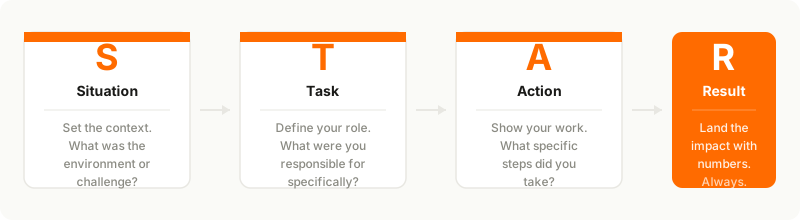
Connect PM behaviors to business outcomes explicitly. “Ran eight customer interviews” is activity. “Ran eight customer interviews that surfaced the insight leading to the pricing model change, which contributed to a 15% improvement in conversion” is impact. PMs who understand what their organization actually values — not just what it says it values — are able to direct their judgment toward the highest-leverage work. Good reviews teach that understanding.
How to Use These Phrases
For Managers
Use these as starting points, not final copy. PM phrases are especially dependent on specific examples — without a named initiative, decision, or customer insight attached, most of these phrases are indistinguishable from generic praise. Pair each phrase with the concrete evidence that earned it.
For Employees
Use these to understand the behavioral model your manager is working from when they evaluate you. If a phrase describes something you’ve done but haven’t articulated, you now have language for your self-assessment. If you see a Needs Development phrase that resonates, it is pointing at a specific skill gap with a specific growth direction — that is useful information.
Rating Level Guide
| Rating | What it means for Product Managers |
|---|---|
| Exceeds Expectations | Makes high-quality decisions with incomplete information, at a scope and complexity above their level. Shapes the team’s strategy, not just executes it. Cross-functional partners seek their input proactively. |
| Meets Expectations | Delivers a clear, well-reasoned roadmap and executes against it reliably. Runs credible discovery, communicates priorities effectively, and navigates stakeholder dynamics without escalation becoming the norm. |
| Needs Development | Struggles to make or defend prioritization decisions independently. Discovery work is insufficient to inform decisions. Stakeholder relationships are strained enough to impede delivery. |
Product Strategy & Vision Performance Review Phrases
Exceeds Expectations
- Consistently articulates a product strategy that connects team-level work to company-level goals in a way that is both coherent and compelling — cross-functional partners understand not just what the team is building but why it will matter.
- Proactively identifies emerging opportunities and risks in the product space before they become obvious, bringing well-reasoned proposals to leadership that reflect a genuine synthesis of customer insight, market signals, and technical constraints.
- Independently develops and defends a point of view on product direction even when organizational pressure favors the easier path — demonstrates the intellectual courage that distinguishes strategic thinking from sophisticated order-taking.
- Drives the team's OKR process in a way that creates genuine clarity about what success looks like and what trade-offs are being made — the team understands not just the goals but the reasoning behind them.
- Regularly builds and maintains a roadmap that reflects a coherent theory of how the product creates value over time, not just a prioritized list of feature requests organized by stakeholder volume.
Meets Expectations
- Maintains a roadmap that clearly reflects current priorities, is grounded in a defensible rationale, and is communicated to stakeholders at an appropriate level of detail for their role.
- Connects sprint and quarterly work to the team's stated strategy with sufficient clarity that engineers and designers understand the purpose behind what they are building.
- Engages thoughtfully with strategy discussions, contributing a product perspective that reflects customer insight and business context.
- Manages roadmap changes with appropriate communication — stakeholders are not surprised by pivots, and the reasoning behind changes is explained rather than announced.
Needs Development
- Would benefit from developing a more explicit strategic rationale for roadmap decisions — current prioritization is defensible on an item-by-item basis but doesn't consistently reflect a coherent theory of how the product creates long-term value.
- Is developing the ability to advocate for a product direction under pressure; currently tends to defer to the most recent strong opinion in the room rather than maintaining a position grounded in evidence and principle.
- Has shown improvement in roadmap communication but needs to build a stronger connection between team-level work and company-level goals — the "why it matters" layer is often underexplained to cross-functional partners.
Discovery & Customer Insight Performance Review Phrases
Exceeds Expectations
- Runs a discovery process that consistently surfaces non-obvious insights — goes beyond validating existing hypotheses to actively challenge assumptions, and brings findings to the team in a form that changes how the problem is framed.
- Proactively builds and maintains deep customer relationships that provide ongoing signal outside of formal research sprints, enabling the team to move faster and with more confidence than competitors who depend on periodic studies.
- Independently synthesizes qualitative and quantitative signals — Amplitude data, Figma prototype feedback, customer interviews, support trends — into a coherent picture of what the customer actually needs rather than what they say they want.
- Consistently ensures that discovery work is scoped and executed in proportion to the decision it informs — knows when a two-day spike is enough and when deeper investigation is warranted, and makes that call correctly.
- Drives a team culture of continuous discovery in which engineers and designers are active participants in understanding customers, not passive recipients of requirements — this creates faster feedback loops and higher-quality solutions.
Meets Expectations
- Conducts customer interviews and usability studies that are well-structured, appropriately scoped, and result in documented insights that inform product decisions.
- Uses Amplitude and product analytics to understand user behavior, identify drop-off points, and validate assumptions — decisions are grounded in data rather than intuition alone.
- Documents discovery findings in a form that is accessible to the team and can be referenced when decisions are questioned later.
- Regularly validates assumptions before committing significant engineering effort — the team does not frequently build features that discovery would have revealed as misaligned with customer needs.
Needs Development
- Would benefit from developing a more rigorous discovery practice — current decisions are often made on the basis of limited customer input, which has contributed to rework when assumptions proved incorrect.
- Is developing the skill of synthesizing multiple data sources into a coherent insight; currently tends to rely heavily on either qualitative feedback or quantitative data rather than triangulating between them.
- Has shown growth in conducting discovery but needs to build stronger habits around documentation — insights from research are sometimes shared verbally and then lost when decisions are revisited.
Execution & Delivery Performance Review Phrases
Exceeds Expectations
- Consistently writes specifications that are clear, complete, and precise enough that the engineering team can execute without recurring clarification requests — edge cases, error states, and acceptance criteria are addressed before they become blockers.
- Proactively identifies dependencies, risks, and sequencing issues in upcoming work, raising them early enough that the team can respond rather than react — sprint velocity is higher because surprises are rare.
- Drives delivery across complex, cross-team initiatives by maintaining clarity on the critical path, tracking dependencies actively in Jira, and escalating the right issues at the right level of urgency.
- Manages scope with genuine discipline — says no to additions that would compromise delivery quality or timeline, and explains those decisions in terms stakeholders find credible rather than merely disappointing.
- Delivers against commitments at a reliability level that builds trust with engineering and leadership alike — when this PM says something will ship, people believe it.
Meets Expectations
- Writes clear, complete product specs that provide engineers and designers with sufficient context to execute, including acceptance criteria and documented edge cases.
- Tracks delivery progress actively, identifies blockers promptly, and escalates when work is at risk before the risk becomes a miss.
- Manages sprint-level scope with appropriate rigor — the team is not regularly pulled off committed work by mid-sprint priority changes introduced without adequate justification.
- Coordinates release communication effectively — stakeholders know what is shipping, when, and what it means for them, without needing to chase the PM for updates.
Needs Development
- Would benefit from developing stronger spec discipline — engineering teams frequently need to return to the PM mid-sprint with clarifying questions that a more complete specification would have anticipated.
- Is developing the ability to manage delivery across complex initiatives; currently struggles to maintain visibility into dependencies and risks across multiple work streams simultaneously.
- Has shown progress in delivery communication but needs to build stronger habits around scope management — mid-sprint additions have contributed to timeline slippage and team frustration that earlier discipline would have prevented.
Stakeholder Management Performance Review Phrases
Exceeds Expectations
- Manages a complex stakeholder environment — including competing priorities from engineering, design, sales, and leadership — with a combination of transparency, principled trade-off communication, and genuine responsiveness that keeps relationships productive under pressure.
- Proactively aligns stakeholders before decisions are made, reducing the frequency of post-hoc escalations and ensuring that disagreements surface in planning rather than in production.
- Independently navigates organizational tension around product priorities, mediating between competing stakeholder needs without creating winners and losers who will relitigate the decision at the next opportunity.
- Builds credibility with engineering leadership through technical fluency and operational respect — engineers trust that this PM understands the cost of what they're asking for.
- Communicates roadmap changes with enough context and lead time that stakeholders can adjust their own plans, demonstrating respect for the downstream effects of product decisions on the broader organization.
Meets Expectations
- Keeps key stakeholders informed about product direction, decisions, and status at an appropriate cadence and level of detail.
- Navigates disagreements with stakeholders constructively, making the trade-offs explicit and reaching conclusions that most parties can accept even when they can't all get what they initially wanted.
- Builds functional working relationships with engineering, design, and go-to-market counterparts — collaboration is generally productive rather than adversarial.
- Manages upward effectively, providing leadership with the visibility needed to make resourcing and prioritization decisions without creating undue noise.
Needs Development
- Would benefit from developing a more proactive stakeholder communication rhythm — surprises at the stakeholder level are more frequent than they should be, and earlier communication would prevent many of them.
- Is developing the ability to navigate stakeholder conflict independently; currently tends to escalate disagreements rather than working through them at the working-team level, which consumes leadership bandwidth unnecessarily.
- Has shown growth in stakeholder relationships but needs to build stronger credibility with engineering — current interactions sometimes feel to engineers like requirements being handed down rather than a collaborative definition of the work.
Data-Driven Decision Making Performance Review Phrases
Exceeds Expectations
- Consistently defines success metrics before work begins and tracks them rigorously after launch — decisions about whether to continue, iterate, or kill a feature are grounded in evidence rather than intuition or organizational inertia.
- Proactively identifies measurement gaps in the product and works with engineering to close them — the team can answer questions about user behavior that competitors cannot, because this PM invested in instrumentation before it became urgent.
- Independently designs and interprets A/B tests in Amplitude with sufficient statistical rigor that results are trustworthy and the team can act on them with confidence.
- Brings data to disagreements in a way that advances the conversation rather than weaponizing it — uses evidence to inform judgment, not to win arguments at the expense of useful nuance.
- Drives a data-informed culture in which the team regularly questions its assumptions with evidence and updates its strategy based on what it learns, not just what it originally believed.
Meets Expectations
- Defines clear success metrics for initiatives before launch and monitors them actively after release, reporting results to stakeholders with appropriate context.
- Uses product analytics to identify usage patterns, drop-off points, and behavioral anomalies that inform prioritization and design decisions.
- Understands the basics of A/B testing and experimentation — can design a clean test, avoid common confounders, and interpret results without overstating confidence.
- Grounds roadmap prioritization in data where available, being transparent about where decisions are evidence-based versus judgment calls.
Needs Development
- Would benefit from developing stronger data fluency — current decisions are more frequently based on stakeholder input and intuition than on systematic analysis of user behavior, which makes it harder to defend prioritization choices with confidence.
- Is developing the habit of defining success metrics before work begins; currently tends to evaluate outcomes post-hoc, which makes it difficult to distinguish success from coincidence.
- Has shown interest in becoming more data-driven but needs to develop stronger skills in experimental design — current A/B tests occasionally have methodological issues that undermine confidence in the results.
How Prov Helps Build the Evidence Behind Every Review
The challenge with PM reviews is that the most important PM behaviors leave few artifacts. The customer insight that changed the roadmap direction lives in a Notion doc that nobody opened since the discovery sprint. The stakeholder conversation that prevented a three-month detour happened in a Slack thread that has since been archived. The judgment call that scoped the feature correctly — avoiding six weeks of engineering work on something users didn’t need — is invisible by definition. When review time comes, these contributions vanish, and what’s left is a feature list that could have been produced by any PM who attended the same sprint reviews.
Prov helps PMs capture these moments in real time — the rough note from the discovery interview that changed their thinking, the brief reflection after the stakeholder conversation that resolved the roadmap conflict. Raw notes get transformed into clear, polished achievement language, so when the review cycle opens, the evidence is already there. The PM who did the work gets credit for it. The reviewer can write specific, substantiated phrases instead of reaching for generalities.
Ready to Track Your Wins?
Free to start, no account, no sign-up. Available on the App Store now.
Download on iOS Free to start, no account needed