Operations managers solve problems so completely that the problems disappear from view. The self-assessment challenge is documenting the chaos that existed before you arrived — because without the before state, the after state looks like nothing happened.
Why Self-Assessments Are Hard for Operations Managers
Operations managers are in the business of making things invisible. A process working well generates no noise. A vendor relationship running smoothly produces no escalations. A team hitting its metrics creates no drama. The better you do your job, the less evidence there is that your job is hard — which makes documenting your impact in a performance review structurally difficult.
There’s also the breadth problem. An ops manager’s week might span renegotiating a vendor contract, debugging a reporting discrepancy in Tableau, resolving a team conflict, redesigning an intake workflow, and presenting quarterly metrics to an executive. The work is genuinely diverse, which makes it hard to build a coherent self-assessment narrative. You can end up with a list of activities that looks impressive in volume but weak in impact.
The improvement attribution challenge adds another layer. When you streamline a process, save costs, or reduce errors, the question is always: would this have happened anyway? Good ops managers ask that question about their own work, which leads to honest self-assessments that inadvertently minimize real contributions. The truth is that improvements don’t happen by themselves — someone designed the solution, drove the change, and sustained the new standard. That someone is you.
The goal: document the before state explicitly, quantify the after state precisely, and name the specific actions that bridged the gap.
How to Structure Your Self-Assessment
The Three-Part Formula
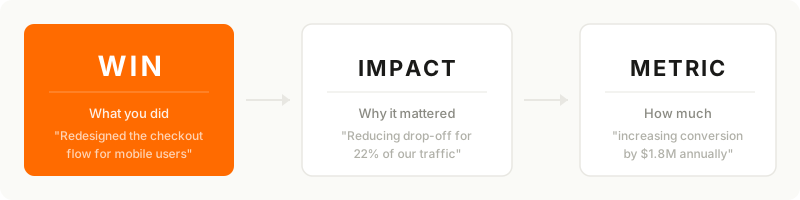
What I did → Impact it had → What I learned or what’s next
For operations managers, the “what I did” section must describe the problem you were solving, not just the solution you built. Reviewers need to understand what broken looked like before they can appreciate what fixed looks like.
Phrases That Signal Seniority
| Instead of this | Write this |
|---|---|
| "I improved our process" | "I redesigned the [specific process], reducing [cycle time / error rate / cost] from [X] to [Y] by [specific mechanism]" |
| "I managed the vendor relationship" | "I renegotiated our [vendor] contract, securing [N]% cost reduction while expanding SLA coverage, saving [$X] annually" |
| "I supported the team" | "I developed [specific capability] in [name/role] through [specific action], enabling them to [take on scope / own outcome] independently" |
| "I want to improve our reporting" | "I'm building real-time operational dashboards in Tableau by Q2 to replace our weekly manual reporting cycle, targeting [specific outcome]" |
Process Design & Improvement Self-Assessment Phrases
Workflow Redesign
- "I redesigned our client onboarding workflow, which had an average completion time of 14 days with a 22% error rate at handoff. By mapping every step, eliminating three redundant approval gates, and automating status notifications via Zapier, I reduced completion time to 6 days and the error rate to under 4%. The improvement freed approximately 8 hours of coordinator time per week."
- "I identified that our order fulfillment process had a manual reconciliation step that consumed 12 hours of team time each week and was the source of 80% of our customer-facing billing errors. I automated the reconciliation using a Google Sheets integration with our NetSuite instance, eliminating the manual step and reducing billing errors by 94% in the following quarter."
- "I audited our intake process across four business units and discovered that each had independently built a different workflow for the same function, creating inconsistency and making cross-unit reporting impossible. I designed a unified intake process and got buy-in from all four unit heads, implementing it over six weeks. Reporting accuracy improved from 68% to 97% within two months."
- "I introduced a weekly operational review cadence using a standardized Monday.com dashboard that replaced three separate ad-hoc reporting requests per week. Stakeholders get the information they need proactively, and my team's time spent on reactive reporting dropped from 6 hours to 45 minutes per week."
- "I built a process exception tracking system that captured every workflow deviation for 90 days, revealing that 30% of exceptions came from a single upstream step with unclear ownership. Fixing that step upstream eliminated the downstream exceptions entirely, removing a recurring source of rework that had persisted for over a year."
Automation & Systems
- "I implemented an automated escalation workflow using Zapier and Asana that routes overdue tasks to managers based on configurable aging rules. The system replaced a daily manual check-and-email process, saving 3 hours per week and reducing average escalation lag from 2.1 days to 4 hours."
- "I migrated our operations team from a spreadsheet-based task system to Monday.com, designing the board structure, automations, and reporting views myself to match our actual workflow rather than adapting our workflow to the tool. Adoption was 100% within three weeks and on-time task completion improved by 28% in the first month."
Team Management & Development Self-Assessment Phrases
Performance & Development
- "I restructured my team's role definitions to clarify ownership and eliminate a gap in our vendor management coverage that had caused two escalations in the prior quarter. The restructure also created a natural growth path that I used to promote one team member, improving retention in a role that had seen 60% turnover in the previous two years."
- "I ran structured monthly development conversations with each of my six direct reports, tied to specific skill goals they set at the start of the year. Four of the six met or exceeded their stated goals. One took on a cross-functional project lead role for the first time, and one completed an external certification I sponsored. I tracked all of this in individual development plans rather than leaving it to informal memory."
- "I identified that a high-performing team member was at attrition risk due to role stagnation and proactively expanded her scope to include vendor strategy ownership — a stretch assignment she'd indicated interest in. She stayed, and her engagement scores improved visibly in the next team pulse survey."
- "I rebuilt our team's onboarding documentation, reducing ramp time for new ops coordinators from 10 weeks to 5 weeks. The documentation is now detailed enough that the last two new hires achieved full independence without requiring the manager-intensive hand-holding that had been standard practice."
Team Culture & Capacity
- "I introduced a monthly retrospective practice for my team, creating a structured space to surface process friction and recognize wins. In six months, the team has self-identified and resolved 11 recurring pain points — improvements that previously would have required escalation or gone unaddressed because there was no formal mechanism to raise them."
- "I built a cross-training matrix for my team that ensures two people can cover every critical function. When a senior coordinator was unexpectedly out for three weeks, we maintained full service continuity with no escalations from stakeholders — an outcome that would have been impossible the year before."
Vendor & Resource Management Self-Assessment Phrases
Contract Negotiation
- "I led renegotiation of our three largest vendor contracts at renewal, approaching each with benchmark data I compiled from industry reports and competitor intelligence. I secured aggregate savings of $340K annually while maintaining or improving service levels. The methodology I used is now documented and will be applied to all future renewals."
- "I identified that we were paying for two overlapping software subscriptions — Asana and a legacy project management tool — that together cost $42K annually. I consolidated to Asana, negotiated an expanded seat count at a volume discount, and transitioned the legacy users over six weeks with no productivity disruption."
- "I introduced vendor scorecard reviews for our top five suppliers, creating quarterly performance data that gave us leverage in service conversations that had previously been entirely relationship-driven. In the first cycle, one vendor improved their SLA compliance from 78% to 94% within 90 days of receiving their scorecard."
Resource Allocation
- "I built our annual operating budget forecast using a bottoms-up model in Google Sheets tied to headcount assumptions and volume projections, replacing the prior year's top-down estimate approach. The forecast came in within 3% of actual spend — a meaningful improvement over the 18% variance the year before — and gave us the credibility to ask for additional headcount mid-year."
- "I identified $180K of underutilized software licenses across our department by auditing login frequency data from our SSO provider. I eliminated the unused licenses and reallocated the budget to tooling the team had been requesting for two quarters."
Metrics & Reporting Self-Assessment Phrases
Dashboard & Reporting Infrastructure
- "I built a real-time operational dashboard in Tableau that replaced a weekly manual report that took three hours to compile and was consistently 5 days stale by the time it reached stakeholders. The dashboard is now the standard weekly business review artifact for two executives, and we've reduced our reporting-related meeting time by 40 minutes per week."
- "I designed a metrics framework for our operations function that tied team activities to business outcomes for the first time. Previously we tracked activity metrics (tickets closed, vendor calls made) with no line to results. The new framework tracks unit economics and quality alongside volume, giving leadership a much clearer picture of operational efficiency."
- "I partnered with the data team to build a SQL-based reporting layer that pulls directly from our Salesforce and NetSuite instances, eliminating the manual data export and join process that had been our only reporting method. Report refresh time went from 4 hours to 15 minutes, and we eliminated a class of errors caused by mismatched manual exports."
- "I established leading-indicator metrics for our team that provide early warning of capacity stress before it affects output quality. Using these indicators, I identified a volume surge six weeks before it hit, giving us time to cross-train and adjust staffing — avoiding what would have been a service degradation event."
Analysis & Insights
- "I ran a root cause analysis on our top 20 customer escalations from the prior year and identified that 65% traced to a single miscommunication point in our handoff process. I redesigned that handoff and tracked the escalation rate in the following two quarters — it dropped by 58%, validating the root cause hypothesis."
- "I presented a quarterly operations review to the leadership team that went beyond status reporting to include trend analysis and a forward-looking capacity model. The presentation prompted a decision to hire one additional FTE that I had been requesting informally for two quarters but had not been able to get approved through informal channels."
Cross-functional Collaboration Self-Assessment Phrases
Stakeholder Management
- "I served as the operations lead for a cross-functional initiative involving sales, finance, and customer success, facilitating weekly working sessions and maintaining a shared decision log that gave all stakeholders visibility into progress and blockers. The project delivered on time despite a mid-project scope change that would have derailed it without active coordination."
- "I built a service catalog for the operations team — a plain-language document describing what ops does, how to request it, and what to expect — that reduced the volume of misdirected requests by 35% in its first two months. It also improved cross-functional satisfaction scores in our internal NPS survey."
- "When finance and operations had conflicting data on departmental spend, I initiated a joint reconciliation project that surfaced a categorization mismatch in our Salesforce-to-NetSuite integration. Resolving it gave both teams consistent data for the first time in 18 months and eliminated a recurring source of friction in quarterly business reviews."
- "I proactively flagged a resource conflict to the product team four weeks before it would have caused a scheduling crisis, proposing a phased approach that met both teams' core needs. The early flag and solution-forward approach preserved the relationship and delivered a better outcome than either team had originally planned independently."
Strategic Projects Self-Assessment Phrases
Organizational Change
- "I led the operational integration of a newly acquired business unit, designing the integration plan, managing the transition timeline, and owning stakeholder communication across three departments. The integration completed two weeks ahead of schedule and under budget, with zero disruption to customer service levels during the transition."
- "I drove a company-wide tool consolidation that reduced our SaaS stack from 14 operational tools to 9, saving $95K annually and meaningfully reducing the cognitive overhead of context-switching for the team. I managed the transition over four months, including data migration, training, and a 30-day parallel-run period that ensured no data was lost."
- "I designed and implemented our business continuity plan for operations — a gap that had existed since the company's founding. The plan includes documented runbooks, cross-trained backups for every critical role, and a tested communication protocol. When we had an unplanned team absence in Q3, we executed the plan successfully with no external visibility."
- "I identified an opportunity to outsource our tier-1 vendor support triage to a managed service, built the business case, and managed the vendor selection process. The arrangement saved 1.2 FTE-equivalents of internal time annually while improving response SLAs, and the business case I wrote became a template for two subsequent outsourcing evaluations."
How Prov Helps Operations Managers Track Their Wins
Operations work is episodic and wide-ranging — a renegotiated contract, a process redesign, a team member’s promotion, a crisis quietly averted. Without a consistent capture habit, the diversity of the work becomes a liability at review time: you have a rough memory of dozens of things but a clear narrative for almost none of them.
Prov captures wins in 30 seconds at the moment they happen, before the context that makes them legible disappears. A quick voice note — “finished vendor renegotiation, saved $340K, down from $480K, used benchmark data I built from scratch” — becomes a polished self-assessment statement that includes the before state, the mechanism, and the outcome. Over a year, that habit builds a comprehensive record of everything you’ve improved, fixed, and built — ready to structure into a performance review that makes the invisible visible. Prov is coming soon on iOS.
Ready to Track Your Wins?
Free to start, no account, no sign-up. Available on the App Store now.
Download on iOS Free to start, no account needed