"Improved the process" is not a performance review phrase. The before-state makes the after-state legible. Without it, operations work is invisible work.
How to Write Effective Operations Manager Performance Reviews
Operations manager reviews suffer from a documentation problem that is somewhat unique to the function: the best operations work eliminates problems so thoroughly that nobody remembers the problem existed. When an operations manager redesigns a fulfillment workflow and the team stops having the escalations that used to consume every Monday morning, the absence of those escalations is the proof of performance — and absence is hard to document. This is why operations reviews that say “improved the process” are almost always underselling the work. The review needs to capture what was broken, what it cost, what changed, and what it costs now.
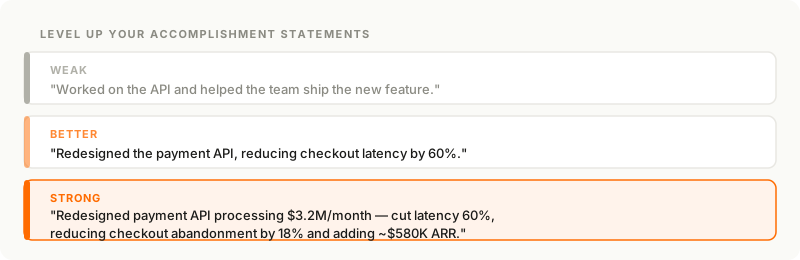
The before-state is the most important sentence in any operations review phrase. “Reduced cycle time by 30%” is a data point. “Reduced cycle time from eleven days to eight days — a level that had been causing customers to cancel orders in the gap — resulting in a 12% reduction in order abandonment” is a performance review phrase. The before-state establishes that the problem was real. The after-state establishes that it was solved. The outcome establishes that solving it mattered.
Team management in operations is also underrepresented in reviews that focus on process outcomes. An operations manager who builds a team that can execute reliably without constant direction, who develops the people under them into promotable contributors, who creates a culture where problems surface upward before they escalate outward — that is a different level of management than one who personally solves every issue that reaches their desk. Reviews should distinguish between the two, and doing so requires specific evidence about how the team was developed, not just what the team delivered.
For employees: when writing your self-assessment, the pattern is: before-state (what was the cost, duration, error rate, or frequency of the problem), your action, after-state (the new number), and business impact (what became possible because of the improvement). If you cannot fill in all four parts, you have the start of a phrase, not a complete one. Prov helps you capture all four while the context is fresh.
How to Use These Phrases
For Managers
These phrases require the before-state to be effective. Before writing any operations review phrase, ask: what was the metric before, and what is it now? If you do not know, that is an information gap worth closing with your direct report before finalizing the review. An operations manager who cannot quantify the before-state of the problems they solved has either not solved the right problems or has not tracked the right metrics — both of which are useful pieces of feedback.
For Employees
Operations managers often undersell because the work is systemic rather than individual. “The team delivered X” is accurate but incomplete — your contribution was designing the system that enabled the team to deliver X reliably. Own that contribution explicitly in your self-assessment. These phrases model the language for doing that without overclaiming.
Rating Level Guide
| Rating | What it means for Operations Managers |
|---|---|
| Exceeds Expectations | Measurably improved operational performance with documented before-and-after; team is stronger because of this manager’s development investment; cross-functional partners actively seek this manager’s involvement |
| Meets Expectations | Operations run reliably within established parameters; team is managed well; metrics are tracked and communicated; vendors are managed to contract |
| Needs Development | Operational metrics have not improved or have declined; team management requires escalation more often than expected; process ownership is reactive rather than proactive |
Process Design & Improvement Performance Review Phrases
Exceeds Expectations
- Redesigned the customer onboarding process from a fourteen-step manual workflow to a six-step semi-automated sequence using Zapier and Google Sheets, reducing average onboarding time from eleven days to four and eliminating the most common source of customer escalations in the first ninety days.
- Identified and eliminated a manual data reconciliation step that consumed twenty-two hours per week across the operations team, building an automated alternative in Google Sheets that completed the same work in under thirty minutes daily.
- Led an end-to-end order fulfillment process review using process mapping in Monday.com, identified seven handoff points creating delay and error risk, and redesigned the workflow to reduce order error rate from 6.2% to 1.1% within sixty days of implementation.
- Built a standard operating procedure library covering forty-three core operations workflows, reducing new hire onboarding time by three weeks and enabling consistent execution across two shift teams that had previously operated with significant variation.
- Designed a capacity planning model in Google Sheets that gave the operations team two-week visibility into resource demand, reducing reactive overtime spending by 34% in the second half of the year.
Meets Expectations
- Managed owned operational processes reliably throughout the year, maintaining performance within target ranges and addressing issues before they escalated to senior leadership.
- Contributed meaningfully to process improvement initiatives, bringing operational expertise to design discussions and implementing agreed changes effectively within the team.
- Documented core process changes promptly as they were implemented, maintaining the operations team's SOP library as a current and usable resource.
- Identified improvement opportunities in owned processes and escalated them with supporting context, enabling management to prioritize and resource improvement work effectively.
Needs Development
- Owned processes have not shown measurable improvement over the review period; committing to tracking two or three key process metrics monthly and setting explicit improvement targets would create the visibility and accountability needed to drive meaningful change.
- Process improvement ideas are raised verbally but rarely documented or followed through; using Monday.com or Asana to track improvement initiatives from identification to implementation would improve conversion from idea to outcome.
- Current processes rely heavily on tribal knowledge rather than documented procedure; prioritizing SOP documentation for the five highest-risk processes would reduce key-person dependency and improve execution consistency across the team.
- Process changes have sometimes been implemented without sufficient stakeholder communication, creating confusion downstream; adding a communication step to the change management checklist before rollout would improve adoption and reduce friction.
Team Management Performance Review Phrases
Exceeds Expectations
- Developed two operations coordinators into fully autonomous process owners who now manage their respective workflows with minimal oversight, creating team capacity that enabled the operations function to absorb a 40% volume increase without adding headcount.
- Built a team culture of proactive problem escalation where issues are surfaced to management before they become customer-facing, measurably reducing the number of escalations that reached the VP level compared to the prior year.
- Designed a structured onboarding program for operations team members that reduced time-to-full-productivity from twelve weeks to six, enabling faster team expansion to meet business growth without sacrificing execution quality.
- Identified and developed a high-potential team member who had been performing below their potential due to misaligned role responsibilities, redesigned their scope, and delivered a contribution that resulted in their promotion at mid-year review.
- Created a weekly team operational review cadence that gave every team member visibility into cross-team performance, building the shared context that enabled faster problem-solving and reduced the number of issues that required manager involvement to resolve.
Meets Expectations
- Managed a team of operations professionals effectively throughout the year, maintaining high performance standards, providing consistent feedback, and supporting team members' development goals.
- Addressed performance issues within the team promptly and constructively, managing the improvement process clearly and fairly without requiring HR escalation.
- Built a reliable team that executed operational responsibilities consistently, with performance metrics within target ranges and stakeholder satisfaction maintained throughout the year.
- Conducted regular one-on-ones with all direct reports, providing development-focused coaching alongside operational direction and maintaining team engagement through a period of significant change.
Needs Development
- Team performance issues have been addressed later than the situation warranted on several occasions; developing a personal framework for recognizing early performance signals and initiating coaching conversations sooner would improve team outcomes and make the management role more effective.
- Team development conversations have been infrequent relative to the team's stated career development interests; establishing a consistent monthly cadence of development-focused one-on-ones would improve retention risk and build the team's long-term capability.
- Delegation has been inconsistent — some team members report limited autonomy while others report unclear ownership; clarifying responsibility and decision-making boundaries for each role would improve both execution consistency and team engagement.
Vendor & Resource Management Performance Review Phrases
Exceeds Expectations
- Renegotiated the primary logistics vendor contract at renewal, incorporating SLA performance data collected over twelve months in Tableau to support a rate reduction of 8% and the addition of performance penalties for recurring delays that had been costing the business $40K annually.
- Identified a vendor concentration risk in the supply chain, developed an approved second-source strategy with two qualified alternatives, and executed a transition for one critical component that reduced single-vendor dependency before a supply disruption occurred.
- Designed a vendor scorecard framework in Google Sheets that gave the operations team a consistent, data-driven basis for quarterly vendor reviews, improving both the quality of vendor conversations and the business's ability to hold suppliers accountable to SLA commitments.
- Managed a complex multi-vendor onboarding for a new fulfillment center, coordinating six vendors across logistics, technology, and facilities workstreams and delivering the facility to operational readiness two weeks ahead of the contracted timeline.
- Built a resource utilization model in Salesforce and Google Sheets that improved capacity planning accuracy by 28%, reducing both under-staffing escalations and the idle time that had been creating unnecessary labor cost variance.
Meets Expectations
- Managed all vendor relationships to contracted SLA standards throughout the year, escalating performance issues with documented evidence and achieving resolution without requiring executive involvement.
- Maintained vendor scorecards and conducted regular performance reviews for all managed vendors, providing leadership with accurate visibility into the health of key supplier relationships.
- Managed resource allocation within budget for the year, making effective trade-offs between competing demands and communicating resource constraints to stakeholders proactively.
- Completed vendor contract renewals on time and with appropriate market comparison research, avoiding automatic renewals on unfavorable legacy terms.
Needs Development
- Vendor performance issues have been accepted rather than escalated in several cases, allowing below-SLA service to continue without formal consequence; establishing a personal practice of logging vendor performance against contract and initiating formal escalation after two consecutive SLA misses would change this dynamic.
- Resource planning has been reactive rather than forward-looking, leading to several instances of short-notice resource requests that created cost and scheduling pressure; building a twelve-week resource demand forecast and reviewing it weekly would improve predictability significantly.
- Vendor contract terms are not always well-understood before they become relevant in a dispute; scheduling a quarterly review of key vendor contracts with the legal or procurement team would build the contract fluency needed to manage these relationships more effectively.
Metrics & Reporting Performance Review Phrases
Exceeds Expectations
- Designed and implemented an operations metrics framework covering eight key performance indicators that gave leadership weekly visibility into operational health for the first time, replacing a monthly retrospective reporting cycle with a real-time monitoring capability in Tableau.
- Identified a correlation between a leading indicator metric and customer escalation volume that the operations team had not previously tracked, enabling proactive intervention that reduced customer escalation incidents by 29% in the second half of the year.
- Built a weekly operations digest for cross-functional partners in Google Sheets that reduced ad-hoc reporting requests to the operations team by 40% by proactively surfacing the information those teams most frequently requested.
- Developed a SQL-based operational reporting suite that automated the weekly metrics package, reducing the time the team spent on reporting preparation from six hours to forty-five minutes and improving data accuracy by eliminating manual aggregation steps.
- Established SLA tracking for all major operational workflows, creating the measurement foundation needed to have credible vendor and team performance conversations and to demonstrate operational improvement quantitatively in business reviews.
Meets Expectations
- Maintained accurate operational metrics for all owned functions and reported them consistently to stakeholders on the agreed cadence, with no lapses in reporting reliability throughout the year.
- Used operational data effectively to support decision-making within the team, presenting metric-informed recommendations to leadership and escalating data-supported concerns before they became crises.
- Built and maintained operational dashboards in Tableau and Google Sheets that gave the team and their stakeholders useful, accurate visibility into performance against targets.
- Responded to ad-hoc data and reporting requests from cross-functional partners with well-structured outputs that answered the question asked without requiring follow-up clarification.
Needs Development
- Operational reporting has been inconsistent in frequency and format, making it difficult for leadership to track performance trends; establishing a fixed reporting cadence and a consistent template would improve the reliability and usefulness of this function significantly.
- Key operational metrics are not currently tracked, meaning that improvement claims cannot be substantiated with data; identifying the three to five metrics that most directly reflect the health of owned operations and beginning to track them immediately is a near-term priority.
- Metric definitions have varied between reporting cycles, creating confusion about whether changes in reported numbers reflect real performance changes or measurement changes; standardizing metric definitions in a shared document would improve the credibility and comparability of operational reporting.
Cross-functional Execution Performance Review Phrases
Exceeds Expectations
- Led the operational workstream of a company-wide systems migration, coordinating twelve dependencies across product, engineering, finance, and customer success teams and delivering the operations cutover on schedule with zero customer-facing incidents.
- Identified a handoff breakdown between the sales and operations teams that was causing a 48-hour delay in contract activation, designed and implemented a shared Monday.com workflow that eliminated the gap and reduced activation time by 60%.
- Built the operations function's first formal cross-functional communication rhythm — a biweekly sync with product, customer success, and logistics — that reduced the number of inter-team issues requiring escalation by creating a reliable forum for early identification and resolution.
- Served as the operations lead on a product launch team, contributing operational readiness planning and risk assessment that identified three go-live risks the product team had not modeled, enabling mitigations that prevented launch-day capacity failures.
- Translated a complex operational constraint into a business impact model that gave the executive team the context to make a resourcing decision they had been deferring for two quarters, unblocking a strategic initiative that operations capacity had been holding back.
Meets Expectations
- Collaborated effectively with cross-functional partners throughout the year, representing the operations function clearly, following through on cross-team commitments, and escalating dependency risks before they became blockers.
- Participated constructively in cross-functional project teams, contributing operational expertise to planning discussions and executing operational workstreams reliably without requiring external coordination overhead.
- Maintained productive working relationships with key internal partners — product, finance, customer success — and served as a reliable operational point of contact for those teams throughout the year.
- Communicated operational constraints and capacity limitations to cross-functional partners proactively, enabling other teams to adjust plans before operational bottlenecks became customer-facing issues.
Needs Development
- Cross-functional relationships are largely reactive — other teams engage the operations function when a problem has already occurred; developing a proactive relationship cadence with the two or three teams most dependent on operations would shift this dynamic and improve early problem identification.
- Cross-team commitments have not always been tracked or followed up on, creating friction with partner teams; building a personal habit of logging cross-functional commitments and their deadlines in Asana or Monday.com would improve reliability and cross-team trust.
- Operational constraints are sometimes communicated to cross-functional partners after plans have already been made rather than during planning; joining key planning discussions earlier — even in a listening capacity — would give operations the opportunity to flag constraints before they become blocking issues.
How Prov Helps Build the Evidence Behind Every Review
Operations work has a compounding documentation problem: the wins are systemic, the before-states are forgotten, and the value only becomes visible when you lay the before and after numbers side by side. The manager who redesigned the onboarding workflow remembers that onboarding used to be painful — but six months later, the specific numbers are gone. Was it twelve days before? Fourteen? What was the abandonment rate? Without those numbers, “reduced onboarding time significantly” is the best you can write, and it sells the work short.
Prov is a career achievement capture app that helps operations managers document the before-state in real time — at the moment of discovery, before the fix makes it easy to forget what was broken. When you identify that a process is costing twenty-two hours per week, open Prov and capture that number. When you implement the fix and see the first week’s results, capture those too. Prov transforms rough notes into polished achievement statements with context and impact preserved. By review time, you have the before-and-after evidence that makes operations performance legible — and credible.
Ready to Track Your Wins?
Free to start, no account, no sign-up. Available on the App Store now.
Download on iOS Free to start, no account needed