Ready-to-use operations manager accomplishment examples organized by competency — process improvement, team leadership, cost management, cross-functional coordination, vendor management, and data-driven decisions.
Why Operations Managers Struggle at Performance Review Time
Operations managers run the engine of the business — and that's exactly the problem. When everything is running smoothly, it's invisible. The warehouse ships on time, the vendor delivers, the team hits SLA, the budget closes clean. Leadership notices the engine only when it breaks down. Which means a great year of operational execution can look, from the outside, like nothing happened.
The other challenge is scope. Operations managers touch everything: people, vendors, systems, budgets, processes, cross-functional projects. That breadth is a strength, but it makes the role hard to narrate. At review time, it's tempting to list everything you managed instead of articulating the specific decisions and improvements that made the operation measurably better than it was a year ago.
And then there's the complexity of attribution. Process improvements compound over time — the workflow you redesigned in March delivered efficiency gains every month through December, but you only captured the win once in Q1 and moved on. The cost savings from a vendor renegotiation are sitting in Finance's spreadsheet, not in yours. The reliability improvement you drove shows up as reduced incident tickets for the engineering team, not in any metric that follows you into your review.
The examples below give you the language to document operational impact in terms that reviewers recognize: speed, cost, quality, reliability, and organizational capacity.
What gets you promoted are documented accomplishments with measurable impact.
Operations Manager Accomplishment Categories
| Competency | What Reviewers Look For |
|---|---|
| Process Improvement & Efficiency | Do you make operations faster, leaner, and more reliable? |
| Team Leadership & Performance | Do you build and run high-performing teams? |
| Cost Management & Budgeting | Do you control and optimize spend without sacrificing output? |
| Cross-functional Coordination | Do you keep complex operations aligned across teams? |
| Vendor & Supplier Management | Do you extract full value from external relationships? |
| Data, Metrics & Reporting | Do you use data to drive decisions and surface risk early? |
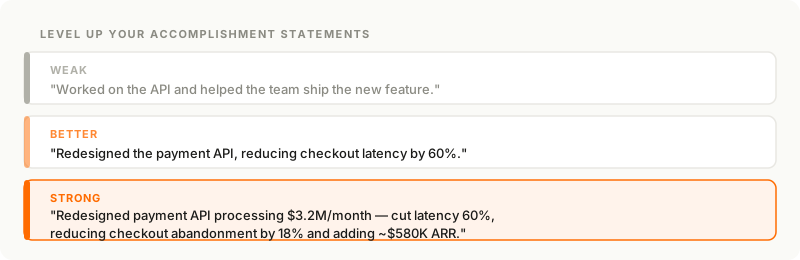
Process Improvement & Efficiency Accomplishments
Process Redesign
- "Redesigned the order fulfillment workflow by eliminating 4 redundant handoff steps — reduced average processing time from 3.2 hours to 1.1 hours per order, increasing daily throughput capacity by 65% without adding headcount."
- "Mapped and rebuilt the customer onboarding process end-to-end — reduced time-to-first-value from 14 days to 6 days, contributing to a 22% improvement in 30-day retention for the cohort onboarded post-launch."
- "Identified a bottleneck in the invoice approval process through a process audit — reduced average invoice processing time from 11 days to 3 days by redesigning the approval matrix and introducing parallel routing for invoices under $10K."
- "Consolidated 3 overlapping internal request workflows into a single intake system — eliminated an estimated 6 hours per week of duplicated coordination work across the operations team."
- "Implemented a standard operating procedure library for the 12-person operations team — reduced error rate on recurring tasks from 8.4% to 1.7% within 60 days of launch and cut new-hire onboarding time by 3 weeks."
- "Led a process improvement sprint across the logistics operation using lean methodology — identified and eliminated $180K in annual waste through 3 targeted improvements to receiving, putaway, and outbound checking."
- "Redesigned the returns processing workflow — reduced average time-per-return from 22 minutes to 9 minutes, enabling the team to process 140% more returns daily with the same staffing level."
- "Standardized quality control checkpoints across 5 production lines — defect rate dropped from 3.1% to 0.8% and customer complaint volume decreased by 44% in the following quarter."
Automation & Tooling
- "Automated the weekly operational reporting pack using Python scripts connected to the HRIS and ERP — reduced manual reporting effort from 8 hours per week to 20 minutes and eliminated copy-paste errors that had caused 2 major data discrepancies in the prior year."
- "Implemented a ticket routing automation in Zendesk that categorized and assigned 84% of incoming requests without human intervention — freed 12 hours per week of tier-1 support capacity for higher-complexity work."
- "Deployed an inventory forecasting tool that integrated with the existing ERP — reduced stockouts by 67% and overstock incidents by 41% in the 6 months following implementation."
- "Built a Zapier-based workflow that automated new employee equipment provisioning notifications — reduced average provisioning delay from 3.8 days to same-day for standard setups, and eliminated a recurring source of new-hire complaints."
- "Led the RFP, selection, and implementation of a new project management platform for the 35-person operations team — reduced status update meetings by 40% and improved on-time project delivery from 61% to 84% within one quarter."
- "Automated the month-end close checklist using a workflow tool, with automated reminders and status tracking — reduced close cycle time from 9 days to 5 days and eliminated 2 recurring audit findings."
Team Leadership & Performance Accomplishments
Team Development
- "Built a 14-person operations team from 8 over 18 months, hiring 6 net-new roles and restructuring 3 existing ones to match evolving business needs — team throughput increased 90% over the same period without proportional headcount growth."
- "Reduced new-hire ramp time from 10 weeks to 6 weeks by building a structured onboarding program with role-specific shadowing plans, competency checklists, and a peer buddy system."
- "Developed 2 operations coordinators into team lead roles within 12 months through a structured development track — promoted both internally, avoiding 2 external leadership hires and an estimated $60K in recruiting spend."
- "Launched a weekly skills rotation program for a 20-person operations team — cross-training coverage improved from 1.4 backups per role to 3.1 backups per role, eliminating single points of failure on 8 critical workflows."
- "Reduced team attrition from 31% to 14% over 12 months by implementing monthly stay interviews, redesigning the career ladder, and addressing 4 systemic scheduling issues surfaced through direct feedback."
- "Grew team engagement score from 3.6 to 4.4 on a 5-point scale in one annual cycle by increasing role clarity, introducing a formal recognition program, and restructuring weekly team meetings to include a wins review."
Performance & Accountability
- "Implemented a daily performance dashboard visible to all team members — SLA compliance improved from 78% to 94% within 60 days as teams gained real-time visibility into their own metrics."
- "Introduced a structured 1:1 cadence with 8 direct reports focused on goals, blockers, and development — reduced escalations to me by 35% as team members resolved more issues independently."
- "Managed a performance improvement process for 3 team members in 12 months — 2 successfully met the defined performance standard, 1 exited cleanly with no HR escalation."
- "Redesigned team KPIs to align individual performance to business outcomes rather than activity metrics — accuracy, speed, and customer satisfaction scores all improved within one quarter of the change."
- "Built a shift handoff protocol that reduced the number of issues dropped between shifts from an average of 11 per week to 2 per week — tracked via a shared handoff log reviewed in daily standup."
- "Coached 4 shift supervisors on structured feedback delivery — team-level performance conversations became a consistent practice rather than a compliance exercise; subsequent engagement survey showed 28% improvement in "my manager helps me grow" scores."
Cost Management & Budgeting Accomplishments
Cost Reduction
- "Identified $340K in annualized cost savings across the operations budget through a zero-based budgeting exercise — eliminated 2 unused SaaS contracts, renegotiated 3 vendor agreements, and consolidated 4 logistics carriers into 2 preferred vendors."
- "Reduced overtime spend by $120K annually by redesigning shift scheduling using 6 months of demand data — reduced unplanned overtime from 18% of total labor hours to 6% without impacting service levels."
- "Implemented a competitive re-bid process for facilities services contracts — switched 2 providers and renegotiated a third, reducing combined annual spend by $88K while maintaining or improving service quality."
- "Reduced waste disposal costs by 37% by introducing a materials sorting program and switching to a specialized recycling vendor — combined savings of $42K per year with no capital investment."
- "Audited the team's software subscriptions and identified 14 redundant licenses across 5 tools — consolidated to 3 tools, saving $31K annually and reducing the team's tool fragmentation."
- "Negotiated a volume discount with the primary supply vendor by consolidating orders across 3 cost centers — reduced per-unit cost by 11% and lowered average monthly supply spend by $18K."
Budget & Forecasting
- "Delivered the operations budget within 2% of forecast for 3 consecutive years — introduced a rolling 13-week cash flow view and a monthly variance review that caught and corrected 4 budget deviations before they became overruns."
- "Rebuilt the annual budgeting model from scratch after taking over a function with no documented assumptions — created a driver-based model that reduced the time to produce the annual budget from 6 weeks to 10 days."
- "Identified a $210K budget variance in Q3 caused by an untracked vendor price escalation — caught it 8 weeks before year-end, reallocated from discretionary spend, and closed the year within approved budget."
- "Developed a capital expenditure proposal and business case for a $1.2M facility upgrade — model was approved by the CFO and board; project delivered on time and 3% under the approved budget."
- "Introduced a monthly budget review with all operations team leads — reduced budget surprises at quarter-end by 80% and improved accountability for departmental spend across 4 cost center owners."
Cross-functional Coordination Accomplishments
Stakeholder Alignment
- "Served as the primary liaison between operations and product during a 6-month platform migration — translated technical requirements into operational impact assessments and coordinated readiness across 4 teams, resulting in a zero-downtime cutover."
- "Established a monthly operations-sales alignment meeting that reduced order management escalations by 52% by giving sales earlier visibility into fulfillment constraints and lead time changes."
- "Partnered with the finance team to redesign the purchase order approval workflow — reduced average approval time from 8.3 days to 2.1 days and eliminated a recurring source of vendor payment delays."
- "Led a cross-functional task force of 7 stakeholders to resolve a recurring quality issue that had been escalated 3 times without resolution — diagnosed root cause in 2 weeks and implemented a fix that reduced the defect rate by 91%."
- "Created an operational readiness checklist used by all new product launch teams — reduced average time to operationalize a new product from 11 weeks to 6 weeks and eliminated 3 recurring categories of post-launch operational issues."
Project Coordination
- "Managed a 9-month office relocation for 200 employees — delivered on schedule, $40K under budget, and with no operational downtime during the transition; post-move employee satisfaction with workspace improved from 52% favorable to 79% favorable."
- "Coordinated a 12-team ERP implementation across 4 departments — program delivered 2 weeks ahead of schedule by implementing a weekly risk review cadence that surfaced and resolved 8 blockers before they impacted the critical path."
- "Ran a quarterly business continuity tabletop exercise involving operations, IT, and legal — exercise identified 3 gaps in the BCP that were remediated before the following year's audit."
- "Managed the operational workstream of a company acquisition integration — completed systems migration, process harmonization, and team reorganization for a 35-person acquired operations team within 90 days of close."
- "Introduced a project status reporting standard across 6 concurrent operations initiatives — eliminated 4 redundant status meetings per week and gave leadership a single view of project health across the portfolio."
Vendor & Supplier Management Accomplishments
Contract & Negotiation
- "Renegotiated the primary logistics contract at renewal — secured a 14% rate reduction, improved SLA terms, and added a quarterly business review clause; estimated savings over the 3-year term are $420K."
- "Ran a competitive RFP for the company's largest recurring services contract — evaluated 6 vendors, selected a new provider, and managed the transition with zero service disruption; new contract was 19% lower cost than the incumbent."
- "Consolidated 8 spot vendors for packaging materials into 2 preferred suppliers with master service agreements — reduced average unit cost by 9% and eliminated $28K in annual administrative overhead from managing multiple vendor relationships."
- "Identified a contract auto-renewal clause that was 60 days from triggering on an underperforming vendor — intervened to renegotiate terms, saving $65K in committed spend that would have been locked in for 24 months."
- "Structured a preferred vendor agreement that included volume commitments in exchange for priority allocation during supply shortages — secured supply continuity through a 6-week industry-wide shortage that impacted 3 competitors."
Vendor Performance
- "Implemented a vendor scorecard system tracking 6 performance dimensions for 11 active vendors — identified 2 chronic underperformers within 90 days; initiated remediation plans for both and replaced 1 vendor that failed to improve within the agreed timeframe."
- "Reduced vendor-caused SLA misses by 61% over 12 months by introducing weekly performance reviews for the 3 highest-impact vendors and establishing escalation paths for recurring issues."
- "Managed a critical vendor failure mid-contract — stood up an alternative supplier within 72 hours, maintained customer SLAs with no breaches, and documented the incident to support a successful penalty claim against the defaulting vendor."
- "Built a vendor onboarding playbook that reduced the time to activate a new supplier from 6 weeks to 2.5 weeks — includes compliance documentation, system integration checklist, and a 30-day performance baseline review."
- "Ran a quarterly vendor business review program for the top 5 vendors by spend — surfaced 3 innovation proposals from vendors that were implemented and contributed an estimated $75K in combined annual savings."
- "Conducted a vendor risk audit across 18 active suppliers — identified 4 single-source dependencies with no documented backup and built contingency plans for all 4 within one quarter."
Data, Metrics & Reporting Accomplishments
Dashboards & Reporting
- "Built the operations team's first real-time performance dashboard in Tableau — consolidated 11 previously separate spreadsheet reports into one view; reduced leadership's data request volume by 70% and enabled faster daily decision-making."
- "Designed a daily operations briefing report for the VP of Operations — distilled 8 data sources into a 1-page summary; briefing time dropped from 30 minutes to 8 minutes per day, and the format was adopted company-wide within 3 months."
- "Automated the weekly KPI report using a SQL query connected to the operational database — eliminated 5 hours of manual data aggregation per week and reduced reporting errors from an average of 3 per month to 0."
- "Created a customer-facing SLA performance report shared monthly with 12 key accounts — reduced SLA dispute volume by 40% by giving customers transparent access to their own metrics before complaints arose."
- "Migrated the operations reporting stack from Excel to a cloud BI tool — 6 dashboards now auto-refresh daily; total reporting maintenance time for the team dropped from 14 hours per week to 3 hours."
KPI Management
- "Defined the first formal KPI framework for the 40-person operations team — established 12 leading indicators tied to business outcomes, set targets, and created a review cadence; 9 of 12 KPIs hit target within the first 6 months."
- "Used cycle time data to identify that a single step in the fulfillment process accounted for 38% of total lead time — isolated and fixed that step, reducing end-to-end cycle time by 29% with no process-wide redesign required."
- "Identified through trend analysis that SLA compliance was degrading 3–4% each month during peak season — built a surge capacity model and pre-scheduled contingent labor 6 weeks ahead; SLA compliance held above 95% through the peak period for the first time in 3 years."
- "Analyzed 18 months of incident data and identified that 62% of operational disruptions originated from 3 root causes — targeted process fixes for all 3; incident frequency dropped by 48% in the following 6 months."
- "Built a cost-per-unit metric for the first time in the operations function — data revealed that one product category was 40% more expensive to process than others at comparable volume; operational design change reduced that gap to 12% within one quarter."
- "Developed a leading indicator scorecard that predicted weekly output within 5% accuracy based on prior-week inputs — used by the team to adjust staffing proactively rather than reactively, reducing overstaffing costs by $22K per quarter."
How to Adapt These Examples
Plug In Your Numbers
Every example above follows: [Action] + [Specific work] + [Measurable result]. Replace the numbers with yours. If your process change reduced cycle time from 4 hours to 90 minutes, use those numbers. If your vendor renegotiation saved $50K, use that figure. If you hit 91% SLA compliance, use 91%. The structure is the template — your actuals are what make it credible.
Don't Have Numbers?
Operations roles generate data constantly, but not all of it is captured at the accomplishment level. For process improvements, try to establish a before-and-after measurement even if it's informal: time a sample of tasks before and after the change, pull a ticket count from your helpdesk, or ask the team lead for their observation. For cost work, check with Finance — savings you drove are likely sitting in their variance analysis. For qualitative outcomes like vendor relationship improvements or team culture changes, describe the observable behavioral change and the timeframe.
Match the Level
Operations coordinators and individual contributors should emphasize execution quality and process adherence — tasks completed accurately, SLAs met, issues resolved. Operations managers should weight their leverage: what changed in the system because of a decision you made, not just what you did personally. Senior operations managers and directors should tie everything to business outcomes: cost savings, capacity gained, risk reduced, and organizational capability built. If you managed a team, the team's performance is your performance — claim it.
Start Capturing Wins Before Next Review
The hardest part of performance reviews is remembering what you did 11 months ago. Prov captures your wins in 30 seconds — voice or text — then transforms them into polished statements like the ones above. Prov is coming soon on iOS.
Ready to Track Your Wins?
Free to start, no account, no sign-up. Available on the App Store now.
Download on iOS Free to start, no account needed