A marketing manager review that lists campaigns launched without connecting them to pipeline influenced, brand metrics moved, or revenue enabled is a budget report, not a performance review.
How to Write Effective Marketing Manager Performance Reviews
Marketing manager reviews fail in a predictable way: they catalog activity instead of evaluating impact. “Launched four campaigns, managed the blog, ran the webinar series, supported the sales team” is a job description, not a performance assessment. Every marketing manager who showed up for a year can produce a list like this. What the review needs to assess is whether the work moved the numbers that matter — pipeline generated, conversion rates improved, brand awareness shifted — and whether the manager made the decisions that caused those outcomes.
The reviewer’s challenge is attribution. Marketing influence is notoriously difficult to isolate, and marketing managers who understand this tend to either overclaim credit for outcomes they touched or underclaim everything because they can’t prove causation. The right frame is contribution, not causation: did this manager’s decisions, executions, and cross-functional work meaningfully contribute to the outcomes the business was trying to produce? The evidence lives in Google Analytics, HubSpot attribution reports, Salesforce pipeline data, and campaign post-mortems — pull it before writing the review.
Recency bias in marketing reviews often inflates the impact of the most recent campaign launch at the expense of the longer-arc work: brand positioning, content strategy, market research, and the process improvements that made everything else more effective. A manager who spent Q1 rebuilding the nurture sequence in HubSpot that then improved conversion rates through Q3 and Q4 should receive credit for that work in the review — not see it displaced by whatever the team launched last month.
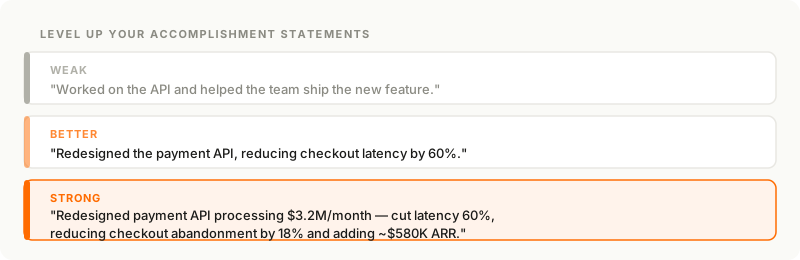
Connect marketing activities to business outcomes with specificity. “Managed the content calendar” is activity. “Managed the content calendar in a way that increased organic traffic 40% and contributed to a doubling of content-sourced pipeline” is impact. Marketing managers who understand what the sales team actually needs from marketing, and who measure their own work against those outcomes, are operating at the level the business needs. Good reviews reinforce that standard.
How to Use These Phrases
For Managers
These phrases are most useful when anchored to specific campaign data or business outcomes. Every Exceeds phrase should be paired with a number — a conversion rate, a pipeline figure, a brand metric — and every Needs Development phrase should point at a specific behavior pattern rather than a general shortfall.
For Employees
Use these to understand the framework your reviewer is applying to your work. If you’ve moved important metrics but haven’t documented the connection between your decisions and those outcomes, you now have language to make that case in your self-assessment. If you see gaps in the Needs Development section, they point at learnable skills with a clear development direction.
Rating Level Guide
| Rating | What it means for Marketing Managers |
|---|---|
| Exceeds Expectations | Campaign results and business outcomes measurably exceed targets. Makes strategic decisions that improve long-term brand and pipeline health. Cross-functional partners cite this manager as a force multiplier for their work. |
| Meets Expectations | Executes campaigns that hit targets, maintains brand standards, and delivers the pipeline and awareness metrics the business depends on. Cross-functional collaboration is productive and reliable. |
| Needs Development | Campaigns are executed but results consistently fall short of targets or lack measurement. Brand and messaging decisions create rework or stakeholder friction. Business impact is difficult to trace to specific decisions. |
Campaign Execution & Results Performance Review Phrases
Exceeds Expectations
- Consistently delivers campaign results that exceed targets across key metrics — not by cherry-picking favorable KPIs after the fact, but by setting ambitious benchmarks before launch and hitting them with reliable regularity.
- Proactively identifies the campaigns most likely to produce high-leverage outcomes before committing resources, demonstrating a judgment about marketing investment that goes beyond executing a predetermined plan.
- Independently manages full-funnel campaign execution — from brief to launch to post-mortem — producing campaigns that improve incrementally each cycle because the learnings are captured, documented, and applied.
- Drives A/B testing discipline that genuinely improves campaign performance over time, not just running experiments for their own sake but designing tests that answer questions the team needs answered to make better decisions.
- Delivers pipeline contribution through marketing campaigns that is recognized by sales leadership as genuinely influential — Salesforce attribution data supports the marketing team's contribution claims rather than contradicting them.
Meets Expectations
- Executes campaigns on schedule and within budget, hitting the primary performance targets set during planning with reasonable consistency.
- Documents campaign performance in post-mortems that capture what worked, what didn't, and what changes will be made in the next cycle — the team learns from each campaign rather than repeating the same mistakes.
- Manages campaign budgets with appropriate accountability — spending is tracked against plan, variances are explained, and ROI is calculated and reported with appropriate context.
- Coordinates campaign logistics across agencies, contractors, and internal teams with the organizational rigor needed to hit launch dates without last-minute scrambles.
Needs Development
- Would benefit from developing stronger measurement discipline — campaigns are currently executed without clear pre-defined success metrics, which makes it difficult to evaluate performance or defend resource allocation to leadership.
- Is developing the ability to connect campaign activity to business outcomes; currently tends to report activity metrics (impressions, clicks, opens) without tracing them to the pipeline or revenue impact the business is trying to produce.
- Has shown improvement in campaign execution but needs to build stronger optimization habits — underperforming campaigns currently run their full duration without mid-flight adjustments that data would support.
Brand & Messaging Performance Review Phrases
Exceeds Expectations
- Consistently maintains brand standards across every touchpoint with a combination of clear guidelines and active quality review — the brand experience is coherent whether a customer encounters it in a paid ad, a sales deck, or an onboarding email.
- Proactively evolves brand messaging in response to market signals, competitive shifts, and customer feedback — the brand stays relevant without losing its core identity.
- Independently develops messaging frameworks that give the entire go-to-market team — sales, customer success, product — a shared vocabulary for talking about the product, reducing the fragmentation that creates a confusing customer experience.
- Builds brand assets and guidelines that enable the broader organization to create on-brand content independently, reducing the marketing team's bottleneck role without sacrificing quality.
- Drives positioning work that is grounded in genuine customer insight and competitive analysis, producing messaging that resonates with target audiences in ways that measurably improve conversion rates in the channels where it is applied.
Meets Expectations
- Maintains consistent brand standards across primary marketing channels, catching and correcting off-brand work before it reaches the audience.
- Produces messaging that is clear, differentiated, and tailored to the target audience — not just accurate descriptions of the product but language that connects product capabilities to customer outcomes.
- Manages brand refresh or messaging update projects with appropriate stakeholder alignment — brand changes do not create surprises for sales, support, or product teams who need to apply them.
- Develops content and copy that reflects a genuine understanding of the customer's perspective, using the language customers use to describe their problems rather than the language the product team uses internally.
Needs Development
- Would benefit from developing stronger brand governance practices — off-brand content from distributed creators currently reaches the audience more often than it should, and stronger review processes would address this.
- Is developing the skill of translating product capabilities into customer-centric messaging; current copy tends to lead with features rather than outcomes, which reduces resonance with buyers who care about what the product does for them, not how it works.
- Has shown improvement in messaging quality but needs to build stronger processes for keeping messaging consistent across teams — the disconnect between what marketing says and what sales says in conversations creates customer confusion that feedback has surfaced repeatedly.
Cross-functional Collaboration Performance Review Phrases
Exceeds Expectations
- Consistently builds the kind of relationship with sales leadership that turns marketing from a support function into a genuine go-to-market partner — sales managers actively seek this person's input on territory strategy, competitive positioning, and campaign timing.
- Proactively partners with the product team to align launch campaigns with product capabilities, ensuring that marketing commitments are grounded in what the product actually delivers and that customers are not set up for disappointment.
- Drives alignment between marketing, sales, and customer success on the customer journey — handoffs between teams are smooth because this manager invested in designing them rather than assuming they would work.
- Independently navigates the tension between brand standards and sales enablement needs, finding solutions that serve both without requiring leadership escalation to resolve the conflict.
- Builds cross-functional relationships that generate organic marketing opportunities — product teams, customer success, and engineering regularly bring this manager into conversations where marketing perspective creates value.
Meets Expectations
- Maintains a functional working relationship with the sales team — marketing-to-sales handoffs are reasonably smooth and feedback from sales about lead quality is incorporated into campaign planning.
- Coordinates effectively with product on launch timing, messaging alignment, and the customer-facing materials needed to support a new release.
- Works constructively with external agencies and contractors, providing clear briefs and managing feedback cycles without creating the kind of friction that delays delivery or degrades output quality.
- Participates actively in cross-functional planning processes — QBRs, go-to-market planning, budget cycles — contributing relevant marketing perspective and incorporating inputs from other functions.
Needs Development
- Would benefit from investing more deliberately in the marketing-sales relationship — current friction between the teams is affecting lead quality perceptions and pipeline attribution in ways that are costing both functions credibility with leadership.
- Is developing the ability to manage cross-functional dependencies proactively; currently tends to discover that other teams need something from marketing late in their planning cycle, creating rushed work that reflects poorly on both parties.
- Has shown willingness to collaborate but needs to build stronger habits around aligning with stakeholders before making commitments — campaign launches have occasionally surprised partner teams whose input or coordination was assumed rather than secured.
Analytics & Optimization Performance Review Phrases
Exceeds Expectations
- Consistently uses Google Analytics, HubSpot, and Salesforce data to build a coherent picture of the full marketing funnel — not just isolated channel metrics, but an integrated view of how awareness converts to pipeline and pipeline converts to revenue.
- Proactively identifies optimization opportunities in the funnel before they are assigned — notices the conversion drop at the demo request form, investigates the root cause, designs a test, and reports the result with appropriate statistical rigor.
- Independently builds the attribution models and reporting infrastructure that give the team credible answers to the questions leadership actually asks — "which campaigns are driving pipeline?" has a defensible, data-supported answer.
- Drives a testing culture in which decisions about creative, copy, channel, and timing are made on the basis of evidence from past experiments, producing a team that improves its marketing effectiveness continuously rather than hoping for better results.
- Uses data to challenge its own priors — regularly surfaces findings that contradict the team's existing assumptions and uses those findings to update strategy rather than explain them away.
Meets Expectations
- Tracks key marketing metrics — traffic, conversion rates, pipeline contribution, customer acquisition cost — with sufficient rigor to report accurately to leadership and identify when performance is off-track.
- Uses campaign data to make optimization decisions during flight — adjusts budget allocation, creative, and targeting based on early performance signals rather than waiting for a campaign to end before acting.
- Produces regular marketing reports that communicate performance clearly to stakeholders who may not be fluent in marketing metrics, including appropriate context for interpreting results.
- Connects marketing investment to pipeline and revenue outcomes in reporting, using available attribution data to tell a credible story about marketing's contribution to the business.
Needs Development
- Would benefit from developing stronger analytics fluency — current marketing reporting focuses on vanity metrics (reach, impressions) rather than the funnel metrics (conversion rate, pipeline influenced, CAC) that leadership uses to evaluate marketing's contribution.
- Is developing the habit of using data to drive optimization decisions; currently campaigns are evaluated at the end rather than monitored during flight, which misses the opportunity to improve performance while the campaign is still running.
- Has shown interest in becoming more data-driven but needs to build stronger skills in HubSpot and attribution reporting — current attribution data is inconsistent in ways that undermine the team's ability to make credible claims about pipeline contribution.
Team Leadership Performance Review Phrases
Exceeds Expectations
- Consistently develops marketing team members in ways that expand both their capability and their ambition — direct reports describe this manager's coaching as the most influential development experience in their career to date.
- Proactively builds a team structure and set of processes that scale with the organization's needs — when headcount grows or scope expands, the team adapts without the crisis-management mode that characterizes less-prepared teams.
- Independently identifies and addresses team capability gaps before they become delivery problems — if the team needs stronger SEO skills or better data fluency, this manager is building that capability six months before the gap is painful.
- Creates team culture that attracts strong marketers — candidates choose this team over competitors, and current members cite the team's environment as a meaningful reason they stay.
- Manages the team's agency and contractor relationships as genuine extensions of team capability — briefs are clear, feedback is constructive, and output quality consistently reflects the manager's standards.
Meets Expectations
- Provides team members with clear direction, regular feedback, and the context they need to do their best work — direct reports understand the priorities, know where they stand, and feel supported in their development.
- Manages team workload with appropriate awareness of capacity — the team is productively busy without regularly operating in an unsustainable crunch that drives attrition.
- Handles performance issues directly and fairly — underperformance is named, supported, and managed with appropriate process rather than ignored until it becomes an escalation.
- Recruits and selects marketing talent with a consistent hiring standard — new hires integrate effectively and contribute to the team's capability rather than diluting it.
Needs Development
- Would benefit from developing a more structured approach to team development — direct reports currently lack consistent growth plans and feedback cadences, which is contributing to uncertainty about career progression that is a retention risk.
- Is developing the ability to delegate effectively; currently tends to retain too much work at the manager level, which creates a bottleneck for the team and limits the development opportunities available to direct reports.
- Has shown genuine care for team members but needs to build stronger practices around workload management — the team has operated in sustained crunch conditions that are not sustainable and are affecting both output quality and morale.
How Prov Helps Build the Evidence Behind Every Review
Marketing is one of the hardest roles to review fairly because the work is both highly visible (campaigns, content, events) and deeply under-documented (the strategic decisions, the optimization calls, the cross-functional negotiations that shaped what got built). The campaign that hit its pipeline target is obvious. The positioning work that made the sales team’s conversations more effective is invisible unless someone documented it at the time.
Prov helps marketing managers capture both kinds of contributions in real time — the quick reflection after the campaign post-mortem, the note about the HubSpot optimization that improved the nurture conversion rate, the brief account of the sales enablement session that changed how the field talks about the product. Those rough notes become polished achievement language so that review season is a retrieval exercise, not a reconstruction project. The manager who drove real outcomes gets credit for them, backed by the specific evidence that makes a review meaningful.
Ready to Track Your Wins?
Free to start, no account, no sign-up. Available on the App Store now.
Download on iOS Free to start, no account needed