A machine learning engineer's job is not to train a good model. It is to create a production system that improves a business metric reliably over time. Reviews that evaluate only model performance miss most of the work.
How to Write Effective Machine Learning Engineer Performance Reviews
Machine learning reviews have a benchmark trap. Offline metrics — accuracy, AUC, F1, RMSE — are easy to measure and easy to cite in reviews. They are also, in isolation, almost meaningless from a business value perspective. A model that achieves 94% accuracy in a Jupyter notebook and degrades to 89% in production two months after launch because of data drift is an operational liability, not a success. Reviews that treat the benchmark number as the primary signal are evaluating the wrong thing.
The most useful frame for ML engineer reviews is the full deployment chain: data quality → feature engineering → model quality → production reliability → business outcome. An engineer who excels at model training but consistently ships models that require frequent retraining because of poor feature stability, or that fail silently in production because monitoring was an afterthought, has a materially different impact from an engineer who optimizes the entire chain. Reviews should evaluate each link explicitly.
Experimentation rigor is a frequently overlooked dimension that separates senior ML engineers from junior ones. The ability to design statistically valid A/B tests, manage experiment traffic allocation, interpret results with appropriate caution about multiple comparison problems, and make clear shipping recommendations from ambiguous results is as valuable as model training skill. Managers reviewing ML engineers should explicitly evaluate whether experiments are designed to produce actionable conclusions, not just results.
Business impact often requires explicit translation in ML reviews because the connection between model quality and business outcome is indirect and probabilistic. The engineer who defines success metrics upfront, tracks the business KPI through the model lifecycle, and communicates results in terms that product and business stakeholders can act on is doing leadership-level work regardless of their title. This translation work deserves recognition in reviews, not quiet assumption.
How to Use These Phrases
For Managers
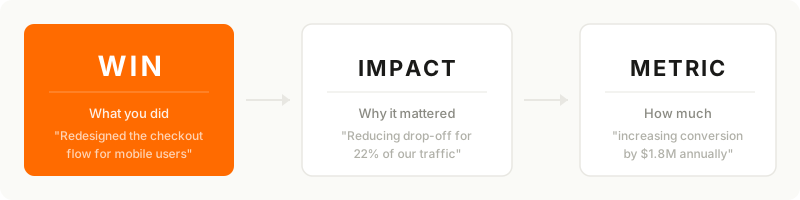
ML review language is most credible when it traces the impact chain explicitly: model quality → production metric → business outcome. “Improved the recommendation model” is weak. “Improved the recommendation model’s NDCG@10 by 12%, which drove a 6% lift in click-through rate in the A/B test and an estimated $240K annual revenue increase at current traffic” is a review. Use these phrases as structure and add the chain from your team’s experiment reports and business dashboards.
For Employees
The phrases in this guide reflect what promotion committees and senior technical reviewers look for in ML engineer assessments: evidence of end-to-end thinking, production reliability discipline, and business impact. If your self-assessment focuses primarily on model metrics, review the “Business Impact” and “MLOps & Production” sections to identify work you may be underselling.
Rating Level Guide
| Rating | What it means for ML Engineers |
|---|---|
| Exceeds Expectations | Drives the full model lifecycle from problem framing to production reliability to business impact measurement; proactively identifies and resolves data quality and production reliability risks; influences the team’s technical direction |
| Meets Expectations | Reliably trains and deploys models that meet quality thresholds; maintains production models with appropriate monitoring; designs and executes experiments that produce actionable conclusions |
| Needs Development | Demonstrates model training skill but requires guidance on production reliability, experiment design, or business impact translation; work often requires senior review before reaching production |
Model Development & Quality
Exceeds Expectations
- Proactively designed the model evaluation framework — including offline metrics, fairness audits, and calibration checks — before beginning training, ensuring the team had agreed success criteria that prevented post-training goal post changes.
- Independently identified that the prior model's training/serving skew was responsible for a 3-point AUC gap between offline evaluation and production performance, and implemented the feature consistency checks that resolved it.
- Consistently applies rigorous holdout strategy — temporally stratified splits, out-of-distribution test sets, demographic parity analysis — that provides honest estimates of production performance rather than optimistic benchmark scores.
- Drives model card documentation practice across the team, ensuring every deployed model has a documented scope, known failure modes, and explicit bias analysis that stakeholders can reference during product decisions.
- Led the neural architecture comparison that evaluated PyTorch transformer variants against established gradient boosting baselines for the fraud detection use case, producing a clear recommendation with a documented tradeoff analysis that shaped the team's model family selection for the next two years.
Meets Expectations
- Trains models using appropriate validation methodology — holdout splits, cross-validation, temporal splits for time-series data — and reports evaluation metrics with confidence intervals.
- Implements hyperparameter optimization using systematic approaches — Bayesian search via Weights & Biases sweeps — rather than manual tuning, and documents the search space and results.
- Analyzes model errors by class, segment, and feature distribution to identify systematic weaknesses before deployment.
- Participates in model review sessions, presenting evaluation results, failure mode analysis, and production readiness assessment before shipping.
Needs Development
- Is developing stronger model evaluation discipline; recent models have been evaluated primarily on accuracy without examining calibration, fairness, or segment-level performance gaps that became apparent after deployment.
- Would benefit from deeper study of training/serving skew and feature consistency validation — the production performance gap on recent deployments suggests evaluation conditions are not matching the serving environment accurately.
- Has shown genuine progress in model training capability but is developing the habits around experiment tracking in MLflow and Weights & Biases that would make model development reproducible and results auditable by the team.
MLOps & Production
Exceeds Expectations
- Proactively designed the model monitoring system using DataDog and custom drift detection, implementing alerts for input feature distribution shift, prediction distribution drift, and business metric degradation — catching a data pipeline change that would otherwise have caused undetected model performance degradation for weeks.
- Independently built the automated retraining pipeline using Kubeflow, enabling weekly model refresh on production data without manual intervention, and reducing the mean time from data availability to new model deployment from 3 weeks to 2 days.
- Consistently implements shadow mode deployment for all new model versions — running the new model in parallel with the production model before traffic cutover — enabling rollback in under 5 minutes if production metrics degrade.
- Drives model serving infrastructure decisions that balance latency, throughput, and cost — including GPU instance right-sizing, batching strategy, and model quantization — achieving a 40% reduction in serving cost without measurable latency impact.
- Led the migration from ad-hoc model deployment scripts to a standardized MLflow model registry workflow, ensuring all production models have documented lineage, reproducible training runs, and consistent promotion gates from staging to production.
Meets Expectations
- Deploys models with appropriate monitoring — prediction distribution tracking, latency percentiles, error rates — and responds to drift alerts within established SLA.
- Maintains model serving infrastructure using established Kubernetes and Kubeflow patterns, coordinating with the platform team for infrastructure changes that exceed standard configurations.
- Registers models in MLflow with documented metadata — training data version, evaluation metrics, hyperparameters — enabling model lineage tracking and reproducible experiments.
- Conducts scheduled model performance reviews, identifying and escalating models that have degraded beyond acceptable thresholds before they impact business metrics.
Needs Development
- Is developing stronger production ML instincts; recent deployments have launched without adequate monitoring configuration, making it difficult to detect performance degradation until business metrics were visibly affected.
- Would benefit from deeper engagement with the team's Kubeflow and MLflow infrastructure to build the end-to-end deployment skills needed to take models from training to production without extensive platform team support.
- Has shown progress in model training quality but is developing the reliability discipline — shadow deployments, rollback testing, graceful degradation design — that distinguishes production ML engineering from research work.
Experimentation & Research
Exceeds Expectations
- Proactively authored the team's A/B testing standards document — minimum detectable effect calculation, sample size requirements, multiple comparison correction policy, and holdout group management — establishing a shared methodology that has improved the reliability of experiment conclusions across the team.
- Independently designed and executed a four-variant experiment that disambiguated competing hypotheses about the recommendation algorithm's underperformance, producing a clear causal conclusion that directed three months of subsequent engineering investment.
- Consistently designs experiments with explicit novelty effects mitigation — longer run times for behavioral feature experiments, holdout groups for long-cycle metrics — producing conclusions that hold up in post-experiment validation rather than dissolving after initial deployment.
- Drives the team's research synthesis process, regularly presenting relevant external ML literature in a format that identifies applicable ideas for the current product context and filters out the irrelevant.
- Led the multi-armed bandit experiment framework implementation using Kubeflow, enabling online learning experiments that adapt traffic allocation in real time and reducing the regret cost of exploration compared to traditional A/B testing by an estimated 15%.
Meets Expectations
- Designs A/B experiments with pre-registered hypotheses, appropriate sample size and power calculations, and statistical significance thresholds defined before results are observed.
- Interprets experiment results with appropriate caution — acknowledging confidence intervals, noting potential confounders, and distinguishing statistical significance from practical significance.
- Completes literature reviews for new model approaches and presents findings to the team with a clear recommendation on whether the approach is worth experimenting with in the current context.
- Documents experiment design, execution, results, and conclusions in a shared repository that enables future engineers to build on prior work rather than rediscovering it.
Needs Development
- Is developing stronger experiment design skills; recent A/B tests have launched without pre-registered success metrics or power calculations, making it difficult to interpret results or know when to stop the experiment.
- Would benefit from deeper study of causal inference and common A/B testing failure modes — novelty effects, network effects, seasonal confounders — to design experiments whose conclusions are more durable.
- Has shown genuine curiosity about new ML approaches but is developing the discipline to connect research exploration to product-relevant experiments with clear success criteria before investing significant compute resources.
Data & Feature Engineering
Exceeds Expectations
- Proactively designed the feature store architecture using Feast, enabling consistent feature computation between training and serving environments and eliminating the training/serving skew that had been degrading production model performance by an estimated 4–6% across three models.
- Independently identified and resolved a systematic data quality issue in the user event pipeline using Great Expectations validation checks, catching label leakage that would have caused an over-optimistic model evaluation and a poor production result.
- Consistently applies feature importance and Shapley value analysis to identify the minimum feature set that achieves target model quality, reducing serving latency by removing features that contributed no measurable performance improvement.
- Drives data quality SLA discussions with the data engineering team, establishing freshness, completeness, and schema stability requirements that protect downstream model reliability.
- Built the real-time feature computation pipeline using Spark Structured Streaming and Kafka, enabling low-latency features for the fraud detection model and reducing false negative rate by 18% compared to the daily-batch feature approach.
Meets Expectations
- Implements feature transformations with appropriate scaling, encoding, and null handling that are consistent between training and serving environments.
- Validates training data for class imbalance, distribution shift, and label quality issues before beginning model development, and documents findings in the experiment record.
- Coordinates with data engineering to clarify data definitions, resolve pipeline reliability issues, and establish freshness SLAs for features that affect model performance.
- Registers features in Feast with documentation — feature definition, source pipeline, freshness requirements — enabling team members to reuse features across models.
Needs Development
- Is developing stronger feature engineering instincts; recent model training runs have used raw features without appropriate normalization and encoding, contributing to training instability and suboptimal model quality.
- Would benefit from a deeper investigation into the data pipelines that feed training datasets — several recent models have been affected by data quality issues that were present in the training data and could have been detected with validation checks before training.
- Has shown progress in feature implementation but is developing the end-to-end data literacy needed to trace data quality issues from the source pipeline through to model performance impacts.
Business Impact
Exceeds Expectations
- Proactively defines business success metrics — revenue per session, conversion rate, churn reduction — alongside technical model metrics at the start of each project, and consistently reports results to product and business stakeholders in terms that connect model quality to business outcomes.
- Independently translated a vague product request ("improve recommendations") into a concrete ML problem formulation with measurable objectives, constraints, and go/no-go criteria — preventing the scope ambiguity that had derailed two prior ML initiatives.
- Consistently evaluates model improvements in terms of the business return on the engineering investment required to achieve them, providing product managers and engineering leads with the information needed to make prioritization decisions about ML work.
- Drives post-deployment business impact tracking for all shipped models, maintaining a living record of model contributions to key business metrics that provides evidence for ML investment decisions in planning cycles.
- Led the cross-functional review that identified a mismatch between the model's optimization objective and the business metric it was intended to improve, preventing a 6-week investment in the wrong direction and reorienting the project toward a framing that achieved the business goal.
Meets Expectations
- Reports model experiment results in terms of both technical metrics and the business outcome they proxy, enabling product stakeholders to evaluate the significance of model improvements.
- Participates in product planning discussions for ML features, providing realistic effort estimates and risk assessments based on data quality, problem difficulty, and deployment complexity.
- Tracks business metrics for shipped models through the first 60–90 days post-deployment, confirming that offline evaluation results translated to the expected production impact.
- Communicates clearly about model limitations and failure modes to product stakeholders, enabling informed decisions about use cases the model should and should not be applied to.
Needs Development
- Is developing stronger business communication skills; current reporting tends to focus on technical model metrics without translating them to the business outcomes that stakeholders are accountable for, creating a gap between technical progress and perceived business value.
- Would benefit from more active engagement with product and business stakeholders during problem framing to develop the shared understanding of business objectives that enables more targeted ML work.
- Has shown genuine technical growth over the review period but is developing the strategic thinking to connect ML capability to business opportunity — identifying which problems in the product roadmap are best addressed with ML versus other approaches.
How Prov Helps Build the Evidence Behind Every Review
Machine learning engineers face a compounding documentation problem: their work spans long time horizons, involves probabilistic outcomes, and delivers impact through a causal chain that is easy to describe vaguely and hard to attribute precisely. The engineer who shipped three models in a year may remember the general results — “the recommendation model improved” — but struggle to reconstruct the specific metrics, the business outcomes, and the engineering decisions that made the work meaningful.
Prov gives ML engineers a lightweight way to capture wins at each link in the impact chain — a quick capture when an experiment result comes in, a voice note after a business review where the model’s contribution was confirmed, a text record when a production monitoring alert catches a drift issue before it becomes an incident. Over time, those notes build a comprehensive record of technical and business impact that is far more compelling than reconstructed summaries. When review season arrives, every model in the portfolio has a documented story.
Ready to Track Your Wins?
Free to start, no account, no sign-up. Available on the App Store now.
Download on iOS Free to start, no account needed