Concrete examples of ML and AI engineering achievements you can adapt for your performance review, promotion packet, or next interview.
The ML Engineer's Review Problem
Machine learning work operates on cycles that are fundamentally misaligned with the calendar quarter. A model takes weeks to train, weeks more to validate, and months to prove out in production. By the time the business impact of your model is measurable, you're already deep into the next project — and the work that generated that impact is a distant memory to everyone, including you. Performance reviews often land while you're mid-experiment, with results that are provisional, probabilistic, and hard to summarize in a single sentence.
There's also the attribution problem. When a recommendation engine lifts click-through rate, the product team celebrates a feature win. When a fraud model saves the company $200K, the finance team cites improved controls. ML engineers are the invisible infrastructure behind other teams' wins, which means your impact is real but routinely credited elsewhere. You need to document the causal chain explicitly — or it disappears.
And then there's the technical-to-business translation gap. AUC improved from 0.81 to 0.87 is a meaningful result to you. To your manager's manager, it's noise. The ability to translate model improvements into business outcomes — false positives avoided, revenue protected, analyst hours saved — is itself a career-defining skill, and it has to be practiced constantly, not retrofitted at review time.
What gets you promoted are documented accomplishments with measurable impact. The examples below give you the language to surface work that is too often invisible — and the framing to make probabilistic, multi-month work land as concrete achievement.
Machine Learning Engineer Accomplishment Categories
| Competency | What Reviewers Look For |
|---|---|
| Model Development & Research | You build models that actually work and reach production |
| ML Systems & MLOps | You get models into production reliably and keep them there |
| Data & Feature Engineering | You build the foundation models need to learn from |
| Model Performance & Optimization | You make models better, faster, and cheaper |
| Business & Product Impact | Your ML work moves metrics that the business cares about |
| Technical Leadership & Collaboration | You raise the ML bar for the team, not just yourself |
Model Development & Research Accomplishments
Model Architecture & Training
- "Designed and trained a transformer-based document classification model using PyTorch that achieved 94% accuracy on the internal dataset, replacing a rule-based system that had a 71% accuracy ceiling and required 3 weeks of manual maintenance per quarter."
- "Built a multi-task learning architecture that jointly predicted churn probability and next-best-action, outperforming two separate specialized models on both tasks while cutting GPU training cost by 40%."
- "Fine-tuned a Hugging Face BERT-base model on 80K internal support tickets to classify intent, achieving 91% precision and reducing misrouted tickets from 18% to 4% of daily volume."
- "Trained a time-series forecasting model using a Temporal Fusion Transformer architecture, reducing demand forecast MAPE from 23% to 11% and enabling the supply chain team to reduce safety stock by $1.2M."
- "Implemented a contrastive learning approach for product embedding that improved catalog similarity search relevance scores by 28%, measured against a human-labeled evaluation set."
- "Designed the ensemble architecture combining gradient boosting and a neural network for the risk scoring model, improving AUC from 0.79 to 0.88 and reducing false positive investigations by 35% at the same recall threshold."
- "Built a RAG pipeline using LangChain and a fine-tuned embedding model to power internal knowledge base search, reducing time-to-answer for support agents from 4 minutes to under 45 seconds."
- "Developed a tabular deep learning model (TabNet) to replace a legacy logistic regression for subscription propensity scoring, lifting model-driven conversion rate by 14% in an A/B test."
Experimentation & Research
- "Ran 12 model architecture experiments over Q3 using a structured MLflow tracking setup, identifying that attention pooling over GRU hidden states outperformed mean pooling by 6 F1 points — a finding that became the team's default pattern."
- "Implemented RLHF fine-tuning on an internal summarization model using human preference labels from 500 annotator sessions, improving helpfulness ratings from 3.2 to 4.1/5.0 in blind evaluation."
- "Evaluated 7 open-source LLM candidates for the code generation feature, building a reproducible benchmark harness that the team reused for 3 subsequent model selection decisions."
- "Conducted ablation study on feature set for the pricing model, identifying 3 high-cost features that contributed less than 1% lift — removing them cut inference cost by 22% with no meaningful accuracy degradation."
- "Implemented offline policy evaluation for the recommendation system, enabling safe experimentation without requiring every hypothesis to run as a live A/B test — reduced experiment cycle time from 3 weeks to 4 days for lower-risk changes."
- "Researched and implemented dataset distillation for the image classification pipeline, reducing labeled training data requirement by 60% while maintaining 97% of the model's performance on the held-out test set."
ML Systems & MLOps Accomplishments
Production Deployment & Serving
- "Designed and shipped the model serving infrastructure on Vertex AI using a custom prediction container, reducing deployment time from a 2-week manual process to a single CI/CD pipeline step — 4 models were deployed in the following month alone."
- "Implemented model versioning and shadow deployment infrastructure using Kubeflow Pipelines, enabling safe rollout of new model versions with automatic traffic-shifting based on live metric thresholds."
- "Migrated the real-time scoring endpoint from a Flask monolith to TorchServe, reducing cold start latency by 70% and enabling auto-scaling that handled a 5x traffic spike during the Black Friday campaign without manual intervention."
- "Built the feature serving layer using Feast, enabling consistent feature computation between training and inference — eliminated a category of training-serving skew bugs that had caused 2 model regressions in the prior year."
- "Containerized 6 model pipelines using Docker and deployed to Kubernetes via Helm charts, reducing environment-related deployment failures from 40% to under 5% of releases."
- "Implemented batch inference on SageMaker Batch Transform for the nightly scoring job, replacing an ad-hoc script that ran on an oversized EC2 instance — cut cost by $4,800/month and added retry logic that eliminated weekly manual restarts."
Monitoring & Reliability
- "Built the model monitoring system that tracked feature distribution drift, prediction distribution shift, and label drift across 8 production models, alerting the team before 3 model degradations affected user-facing metrics."
- "Implemented automated retraining triggers using Evidently AI for drift detection, reducing average model staleness from 6 weeks to 10 days without requiring manual intervention from the team."
- "Established p99 latency SLOs for all production ML endpoints and wired them into PagerDuty, giving the on-call rotation visibility into model serving issues for the first time — resolved 2 latency incidents within minutes rather than hours."
- "Designed the fallback serving strategy for the recommendation model, ensuring degraded-mode rules-based results were served during model outages — eliminated 3 incidents where users saw empty recommendation carousels."
- "Built the data quality gate in the ingestion pipeline that blocked model retraining when upstream feature tables had null rates above threshold — caught a schema change that would have silently trained a degraded model on corrupted data."
Data & Feature Engineering Accomplishments
Feature Engineering
- "Engineered 23 behavioral sequence features from raw clickstream data using a sliding window aggregation pipeline, contributing the single largest accuracy improvement (+9 F1 points) in the model's development history."
- "Built the real-time feature computation service using Kafka Streams that calculated user session features with sub-200ms latency, enabling the personalization model to use live behavioral signals for the first time."
- "Designed the feature store schema in Tecton for 47 shared features, enabling 3 separate model teams to reuse pre-computed features — reduced feature development time for subsequent models by an estimated 4 weeks each."
- "Implemented entity embedding lookup for high-cardinality categorical features (product IDs, merchant IDs), replacing one-hot encoding that had made the feature matrix too sparse to train effectively — model accuracy improved by 11%."
- "Created the automated feature importance pipeline using SHAP values that ran after every model training run, surfacing the top 20 predictive features for stakeholder review and catching data leakage in 2 feature candidates before production."
- "Engineered cross-feature interactions for the credit risk model that captured non-linear relationships the base features missed, improving recall at the 5% FPR operating point from 62% to 78%."
Data Quality & Pipelines
- "Built the training data pipeline using dbt and Airflow that processed 90 days of behavioral data into model-ready tensors, replacing a notebook-based process — reduced data prep time from 6 hours to 40 minutes and made it reproducible."
- "Implemented Great Expectations data validation on all 12 model training datasets, catching data quality issues before they reached training — identified 3 upstream schema changes that would have silently degraded model quality."
- "Designed the label generation pipeline for the content moderation model, working with the trust and safety team to transform raw moderator decisions into a clean training set — reduced labeling ambiguity rate from 22% to 6%."
- "Resolved a 4-month-old training-serving skew issue in the engagement prediction model by auditing feature computation code across training and serving paths — fixing it improved model accuracy by 8% with no model retraining required."
- "Built the data augmentation pipeline for the low-resource intent classification model that synthetically expanded the training set from 2K to 18K examples using back-translation — model accuracy on rare intents improved from 54% to 79%."
Model Performance & Optimization Accomplishments
Accuracy & Quality Improvements
- "Improved the fraud detection model's precision from 74% to 91% at fixed recall by reframing the class imbalance problem with focal loss and cost-sensitive learning, reducing false positive investigation workload by 45 analyst-hours per week."
- "Increased the search ranking model's NDCG@10 from 0.71 to 0.83 through pairwise learning-to-rank training and a richer feature set, measured against a curated relevance judgment dataset — product team observed a 12% increase in search-to-purchase conversion."
- "Eliminated 34% of the NER model's false positives on ambiguous entity types by adding a confidence calibration layer and routing low-confidence predictions to a rules-based fallback — reduced downstream extraction pipeline errors by half."
- "Improved the anomaly detection model's F1 score from 0.61 to 0.79 by switching from isolation forest to an autoencoder architecture better suited to the high-dimensional time-series data — reduced mean time to alert from 4.2 hours to 55 minutes."
- "Addressed systematic bias in the hiring recommendation model discovered during a fairness audit, retraining with debiased embeddings and adversarial debiasing — reduced demographic parity gap from 18% to 3% with less than 1% accuracy tradeoff."
Latency & Cost Optimization
- "Reduced the real-time inference p99 latency from 340ms to 62ms through model quantization (INT8), ONNX export, and TensorRT compilation — unlocked the product team's requirement for sub-100ms scoring that had blocked a feature for two quarters."
- "Applied knowledge distillation to compress a 340M parameter BERT model to a 22M parameter student model for the text classification endpoint, reducing GPU memory footprint by 85% and cutting serving cost from $8,200 to $1,100/month with 97% of the original accuracy."
- "Optimized the batch training job on Ray using data parallelism across 8 A100 GPUs, reducing training time from 18 hours to 2.5 hours — enabled daily retraining that had been infeasible at the prior cycle time."
- "Identified and fixed a GPU utilization bottleneck in the training pipeline caused by a CPU-bound data loader — adding prefetching and pin_memory improved GPU utilization from 34% to 87% and reduced training wall time by 60%."
- "Implemented dynamic batching in the inference server, increasing throughput from 120 to 850 requests/second on the same hardware — eliminated the need for a planned $6K/month infrastructure scaling investment."
- "Replaced a full model retrain with incremental online learning for the click prediction model, reducing retraining compute cost by 70% while keeping model freshness within the same 4-hour window."
Business & Product Impact Accomplishments
Product Integration
- "Partnered with the Product and Engineering teams to integrate the propensity model into the email send-time optimization feature, shipping end-to-end in 6 weeks — model was live before the original engineering-only timeline would have completed."
- "Designed the ML model API contract for the personalization service, enabling the frontend team to integrate without any ML team involvement on a per-feature basis — reduced cross-team coordination overhead for 4 subsequent feature launches."
- "Built the explanation layer for the loan decision model that surfaced the top 3 decline reasons per applicant, enabling compliance with adverse action notice requirements and eliminating a regulatory gap that legal had flagged for 6 months."
- "Worked with the growth team to integrate the LTV prediction model into the bidding strategy for paid acquisition — campaigns informed by model targeting achieved 2.3x return on ad spend versus the control group."
- "Shipped the content moderation model to production as a pre-screening layer before human review, reducing the volume of items requiring manual review by 67% and cutting the trust and safety team's backlog from 5 days to under 12 hours."
Revenue & User Metrics
- "The recommendation model shipped in Q2 contributed to a 19% increase in items-per-session for users in the treatment group, translating to an estimated $3.4M in incremental annual revenue based on the A/B test lift scaled to full rollout."
- "The churn prediction model enabled the Customer Success team to intervene with at-risk accounts 30 days earlier — accounts flagged by the model and contacted renewed at a 28% higher rate than the control group, retaining an estimated $1.8M ARR."
- "The dynamic pricing model increased gross margin by 4.2 percentage points on the experimental product category while maintaining conversion rate within 1% of baseline, validated over an 8-week holdout test."
- "The search intent classifier reduced zero-result searches from 11% to 3.4% of queries, measured over 90 days post-launch — zero-result rate is directly correlated with session abandonment in our historical data."
- "The automated underwriting model reduced loan application processing time from 3 days to 4 hours for 78% of applicants, improving applicant conversion rate by 22% and enabling the team to process 3x the monthly application volume without headcount increases."
- "Reducing false positives in the fraud model by 45% freed $180K in previously blocked legitimate transactions per month, recovering revenue that was invisible because it never appeared in any business metric."
Technical Leadership & Collaboration Accomplishments
Cross-team ML Enablement
- "Designed the team's model evaluation framework and pushed it as a shared library, giving 4 other model teams a standardized way to benchmark improvements — adopted across 9 active models within 6 weeks of release."
- "Led the ML platform selection process for the company's move from ad-hoc scripts to Kubeflow Pipelines, documenting requirements across 6 stakeholder teams and driving consensus on a single platform that reduced infra fragmentation."
- "Established the ML experiment tracking standard using MLflow across the ML team, making previously undocumented model runs reproducible — reduced time spent re-running experiments to understand prior results by an estimated 3 hours/week per engineer."
- "Built the internal prompt engineering library for LLM-based features, providing tested prompt templates, retry logic, and JSON output parsing — reduced time-to-first-working-prototype for new LLM features from 2 days to 2 hours."
- "Defined the team's A/B testing readiness checklist for model launches, ensuring every production model had monitoring, fallback logic, and a defined rollback plan before go-live — zero unplanned rollbacks in the 8 months since adoption."
Mentorship & Standards
- "Mentored 2 junior ML engineers through their first end-to-end model deployments, providing weekly code reviews and design walkthroughs — both shipped production models independently within 4 months."
- "Created the team's ML code review checklist covering data leakage, evaluation methodology, and serving considerations — adopted as the standard review template and cited by 3 engineers as the resource that most improved their production readiness."
- "Led 8 internal ML reading group sessions on topics from causal inference to LLM evaluation, averaging 12 attendees per session — two of the concepts covered were directly applied to production work within the following quarter."
- "Wrote the team's on-call runbook for the 6 production ML systems, reducing average incident resolution time for the rotation from 90 minutes to 25 minutes by documenting diagnostic steps and known failure modes."
- "Championed and implemented the responsible AI review process for all new model deployments, including bias evaluation and model card documentation — adopted as a company requirement by the CTO after the team demonstrated it on 3 models."
How to Adapt These Examples
Plug In Your Numbers
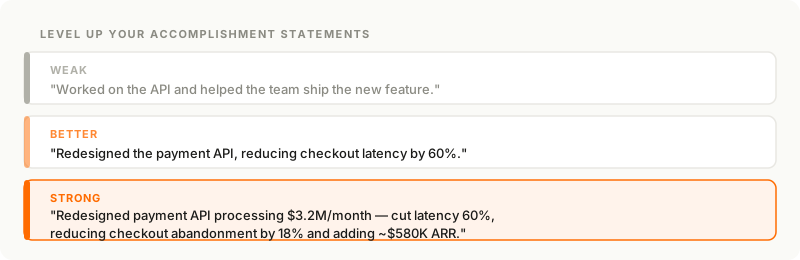
Every example above follows: [Action] + [Specific work] + [Measurable result]. Replace the numbers with yours. If the model improved AUC by 0.04 instead of 0.08, that's still a real improvement — write it down accurately.
Don't Have Numbers?
ML work generates numbers by definition — you just have to find them. Check your MLflow or experiment tracking runs for accuracy metrics. Check the monitoring dashboards for latency and throughput figures. Ask the product team for the A/B test results. Check cloud billing dashboards for compute cost before and after optimization. If none of those are available, document what you can: "reduced training time" is weaker than "reduced training time by 60%" but still better than "improved the training pipeline." Go get the number.
Match the Level
Junior and mid-level ML engineers should emphasize execution quality, technical growth, and model performance improvements. Senior ML engineers and staff should show system-level thinking, cross-team impact, and business outcomes. Principal and staff-level work should demonstrate how you raised the ML practice, not just the model. If your title is senior but your accomplishments read like junior work (model accuracy improved), add the layer above: what decision did that enable, what business problem did it solve, what did it unblock for other teams.
Start Capturing Wins Before Next Review
The hardest part of ML performance reviews is that your best work happened 9 months ago, the impact numbers took 3 months to materialize, and you've shipped 4 more models since then. Prov captures your wins in 30 seconds — voice or text — then transforms them into polished statements like the ones above. Prov is coming soon on iOS.
Ready to Track Your Wins?
Free to start, no account, no sign-up. Available on the App Store now.
Download on iOS Free to start, no account needed