HR business partners are often measured by things that didn't happen: the leader who didn't quit, the conflict that didn't escalate, the compliance violation that was caught before it became a lawsuit. The self-assessment challenge is translating the absence of bad outcomes — and the presence of slow-moving good ones — into language that finance and executives find credible.
Why Self-Assessments Are Hard for HR Business Partners
HR impact has a uniquely unfavorable measurement structure. The most consequential HR work — retaining a critical leader, resolving a conflict before it becomes a grievance, building a manager’s capability — is measured in counterfactuals. You can’t point to the turnover that didn’t happen; you can only show the retention rate and argue that your interventions contributed to it. That’s a harder story to tell than “I shipped the feature” or “I closed the deal.”
The timeline problem compounds this. A culture initiative launched in January may not show up in engagement survey scores until November. A development program you invested in this year produces promotable internal candidates next year. HR work that’s done well tends to look invisible in the short term and obvious in retrospect — a pattern that systematically disadvantages HRBPs in annual review cycles.
There’s also a credibility gap with business stakeholders. Finance and operations leaders often perceive HR work through a cost-and-compliance lens, which means HRBPs who frame their self-assessments in HR language — “I improved employee relations” — are reinforcing the perception that HR is a support function rather than a business function. The self-assessment has to translate people-work into commercial terms: retention cost savings, manager effectiveness improvement, time-to-hire reduction, performance management outcomes.
The goal: write phrases that are specific about your intervention, honest about what you can and cannot measure, and grounded in business outcomes — not just HR process metrics.
How to Structure Your Self-Assessment
The Three-Part Formula
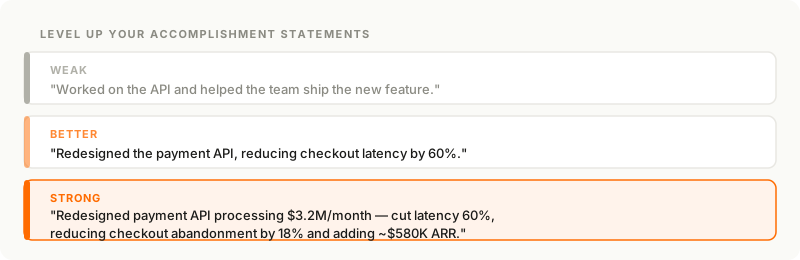
What I did → Impact it had → What I learned or what’s next
For HRBPs, “what I did” is the intervention, program, or advisory action. “Impact it had” requires translating people outcomes into business terms wherever possible. “What’s next” shows that you’re building organizational capability, not just managing incidents.
Phrases That Signal Seniority
| Instead of this | Write this |
|---|---|
| "I handled employee relations issues" | "I resolved six complex employee relations cases this year, including two that had escalation potential — both were closed at the manager level through structured mediation, preventing formal grievance filings and the associated legal and productivity costs" |
| "I supported the business with talent" | "I partnered with the Engineering VP to redesign the technical hiring process, reducing time-to-hire from 67 days to 41 days while maintaining or improving offer acceptance rates — a change that unblocked three critical roles that had been open for over 90 days" |
| "I improved the performance management process" | "I redesigned our performance improvement plan template and manager training to make PIPs genuinely developmental rather than exit-oriented — and of the seven PIPs completed this year, four employees are now meeting expectations and remain employed, versus a historical pattern where most resulted in separations" |
| "I want to get better at data" | "I am developing stronger HR analytics capability by learning Workday reporting and Lattice's Insights dashboard, targeting the ability to produce monthly people metrics for my business unit independently without routing through the central HR analytics team by Q2" |
Employee Relations & Culture Self-Assessment Phrases
Conflict Resolution & ER Cases
- "I managed 14 employee relations cases this year, ranging from interpersonal conflicts to a serious misconduct investigation. I closed all 14 within our SLA, documented every case rigorously in Workday, and escalated appropriately to Legal in the two cases that carried legal risk. The misconduct investigation — which involved a senior manager — was handled with sufficient thoroughness that Legal described it as 'the best-documented investigation we've seen from an HRBP this year.'"
- "I identified a pattern in ER cases from one business unit — four complaints in six months involving the same manager's communication style. Rather than treating each case in isolation, I brought the pattern to the VP as a manager capability issue and recommended a structured coaching intervention. The manager completed the coaching program, and we have had no ER cases from that team in the subsequent two quarters."
- "I facilitated a team conflict resolution process for a leadership team that had developed a significant functional divide between two senior leaders. The conflict had begun affecting hiring decisions and cross-team project delivery. Through four structured sessions over eight weeks, I helped the leaders establish working agreements and a communication protocol. Both leaders remain in their roles and reported in their subsequent 360 reviews that the working relationship had improved."
Culture & Engagement
- "I analyzed our annual engagement survey results for my business unit using Culture Amp's driver analysis, identifying manager effectiveness as the primary driver of our 12-point engagement gap versus the company benchmark. I built a targeted manager development program around the three specific behaviors the data flagged — and in our mid-year pulse survey, manager effectiveness scores in the affected teams improved by 18 points."
- "I launched a psychological safety initiative in two engineering teams where the engagement data showed below-average scores on 'I feel safe to take risks.' I facilitated team norms workshops and embedded a speaking-up question into the monthly team retrospective. Six months later, both teams' psychological safety scores had moved from the bottom quartile to the median — and one team's innovation output, as measured by internal hackathon participation, increased by 3x."
- "I designed and facilitated the cultural integration workstream for our acquisition of a 40-person team, running structured sessions to surface values tensions before they became behavioral conflicts. None of the acquired team's senior employees left in the 12 months following acquisition — a retention outcome the CEO explicitly noted as better than our two prior acquisitions."
Talent Acquisition & Development Self-Assessment Phrases
Hiring & Pipeline
- "I partnered with three hiring managers to redesign their interview processes, replacing inconsistent question sets with structured behavioral interviews scored against defined competency rubrics in Greenhouse. Offer acceptance rates for these roles improved from 64% to 81%, and the hiring managers reported in feedback surveys that they felt more confident in their hiring decisions than under the previous unstructured approach."
- "I diagnosed a sourcing problem for our senior individual contributor roles — we were seeing diverse top-of-funnel but losing diversity at the technical screen stage. I analyzed the drop-off using Greenhouse pipeline data, identified that one technical screen question had a disparate failure rate by demographic, flagged it to the hiring team, and facilitated a question redesign. Pass-through rates equalized within two hiring cycles."
- "I built a talent pipeline for our hardest-to-fill role category by establishing a relationship with three university programs and attending two industry conferences on behalf of the recruiting team. The pipeline contributed four hires this year at a 35% lower cost-per-hire than agency placements — and the candidates who came through the pipeline have had higher 6-month performance ratings than the agency-sourced cohort."
Learning & Development
- "I designed and delivered a manager essentials program for 14 first-time managers using a cohort format over eight weeks. Pre- and post-program assessments showed a statistically significant improvement in the four targeted competencies — feedback quality, goal setting, accountability conversations, and delegation. Three managers who completed the program have since been promoted to senior manager."
- "I identified a critical skill gap in data literacy across the middle management layer of my business unit through LinkedIn Talent Insights analysis and a series of stakeholder interviews. I built the business case for a targeted upskilling investment, sourced a vendor, and managed the rollout for 28 managers. Six months post-program, two participants have taken on expanded analytical responsibilities and the business unit leader has cited data-driven decision making as a visible improvement in the team's operating culture."
- "I established a mentoring program that matched 18 high-potential individual contributors with senior leaders outside their direct reporting line. Of the 18 participants, 6 have since been promoted — a 33% promotion rate compared to a 12% rate for a comparable cohort not in the program. I attribute the difference cautiously — selection effects may exist — but the qualitative feedback from both mentors and mentees has been strongly positive."
Performance Management Self-Assessment Phrases
Goal Setting & Review Cycles
- "I redesigned the performance review calibration process for my business unit, introducing a structured calibration meeting with clear criteria for each rating level and a requirement that every below-target rating be supported by documented evidence. The change reduced rating inflation — the proportion of employees rated 'exceeds expectations' dropped from 58% to 34%, aligning better with actual performance distribution — and manager confidence in the calibration outcome improved significantly."
- "I implemented a quarterly check-in structure for the 120 employees in my business unit, replacing an annual review-only cycle. The change required manager training, template design, and tracking in Lattice. At year-end, employees in my business unit reported 22 points higher agreement with 'I receive regular feedback on my performance' than the company average — and we had fewer rating surprises in the annual review cycle than any prior year."
- "I supported five managers through their first experience conducting honest underperformance conversations, coaching them before and debriefing after each conversation. All five managers reported increased confidence after the experience, and four of the five performance situations were resolved within the quarter — three through performance improvement, one through a mutually agreed departure."
PIPs & Difficult Conversations
- "I redesigned our performance improvement plan template in partnership with Legal to make it genuinely developmental rather than a documented path to termination. The new template includes specific, measurable success criteria, a support plan from the manager, and weekly check-ins. Of seven PIPs completed under the new template this year, four employees successfully completed the plan and continue in their roles — compared to a 100% departure rate under the previous template."
- "I supported the business through three sensitive leadership transitions this year, two of which involved involuntary separations at the senior manager level. I handled each transition with thorough documentation, appropriate severance structuring, and clear communication planning — and none of the three resulted in legal action. One of the three situations had significant litigation risk that I identified and mitigated through careful documentation practices."
Organizational Design Self-Assessment Phrases
Structure & Role Design
- "I led an organizational design review for the customer success function, which had grown from 8 to 34 people over 18 months without a deliberate structural review. I interviewed every team member and manager, analyzed span of control and role scope against benchmarks from LinkedIn Talent Insights, and produced a restructuring recommendation that the VP accepted and implemented. The restructuring reduced management layers from four to three and is expected to improve team velocity — early signals from the first quarter post-restructuring are positive."
- "I identified a role duplication problem between the sales operations and revenue operations functions that was creating confusion and conflict over ownership. I facilitated a structured role clarity workshop, developed a RACI for the 12 shared responsibilities, and worked with both VPs to establish clear boundaries. The conflict had been consuming approximately 4 hours per week of VP time — that cost has effectively been eliminated."
- "I supported a business unit through a 15% reduction in force, managing the selection process, severance administration, and communication plan for 22 impacted employees. The process was handled with full legal compliance, zero post-RIF claims, and — based on manager feedback — with enough care for the affected employees that our Glassdoor rating did not decline in the months following the announcement."
Succession & Workforce Planning
- "I built a succession plan for the top 15 roles in my business unit — the first formal succession planning exercise the unit had ever done. The process identified three critical single-points-of-failure where we had no viable internal successors and no pipeline, and it generated a specific development plan for four high-potential internal candidates. One of the identified successors was promoted into an open VP role six months later, rather than an external hire that would have taken four months and cost significantly more."
- "I partnered with the business unit leader to build a 12-month workforce plan based on the product roadmap and revenue projections, translating headcount scenarios into skill requirements and sourcing timelines. The plan allowed us to begin recruiting for three roles three months before the business leader had initially anticipated needing them — a lead time advantage that proved important when two of the roles took longer to fill than expected."
HR Analytics & Reporting Self-Assessment Phrases
People Metrics
- "I built a monthly people metrics dashboard for my business unit in Workday and Tableau that gives the business leader visibility into headcount, attrition, time-to-hire, and manager-to-IC ratios alongside the financial metrics they already review. This is the first time people data has been reviewed in the same cadence as financial data in this business unit, and the leader has already used it to make two decisions — a backfill prioritization and a manager headcount adjustment — that would previously have been made without the data."
- "I analyzed two years of attrition data for my business unit using BambooHR exit data and found that attrition was disproportionately concentrated in employees in their 13-18 month tenure band — a cohort that wasn't receiving the same onboarding attention as new hires or the same career development focus as established employees. I presented the finding to the leadership team and we implemented a targeted 12-month check-in intervention. Early retention data for that cohort is tracking better than the prior-year equivalent."
- "I built a compensation equity analysis using Workday data that identified 11 employees whose salaries had drifted more than 15% below market for their role and level — a compounding risk I expected would drive near-term attrition. I presented the analysis to the business leader with a cost-of-inaction estimate based on replacement costs, and six of the 11 employees received off-cycle adjustments. None of the six have left in the subsequent six months."
Compliance & Risk
- "I conducted a proactive audit of our employment documentation practices ahead of a state-level regulatory change, identifying 23 employees whose offer letters and classification records needed updating. I completed the updates four months before the deadline, working with Legal and Payroll to ensure full compliance. The audit and remediation prevented what could have been a material compliance exposure."
Business Partnership Self-Assessment Phrases
Strategic Advisory
- "I shifted my business partner relationship with the VP of Engineering from transactional — requests in, responses out — to advisory, by proactively bringing workforce and people insights into the VP's quarterly planning process. The relationship change was gradual and required demonstrating that my input added value rather than complexity. By Q3, I was included in the VP's direct staff meetings as a standing attendee rather than an occasional guest — a recognition of the partnership's evolved scope."
- "I advised the CEO through two significant leadership decisions this year, providing both the process framework and the people assessment input that informed who was selected. In both cases, the CEO explicitly credited the quality of the people data and process I provided as making the decision more defensible to the board than previous leadership appointments."
- "I built a business case for a flexible work policy update that aligned our practices with the competitive market while addressing the operational concerns the COO had raised. I synthesized data from LinkedIn Talent Insights on competitor practices, our own exit interview data on flexibility as a retention factor, and a cost analysis of the operational adjustments required. The policy was approved and implemented without the attrition spike the COO had feared."
Cross-functional HR Contribution
- "I contributed to three company-wide HR initiatives this year beyond my business unit remit: I co-designed the new manager onboarding program, led the job architecture refresh for the engineering function, and served as the HRBP representative on the DEI steering committee. Each of these contributions improved my understanding of the broader organization and built relationships with leaders outside my business unit that have made me more effective in my primary role."
How Prov Helps HR Business Partners Track Their Wins
HR business partners deal in conversations, judgments, and interventions — not artifacts. The most important work you do often produces no document, no system record, and no metric that updates immediately. By review season, the coaching conversation that prevented a resignation, the ER case you resolved without escalation, and the org design recommendation that shaped a business unit’s structure can all feel like they happened to someone else a long time ago.
Prov captures those wins in 30 seconds, voice or text, when they’re fresh. Over a quarter, it builds the evidence base for an HRBP self-assessment that translates people-work into the business language that earns credibility with finance and executive stakeholders — not just with other HR practitioners. Prov is coming soon on iOS.
Ready to Track Your Wins?
Free to start, no account, no sign-up. Available on the App Store now.
Download on iOS Free to start, no account needed