Heads of product are evaluated on outcomes they can't directly control — engineers build it, designers design it, sales sells it. The self-assessment challenge is demonstrating leadership of outcomes without either overstating your personal contribution or disappearing behind the team's collective success.
Why Self-Assessments Are Hard for Heads of Product
The head of product role is structurally ambiguous. You’re accountable for outcomes — activation rates, retention, revenue — but the path from your decisions to those outcomes runs through designers, engineers, sales reps, and customers. When a product succeeds, it’s the team’s success. When it struggles, it’s often attributed to product. The self-assessment has to navigate this asymmetry without reading as either falsely modest or inappropriately proprietary.
There’s also the leverage problem. Heads of product operate through influence rather than execution. Your highest-leverage move might be a 30-minute conversation that reframes a roadmap prioritization decision, a user research session that changes an engineering team’s assumptions, or a written strategy document that aligns three functions behind a coherent bet. None of those feel like tangible outputs at review time — they feel like you just talked to people and wrote things.
The time horizon creates a third challenge. Good product decisions often take 12–18 months to prove out, while poor decisions can look fine in the short term. A head of product who made excellent strategic calls this year might not see them validate until next year — and someone who over-built on a local optimization might be riding good metrics from a decision their predecessor made.
The goal: write phrases that describe the decisions you made, the judgment you applied, and the leadership you provided — with enough specificity that a reader who wasn’t in the room can understand what you actually did and why it mattered.
How to Structure Your Self-Assessment
The Three-Part Formula
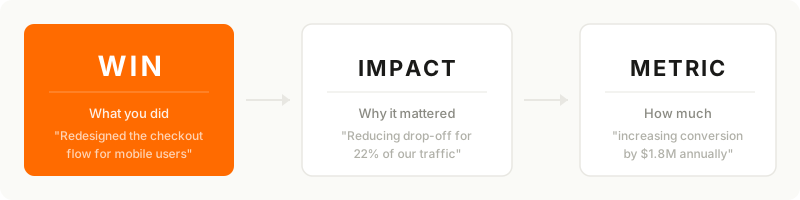
What I did → Impact it had → What I learned or what’s next
For heads of product, “what I did” should focus on decisions, frameworks, and leadership actions — not just ship dates. “Impact it had” connects the decision to an outcome or an organizational capability. “What’s next” demonstrates that your thinking has evolved and you can see around corners.
Phrases That Signal Seniority
| Instead of this | Write this |
|---|---|
| "We shipped the new dashboard" | "I made the prioritization call to invest Q2 in the dashboard rebuild over three competing initiatives — a bet on retention over acquisition — and the decision is validating: 30-day retention for active users improved 14 points in the quarter following launch" |
| "I managed the product team" | "I restructured the product team from feature-based to outcome-based squads, which required redefining every PM's scope and success metrics — a change that improved quarterly goal clarity and increased PM satisfaction scores from 62 to 84 in our next pulse survey" |
| "I worked with stakeholders" | "I drove alignment across Product, Engineering, Sales, and Customer Success on a revised ICP definition that changed how we prioritize features — the first time all four functions agreed on the same customer profile in the company's history" |
| "I want to get better at data" | "I am developing stronger quantitative judgment by partnering directly with our data analyst on cohort analysis for the next two quarters, with the goal of running my own Amplitude analyses independently by year-end" |
Product Strategy & Vision Self-Assessment Phrases
Strategic Direction
- "I authored our three-year product strategy document and led the cross-functional review process to reach genuine alignment — not just sign-off — from the CEO, CTO, and VP of Sales. The document has become the operating reference for roadmap trade-offs across four product squads and has reduced the frequency of scope-escalation debates in quarterly planning from a recurring problem to a rare exception."
- "I identified that our product was over-indexed on acquisition-stage features and under-invested in depth features for power users — a diagnosis supported by Amplitude retention data showing our 90-day power user retention was 28 points below industry benchmark. I rebalanced our roadmap for two consecutive quarters and the power user retention metric has since improved by 19 points."
- "I made the call to sunset two features that were consuming 20% of engineering capacity with less than 3% adoption. The decision required building internal consensus against significant sunk-cost thinking, and I invested in the process rather than forcing it — running a structured evaluation with the engineering and design leads that made the conclusion hard to dispute. The freed capacity funded two higher-conviction bets in Q3."
- "I developed a Jobs-to-be-Done framework for our core use cases and used it to rewrite our product positioning in collaboration with Marketing. The framework has changed how we write specs, how we evaluate feature requests, and how we talk to customers in discovery — it's now the shared language for what our product does and for whom."
Competitive & Market Positioning
- "I ran a competitive strategy review after a key competitor launched a feature that overlapped directly with our core value proposition. Rather than reacting with a defensive roadmap, I commissioned user research with 25 customers to understand how they perceived the competitive move. The research revealed we had a differentiation axis our competitor couldn't easily match — I built the roadmap response around that axis rather than feature parity, a call I believe was correct and that the data is beginning to support."
- "I identified a market adjacency that represented an untapped segment based on inbound signals from our sales team and win/loss data in Dovetail. I built the business case, ran a six-week discovery sprint with a dedicated PM and designer, and presented a go/no-go recommendation with clear success criteria to the leadership team. The initiative was approved and is currently in early access with 40 beta customers."
Team Leadership & Development Self-Assessment Phrases
PM Development
- "I hired three PMs this year, building a team that is now capable of running major initiatives without my direct involvement in day-to-day decisions — a deliberate transition from my role a year ago. I invested significantly in their development through weekly 1:1s, direct feedback on written work, and deliberate delegation of decisions I would previously have made myself. All three are performing at or above expectations."
- "I identified a product manager on my team who had strong execution skills but was not growing into strategic thinking. Rather than managing this as a performance issue, I redesigned her role to give her direct ownership of a discovery phase for a new initiative — a forcing function for strategic reasoning. She has since produced the clearest opportunity brief the team has written this year."
- "I restructured how my team operates in the discovery phase, introducing a standardized discovery brief template and a peer review step before any discovery moves to solutioning. The change has improved the quality and consistency of opportunity framing across the team and has made my reviews more efficient — I can assess a brief in 20 minutes rather than the 60 minutes the variable-format briefs used to require."
Team Health & Culture
- "I conducted individual career conversations with every PM on my team at the start of the year to understand their 2-3 year goals and designed their responsibilities with those trajectories in mind. In our mid-year engagement survey, the question 'my manager understands my career goals' improved from 61 to 88 — the highest score in that category across all engineering and product teams."
- "I diagnosed a collaboration breakdown between the product and engineering teams that was manifesting as repeated spec-change conflicts in sprints. I facilitated a structured retrospective, identified three root causes — all process rather than people — and implemented changes to the spec review and handoff process. Engineering satisfaction with product collaboration improved from 3.1 to 4.2 out of 5 in the following pulse survey."
Roadmap & Prioritization Self-Assessment Phrases
Prioritization Discipline
- "I introduced a structured prioritization framework — based on impact, confidence, and effort — to replace the implicit horse-trading that had characterized previous roadmap planning. Getting the team to trust the framework required demonstrating its use publicly and being willing to let it override my own preferences twice in the first quarter. It's now used consistently and has reduced the time our quarterly planning takes by 40%."
- "I made a controversial call to delay a customer-requested feature that had been on the roadmap for two quarters in favor of infrastructure work that would unblock three other features simultaneously. I communicated the decision and rationale clearly to the customers who had requested it, and held the position through significant internal pressure. The infrastructure shipped in six weeks and enabled the delivery of four features in the following quarter."
- "I track roadmap commitments versus delivery in a Linear dashboard that is visible to the entire product and engineering org. This transparency has changed the culture around estimation — teams now build in more realistic buffers, and when slippage happens, it surfaces earlier and is managed more proactively. Our on-time delivery rate for quarterly commitments improved from 58% to 79% over the year."
Scope & Trade-off Management
- "I introduced the practice of writing explicit trade-off memos for major roadmap decisions — documenting what we are not doing and why, alongside what we are doing. These memos have become the reference point when stakeholders revisit deprioritized requests, reducing the reopening of settled decisions and the associated leadership time spent re-litigating them."
- "I identified scope creep as a systematic problem on our largest initiative — the feature had grown from a three-month to a six-month project without a deliberate decision to expand scope. I ran a scope reset workshop, identified the minimum viable version that would generate the learnings we needed, and re-committed to a three-month timeline with the reduced scope. The initiative shipped in ten weeks."
Cross-functional Execution Self-Assessment Phrases
Engineering Partnership
- "I invested in rebuilding the product-engineering relationship after a period of repeated last-minute spec changes had eroded trust. I implemented a 'no spec changes after kickoff' norm with a formal exception process, gave engineering leads advance visibility on the next two sprints' priorities, and attended one engineering team retrospective per month to hear friction points directly. Engineering NPS toward product went from 31 to 67 over two quarters."
- "I partnered with the engineering lead to establish quarterly tech-debt investment as a standing allocation rather than a discretionary ask. This required making the business case for reliability and velocity in terms the finance team could evaluate, which I prepared as a formal proposal with three scenarios. The outcome was a 20% tech-debt allocation that has since reduced our incident rate and improved engineering velocity on net-new features."
Go-to-Market Alignment
- "I established a monthly product-to-sales briefing that gives the sales team advance visibility on roadmap direction and collects field intelligence on what prospects are asking about. The briefing has materially improved the quality of competitive positioning in sales calls — the win rate in competitive deals involving our core differentiator features has improved from 38% to 51% over the two quarters since launch."
- "I led the go-to-market planning for our largest launch of the year — a new pricing tier — working with Sales, Marketing, and Customer Success to align on positioning, rollout sequence, and customer communication. The launch reached 100% of its 90-day adoption target, and the GTM alignment I drove was cited by the CRO as the reason the rollout was smoother than previous pricing changes."
Customer & Market Insight Self-Assessment Phrases
Customer Research
- "I conducted 40 customer discovery interviews this year — more than any PM on my team and more than I had done in the prior two years combined. I treat this as a deliberate practice because I believe my strategic judgment degrades without direct exposure to customer thinking. The interviews have directly influenced three significant roadmap decisions and have prevented two initiatives that would have solved the wrong problem."
- "I built a customer advisory board of 12 enterprise users and ran four structured sessions this year in Dovetail, generating 180 tagged insights that are now searchable and referenced in spec work across the team. Before the CAB, our customer insight was ad-hoc and underdocumented — this infrastructure has meaningfully improved the quality of customer reasoning in product decisions."
- "I implemented a systematic win/loss review process, analyzing 80 closed opportunities with the sales team to understand what drove decisions for and against our product. The research identified a feature gap that appeared in 35% of lost deals — a finding that changed our H2 roadmap and has since been cited in two customer renewals as evidence we listened."
Market Intelligence
- "I established a competitive intelligence cadence — a monthly review of competitor releases, job postings, and customer community discussions — that keeps the product team informed and has caught three significant competitive moves before they affected our win rates. The practice has changed how we talk about competition internally: from reactive anxiety to calibrated awareness."
Org-level Impact Self-Assessment Phrases
Executive & Board Contribution
- "I presented product strategy to the board of directors twice this year, each time preparing materials that connected our roadmap investments to long-term competitive positioning and financial outcomes. After the second presentation, a board member asked me to connect with a portfolio company facing similar strategic questions — unsolicited recognition of the quality of my thinking at that level."
- "I contributed to our Series B fundraising process by preparing the product vision and roadmap materials for the investor data room and joining four investor conversations. The lead investor cited product clarity as a positive differentiator from other deals they evaluated — feedback relayed by the CEO after close."
Cross-org Influence
- "I drove the adoption of continuous discovery practices across two product teams that had previously operated on a 'batch research' model. I supported the change by running a training session, pairing with each PM for their first two discovery cycles, and making the results visible in our monthly product reviews. Both teams now run weekly customer touchpoints as a standard practice."
- "I led a cross-functional working group to define our data privacy product principles, bringing together Legal, Engineering, Design, and Product to establish guidelines that will govern every future feature that touches user data. The principles document has already been used to resolve two ambiguous decisions in feature design and has been referenced in our privacy policy update."
How Prov Helps Heads of Product Track Their Wins
Product leadership is dense with decisions — small ones that compound and large ones that define a year — but few of those decisions create a visible artifact at the time they’re made. The strategic call to cut a feature, the reframe that changed a team’s thinking, the 1:1 that accelerated a PM’s trajectory: these are the highest-value contributions, and they’re the first to be forgotten.
Prov lets you capture those moments in 30 seconds, as they happen. By review season, you have a documented record of not just what shipped, but why you made the calls you made and what changed as a result — the foundation of a head-of-product self-assessment that reads like leadership rather than a changelog. Prov is coming soon on iOS.
Ready to Track Your Wins?
Free to start, no account, no sign-up. Available on the App Store now.
Download on iOS Free to start, no account needed