A Head of Product is judged not by how many features shipped, but by whether the right problems were chosen, the right team was built to solve them, and the organization moved faster because of how they led.
How to Write Effective Head of Product Performance Reviews
Reviewing a Head of Product is one of the more demanding writing tasks a senior leader faces. The role operates at the intersection of strategy, execution, and people leadership — and the most consequential work is often invisible. The quality of a strategic bet isn’t legible until two or three quarters later. The team culture a product leader builds shows up in retention data and promotion rates, not meeting notes. The influence they exert across engineering, design, and sales frequently goes unattributed.
Start by separating outputs from inputs. Outputs — shipped features, roadmap completion rates, OKR scores — tell you what happened. Inputs are what a Head of Product actually controls: the quality of prioritization decisions, how clearly they translated user insight into engineering requirements, whether they built alignment or merely consensus. Strong reviews assess both layers, and they’re explicit about which is which.
The hardest part of writing these reviews is evaluating strategic bets that haven’t resolved yet. A Head of Product who made a well-reasoned call on a platform investment in Q2 should receive credit for the quality of that decision even if the returns materialize in the following fiscal year. Conversely, a leader who delivered against plan but only because the plan was deliberately conservative has a different performance story than a leader who made a genuine bet and won. Your review should distinguish between these cases.
Finally, cross-functional influence is where most Head of Product reviews fall short. Use concrete examples: Did they change how engineering estimated? Did they introduce a discovery process that reduced rework? Did they shift the sales team’s positioning? The absence of conflict is not the same as influence. The best product leaders leave fingerprints across functions — name them.
How to Use These Phrases
For Managers
These phrases are starting points, not copy-paste solutions. Every phrase works best when you replace the bracketed context with a real project, decision, or outcome from the review period. For a Head of Product, the most persuasive reviews cite specific product bets, team composition decisions, and influence moments — not role descriptions dressed up as accomplishments.
For Employees
If you’re a Head of Product preparing for your own review or writing a self-assessment, these phrases help you understand how strong performance is framed at your level. Read the “Exceeds” phrases and ask: which of these apply to my last 12 months? Then ask: do I have a specific example to back each one up? If not, you have your self-assessment gap list.
Rating Level Guide
| Rating | What it means for Head of Product |
|---|---|
| Exceeds Expectations | Made strategic bets that created durable competitive advantage; built and retained a high-performing team; drove measurable velocity improvements across engineering and design |
| Meets Expectations | Delivered against committed roadmap; led team effectively through normal operating conditions; maintained productive cross-functional relationships |
| Needs Development | Roadmap decisions reactive rather than proactive; team development inconsistent; cross-functional influence limited or primarily reactive |
Product Strategy & Vision Performance Review Phrases
Exceeds Expectations
- Consistently articulates a product vision that is both ambitious enough to inspire engineering investment and grounded enough to guide quarterly prioritization — the team rarely asks "why are we building this?"
- Proactively identified a market adjacency in Q2 and built a 12-month exploration thesis backed by Dovetail research and Amplitude cohort analysis, securing executive alignment before the opportunity became obvious to competitors.
- Independently developed a three-year product strategy that was adopted as the company's official product narrative in board materials and fundraising decks — a direct output of the rigor applied to customer and market research.
- Drives strategic clarity across the organization by translating ambiguous company goals into specific product bets with explicit assumptions, success metrics, and kill criteria documented in Notion.
- Demonstrates an unusual ability to hold a long-term vision while making short-term concessions without losing the thread — engineering and design report that strategy feels coherent even when priorities shift.
Meets Expectations
- Maintains a clear and well-communicated product vision that the team understands and can connect their daily work to; updates it when meaningful new information arrives.
- Translates company OKRs into product-level strategies with reasonable fidelity — the connection between business goals and roadmap choices is traceable and defensible.
- Engages regularly with market trends and competitive signals, incorporating relevant findings into strategy reviews and quarterly planning cycles.
- Communicates strategic direction with enough clarity that engineering and design can make autonomous decisions within defined guardrails.
- Makes strategic trade-offs explicitly rather than by omission — stakeholders understand what is not being pursued and why.
- Revisits and updates the product strategy at appropriate intervals — the vision is not set-and-forgotten but evolves as the business learns and the market shifts.
Needs Development
- Would benefit from developing a more structured approach to strategy articulation — the product vision is present but not consistently communicated in ways that help the team self-direct between planning cycles.
- Strategic decision-making is often reactive to stakeholder requests rather than proactive; developing a framework for evaluating inbound asks against defined strategic bets would improve consistency.
- Opportunities to connect roadmap choices to market dynamics are sometimes missed — building a more systematic competitive research practice would strengthen the strategic foundation of prioritization decisions.
- Longer-horizon thinking would strengthen the role's impact; current strategy work is often one quarter ahead rather than the 18-month horizon the role requires.
- Would benefit from documenting strategic assumptions more explicitly — when bets don't pan out, the team lacks the retrospective clarity to understand whether the bet was wrong or merely unlucky, which limits organizational learning.
Team Leadership & Development Performance Review Phrases
Exceeds Expectations
- Consistently invests in the development of individual PMs — three direct reports received promotions or significant scope expansions during this review period, a direct result of deliberate coaching and progressive responsibility assignment.
- Proactively restructured team ownership to match individual strengths to product areas, resulting in measurably higher PM confidence scores in quarterly surveys and a reduction in escalations to the Head of Product level.
- Independently built a PM hiring bar that has materially raised the quality of product thinking across the team — the interview process they designed is now used across the broader product org.
- Drives psychological safety on the product team by modeling intellectual honesty in strategy reviews — PMs report feeling comfortable surfacing dissenting data and reversing earlier decisions without social cost.
- Demonstrates rare skill in developing early-career PMs — takes on associate-level hires that other leaders defer, and reliably moves them to independent ownership within 18 months.
- Proactively built a PM onboarding program that has reduced ramp time for new product managers by an estimated six weeks — new hires report higher confidence and earlier autonomy as direct results of the structured onboarding investment.
- Independently identified retention risk on the product team and designed a career development conversation framework that reduced voluntary attrition to zero for the review period — a meaningful outcome given the competitive market for experienced PMs.
Meets Expectations
- Provides consistent, constructive feedback to direct reports through regular 1:1s and structured performance conversations; team members report feeling supported in their development.
- Makes sound staffing and scope decisions that match PM capability to product complexity — team members are appropriately challenged without being set up to fail.
- Recruits and retains strong product managers; attrition on the team is below org average and departures are driven by external opportunity rather than dissatisfaction.
- Develops team members through delegation and coaching rather than problem-solving on their behalf — PMs grow in autonomy over time under this leader.
Needs Development
- Team development would benefit from more structure — high-potential PMs are identified informally, but explicit growth plans and regular progress check-ins would accelerate their progression.
- Delegation patterns sometimes result in unclear ownership; establishing clearer decision rights between the Head of Product and direct reports would improve team confidence and reduce duplicated effort.
- Would benefit from investing more in the development of mid-level PMs — current coaching energy is concentrated at the senior end of the team, leaving some contributors underdeveloped.
- Hiring bar consistency needs development — PM interviews are run individually without a shared evaluation rubric, which produces inconsistent hiring decisions and makes debrief conversations harder to navigate.
Roadmap & Prioritization Performance Review Phrases
Exceeds Expectations
- Consistently produces roadmaps that are defensible on first principles — every prioritization decision in Linear traces back to explicit customer evidence from Dovetail or behavioral data from Amplitude, not stakeholder preference.
- Proactively developed a prioritization framework that reduced roadmap thrash by an estimated 40% — cross-functional partners report that the roadmap is more predictable and that mid-quarter reprioritizations are rarer and better explained.
- Independently navigated a major scope conflict between enterprise sales commitments and platform investment priorities, finding a sequencing solution that honored both without delaying either by more than one sprint.
- Drives healthy debate in roadmap reviews by requiring explicit trade-off documentation — the team defaults to rigorous analysis rather than advocating for pre-decided outcomes.
Meets Expectations
- Maintains a roadmap that is well-structured, appropriately sequenced, and communicated to stakeholders with sufficient lead time for engineering planning and go-to-market preparation.
- Balances competing stakeholder interests in prioritization decisions with reasonable transparency — rationale is shared and stakeholders understand the trade-offs even when they disagree with the outcome.
- Manages roadmap changes responsibly — scope changes are communicated proactively, impact on downstream teams is assessed, and the team rarely encounters surprise reprioritizations.
- Applies a consistent prioritization methodology; decisions are traceable and the team can explain the reasoning behind what is on and off the roadmap at any point.
- Manages the ratio of maintenance to new feature work sensibly — technical health investments are protected even under delivery pressure, and the roadmap reflects realistic engineering capacity rather than aspirational throughput.
Needs Development
- Prioritization decisions would benefit from more explicit documentation of trade-offs — stakeholders sometimes feel that roadmap choices are presented as final rather than reasoned, which reduces buy-in and increases revision cycles.
- Roadmap predictability has been inconsistent this period; developing more robust capacity estimation practices in partnership with engineering leadership would reduce the frequency of scope slippage.
- Would benefit from greater rigor in killing or deferring low-value work — the current roadmap carries too many small items that dilute team focus without delivering proportionate user or business impact.
- Stakeholder roadmap communication needs improvement — updates are reactive rather than proactive, which means stakeholders frequently have outdated expectations and changes land as surprises rather than informed decisions.
Cross-functional Execution Performance Review Phrases
Exceeds Expectations
- Consistently builds organizational trust that accelerates execution — because cross-functional partners believe the product team's commitments are reliable and well-reasoned, the time spent on alignment and negotiation has dropped measurably over the review period.
- Proactively created a shared product-engineering-design operating model that clarified decision rights, reduced meeting overhead, and gave each function the autonomy they needed to move faster — teams report shipping with less friction than at any previous point.
- Consistently serves as a force-multiplier across engineering, design, and go-to-market — cross-functional partners name this leader as the person most responsible for shipping discipline improving across the org in the past year.
- Proactively built a launch readiness process with sales, marketing, and customer success that reduced post-launch issue escalations by over 30% and gave GTM teams two additional weeks of preparation time on average.
- Independently resolved a recurring friction point between product and engineering by introducing async RFC reviews in Notion — reduced the frequency of "surprise" scope additions by the middle of sprints and improved sprint completion rates.
- Drives alignment rather than consensus — uses data from Figma prototypes and Amplitude experiments to resolve cross-functional disagreements rather than defaulting to committee decisions.
- Demonstrates exceptional skill at managing upward and laterally simultaneously — keeps executives informed without creating bureaucratic overhead for the team, and keeps cross-functional peers aligned without slowing down delivery.
Meets Expectations
- Manages cross-functional relationships effectively — engineering, design, and GTM partners report that handoffs are clean, expectations are set early, and escalations are handled constructively.
- Maintains productive working relationships with sales and customer success, ensuring that customer-facing commitments are reflected in roadmap planning and that product changes are communicated with adequate lead time.
- Communicates product decisions to non-technical stakeholders clearly — executives and commercial partners understand the product strategy without requiring translation from the engineering or design team.
- Navigates cross-functional conflict with maturity — disagreements are raised and resolved at the working level rather than escalated unnecessarily.
- Maintains a productive feedback loop with design — Figma reviews are substantive rather than ceremonial, and design direction reflects genuine alignment between product intent and design execution.
Needs Development
- Cross-functional communication would benefit from greater proactivity — GTM and engineering partners have occasionally been surprised by roadmap changes or product decisions that were made without adequate notice.
- Building stronger collaborative relationships with the commercial side of the business would improve product-market fit; current feedback loops between sales, customer success, and product discovery are underutilized.
- Would benefit from developing a more systematic stakeholder management approach — high-visibility partners are well-managed, but lower-profile cross-functional dependencies sometimes receive insufficient attention until they become blockers.
- Cross-functional influence outside product and engineering needs development — the product leader's voice is underrepresented in go-to-market planning and pricing discussions where product insight would materially improve decision quality.
Customer & Market Insight Performance Review Phrases
Exceeds Expectations
- Independently built a customer advisory board that has become a genuine source of product direction rather than a showcase — members provide candid early feedback on direction changes, and their input has visibly shaped two major roadmap decisions this year.
- Consistently grounds product decisions in primary customer research — runs or commissions Dovetail studies before major investment decisions and uses Amplitude data to challenge internal assumptions rather than confirm them.
- Proactively built a continuous discovery practice that runs in parallel with delivery, ensuring the team always has fresh customer signal informing the next planning cycle rather than relying on periodic research sprints.
- Independently identified a customer segment that was underserved by the current product, built the business case from behavioral data and qualitative interviews, and secured investment to address it — that segment now represents 18% of new ARR.
- Drives customer empathy across the product team by requiring direct customer exposure as a condition of autonomous decision-making — PMs who own discovery loops make faster, more confident prioritization calls.
- Demonstrates mature competitive intelligence practices — monitors competitor signals systematically and translates them into concrete product implications rather than reactive positioning updates.
Meets Expectations
- Regularly incorporates customer research into product planning; Dovetail findings and Amplitude behavioral data inform prioritization decisions and are referenced in strategy documents.
- Maintains awareness of the competitive landscape and incorporates competitive signals into roadmap and positioning decisions at appropriate intervals.
- Ensures the team has regular access to customers through interviews, usability studies, and feedback channels — product decisions are made with genuine customer input, not assumptions.
- Uses quantitative and qualitative research methods appropriately — reaches for behavioral data to understand what is happening and qualitative interviews to understand why.
- Translates customer and market insight into product requirements with reasonable fidelity — engineering and design teams receive briefs that reflect genuine user needs rather than internal assumptions dressed up as user feedback.
Needs Development
- Customer research practices would benefit from greater systematization — insight collection currently depends heavily on individual PM initiative; a shared discovery process would improve the consistency and quality of customer signal across the team.
- Competitive analysis has been reactive this period; developing a more proactive market monitoring practice would give the team earlier notice of shifts that affect product strategy.
- Would benefit from spending more direct time with customers rather than relying solely on synthesized research — firsthand exposure would strengthen both the quality of insight and the team's confidence in the direction being set.
- Customer insight sharing with cross-functional partners needs development — research that would benefit GTM and sales positioning often stays within the product team; developing a habit of sharing relevant customer signal broadly would improve organizational alignment.
How Prov Helps Build the Evidence Behind Every Review
The hardest part of writing a Head of Product review — for managers and for the individual themselves — is assembling the evidence. The strategic bet made in February, the hiring bar redesigned in April, the cross-functional conflict resolved without escalation in July: none of these show up in a dashboard, and most are forgotten by the time December review prep begins.
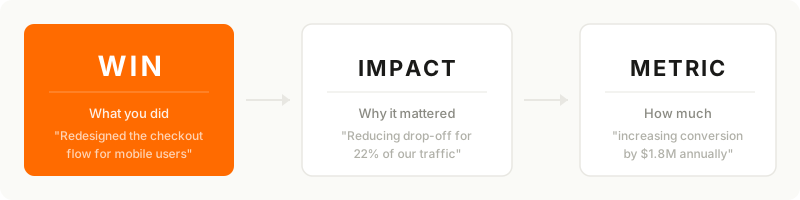
Prov is designed for exactly this problem. Heads of Product and the PMs they manage can capture wins in 30 seconds — a rough note about a decision made, a customer insight that changed the roadmap, a team moment worth remembering. Prov transforms those rough inputs into polished accomplishment statements, extracts the underlying skills and patterns, and stores them as a permanent record. When review season arrives, the evidence is already documented, organized, and ready to reference — whether you’re writing a self-assessment, preparing your manager for your review, or writing reviews for your direct reports.
Ready to Track Your Wins?
Free to start, no account, no sign-up. Available on the App Store now.
Download on iOS Free to start, no account needed