Ready-to-use growth manager accomplishment examples organized by competency — user acquisition, conversion optimization, retention and LTV, product-led growth, experimentation, and revenue growth.
Why Growth Managers Struggle to Document Their Impact
Growth is one of the most results-oriented functions in any company. You live in dashboards. You run experiments daily. You move metrics that the entire business watches. And yet, when performance review season arrives, growth managers consistently undersell themselves — because the metric moved, but no one wrote down what you specifically did to move it.
A 12% lift in activation doesn't explain itself. Was it the onboarding flow redesign? The cohort analysis in Amplitude that revealed the aha moment? The Braze campaign that re-engaged dormant users in the critical first week? The A/B test you ran and iterated on three times before finding the winning variant? All of that is your work. None of it is visible unless you document it.
Growth managers also carry infrastructure work that rarely surfaces in KPI reviews: building event tracking in Segment, setting up funnels in Amplitude, establishing the experimentation framework the whole product team now uses. These are career-defining contributions that get forgotten because they don't have a metric attached. They deserve to be written down too.
What gets you promoted are documented accomplishments with measurable impact — and the story of how you produced them.
From Weak to Strong: The Growth Manager Version
| Level | Example | Why It Lands (or Doesn't) |
|---|---|---|
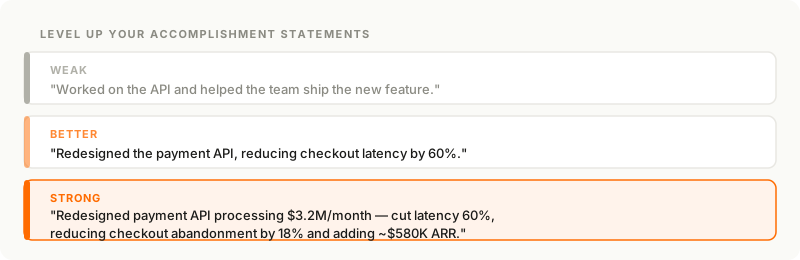
| Weak | "Improved onboarding flow." | No metric, no action, no context. Could describe any change by anyone. |
| Better | "Redesigned the onboarding flow and improved activation rate." | Clearer action, but still no number, no tool, no timeframe. |
| Strong | "Redesigned the 4-step onboarding flow in Appcues based on Amplitude funnel data showing a 54% drop-off at step 2 — activation rate improved from 31% to 47% within 6 weeks, adding an estimated 1,200 activated users per month at current traffic levels." | Specific action, named tools, quantified outcome, timeframe, business impact. |
Growth Manager Accomplishment Categories
| Competency | What Reviewers Look For |
|---|---|
| User Acquisition | Can you build and scale efficient paid and organic channels? |
| Conversion Optimization | Do you systematically improve funnel performance with evidence? |
| Retention & LTV | Can you keep users engaged and grow their value over time? |
| Product-Led Growth | Do you build loops and features that drive acquisition through the product itself? |
| Experimentation & A/B Testing | Do you run a rigorous, high-velocity test program? |
| Revenue Growth | Can you connect growth work to monetization outcomes? |
User Acquisition Accomplishments
- "Reduced blended customer acquisition cost from $94 to $61 over two quarters by reallocating paid budget from Google Search to Meta Advantage+ campaigns based on Mixpanel cohort data showing higher 30-day retention from social-acquired users."
- "Scaled paid acquisition from $40K to $120K monthly ad spend while holding CAC flat by building a creative testing framework in Meta Ads Manager — launched 18 ad variants per month and paused underperformers within 72 hours of launch."
- "Grew organic search traffic by 64% year-over-year by identifying 340 bottom-of-funnel keyword opportunities through Ahrefs, briefing a content team to produce 28 landing pages, and tracking conversion performance in Segment."
- "Built a referral program using ReferralHero seeded with the top 15% of engaged users identified in Amplitude — 22% of new signups in Q3 were referred, at a CAC 71% lower than the paid acquisition average."
- "Improved paid social ROAS from 1.8x to 3.1x over 3 months by introducing dynamic creative optimization in Meta and shifting budget toward lookalike audiences built from Mixpanel's highest-LTV user cohort."
- "Launched a creator partnership program with 14 mid-tier influencers tracked via unique Segment sources — drove 8,600 app installs in 6 weeks at a cost-per-install 38% below the paid channel average."
- "Designed and executed an App Store Optimization overhaul — updated screenshots, revised description copy, and ran keyword experiments in App Store Connect — organic installs increased 29% within 8 weeks with no additional spend."
- "Built a co-marketing pipeline with 6 complementary SaaS tools targeting the same ICP, tracked via HubSpot — joint newsletter placements and integration spotlights drove 1,900 net-new signups over 90 days at zero incremental cost."
- "Established UTM governance and attribution standards across all acquisition channels in Segment — reduced unattributed traffic from 34% to 8% and enabled accurate CAC reporting by channel for the first time."
Conversion Optimization Accomplishments
- "Improved free trial-to-paid conversion from 18% to 27% over two quarters by identifying the three product actions most correlated with conversion in Amplitude and rebuilding onboarding to drive users to each action within day 1."
- "Reduced pricing page bounce rate from 62% to 41% by running 4 sequential A/B tests in Optimizely — tested headline framing, plan layout, and CTA copy; the winning variant increased checkout initiations by 33%."
- "Rebuilt the signup form to reduce required fields from 9 to 4 based on Hotjar session recording analysis — conversion from landing page to registered account increased from 23% to 38% within two weeks, validated across 3 traffic sources."
- "Introduced a product-qualified lead score in HubSpot using Segment behavioral events — sales team prioritized PQL outreach over MQLs, and outbound-to-meeting conversion improved from 11% to 19% within one quarter."
- "Ran a checkout abandonment recovery campaign in Braze using behavioral triggers — recovered 14% of abandoned checkouts, generating $48K in incremental monthly revenue at a 9:1 ROI."
- "Identified a mobile-specific conversion gap through Amplitude device segmentation — mobile web conversion was 2.4x lower than desktop. Rebuilt the mobile checkout flow; the gap narrowed from 2.4x to 1.3x within 6 weeks."
- "Developed a lead nurture sequence in HubSpot for trial signups who had not activated within 48 hours — 6-email sequence drove a 19% reactivation rate and contributed 340 additional paid conversions in Q2."
- "Partnered with engineering to instrument the full activation funnel in Segment for the first time — surfaced 3 previously invisible drop-off points and unblocked a roadmap of conversion experiments that had been stalled on missing data."
- "Redesigned the 4-step onboarding flow in Appcues based on Amplitude funnel analysis showing 54% drop-off at step 2 — activation rate improved from 31% to 47% within 6 weeks, adding an estimated 1,200 activated users per month."
Retention and LTV Accomplishments
- "Improved 90-day retention from 38% to 52% over 6 months by identifying the aha moment — 3 core actions completed in the first week — through Mixpanel cohort analysis, then rebuilding onboarding to drive users there within 24 hours."
- "Reduced monthly churn from 6.2% to 3.8% by launching a Braze-powered early disengagement intervention — users showing churn signals received a targeted in-app message and personal CS outreach within 48 hours."
- "Increased net revenue retention from 94% to 108% by building an expansion revenue motion: identified upsell-ready accounts using Amplitude usage signals and routed them automatically to a dedicated growth sales rep via HubSpot."
- "Grew average customer LTV from $340 to $510 over 12 months by restructuring the mid-tier plan, introducing annual billing incentives, and reducing involuntary churn through Stripe Radar and a Braze dunning sequence."
- "Designed a re-engagement campaign in Braze for dormant users with no login in 30 days — 3-message sequence with personalized content recommendations drove 22% of dormant users back to active status within 14 days."
- "Launched a customer health score in Amplitude using 7 engagement signals — Customer Success used it to prioritize QBR outreach and proactive interventions, reducing estimated at-risk churn by $180K ARR in Q3."
- "Reduced involuntary churn by 31% by implementing a failed payment recovery flow — card update nudges sent via Braze 5, 3, and 1 day before expiry combined with Stripe Smart Retries recovered 68% of previously churned payment failures."
- "Built a power user program for the top 15% of engaged accounts identified in Mixpanel — early feature access and a dedicated Slack channel drove 97% retention for power users versus 71% for the rest of the base."
- "Introduced cohort-based retention reporting in Mixpanel broken down by acquisition channel, plan type, and onboarding path — surfaced that organic search users retained at 2.1x the rate of paid users, which shifted $60K in monthly acquisition budget."
Product-Led Growth Accomplishments
- "Designed and launched a viral sharing loop — users could publish a shareable results page tracked via Segment — 18% of new signups in the first quarter cited a shared link as their entry point, at zero additional acquisition cost."
- "Led the freemium tier launch — defined feature gates using Amplitude usage data, set limits that maximized upgrade intent, and instrumented upgrade prompts in Appcues. Freemium-to-paid conversion hit 9.4% in the first 90 days against a 7% target."
- "Identified the product's activation metric — users completing 3 core actions in week 1 retained at 3.4x the rate of those who did not — through Amplitude cohort analysis. This definition became the company's official activation north star and anchored the product team's Q3 roadmap."
- "Built a contextual in-app upgrade prompt system using Appcues triggered at feature gates — prompts converted at 6.8% compared to 1.2% for email-based upgrade campaigns, adding $31K in monthly upgrade revenue within 2 months of launch."
- "Collaborated with product to add teammate invitations as a required onboarding step after Amplitude analysis showed invited users retained at 2.8x the rate of solo users — teammate invite rate grew from 14% to 41% within 6 weeks."
- "Launched an embeddable widget tracked in Segment — 3,200 widget installations generated 1,800 click-throughs and 420 new signups in the first quarter, creating a fully self-sustaining acquisition loop with no ongoing spend."
- "Introduced a weekly product usage digest email sent via Braze using each user's own activity data — 48-hour re-engagement rate among digest recipients was 3.1x higher than non-recipients in a holdout test, making it the highest-performing retention lever in the channel stack."
- "Ran a jobs-to-be-done interview series with 24 churned users and synthesized findings in a shared doc — identified 3 unmet use cases, 2 of which were added to the H2 product roadmap after the growth team presented the research."
Experimentation and A/B Testing Accomplishments
- "Built the company's first structured A/B testing program using Optimizely — established hypothesis templates, minimum detectable effect calculations, and a weekly results review cadence. Team experiment velocity grew from 2 to 9 tests per month within one quarter."
- "Ran 43 experiments in 12 months with a 38% win rate — 16 winning variants were shipped to production, contributing a cumulative estimated $620K in additional annual recurring revenue based on holdout analysis."
- "Designed a holdout group methodology in Amplitude to measure the true incremental impact of lifecycle campaigns — discovered that 3 campaigns the team considered high-performing had near-zero incremental lift, freeing 14 hours per week of marketing operations time."
- "Ran a multivariate test on the activation email sequence — tested subject line, send timing, and body copy in a 2x2x2 design using Braze. Winning combination improved email-to-activation conversion by 28%, adding 340 activations per month at current send volume."
- "Identified a novelty effect problem in the team's experimentation practice — tests were being called at 4–5 days before reaching statistical significance. Introduced a 14-day minimum run time policy and re-evaluated 6 prior tests; 2 were reclassified as inconclusive."
- "Built a shared experiment repository in Notion with all test results, methodologies, and learnings — eliminated 4 instances of teams running duplicate experiments and became the foundation for a quarterly growth review with the VP of Product."
- "Ran a pricing experiment testing monthly versus annual billing emphasis on the pricing page in Optimizely — annual-first layout increased annual plan selection from 29% to 44%, improving projected LTV for new subscribers by an estimated 2.3x."
- "Introduced feature flags in LaunchDarkly for all growth experiments — enabled instant rollback capability, reduced experiment deployment time from 3 days to 4 hours, and allowed simultaneous multi-variant tests without engineering bottlenecks."
Revenue Growth Accomplishments
- "Grew monthly recurring revenue from $280K to $490K over 12 months by compounding improvements across acquisition (lower CAC), activation (higher conversion), and retention (lower churn) — modeled the contribution of each lever in a cohort-based revenue model built in Mixpanel."
- "Launched an annual plan incentive campaign in Braze targeting month-to-month subscribers — offered 2 months free on annual; 34% of targeted users upgraded, converting $62K in monthly MRR to committed ARR and reducing near-term churn exposure."
- "Designed a usage-based upsell trigger in Braze that fired when users hit 80% of their plan limit — in-app message and email combination converted 21% of triggered users to the next tier, adding $18K in monthly expansion revenue."
- "Led the monetization model change from per-seat to usage-based pricing — modeled impact across 14 customer segments using Amplitude usage data, ran a 90-day migration with a dedicated Braze communication sequence, and increased ARPU by 34% with less than 3% involuntary churn."
- "Partnered with finance to build a revenue attribution model connecting Segment events to Stripe revenue — enabled the first accurate channel-level ROI calculation and informed a $200K reallocation of marketing spend toward the two highest-ROI acquisition channels."
- "Designed a win-back campaign in Braze for churned paid users lapsed 30–180 days — personalized offer based on last-used features identified in Mixpanel. 11% of targeted users resubscribed, recovering $24K in MRR in the first campaign cycle."
- "Identified through Amplitude conversion analysis that enterprise trial users who received a live demo converted at 4.2x the rate of self-serve trials — coordinated with sales to launch proactive demo outreach for all enterprise signups, increasing enterprise conversion from 8% to 19%."
How to Adapt These Examples
Plug In Your Numbers
Every example above follows: [Action] + [Specific work] + [Tool used] + [Measurable result]. Replace the numbers with yours. If your activation rate went from 24% to 36%, use those numbers. If the experiment program you built now runs 6 tests a month instead of 1, that is the number that belongs here. The structure is the template — the specifics are yours.
Don't Have Clean Metrics?
Growth work is often metrics-rich, but attribution is messy and not every experiment has a clean result. For infrastructure and process work — building the event tracking, establishing the testing framework, setting up dashboards — describe the before and after state explicitly: "Before this, the team had no reliable funnel data. After, we could see drop-off at every step." For inconclusive experiments, the contribution is still real: you eliminated a hypothesis, saved the team from shipping a bad idea, or built methodology that improved future tests.
Match the Level
Junior growth managers should emphasize experiment execution, funnel analysis, and specific campaign results — the work you did and what it produced. Senior growth managers and leads should weight the systems they built: the experimentation framework, the attribution model, the activation metric definition that changed how the whole product team works. Heads of growth should connect everything to business outcomes: MRR, LTV, CAC payback, and the organizational capability they built that will compound beyond any single quarter.
How Prov Helps Growth Managers Track Their Wins
The hardest part of performance reviews is not writing the accomplishments — it is remembering what you did 9 months ago. An experiment you ran in Q1 that compounded into a Q3 result is easy to lose track of. A funnel insight that reshaped the roadmap gets forgotten once the next sprint starts.
Prov captures your wins in 30 seconds — voice or text — immediately after the work happens. You describe the rough outcome in plain language. Prov transforms it into a polished accomplishment statement like the ones in this post, extracts the skills involved, and builds a searchable archive of your growth work over time.
When review season arrives, your accomplishments are already written. You are not trying to reconstruct 12 months of context from Slack threads and Amplitude dashboards — you are editing and selecting from a library of documented wins. Prov is coming soon on iOS.
Ready to Track Your Wins?
Free to start, no account, no sign-up. Available on the App Store now.
Download on iOS Free to start, no account needed