Frontend engineers are the only engineers whose work is literally visible to every user — yet they're also the ones most often asked to translate "the button is 2px off" into a business outcome that justifies a senior-level compensation review.
Why Self-Assessments Are Hard for Frontend Engineers
Frontend engineers sit at the intersection of technical depth and user experience, which means their work is simultaneously too granular and too abstract for a standard performance review. A Lighthouse score improvement from 62 to 91 is meaningful — but to a non-technical manager, it sounds like moving a number rather than improving a product. The self-assessment challenge is building the bridge between the milliseconds and the revenue.
There’s also a perception problem. Frontend work is often dismissed as “just UI” until something breaks — and when it does, the blame is immediate. The wins, by contrast, tend to be invisible: the layout that renders correctly on every device, the form that never loses user data, the animation that runs at 60fps without melting a phone battery. Documenting invisible correctness requires a different kind of discipline than documenting visible features.
Cross-functional work adds another layer. Frontend engineers are uniquely positioned at the boundary of design, product, and engineering — attending design reviews, writing tickets, reviewing Figma files, and debugging production issues simultaneously. That breadth is hard to summarize in a competency box without it reading as scattered rather than versatile.
The goal: write phrases that connect technical specifics — bundle sizes, Lighthouse scores, TypeScript coverage, Playwright test counts — to user experience and business outcomes, without losing the technical substance that earns credibility with engineering managers.
How to Structure Your Self-Assessment
The Three-Part Formula
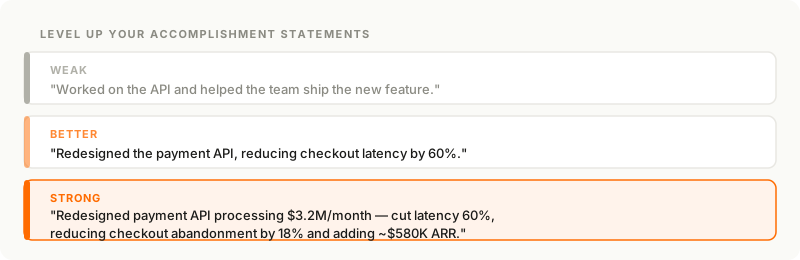
What I did → Impact it had → What I learned or what’s next
In frontend, “what I did” is the technical work. “Impact it had” is the user or business outcome. “What’s next” signals that you understand where the platform or product is heading and how your work fits into it.
Phrases That Signal Seniority
| Instead of this | Write this |
|---|---|
| "I built the checkout UI" | "I owned the checkout redesign end-to-end, from Figma handoff review to production, and reduced form abandonment by 18% in the first month through accessibility improvements and inline validation" |
| "I improved performance" | "I reduced our largest bundle from 1.4MB to 680KB through code splitting and lazy loading, improving LCP on the landing page from 4.1s to 1.8s and increasing our Lighthouse performance score from 58 to 91" |
| "I fixed a lot of bugs" | "I reduced our open frontend bug backlog from 94 to 31 over the quarter by triaging, root-causing, and fixing issues systematically — and introduced a Playwright regression test for every bug closed" |
| "I want to get better at TypeScript" | "I am targeting full strict-mode TypeScript coverage on the shared component library by Q3, starting with the form components where we've had the most runtime type errors in production" |
Feature Delivery & Quality Self-Assessment Phrases
Feature Ownership
- "I owned the end-to-end delivery of the onboarding flow redesign in React and Next.js, from design handoff through production rollout. The new flow reduced time-to-first-action by 34% and increased activation in the first session by 22% — the largest single-feature activation improvement in our product's history."
- "I shipped the real-time notification system on a six-week timeline that initially seemed impossible, delivering a working implementation using WebSockets and React's concurrent rendering without blocking the wider team. I identified two scope items that could be phased to a follow-up sprint and made that trade-off visible to product three weeks before it would have become a crisis."
- "I took ownership of a feature that had been stuck in development for two months due to a complex state management problem. I rebuilt the data flow using React Query with an optimistic update strategy, resolved the conflict, and shipped within two weeks. The new approach became the team standard for similar patterns."
- "I delivered all five features I committed to this half with zero post-launch P1 incidents. I achieve this by treating the Playwright end-to-end test suite as a hard gate before any PR is merged, which adds two days to delivery timelines but has eliminated the 'fix it in prod' pattern I observed in prior cycles."
Code Quality
- "I raised TypeScript strict-mode coverage in our core application from 43% to 89% over two quarters, eliminating a class of runtime type errors that had been appearing in our error tracking at a rate of roughly 20 per week. The investment also made refactoring significantly safer — I can now confidently rename or reshape a shared type and trust the compiler to catch every downstream usage."
- "I introduced a GitHub Actions workflow that runs Lighthouse CI on every pull request and fails builds that regress our Core Web Vitals below defined thresholds. Since deployment, we've caught and fixed four performance regressions before they reached users — including one that would have pushed our LCP above 4 seconds during a peak traffic period."
Performance & Core Web Vitals Self-Assessment Phrases
Bundle & Load Performance
- "I conducted a systematic audit of our JavaScript bundle using Webpack Bundle Analyzer and identified $1.4MB of unnecessary dependencies in our main chunk. After implementing route-based code splitting, dynamic imports for heavy third-party libraries, and tree-shaking improvements, our initial bundle dropped to 680KB — a 51% reduction that improved our LCP on the landing page from 4.1s to 1.8s."
- "I eliminated 800ms of render-blocking behavior on our checkout flow by deferring three non-critical scripts and inlining critical CSS. The Lighthouse performance score for the checkout path improved from 61 to 88, and we saw a statistically significant reduction in checkout abandonment in the A/B test we ran during the rollout."
- "I built a performance budget enforcement system into our CI pipeline that tracks bundle size, LCP, and CLS across our five key user journeys on every merge to main. The system has caught regressions from eight PRs that would otherwise have degraded the user experience silently."
- "I resolved a CLS issue on our product listing pages that was caused by late-loading image dimensions. By adding explicit width and height attributes and implementing a skeleton loading pattern, I reduced the CLS score from 0.28 to 0.04 — moving us from 'needs improvement' to 'good' in Google's Core Web Vitals assessment, with measurable improvement in our organic search click-through rate in the following month."
Runtime Performance
- "I identified a severe re-render cascade in our dashboard component that was causing 800ms freezes during data updates. By profiling in React DevTools, I traced the issue to a missing memo boundary and an unstable object reference in a context provider. The fix reduced re-renders by 90% and eliminated the freeze entirely, improving the experience for our highest-usage feature."
- "I optimized our data table component to use virtualization via react-window, reducing DOM node count from 8,000+ to under 200 for large datasets. The change made the table usable on lower-end devices for the first time and reduced the support tickets we were receiving from enterprise users on older hardware by approximately 60%."
Component System & Architecture Self-Assessment Phrases
Design System Contribution
- "I led the migration of our UI component library from a hand-rolled CSS system to a Storybook-documented component library with design token support. The migration consolidated 14 different button variants into 4 intentional variants, reduced our UI-related bug reports by 35%, and gave the design team a shared vocabulary with engineering that has visibly accelerated design handoffs."
- "I built the form primitive layer for our design system — inputs, selects, checkboxes, and radio groups — with full TypeScript generics, accessible ARIA attributes, and Storybook stories for every variant. Three other teams have adopted these components, and our product designer noted that it has halved the time she spends specifying interaction states in Figma because the system now has authoritative defaults."
- "I introduced a component composition pattern that replaced our inheritance-based customization approach with a slots-and-overrides API. The new pattern has made it possible to customize components without forking them, reducing the number of one-off component variants in the codebase from 23 to 6 over the two quarters since introduction."
Architecture Decisions
- "I drove the team's adoption of a server-component-first architecture in Next.js, presenting the performance and developer experience case to the team and running a proof of concept on two existing pages before proposing a broader migration plan. The pages migrated to server components saw an average LCP improvement of 1.2 seconds and a 30% reduction in client-side JavaScript."
- "I proposed and got alignment on moving our global state management from a monolithic Redux store to a collocated server-state and local-state approach using React Query and Zustand. The migration reduced the cognitive overhead of state debugging significantly and eliminated a class of cache invalidation bugs that had been recurring quarterly."
Accessibility & Standards Self-Assessment Phrases
WCAG & Keyboard Navigation
- "I conducted an accessibility audit of our core user flows using axe-core and manual keyboard navigation testing, identifying 34 violations — 11 of which were WCAG AA failures. I prioritized and fixed all 11 critical violations within the quarter, reducing our legal exposure and improving the experience for users relying on assistive technology."
- "I rebuilt our modal, dropdown, and tooltip components with correct ARIA roles, focus trapping, and keyboard navigation — fixing patterns that had been broken since the components were originally written. The repair work also surfaced two focus management bugs in our auth flow that were preventing screen reader users from completing sign-in."
- "I added automated accessibility testing to our Playwright suite, covering keyboard navigation and ARIA semantics for our 12 highest-traffic pages. The suite runs in CI and has already caught three regressions introduced by other engineers who were unaware of the accessibility implications of their changes."
- "I ran a two-session accessibility workshop for our frontend team, covering WCAG principles, common patterns, and how to use axe-core and the browser accessibility tree inspector. In the sprint following the workshop, two engineers proactively flagged and fixed accessibility issues in their own PRs before review — a behavioral change that will compound over time."
Cross-browser & Device Standards
- "I diagnosed and resolved a Safari-specific rendering issue in our date picker component that had been affecting 18% of our user base for two months. The root cause was a flex gap incompatibility I identified through systematic cross-browser testing in BrowserStack. I added a Safari regression test to our Playwright suite and documented the pitfall for the team."
- "I implemented a progressive enhancement strategy for our video playback feature that provides a working experience for users on slow connections and older browsers. Usage analytics showed 12% of our user base was experiencing errors with the previous implementation — the enhanced version has reduced that to under 1%."
Collaboration & Design Handoff Self-Assessment Phrases
Design Partnership
- "I established a design review practice for my team where engineers review Figma files before implementation begins, flagging technical feasibility questions and component reuse opportunities. The practice has reduced the number of mid-sprint design changes by approximately 40% and improved the relationship between engineering and design — our designer now joins sprint planning to discuss implementation constraints proactively."
- "I worked closely with our product designer to define interaction specifications for our new animation system, translating design intent from Figma prototypes into concrete timing, easing, and trigger specifications that other engineers could implement consistently. The collaboration produced a motion guidelines document that is now used as the authoritative reference for all animated components."
- "I identified a category of Figma component that was being redefined every sprint by different designers because there was no system-level ownership. I proposed and facilitated a component ownership workshop, and we established clear ownership and versioning for 18 shared components — reducing the design inconsistency that had been causing rework in engineering."
Cross-functional Communication
- "I improved my practice of writing implementation notes in pull requests this cycle — specifically explaining performance tradeoffs and browser compatibility considerations in language that product managers and designers can follow. Two PMs have told me directly that they now understand our frontend decisions better and feel more confident making informed trade-off calls."
- "I proactively flagged a technical risk in a proposed product feature four weeks before its scheduled development start, identifying that the animation spec as written would cause frame drops on mid-range Android devices. I proposed a design alternative that preserved the intent with better performance, and the product team accepted it without the feature needing to be descoped."
Technical Leadership Self-Assessment Phrases
Mentorship & Standards
- "I mentored two mid-level engineers on performance optimization techniques this cycle, running paired profiling sessions using Chrome DevTools and React DevTools. Both engineers are now independently identifying and resolving performance issues in their own work — one found and fixed a virtualization opportunity that I had not spotted, which was a clear signal that the mentorship had transferred the skill, not just the fix."
- "I raised the testing standard on our frontend team by introducing a code review norm where any new interactive component requires at least one Playwright user-journey test before merge. Initial resistance faded within three weeks as engineers saw the tests catching regressions they would previously have found in production."
- "I created a frontend onboarding guide covering our Next.js conventions, state management patterns, component library usage, and testing practices. The last three engineers to join the team used it as their primary onboarding reference and all three were shipping independently in their second week — a week faster than the previous cohort."
Technical Direction
- "I led a technical spike on migrating our CSS architecture from a global stylesheet to CSS Modules, presenting findings on bundle impact, developer experience, and migration effort. The team adopted the approach, and I led a phased migration that has so far covered 60% of our pages without disrupting ongoing feature work."
- "I wrote and got consensus on an architectural decision record defining our approach to client-side data fetching, resolving a years-long inconsistency where different parts of the codebase used fetch, Axios, and SWR interchangeably. Standardizing on React Query has improved developer experience and eliminated two categories of cache bug."
How Prov Helps Frontend Engineers Track Their Wins
Frontend engineering produces dozens of discrete wins every quarter — a Lighthouse score improved, a component extracted, a type error category eliminated, a design spec gap caught before implementation. But these wins are easy to forget by review season, because they feel like normal work rather than achievements.
Prov lets you capture those wins in 30 seconds, voice or text, as they happen. It transforms rough notes into polished achievement statements that connect your technical work to the outcomes that matter in a review — user experience, reliability, team velocity. Prov is coming soon on iOS.
Ready to Track Your Wins?
Free to start, no account, no sign-up. Available on the App Store now.
Download on iOS Free to start, no account needed