Concrete examples of frontend engineer achievements you can adapt for your performance review, resume, or salary negotiation.
The Frontend Engineer's Review Problem
Frontend engineers often get the rawest deal at performance review time. Your work is the most visible thing in the product — every pixel, every interaction, every loading state is something a user sees and feels — but it's also the hardest to capture in a performance review document. Managers who came up on the backend don't naturally think in terms of Lighthouse scores and layout shift budgets. Product managers remember when things were late, not when a complex animation shipped perfectly. Designers remember the compromises, not the constraints you navigated to make their mock-up real.
There's also the invisible-work problem. A huge fraction of frontend value is preventive: the component architecture that meant the rebrand took two days instead of two months, the accessibility audit that avoided a compliance incident, the performance budget that kept Core Web Vitals green while the product team doubled the page's feature count. None of that shows up in a ticket. It shows up as the absence of a crisis, and absences are notoriously hard to credit.
Finally, frontend work lives at the seam between design, product, and engineering. That's valuable — you're the translator who makes ideas real — but it can make your contributions look like everyone else's at review time. "Worked with design to ship X" makes your role invisible. You need language that surfaces your specific technical contribution without underselling the collaboration that made it possible.
What gets you promoted are documented accomplishments with measurable impact. The examples below give you that language.
Frontend Engineer Accomplishment Categories
| Competency | What Reviewers Look For |
|---|---|
| Feature Development & UI | You ship polished, functional interfaces that users actually enjoy |
| Performance & Core Web Vitals | You make the product fast and keep it fast as features compound |
| Accessibility & Inclusivity | You build for everyone, not just the median user |
| Component Systems & Architecture | You think beyond the ticket — your decisions reduce future cost |
| Developer Experience & Collaboration | You make the team more effective, not just yourself |
| Quality & Reliability | Your code holds up in production, across browsers, under edge cases |
Feature Development & UI Accomplishments
UI Features & Interactions
- "Shipped the redesigned onboarding flow in React, increasing new user activation rate from 38% to 61% over 6 weeks."
- "Built the real-time collaborative editing interface using WebSockets and operational transforms, now used by 12,000 daily active users."
- "Delivered the drag-and-drop kanban board with keyboard accessibility, replacing a third-party widget and saving $18,000/year in licensing."
- "Implemented the advanced filtering UI with URL-persisted state, reducing support tickets about 'lost filters' by 40%."
- "Shipped the data visualization dashboard using D3.js and React, giving customers self-serve reporting and unblocking 4 enterprise renewal conversations."
- "Built the multi-step checkout flow with inline validation and auto-save, reducing cart abandonment at the payment step by 22%."
- "Developed the notification preference center with granular channel controls, directly addressing the top-rated support request for 8 months running."
- "Shipped the responsive document editor with autosave and conflict resolution, handling 500+ concurrent sessions in the first week."
- "Implemented the command palette (Cmd+K interface) using a custom React hook, reducing power-user task completion time by 35%."
- "Built the infinite scroll feed with virtualization via react-window, reducing DOM node count from 4,000 to 80 and eliminating scroll jank on low-end devices."
Complex UI Engineering
- "Engineered the PDF annotation layer over a rendered document using canvas compositing and pointer event math — shipped on schedule to meet an enterprise contract requirement."
- "Built the custom date range picker with locale-aware formatting and time zone handling, replacing a dependency that added 38KB to the main bundle."
- "Implemented the image cropper with touch gesture support (pinch-zoom, rotate) using Pointer Events API, enabling mobile-first workflows for the content team."
- "Rebuilt the search autocomplete with debouncing, request cancellation via AbortController, and keyboard navigation, reducing erroneous API calls by 80%."
- "Created the animated transitions system using the View Transitions API with a CSS fallback, cutting perceived navigation time by half in user testing."
- "Delivered the resizable split-pane layout with persisted widths and touch support, a critical feature request that had been deferred for two quarters."
- "Implemented optimistic UI for the task board, making interactions feel instant while maintaining consistency with eventual server state."
- "Built the rich text editor using ProseMirror with custom extensions for @mentions and /slash commands, handling cross-browser paste edge cases that three prior attempts had abandoned."
Performance & Core Web Vitals Accomplishments
Load & Render Performance
- "Improved Largest Contentful Paint from 5.1s to 1.8s on the marketing site, moving the page from 'Poor' to 'Good' in Google's CrUX data."
- "Reduced Cumulative Layout Shift score from 0.31 to 0.02 by reserving space for async-loaded images and ads, directly improving SEO ranking signals."
- "Cut First Input Delay from 280ms to 40ms by breaking up a long JavaScript task using scheduler.postTask, improving mobile responsiveness across all entry pages."
- "Eliminated render-blocking scripts on the checkout page, reducing Time to Interactive by 2.3 seconds and recovering an estimated 8% of dropped sessions."
- "Implemented React Server Components for the product listing page, reducing client-side JavaScript by 60% and cutting LCP by 1.4 seconds."
- "Added Suspense boundaries with skeleton screens throughout the app, reducing perceived load time in user testing by ~40% with no infrastructure changes."
- "Replaced synchronous localStorage reads in the app shell with an async cache-first strategy, eliminating the 200ms blocking delay on every cold start."
Bundle & Asset Optimization
- "Audited and restructured Webpack code splitting, reducing the initial JS bundle from 1.2MB to 340KB and cutting TTI on 3G connections by 4 seconds."
- "Migrated image delivery to next/image with WebP encoding and responsive srcsets, reducing homepage image payload by 70% (2.4MB → 720KB)."
- "Identified and removed 6 duplicate dependencies in the bundle using webpack-bundle-analyzer, saving 180KB gzipped."
- "Converted icon library from a 240-icon monolith import to individual SVG components with tree-shaking, cutting icon-related bundle weight by 92%."
- "Implemented route-based code splitting with React.lazy across 14 routes, reducing the entry bundle by 55% and improving cold start performance for first-time visitors."
- "Set up a Lighthouse CI budget in the PR pipeline that blocks merges exceeding LCP or bundle size thresholds — caught 3 performance regressions before they reached production."
- "Migrated CSS-in-JS (emotion) to CSS Modules on the core components, eliminating 22KB of runtime styling overhead and improving hydration time by 30%."
Accessibility & Inclusivity Accomplishments
WCAG & A11y
- "Led an accessibility audit of the core product using axe-core and manual VoiceOver testing, identifying 47 violations and prioritizing a fix roadmap with the team."
- "Remediated the modal and dialog system to meet WCAG 2.1 AA focus management requirements, unblocking a government contract that required documented accessibility compliance."
- "Fixed 23 color contrast violations across the design system by working with Design to update the token palette — no visual regressions, full AA compliance."
- "Implemented skip navigation links and landmark roles across all authenticated pages, verified with NVDA and VoiceOver screen readers."
- "Added ARIA live regions to the notification and toast system, making status updates audible to screen reader users without disrupting reading flow."
- "Established axe-core automated testing in the Jest suite for all new component stories, preventing accessibility regressions at the component level going forward."
Inclusive Design Implementation
- "Rebuilt the entire keyboard navigation model for the data table — tab order, row actions, column sorting — making the feature usable without a mouse for the first time."
- "Implemented prefers-reduced-motion support across all CSS transitions and JavaScript animations, eliminating vestibular triggers for users with motion sensitivities."
- "Added focus-visible styles to every interactive element using the :focus-visible pseudo-class, improving keyboard usability without visual clutter for mouse users."
- "Internationalised the date, number, and currency formatting using the Intl API, enabling the product to launch in 4 new locales without a separate localisation build."
- "Implemented RTL layout support using CSS logical properties throughout the component library, reducing the RTL-specific CSS override surface from 180 lines to 12."
Component Systems & Architecture Accomplishments
Design System Contributions
- "Built the foundational component library (Button, Input, Modal, Toast, Dropdown) in React with TypeScript and Storybook — now used by 4 product teams, saving an estimated 3–5 days per new feature."
- "Migrated the component library from PropTypes to TypeScript generics, catching 14 type errors across consuming apps on the first run and eliminating a class of runtime bugs."
- "Authored the design token system in CSS custom properties with light/dark mode support, enabling the dark mode launch with zero hardcoded color changes in application code."
- "Created the Form primitives (Field, Label, ErrorMessage) with built-in ARIA association, replacing 6 different ad-hoc form patterns across the codebase."
- "Wrote Storybook interaction tests for all 32 component variants, giving designers a live playground that reduced design QA cycles from 3 rounds to 1."
- "Published the internal npm package for the design system with semantic versioning and a changelog, enabling consuming teams to adopt updates on their own schedules."
Architecture & Patterns
- "Introduced the compound component pattern for complex UI primitives (Tabs, Accordion, Select), reducing the prop surface of each component by ~60% while increasing flexibility."
- "Designed the global state architecture using Zustand with slice isolation, replacing a Redux store that had grown to 4,000 lines with tangled selectors."
- "Established the data-fetching layer using React Query with optimistic updates and background refetch, standardising async state management across 8 feature areas."
- "Created the feature flag integration layer using LaunchDarkly's React SDK with TypeScript discriminated unions, making flag-gated code paths statically verifiable."
- "Architected the micro-frontend boundary between the legacy Angular shell and the new React features using Module Federation, enabling parallel development without a big-bang migration."
- "Defined the folder structure and barrel export conventions for a monorepo with 6 frontend packages, documented in an ADR adopted by the team."
Developer Experience & Collaboration Accomplishments
Code Reviews & Mentorship
- "Mentored 2 junior frontend engineers over 6 months — both merged their first solo features within 8 weeks and one received a mid-year promotion."
- "Established the team's code review checklist covering performance, accessibility, and TypeScript correctness, reducing revision cycles on PRs from an average of 3.2 to 1.8."
- "Ran a 4-session internal workshop on React performance patterns (useMemo, useCallback, virtualization) with 12 engineers attending — follow-up surveys rated it 4.7/5."
- "Conducted structured accessibility pairing sessions with 3 engineers unfamiliar with ARIA, directly resulting in 2 accessibility fixes shipped in the following sprint."
- "Authored the frontend onboarding guide covering local setup, component conventions, and testing patterns, reducing new hire ramp-up time from 2 weeks to 4 days."
Tooling & Processes
- "Migrated the build system from Create React App to Vite, cutting local dev cold start from 28 seconds to 800ms and saving the 5-person team ~30 minutes of wait time per day."
- "Set up Chromatic visual regression testing in CI, catching 7 unintended component changes before they reached staging in the first month."
- "Configured ESLint with jsx-a11y, react-hooks, and @typescript-eslint rule sets, surfacing 60+ latent issues and preventing new ones at the author stage."
- "Automated the Storybook deployment on every PR so designers could review interaction states without running the app locally — cut design review turnaround from 2 days to same-day."
- "Introduced mock service worker (MSW) for frontend development, eliminating the need for a running backend during UI development and unblocking the team during 3 backend incidents."
- "Wrote the PR description template for frontend changes requiring design sign-off, reducing back-and-forth on visual PRs by standardising what screenshots and states to include."
Quality & Reliability Accomplishments
Testing & Coverage
- "Increased component test coverage from 22% to 71% on the payments flow using React Testing Library, catching a critical edge case in the address validation logic before it reached production."
- "Implemented Cypress end-to-end tests for the 5 highest-traffic user journeys, which caught 4 regression bugs in the following quarter that would have reached production."
- "Set up contract testing with Pact between the frontend and 3 backend services, eliminating the class of 'API response shape changed without notice' bugs that had caused 2 incidents."
- "Migrated 120 Enzyme tests to React Testing Library during the React 18 upgrade, maintaining full coverage without blocking the upgrade by 3 months."
- "Created the accessibility testing suite using jest-axe, integrated into CI — runs on every PR and catches violations before code review."
Bug Reduction & Stability
- "Diagnosed and fixed the race condition in the auth token refresh logic that was silently logging out 3% of users on session resume — resolved with an AbortController-based request queue."
- "Resolved the memory leak in a WebSocket subscription hook that caused browser tab crashes after 4+ hours of usage, reducing crash reports in Sentry by 94%."
- "Fixed the Safari-only layout regression in the navigation bar that affected 18% of our user base for 6 days — root-caused to a CSS gap property fallback and patched same-day."
- "Implemented error boundaries around 12 high-risk component subtrees, preventing full-page crashes from isolated failures and reducing Sentry error volume by 60%."
- "Added comprehensive TypeScript strict mode to the codebase incrementally, surfacing 34 previously uncaught null-reference bugs and eliminating them across a 4-week campaign."
- "Resolved the CSS specificity conflict between the legacy global stylesheet and the design system, ending 3 months of unpredictable style overrides across 6 pages."
How to Adapt These Examples
Plug In Your Numbers
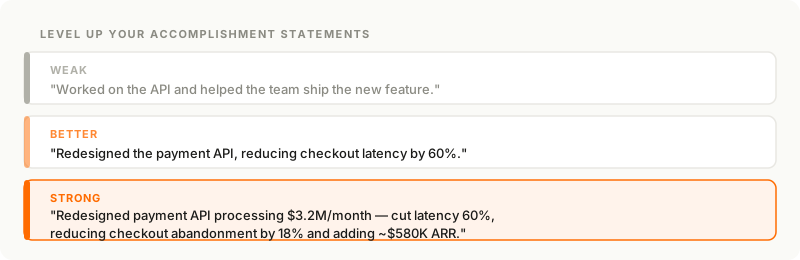
Every example above follows: [Action] + [Specific work] + [Measurable result]. Replace the numbers with yours. Your LCP improvement won't be the same as the example, but the structure — what you did, what changed, why it mattered — is universal.
Don't Have Numbers?
Frontend work is full of measurable outcomes if you know where to look. Lighthouse scores before and after are objective. Bundle sizes are in your build output. Time spent on a manual task (design QA, local setup, test runs) multiplied by frequency gives you hours recovered. If you shipped a feature that addressed a top support request or unblocked a sales deal, your PM or customer success team has that data. Ask for it retroactively — people are usually happy to share it when you explain why you need it.
Match the Level
Mid-level engineers should emphasise feature delivery metrics, bug resolution, and growing code review participation. Senior engineers need to show cross-team influence — the component someone else shipped using your API, the performance budget you established that the whole team now works within, the junior you mentored who shipped independently. Staff-level frontend engineers should document architectural decisions with org-wide impact: the design system adoption curve, the migration strategy that avoided a rewrite, the standard that eliminated a class of bugs across multiple teams.
Start Capturing Wins Before Next Review
The hardest part of performance reviews is remembering what you did 11 months ago. Prov captures your wins in 30 seconds — voice or text — then transforms them into polished statements like the ones above. Prov is coming soon on iOS.
Ready to Track Your Wins?
Free to start, no account, no sign-up. Available on the App Store now.
Download on iOS Free to start, no account needed