Finance managers work behind every major business decision, but the analysis that shaped a $4M budget call is invisible in the meeting notes. The self-assessment challenge isn't writing well — it's proving that your model changed the outcome, not just that you ran the numbers.
Why Self-Assessments Are Hard for Finance Managers
Finance managers operate in a paradox: the more rigorous their work, the less visible it becomes. When your variance analysis is tight and your forecast is accurate, nothing goes wrong — and nothing going wrong rarely makes it into a performance review. The work that prevents a crisis is structurally harder to document than the work that responds to one.
There’s also a credibility trap around influence. Finance managers regularly shape decisions made by leaders three or four levels above them — a well-framed sensitivity analysis shifts a capital allocation, a reforecast changes a hiring plan. But claiming “I influenced the CFO’s Q3 decision” sounds presumptuous without the documentation to back it up. The trick is to describe what analysis you produced, what decision it informed, and what happened as a result.
The tools compound the problem. Excel models, Adaptive Insights builds, and Anaplan implementations are months of careful work that compress into a single output — a dashboard, a report, a recommendation. If you can’t describe what the output enabled, the effort is invisible.
The goal: write phrases that connect your analytical work to the business outcomes it drove — not just the deliverables you produced.
How to Structure Your Self-Assessment
The Three-Part Formula
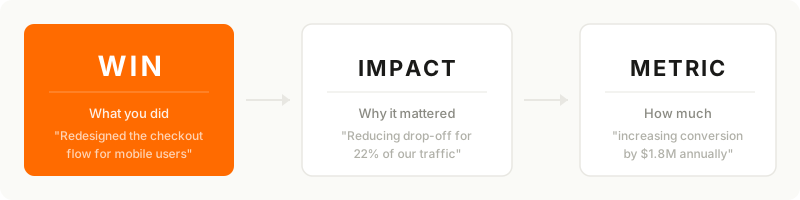
What I did → Impact it had → What I learned or what’s next
In finance, “what I did” is the model or analysis. “Impact it had” is the decision it informed or the outcome it changed. “What’s next” signals that you understand the business context beyond the spreadsheet.
Phrases That Signal Seniority
| Instead of this | Write this |
|---|---|
| "I built the budget model" | "I redesigned the annual budget model in Adaptive Insights, reducing consolidation time by 3 days and enabling scenario planning that directly informed the Q4 headcount decision" |
| "I did variance analysis" | "I identified a $1.2M favorable OpEx variance in Q2, traced it to a delayed vendor contract, and reforecast $800K of that as a Q3 risk before leadership had flagged it" |
| "I partnered with the business" | "I embedded with the Sales ops team for Q3 planning, translating their pipeline assumptions into financial model inputs and surfacing a $600K revenue risk their team had not modeled" |
| "I want to improve my presentation skills" | "I am developing executive-level financial storytelling by presenting at two board prep sessions this half, targeting a role in our next investor relations briefing by Q3" |
Financial Planning & Analysis Self-Assessment Phrases
Budgeting & Forecasting
- "I led the annual budget process for three business units totaling $48M in operating expense, coordinating inputs from 12 cost center owners and delivering a consolidated plan three days ahead of the CFO deadline. I also built a rolling 12-month forecast in Adaptive Insights that gave leadership real-time visibility into full-year outcomes rather than a point-in-time snapshot."
- "I redesigned our quarterly reforecast process to replace a static submission cycle with a continuous driver-based model in Anaplan. The change reduced the reforecast cycle from 10 days to 4 and improved forecast accuracy — our Q3 and Q4 actuals came in within 2% of forecast versus a 7% average the prior year."
- "I built a headcount planning model that reconciles finance's budget view with HR's system of record in real time, eliminating a recurring reconciliation that was consuming 6 hours of FP&A time per month and causing version confusion in leadership reviews."
- "I identified a $2.1M unfavorable variance risk in our cost of goods sold forecast that had been masked by favorable mix in the top-line model. I surfaced this to the CFO six weeks before quarter-end, allowing the operations team time to negotiate two vendor contracts that recovered $900K of the exposure."
- "I introduced scenario-based planning to our annual budget process for the first time, building upside, base, and downside cases with explicit driver assumptions. The CFO used the downside scenario directly in a board presentation, and two of its sensitivity assumptions were cited in our investor Q&A."
Long-range Planning
- "I owned the financial model for our 5-year strategic plan, translating the strategy team's qualitative assumptions into a financially coherent projection with clearly stated drivers and sensitivities. The model was used without modification in our Series C data room and cited by two investors in their term sheets."
- "I built a market sizing model that stress-tested the revenue assumptions in our long-range plan against three independent data sources. The analysis revealed that the base-case plan required a market share assumption that was 40% higher than our best comparable — a finding that changed the M&A evaluation framework for the next 12 months."
Reporting & Variance Analysis Self-Assessment Phrases
Management Reporting
- "I redesigned the monthly management reporting pack, reducing it from a 42-slide document to a 12-slide executive summary with exception-based variance commentary. Senior leaders reported in our next engagement survey that finance reporting was 'more useful than ever' — a direct reversal of a prior-year feedback theme."
- "I built a Tableau dashboard that gives business unit leaders self-serve access to their P&L performance against budget, reducing ad-hoc reporting requests to the FP&A team by roughly 30% per month. The time recovered has been redirected to forward-looking analysis rather than backward-looking data pulls."
- "I standardized variance commentary across three business units by developing a template and style guide that reduced the time finance business partners spend writing monthly narratives by 40% while making the commentary more consistent and decision-useful for senior leadership."
Variance Investigation
- "I traced a persistent $300K monthly favorable variance in T&E to a policy interpretation discrepancy that had been incorrectly categorized for eight months. I corrected the classification, worked with accounting to true up the prior-period entries, and presented the root cause to the controller — preventing the issue from compounding further."
- "I identified an $800K unfavorable revenue variance in Q1 that the business initially attributed to seasonality. My analysis showed it was actually concentrated in two product lines and two regions — a more actionable finding that gave the sales team a specific remediation target. Q2 revenue in those segments recovered by $600K."
- "I built a variance decomposition model in SQL that separates price, volume, and mix effects automatically from our raw transaction data, replacing a manual weekly analysis that was taking an analyst 4 hours to produce. The automated version runs in 8 minutes and has better granularity."
Business Partnering Self-Assessment Phrases
Strategic Support
- "I partnered with the VP of Marketing to build an ROI model for a proposed $1.5M brand campaign, translating marketing's attribution assumptions into financial terms and identifying the payback period under three customer lifetime value scenarios. The model gave the CFO a structured framework for approving the spend and setting a measurable success threshold."
- "I embedded with the Product team for two quarters to support their annual planning cycle, attending weekly roadmap reviews and providing real-time financial modeling as features were scoped. This proximity allowed me to flag a $700K cost assumption error before it was committed to the board roadmap."
- "I built a capital expenditure evaluation framework for the Operations team, standardizing how they present NPV, IRR, and payback analysis for investment requests. All four capex requests submitted using the framework were approved in the first review cycle — a marked improvement from prior cycles where requests averaged two revision rounds."
Financial Decision Support
- "I prepared the financial analysis for our two largest vendor renegotiations this year, modeling total cost of ownership across contract terms and identifying $340K of cost-saving opportunities that the procurement team used as leverage in negotiations. Both contracts were renewed with better terms than the prior cycle."
- "I developed a make-vs-buy model for our customer support function that quantified the fully loaded cost of in-house staffing against three outsourcing scenarios. The analysis showed a $1.1M cost difference over three years that the COO had not previously seen, and it changed the direction of the sourcing decision."
- "I supported three new market entry evaluations this year by building localized P&L models that adjusted for regional cost structures, tax rates, and currency exposure. Two of the three markets were approved for entry; the third was deprioritized based directly on the margin profile my model surfaced."
Process Improvement Self-Assessment Phrases
Systems & Automation
- "I led the migration of our budget consolidation process from Excel to Adaptive Insights, a project that had been deprioritized for two years due to perceived complexity. I delivered the migration in one quarter by phasing the scope, and the first annual budget cycle on the new platform ran 4 days faster than the previous year with zero consolidation errors."
- "I automated our month-end close variance package using a combination of SQL queries and Tableau data sources, replacing a process that required two analysts to work overtime for three evenings per month. The automated version runs overnight and produces a more detailed output — total time saving of approximately 40 hours per quarter."
- "I built a NetSuite report set that gives the accounting team real-time expense accrual visibility, eliminating the manual tracking spreadsheet they had been maintaining for three years. The change reduced month-end close time for that step by two days and has not required any rework since implementation."
Close & Controls Improvement
- "I identified five redundant steps in our month-end close checklist that had accumulated over three years without serving a current control purpose. Removing them reduced our close timeline from 8 days to 6 days without any increase in post-close adjustments — confirming the steps were genuinely redundant rather than informally load-bearing."
- "I redesigned the intercompany reconciliation process by building a shared matching tool in Excel with automated exception flagging, reducing a process that took two people two days to one person four hours. The tool also catches discrepancies earlier in the month, reducing last-minute close surprises."
Risk & Controls Self-Assessment Phrases
Internal Controls
- "I conducted a controls self-assessment for our revenue recognition process ahead of our external audit, identifying two documentation gaps that could have been raised as findings. I closed both gaps before the audit window, and we received a clean opinion with no management letter comments related to revenue recognition."
- "I redesigned our expense approval workflow to add a second-level review for transactions above $25K, closing a segregation-of-duties gap that had been flagged in our prior-year internal audit. The control has been operating effectively for two full quarters with no exceptions."
- "I built a monthly analytical review that flags statistical outliers in our general ledger by account, department, and period. In the three months since deployment, it has caught two coding errors and one duplicate payment totaling $47K before they reached the financial statements."
Risk Identification
- "I proactively modeled the foreign currency exposure in our EMEA cost base after a significant sterling movement, identifying a $280K annualized earnings risk that had not been captured in our FX hedging program. I presented the analysis to the Treasurer and it resulted in an expansion of our hedging coverage."
- "I flagged a contract renewal that had been omitted from our commitments schedule, representing $190K of vendor liability the legal team was unaware was approaching. Catching it with six weeks of lead time allowed us to negotiate rather than auto-renew."
Team Development Self-Assessment Phrases
Coaching & Mentorship
- "I managed two analysts this year and invested deliberately in their technical development — specifically in financial modeling discipline and business communication. Both analysts now own their own business unit relationships independently, a responsibility neither held at the start of the year. One was promoted to Senior Analyst ahead of cycle."
- "I introduced a model review process within the FP&A team where analysts peer-review each other's models before they go to business partners. The practice has improved model quality and created a learning environment where junior analysts are exposed to approaches and techniques from more senior colleagues."
- "I mentored a junior analyst who was strong technically but struggling to communicate findings to non-finance stakeholders. I ran four structured coaching sessions focused on financial storytelling, and by Q4 she was leading business partner presentations independently — a milestone her prior manager had not thought achievable this year."
Process & Knowledge Transfer
- "I documented the full methodology for our budget model, reforecast process, and management reporting templates — a body of tribal knowledge that had previously existed only in the heads of two senior team members. The documentation reduced onboarding time for a new FP&A hire from eight weeks to four."
- "I ran a quarterly training series for finance business partners on SQL basics and Tableau, building self-sufficiency for the most common data pulls they were escalating to our data team. The series freed up approximately 6 hours per week of data team capacity and made the FBPs more effective partners to the business."
How Prov Helps Finance Managers Track Their Wins
Finance managers often do their most impactful work in the middle of a busy quarter — a model that changes a decision, an analysis that surfaces a risk, a business partner meeting where you reframe a problem. By the time review season arrives, those moments have faded behind the steady rhythm of close, reforecast, and reporting.
Prov captures those wins in 30 seconds, when they’re fresh, using voice or text. Over time, it builds a documented record of not just what you delivered but what it changed — the kind of evidence that turns a solid self-assessment into a promotion-worthy one. Prov is coming soon on iOS.
Ready to Track Your Wins?
Free to start, no account, no sign-up. Available on the App Store now.
Download on iOS Free to start, no account needed