The best DevOps work leaves no incident report. Reviewing it well requires evaluating what didn't happen, and why.
How to Write Effective DevOps Engineer Performance Reviews
DevOps engineering has the most counterintuitive review problem in software: the better the engineer, the less reviewable their impact appears. A flawless deployment pipeline that runs 200 times a year without incident is a significant engineering achievement. From a review form perspective, it looks like nothing. The engineer who spends the year quietly preventing outages, reducing toil, and improving developer experience will consistently be outscored by the engineer who dramatically resolves the incidents their own absent preparation caused.
Managers reviewing DevOps engineers need to actively invert the default frame. The question is not “what went wrong and how was it handled?” — it’s “what didn’t go wrong because of this engineer’s work, and how do we know?” This requires looking at metrics: deployment frequency, change failure rate, mean time to recovery, on-call alert volume, and developer experience survey results. These are the numbers that reveal prevention-oriented work.
Infrastructure-as-code quality deserves dedicated attention in DevOps reviews. Terraform modules that are well-structured, thoroughly documented, and safely parameterized create leverage across every team that provisions infrastructure. ArgoCD configurations that enforce GitOps discipline prevent configuration drift. Kubernetes resource limit policies that prevent noisy-neighbor problems protect the entire platform. This work is architectural in nature and should be evaluated at the same level of rigor as backend service design.
Developer experience is frequently the most leverage-generating dimension of senior DevOps work and the most commonly overlooked. CI pipeline run time directly affects every engineer’s productivity. Clear, actionable error messages in deployment tooling reduce the support burden on the DevOps team. Self-service infrastructure provisioning via well-designed GitHub Actions workflows enables product teams to move faster without creating toil. These outcomes compound across the engineering organization, and reviews should name them explicitly.
How to Use These Phrases
For Managers
DevOps review phrases are most credible when paired with operational metrics from the review period. Deployment frequency, mean time to recovery, on-call alert volume, and pipeline run time are the numbers that make these phrases verifiable. Before writing reviews, pull the quarterly DevOps metrics from DataDog or PagerDuty — they’ll provide the evidence base that separates strong reviews from generic ones.
For Employees
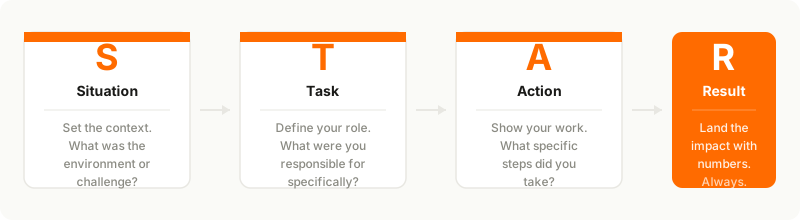
Use the STAR framing to attach specific context to each phrase you apply to your own work. “Improved deployment reliability” is a phrase. “Reduced the change failure rate from 8% to 1.2% by implementing automated rollback triggers in ArgoCD” is a review. The phrases below give you the structure; the metrics from your team’s dashboards give you the specifics.
Rating Level Guide
| Rating | What it means for DevOps Engineers |
|---|---|
| Exceeds Expectations | Proactively designs systems that prevent incidents rather than respond to them; measurably improves deployment frequency and reliability; drives developer experience improvements that compound across teams |
| Meets Expectations | Maintains reliable CI/CD pipelines and infrastructure; responds to incidents within SLA; implements and documents infrastructure changes using established patterns |
| Needs Development | Responds to issues reactively rather than proactively; infrastructure work requires additional review for safety and reliability; is developing independent judgment on platform-level decisions |
CI/CD & Deployment
Exceeds Expectations
- Proactively redesigned the GitHub Actions pipeline architecture to enable parallel test execution, reducing average CI run time from 22 minutes to 7 minutes and returning an estimated 4 hours of developer time per engineer per week.
- Independently implemented progressive delivery using ArgoCD with automated canary analysis, enabling the product team to ship 40% more deployments per week while reducing the change failure rate from 6% to 0.8%.
- Consistently designs deployment pipelines with automated rollback triggers — based on error rate and latency thresholds in DataDog — ensuring that failed deployments recover automatically without requiring on-call intervention.
- Drives GitOps discipline across all Kubernetes workloads, ensuring that every infrastructure state is represented in version-controlled manifests and that configuration drift is detected and remediated automatically.
- Led the migration from manual deployment scripts to a fully automated ArgoCD-based continuous delivery system, eliminating the class of deployment errors caused by human procedure deviations that had been responsible for 3 incidents in the prior year.
Meets Expectations
- Maintains CI/CD pipelines with high availability, addressing build failures, dependency version conflicts, and flaky tests within established SLA.
- Implements deployment pipelines for new services following established patterns — build, test, security scan, deploy, smoke test — without requiring significant review cycles.
- Documents deployment procedures clearly, ensuring on-call engineers can manage routine releases without escalating to the DevOps team.
- Monitors deployment success rates and addresses systematic failure patterns before they compound into reliability problems.
Needs Development
- Is developing stronger skills in CI/CD pipeline design; recent pipeline implementations have required significant revision for reliability and security scanning coverage before being approved for production use.
- Would benefit from deeper study of progressive delivery patterns — blue/green deployments, canary analysis, feature flags — to reduce the all-or-nothing deployment risk profile that has caused several rollback events.
- Has shown progress in maintaining existing pipelines but is developing the skills to design new deployment architectures that meet reliability and developer experience requirements with minimal guidance.
Infrastructure & Platform
Exceeds Expectations
- Independently designed and implemented the Terraform module library for AWS infrastructure provisioning, enabling product teams to provision production-ready VPCs, RDS clusters, and EKS node groups in under 30 minutes with full tagging and cost-allocation compliance.
- Proactively implemented Kubernetes pod disruption budgets, resource quotas, and network policies across all namespaces, preventing the noisy-neighbor incidents that had caused 4 reliability events in the prior year.
- Consistently applies infrastructure-as-code principles to all platform changes, ensuring that every AWS and GCP resource is managed in Terraform with documented variable inputs, output declarations, and state isolation.
- Drives platform cost optimization by implementing right-sizing analysis and spot instance strategies, achieving a 28% reduction in monthly cloud spend without impacting service reliability or performance.
- Led the Kubernetes upgrade from 1.25 to 1.28 across three production clusters with zero service disruption, managing the deprecation API migrations and coordinating workload compatibility validation with eight engineering teams.
Meets Expectations
- Implements infrastructure changes using Terraform with appropriate variable parameterization, state management, and peer review before applying to production environments.
- Manages Kubernetes cluster resources — node pools, namespaces, RBAC, network policies — according to documented standards and reviews changes with the team before production application.
- Responds to capacity signals from DataDog before services are resource-constrained, scaling infrastructure in advance of projected load increases.
- Maintains infrastructure documentation with current architecture diagrams and runbooks for routine operational procedures.
Needs Development
- Is developing stronger infrastructure-as-code habits; several recent infrastructure changes were applied manually without Terraform representation, creating state drift that required remediation work.
- Would benefit from deeper engagement with Kubernetes resource management — particularly resource limits, node affinity, and pod disruption budgets — to design more reliable workload configurations independently.
- Has shown progress in following established infrastructure patterns but is developing the judgment to evaluate design tradeoffs — cost vs. reliability, flexibility vs. complexity — when patterns don't directly apply.
Reliability & Incident Response
Exceeds Expectations
- Proactively audited PagerDuty alert configurations across all services, eliminating 62% of low-signal alerts that had been contributing to on-call fatigue and improving the signal-to-noise ratio for genuine incidents.
- Independently designed the multi-region failover strategy for the production database cluster, reducing the theoretical RTO from 45 minutes to 8 minutes and successfully validating the runbook with a planned failover drill.
- Consistently leads post-incident reviews with a systems-thinking approach — tracing contributing causes rather than assigning blame — producing action items that address root causes and have demonstrably reduced repeat incident rates.
- Drives SLI/SLO definition and error budget tracking across the service portfolio, providing engineering teams with the shared language to make data-driven prioritization decisions about reliability work vs. feature work.
- Built the automated incident detection system using DataDog composite monitors and PagerDuty escalation policies, reducing mean time to detection from 12 minutes to under 90 seconds for the three most common incident patterns.
Meets Expectations
- Responds to on-call incidents within SLA, following established runbooks and escalating appropriately when issues exceed scope or require additional expertise.
- Contributes accurate timelines and technical analysis to post-incident reviews, identifying actionable follow-up items and completing assigned remediation work within agreed deadlines.
- Maintains DataDog dashboards and alert configurations for owned services, updating thresholds when signal-to-noise issues are identified.
- Conducts routine reliability reviews — backup validation, failover testing, capacity checks — on the agreed schedule without requiring prompting.
Needs Development
- Is developing stronger incident response skills; recent on-call shifts have required escalation at a higher rate than expected, and the post-incident documentation has been insufficient for the team to use as a learning resource.
- Would benefit from developing more proactive reliability habits — reviewing alert configurations, validating runbooks before incidents occur — rather than addressing reliability gaps reactively after events.
- Has shown progress in following incident response procedures but is developing the diagnostic skills needed to triage novel failure modes independently without extended support from senior team members.
Security & Compliance
Exceeds Expectations
- Proactively implemented container image scanning with Trivy in all GitHub Actions build pipelines, catching 14 high-severity CVEs before they reached production and establishing a policy that blocks builds containing critical vulnerabilities.
- Independently designed the AWS IAM role architecture using least-privilege principles and permission boundaries, eliminating over-permissioned service accounts that had been identified as a high risk in the annual security audit.
- Consistently champions security-as-code practices — secrets management via AWS Secrets Manager, network policy enforcement in Kubernetes, infrastructure vulnerability scanning in Terraform plans — setting a compliance standard that reduces audit burden for the entire engineering organization.
- Led the SOC 2 Type II evidence collection for infrastructure controls, designing automated compliance checks in AWS Config that generate audit evidence continuously rather than requiring manual quarterly collection.
- Drives security posture reviews by analyzing AWS Security Hub findings and coordinating remediation work with engineering teams, reducing the open critical finding count from 34 to 2 over the review period.
Meets Expectations
- Manages secrets using established secrets management tools — AWS Secrets Manager, Vault — ensuring no credentials are stored in environment variables, configuration files, or version control.
- Applies security scanning to container images and Terraform plans in CI pipelines, blocking deployments that introduce known critical vulnerabilities.
- Implements network segmentation and Kubernetes network policies that restrict service-to-service communication to what is explicitly required.
- Responds to security findings from automated scanning tools within established SLA, coordinating with affected teams when remediation requires application-level changes.
Needs Development
- Is developing stronger security-first instincts in infrastructure design; recent configurations have required security team review to identify least-privilege IAM policy issues and network exposure gaps that should be caught during design.
- Would benefit from a structured review of cloud security fundamentals — IAM policy design, network segmentation, secrets management patterns — to build the foundation for independent security decision-making.
- Has shown genuine progress in following security procedures but is developing the proactive mindset to evaluate security implications of infrastructure decisions before review, rather than addressing feedback after the fact.
Developer Experience
Exceeds Expectations
- Proactively designed the self-service GitHub Actions workflow library that enables product engineers to provision staging environments, run integration tests against feature branches, and manage database migrations without DevOps team involvement — reducing DevOps support requests by 45%.
- Independently improved the developer onboarding experience by automating local environment setup with a single script, reducing the average time for a new engineer to make their first code change from 3 days to 4 hours.
- Consistently produces infrastructure runbooks with the level of detail and clarity that enables any on-call engineer to execute routine procedures independently — reducing the after-hours escalations to DevOps that had been a persistent pain point for the team.
- Drives internal platform improvements based on engineer feedback, establishing a quarterly developer experience survey and using results to prioritize tooling investments that have measurably improved team velocity.
- Led the migration to a standardized local development environment using Docker Compose, eliminating the "works on my machine" class of issues that had been consuming an estimated 6 hours per engineer per sprint across the engineering organization.
Meets Expectations
- Documents infrastructure processes clearly enough for other engineers to execute routine operations without assistance, maintaining documentation accuracy as systems evolve.
- Responds to developer support requests — environment issues, pipeline failures, access requests — within established SLA, providing solutions rather than workarounds where possible.
- Proactively communicates planned infrastructure changes — maintenance windows, API deprecations, configuration changes — to affected teams with sufficient lead time for planning.
- Collects and acts on developer feedback about tooling pain points, prioritizing improvements that unblock the most engineers.
Needs Development
- Is developing stronger documentation habits; infrastructure processes owned by this engineer frequently require knowledge transfer when other team members need to execute them, creating a single-point-of-failure risk.
- Would benefit from investing in developer experience improvements beyond reactive support — the pattern of waiting for engineers to report pain points rather than proactively identifying friction means improvements happen more slowly than the team needs.
- Has shown progress in the technical dimensions of the role but is developing the communication skills to make infrastructure changes and platform decisions legible to non-DevOps engineers who depend on them.
How Prov Helps Build the Evidence Behind Every Review
DevOps engineers face the most acute version of the documentation problem: their most important work is the work that didn’t happen. The incident that was prevented, the deployment that went smoothly, the on-call alert that never fired because the monitoring was well-calibrated — none of this generates a ticket, a PR, or a Slack notification. At review time, that work is invisible unless the engineer documented it as it happened.
Prov gives DevOps engineers a lightweight way to capture operational wins in real time — a quick voice note after a major Kubernetes upgrade completes, a text capture after closing a long-running security remediation, a 30-second record of a developer experience improvement that saved the team hours. Those notes accumulate into a searchable record with extracted skills and patterns. When review season arrives, “the infrastructure just worked” becomes a body of specific, dated evidence that makes the invisible work impossible to overlook.
Ready to Track Your Wins?
Free to start, no account, no sign-up. Available on the App Store now.
Download on iOS Free to start, no account needed