Concrete examples of DevOps and SRE achievements you can adapt for your performance review, promotion packet, or resume.
The DevOps Engineer's Performance Review Problem
You kept the lights on all year. You migrated the cluster, tightened the pipelines, killed the alert fatigue, and cut the cloud bill. You were paged at 2am three times and resolved every incident before users noticed. And now, at review time, you're writing "maintained infrastructure" and wondering why your work feels invisible.
The problem is structural. DevOps and SRE work is defined by absence: when you do it well, nothing bad happens. There's no launch moment, no shipped feature for the changelog. The value is in the incidents that never escalated, the deployments that took 4 minutes instead of 45, the developers who stopped waiting on manual approvals. Invisible value is still value — but you have to make it visible yourself.
There's also a second challenge: your reviewers are often engineering managers or VPs who care about cost, reliability, and team velocity but don't speak Terraform or Kubernetes. Saying you "implemented a GitOps workflow using Flux CD" tells them nothing. Saying you "implemented a GitOps workflow that cut deployment failures by 70% and allowed any engineer on the team to ship independently, without a deployment specialist on call" tells them everything.
The examples below are organized by the competencies that matter most in DevOps and SRE performance reviews. They're specific, measurable, and ready to adapt to your actual numbers. Every one of them follows the same structure: what you built or changed, and why it mattered to the business or the team.
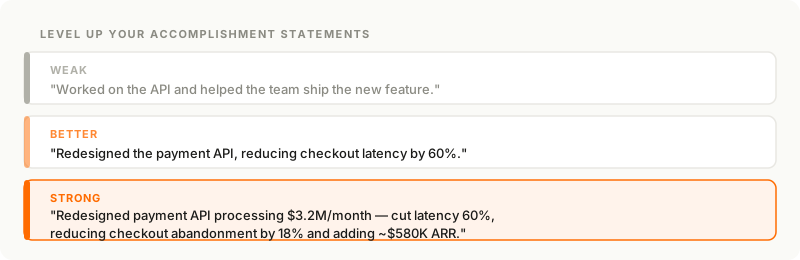
What gets you promoted are documented accomplishments with measurable impact.
DevOps Engineer Accomplishment Categories
| Competency | What Reviewers Look For |
|---|---|
| Infrastructure & Platform | Can you build reliable, scalable foundations? |
| Reliability & Incident Response | Do you keep things running and recover fast? |
| Security & Compliance | Do you protect the system proactively? |
| Developer Experience | Do you make engineers faster without adding toil? |
| Cost Optimization | Do you manage cloud spend with intention? |
| Automation & CI/CD | Do you eliminate manual work at scale? |
Infrastructure & Platform Accomplishments
Cloud & Platform
- "Migrated 40 microservices from self-managed EC2 to EKS, reducing operational overhead by 60% and enabling the team to scale to 10x traffic with zero infrastructure changes"
- "Led the AWS to multi-cloud migration for disaster recovery, achieving an RPO of 15 minutes and RTO of 30 minutes — down from 4 hours — for the first time in company history"
- "Designed and implemented the Terraform module library (32 reusable modules) that standardized infrastructure provisioning across 4 engineering teams"
- "Migrated the database tier from RDS single-AZ to Aurora Global with read replicas, improving read latency from 45ms to 8ms for our EU users"
- "Implemented the VPC architecture redesign with transit gateway, private link, and proper CIDR planning — eliminating the network debt that had blocked 3 compliance certifications"
- "Deployed the service mesh (Istio) across 25 services, enabling mTLS, canary traffic splitting, and distributed tracing without application code changes"
- "Set up the landing zone with AWS Organizations — 6 accounts, SCPs, centralized logging — establishing the governance foundation before the SOC 2 audit"
Scaling & Capacity
- "Designed the auto-scaling strategy for the API tier using predictive scaling based on traffic patterns, eliminating 14 manual scaling events per month that previously required on-call intervention"
- "Implemented horizontal pod autoscaling and KEDA event-driven scaling, handling a 15x traffic spike from a viral campaign with zero performance degradation and no manual intervention"
- "Built the load testing framework using k6 that simulated 500K concurrent users, identifying the bottleneck that would have caused an outage at 5x scale before it became a production issue"
- "Migrated the session store from a single Redis instance to Redis Cluster, enabling linear read/write scaling and eliminating the capacity ceiling that would have been hit in Q3"
- "Implemented CDN caching strategy across 4 content types, reducing origin requests by 75% and cutting bandwidth costs by $3,200/month"
Reliability & Incident Response Accomplishments
Uptime & SLAs
- "Improved API availability from 99.5% to 99.95% year-over-year — reducing annual downtime from 43 hours to 4 hours — through systematic elimination of single points of failure"
- "Implemented multi-region active-active deployment for the payment service, achieving 99.99% availability required by our enterprise SLA and unblocking 2 Fortune 500 contracts"
- "Defined and published SLOs for all 15 critical services, giving the engineering org its first quantitative reliability targets and a shared language with product and leadership"
- "Reduced p99 API latency from 850ms to 120ms through caching, connection pooling, and query optimization — improving the SLO compliance rate from 82% to 99.2%"
- "Led the quarterly game day exercises (4 per year, 12 failure scenarios total), discovering 8 recovery gaps and reducing MTTR by 55% across the incidents we simulated"
Incident Management
- "Cut mean time to detect (MTTD) from 18 minutes to 3 minutes by consolidating 6 monitoring tools into a unified Datadog stack with intelligent alert routing"
- "Reduced mean time to resolve (MTTR) from 2.5 hours to 25 minutes by building a runbook library (45 runbooks) covering the top 90% of incident types by frequency"
- "Led 3 major incident post-mortems that identified systemic causes and drove 14 engineering projects, preventing 8 classes of recurring incidents in the following quarter"
- "Implemented PagerDuty on-call rotations with proper escalation policies and alert deduplication, reducing alert fatigue from 200+ weekly pages to 35 — a 75% reduction without increasing MTTD"
- "Built the incident communication workflow including automated status page updates and stakeholder notification templates, reducing time spent on communication during incidents by 60%"
- "Resolved the cascading database failure that affected 30% of users in under 40 minutes — root cause identified, failover completed, and post-mortem published within 24 hours"
Security & Compliance Accomplishments
Vulnerability & Access
- "Implemented zero-trust network architecture with Cloudflare Access, eliminating the VPN and reducing the attack surface while improving developer access experience"
- "Deployed Trivy and Snyk into the CI pipeline, scanning 100% of container images and dependencies before merge — catching 34 critical CVEs before they reached production"
- "Led the IAM rationalization project, reducing over-privileged roles from 140 to 22 and achieving least-privilege access across all AWS services without a single production disruption"
- "Implemented secrets management using HashiCorp Vault, eliminating 600+ hardcoded secrets found in the codebase audit and reducing secret rotation from a manual quarterly process to automated monthly rotation"
- "Set up runtime threat detection with Falco across the Kubernetes cluster, detecting and alerting on 4 anomalous behavior patterns that led to blocking 2 compromised service accounts"
- "Automated certificate rotation for 80+ TLS certificates across 3 environments, eliminating the manual process that had caused 2 expired-cert outages in the previous 18 months"
Compliance & Audits
- "Implemented the technical controls required for SOC 2 Type II certification — logging, access reviews, encryption, change management — completing audit prep 3 weeks ahead of schedule"
- "Built the AWS Config + Security Hub pipeline that continuously evaluates 180+ compliance controls, reducing the manual audit preparation effort from 3 weeks to 2 days"
- "Implemented GDPR data residency controls ensuring EU customer data never left eu-west-1, satisfying the contractual requirement that had blocked 5 enterprise deals"
- "Led the PCI DSS scoping exercise and implemented the required network segmentation, allowing the payment team to reduce their compliance scope and cut audit costs by $40K annually"
- "Created the infrastructure change management process — RFC templates, approval workflows, audit trails — that satisfied the ITIL-based requirements of our largest enterprise customer"
Developer Experience Accomplishments
Tooling & Workflows
- "Built the internal developer platform (Backstage) with service catalog, templates, and TechDocs — reducing time from idea to deployed service from 2 weeks to 4 hours for new projects"
- "Implemented ephemeral preview environments for every pull request, enabling designers and PMs to review changes without setting up a local environment — adopted by 100% of the team within 2 weeks"
- "Standardized the local development environment using devcontainers, cutting new engineer setup time from 3 days to 45 minutes and eliminating "works on my machine" incidents"
- "Built the feature flag platform (integrated with LaunchDarkly) that allowed the product team to do gradual rollouts independently, removing 4 deployment requests per week from the platform team's queue"
- "Created the observability starter kit — pre-configured dashboards, alerts, and SLO templates — that any team could deploy in 30 minutes instead of building from scratch over 2 weeks"
- "Implemented distributed tracing with OpenTelemetry across all services, reducing the average time engineers spent debugging cross-service issues from 4 hours to 35 minutes"
Onboarding & Documentation
- "Wrote the infrastructure runbook library — 45 procedures covering deployments, rollbacks, database operations, and incident response — reducing escalations to the platform team by 50%"
- "Created the "Day 1" engineering onboarding guide and automated the setup scripts, reducing new hire time-to-first-commit from 5 days to 1 day"
- "Built the architecture decision record (ADR) practice for infrastructure changes, creating 28 ADRs in the first 6 months that gave new team members context that previously required months of tribal knowledge"
- "Ran 8 internal workshops on Kubernetes, Terraform, and observability — attended by 45 engineers across 6 teams — reducing infrastructure-related support requests by 35%"
- "Published the incident response playbook and trained all on-call engineers across 4 teams, reducing the number of escalations to senior SREs during incidents by 60%"
Cost Optimization Accomplishments
Cloud Cost Reduction
- "Identified and eliminated $28,000/month in unused EC2 instances, EBS volumes, and idle RDS databases through a systematic cloud waste audit — without any service disruptions"
- "Implemented Reserved Instance and Savings Plans coverage, bringing commitment coverage from 12% to 74% and reducing the EC2 bill by $18,000/month at the same compute level"
- "Migrated batch processing workloads from on-demand EC2 to Spot Instances with interruption handling, cutting compute costs for those workloads by 72% ($6,400/month)"
- "Rightsized 180 EC2 instances based on CloudWatch utilization analysis, reducing monthly compute spend by $12,000 with no performance impact on any service"
- "Implemented S3 Intelligent-Tiering across 14 buckets totaling 40TB of data, reducing storage costs by $2,800/month through automatic transition to lower-cost tiers"
- "Renegotiated the Datadog contract based on actual usage data and a migration plan for unused features, reducing the annual bill by $45,000"
Resource Efficiency
- "Implemented Kubernetes resource requests and limits across all workloads, improving cluster utilization from 28% to 61% and eliminating 4 underutilized node groups"
- "Deployed Karpenter for cluster autoscaling, replacing the fixed node groups and reducing compute costs by 35% while improving scaling responsiveness from 8 minutes to 90 seconds"
- "Built the cost allocation tagging system (100% coverage across 1,200+ resources) enabling per-team, per-environment, and per-product cost visibility for the first time"
- "Optimized CloudFront distribution configuration and Lambda@Edge usage, reducing per-request costs by 45% — $3,100/month savings at current traffic volumes"
- "Implemented database connection pooling with PgBouncer, reducing RDS connection count from 800 to 60 and allowing a downgrade from db.r6g.2xlarge to db.r6g.large ($1,400/month savings)"
Automation & CI/CD Accomplishments
CI/CD Pipelines
- "Redesigned the GitHub Actions CI pipeline — parallel test execution, incremental builds, layer caching — cutting average pipeline time from 28 minutes to 6 minutes across 15 repositories"
- "Implemented the blue-green deployment strategy for the production API, reducing deployment-related downtime from an average of 4 minutes per release to zero"
- "Built the canary deployment system using Flagger and Istio, automatically rolling back releases that exceeded error rate thresholds — catching 3 bad deploys in the first quarter without manual intervention"
- "Standardized CI/CD pipelines across 12 teams using reusable GitHub Actions workflows, reducing the time teams spent maintaining their own pipelines by an estimated 8 hours/week in aggregate"
- "Implemented automated rollback triggered by Datadog SLO burn rate alerts, reducing the time from bad deploy to rollback from 22 minutes (manual detection + action) to 4 minutes"
- "Built the release automation system — tagging, changelog generation, Jira transitions, Slack notifications — eliminating the 2-hour manual release process and all associated human error"
Infrastructure as Code
- "Converted 100% of manually-provisioned infrastructure to Terraform, achieving full infrastructure-as-code coverage and enabling the team to recreate the entire environment in 45 minutes"
- "Implemented Atlantis for Terraform GitOps, requiring all infrastructure changes to go through pull request review and plan approval — eliminating 4 incidents caused by unreviewed manual changes"
- "Built the Terraform module registry with 32 opinionated modules, enabling new services to be provisioned with compliant, secure defaults without requiring platform team involvement"
- "Migrated CloudFormation stacks to Terraform CDK, enabling the platform to be tested with unit tests — increasing infrastructure change confidence and catching 9 breaking changes before apply"
- "Implemented drift detection across all Terraform-managed resources using Atlantis scheduled plans, identifying and correcting 14 configuration drift instances that had accumulated from emergency manual changes"
How to Adapt These Examples
Plug In Your Numbers
Every example above follows: [Action] + [Specific work] + [Measurable result]. Replace the numbers with yours. Pull pipeline times from GitHub Actions analytics, cost figures from AWS Cost Explorer, availability from your observability platform, and incident metrics from PagerDuty or your incident tracker. Before-and-after comparisons are the most compelling format — find the baseline even if you have to calculate it retroactively.
Don't Have Numbers?
Infrastructure work often prevents costs rather than reducing them, and prevention is harder to quantify. When you don't have a direct metric, use the closest available proxy: number of incidents in the category before vs. after, number of manual processes eliminated, number of teams unblocked, or the estimated engineer-hours saved per week. "Eliminated the weekly manual process that took 3 hours and was the source of 40% of our configuration drift incidents" is a strong statement even if you never measured drift in dollar terms. Absence of incident is impact — describe the before state to make the absence visible.
Match the Level
Junior and mid-level DevOps engineers should document specific technical implementations and their direct outcomes: what you built, what broke less, what ran faster. Senior engineers should emphasize the decisions behind the work — why this approach over that one, what the tradeoffs were, how it shaped the team's direction. Staff and principal SREs should focus on org-level reliability culture: the SLO framework you introduced, the incident review practice you established, the platform that other teams built on top of, the engineers you leveled up on infrastructure. The higher the level, the more your accomplishments should show that you improved how the whole org thinks about reliability, not just that you fixed individual systems.
Start Capturing Wins Before Next Review
The hardest part of performance reviews is remembering what you did 11 months ago. Prov captures your wins in 30 seconds — voice or text — then transforms them into polished statements like the ones above. Prov is coming soon on iOS.
Ready to Track Your Wins?
Free to start, no account, no sign-up. Available on the App Store now.
Download on iOS Free to start, no account needed