A model with 92% accuracy that never gets deployed creates exactly zero business value. The data scientist's self-assessment must bridge three things that rarely appear together: model quality, production reality, and business outcome — and most scientists only write about the first.
Why Self-Assessments Are Hard for Data Scientists
Data scientists are trained to be rigorous about uncertainty — which is exactly the wrong instinct when writing a self-assessment. When you say “the model improved conversion by approximately 8-12%,” you’re being intellectually honest. Your manager hears hedging. The best self-assessments commit to the most defensible number and add context, rather than padding every claim with confidence intervals.
The deployment gap is the defining challenge of the role. The hardest work in data science is often not building the model — it’s getting it into production, getting stakeholders to trust it, and getting the organization to actually change behavior based on its outputs. A scientist who ships a model that is actively used by the business has contributed far more than one who produced a technically superior model that lives in a Jupyter notebook. Self-assessments should draw this distinction sharply.
There’s also a narrative problem with research-oriented work. When you spend three months exploring a hypothesis that turns out to be wrong, you have something valuable to show for it — you de-risked a direction, saved the team from a larger investment, and generated learning. But it’s hard to write “I proved a negative and that was worth three months of time” without sounding defensive. The best scientists frame negative results as scope reduction, not failure.
Finally, data science work tends to be invisible until it breaks. A recommendation model that’s been running cleanly for eight months generating revenue doesn’t appear in any incident report or launch announcement. Your self-assessment has to surface this ongoing value explicitly — or it simply won’t be counted.
How to Structure Your Self-Assessment
The Three-Part Formula
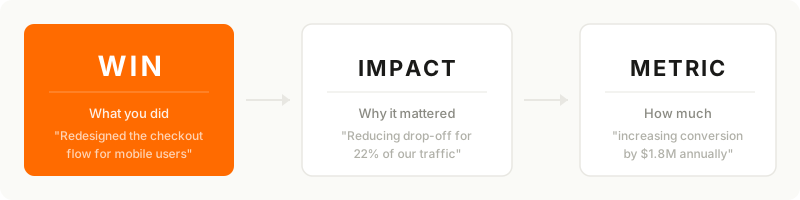
What I did → Impact it had → What I learned or what’s next
For data scientists, the “impact it had” section must cross the deployment boundary. If a model never shipped, its accuracy is not impact — it’s a technical milestone. If a model shipped, its business metric movement is the impact. Frame every contribution through the lens of: did the business change behavior as a result of my work?
Phrases That Signal Seniority
| Instead of this | Write this |
|---|---|
| "I built a model with 94% accuracy" | "I shipped a production model that [business team] uses for [decision], which has [measurably changed outcome] since deployment" |
| "I ran an experiment" | "I designed and analyzed an A/B test for [feature] that reached statistical significance in [N] days and produced a [X]% lift in [metric], which [team] used to [decision]" |
| "I explored the data" | "My exploratory analysis identified [specific finding] that was previously unmeasured; this directly informed [decision] and [outcome]" |
| "I want to learn MLOps" | "I'm building production deployment skills through [specific project/course], targeting independent model deployment ownership by [timeframe] to reduce my dependency on the platform team" |
Model Development Self-Assessment Phrases
Model Design & Training
-
“I built and shipped a churn prediction model in scikit-learn that identifies at-risk customers 30 days before their contract renewal. The model is now used by the customer success team in their weekly outreach prioritization — in its first quarter of use, accounts flagged by the model had a 34% higher save rate than accounts worked without it.”
-
“I developed a multi-class intent classification model using PyTorch that routes support tickets to the correct specialist team with 91% accuracy, up from 73% under the previous keyword-based rules system. Mis-routed ticket volume dropped by 62%, saving the support team an estimated 14 hours per week of re-routing effort.”
-
“I replaced a heuristic-based pricing model with an ML model trained on 18 months of transaction data. The new model captures seasonal and competitive signals the heuristics missed, and in a 6-week shadow deployment it outperformed the existing model on hold-out revenue accuracy by 11 percentage points before it went live.”
-
“I built a document similarity model using sentence embeddings that powers our content deduplication feature. The model handles 50,000 documents per day with 96% precision, and in the three months since deployment has prevented an estimated 12,000 duplicate items from entering the product catalog.”
Model Evaluation
-
“I established a rigorous offline evaluation framework for our recommendation system, including business-aligned metrics that correlated more strongly with online revenue lift than the pure accuracy metrics the team had been using. This framework caught a model regression before a planned deployment that would have reduced click-through by an estimated 7%.”
-
“I discovered through careful hold-out analysis that our fraud detection model had a significant false-positive rate for a specific customer segment — a bias that was not visible in aggregate metrics. I documented the finding, proposed a mitigation strategy, and prevented a deployment that would have incorrectly flagged an estimated 400 legitimate transactions per month.”
Experimentation & A/B Testing Self-Assessment Phrases
Experiment Design
-
“I designed an A/B test for our email recommendation feature that controlled for the segment-level confounds that had made two previous experiment results uninterpretable. The well-designed test reached statistical significance in 18 days with 95% confidence, producing a 14% click-through improvement that was credibly attributable to the feature change.”
-
“I introduced a pre-experiment power analysis process for our team, requiring all experiments to specify minimum detectable effects before launch. This change prevented three underpowered experiments from running and wasting six combined weeks of exposure on tests that could never have been conclusive.”
-
“I built a reusable experiment analysis notebook in Python that automates the statistical testing, confidence interval calculation, and segment-level breakdowns that had previously required 4-6 hours of analyst work per experiment. The team now completes post-experiment analysis in under 90 minutes, increasing our effective experiment throughput.”
Experiment Analysis
-
“My analysis of a failed experiment identified that the overall null result masked a strong positive effect for a specific user segment. I flagged this finding with appropriate caveats about multiple comparisons, and the product team launched a targeted version of the feature for that segment — which later showed a statistically significant 19% conversion lift in a confirmatory test.”
-
“I led a retrospective analysis of 24 months of historical experiments, identifying that our experiments had systematically overestimated positive effects by 30% due to novelty bias in our short-run testing windows. I proposed extending our standard test duration, which has led to more durable shipped improvements in the subsequent quarter.”
-
“I caught a data contamination issue in a running experiment where control group users were receiving treatment-adjacent features via a different surface. I halted the test, diagnosed the source, proposed a corrected design, and relaunched — saving the team from making a major product decision based on invalid data.”
Business Impact & Stakeholder Work Self-Assessment Phrases
Translating Models to Decisions
-
“I partnered with the merchandising team to deploy our demand forecasting model into their weekly buying process. This required building a Looker dashboard that surfaced model outputs in their existing workflow vocabulary, running four training sessions, and being available for questions during the first month of adoption. Inventory waste in the categories using the model dropped 18% in the first quarter.”
-
“I translated our churn model’s raw probability scores into a three-tier risk categorization that the customer success team could act on without needing to understand the underlying statistics. This design decision was the difference between a model that got used and one that didn’t — adoption reached 100% of the CS team within three weeks of launch.”
-
“When a VP questioned the ROI of our recommendation system, I built a counterfactual revenue analysis comparing observed revenue to a modeled baseline using Airflow and SQL. The analysis demonstrated $2.1M in attributable annual revenue from the system, which directly informed the decision to increase investment in the feature.”
Stakeholder Communication
-
“I developed a model card and limitations document for every model I shipped this cycle, clearly stating what each model can and cannot be used for, its performance characteristics across different segments, and the conditions under which it should not be trusted. This documentation reduced misuse of model outputs and is now a team-wide standard.”
-
“I presented a quarterly model performance review to a mixed technical and business audience, surfacing one model that had experienced significant concept drift and recommending its deprecation. The business accepted my recommendation and we replaced the model with a retrained version before it affected downstream metrics.”
Data Exploration & Analysis Self-Assessment Phrases
Statistical Analysis
-
“I built a customer segmentation analysis using clustering in Python and scikit-learn that identified four distinct behavioral segments previously treated as a homogeneous user base. The segmentation is now used by product, marketing, and customer success to tailor their approaches, and has been cited as a foundational input to the company’s annual strategy planning.”
-
“I conducted a causal analysis of the relationship between onboarding completion and 90-day retention using propensity score matching in Python, controlling for the selection bias that had made previous correlational analyses misleading. The causal estimate was 40% lower than the correlational estimate — a finding that significantly recalibrated the team’s expectations for an onboarding improvement project.”
-
“I performed a survival analysis on our trial-to-paid conversion data, identifying the critical conversion windows and behavioral predictors that the product team had been guessing at. The analysis identified three specific in-product events as leading indicators of conversion, which became the basis for a new activation metric that is now tracked in the weekly business review.”
ML Engineering & Production Self-Assessment Phrases
Model Deployment
-
“I took full ownership of deploying our first real-time scoring model into production, working across data engineering, platform, and the API team to build a serving infrastructure using FastAPI and Kubernetes. The model now serves 400K predictions per day with p99 latency under 80ms — a deployment I drove from prototype to production in six weeks.”
-
“I built an MLflow experiment tracking workflow that standardized how our team logs model artifacts, parameters, and metrics. This made it possible to reproduce any experiment from the past six months and has become the standard for all new model development on the team.”
-
“I set up automated model monitoring using Python and Airflow that tracks prediction distribution shift, feature drift, and business metric correlation for our three production models. The monitoring caught a feature drift issue within 48 hours that would previously have gone undetected for weeks.”
Production Reliability
-
“I implemented a model versioning and rollback workflow using MLflow and Kubernetes that allows us to revert a production model to a previous version in under 5 minutes. This capability was used once during the review period to roll back a model that showed unexpected behavior in production, resolving the issue before it impacted more than 0.2% of traffic.”
-
“I added comprehensive observability to our prediction pipeline using Weights & Biases, including real-time dashboards tracking input feature distributions and output score distributions. This visibility has reduced our mean time to detect model degradation from weeks to hours.”
Research & Learning Self-Assessment Phrases
Applied Research
-
“I conducted a systematic literature review of modern approaches to our core recommendation problem, producing a 12-page internal report comparing three architectures on our specific data characteristics. The report directly influenced the team’s decision to invest in a transformer-based approach, a choice that has since shown a 15% improvement in offline evaluation metrics.”
-
“I built a proof-of-concept for a real-time feature store using Redis and Airflow, demonstrating that real-time personalization was technically feasible within our infrastructure constraints. The POC de-risked a $200K engineering investment decision by answering the feasibility question with a two-week experiment rather than a six-month build.”
-
“I explored and formally rejected a graph neural network approach for our recommendation system after six weeks of experimentation, documenting the reasons comprehensively. This negative result is valuable: it saved the team from a larger investment and the documentation means we won’t revisit the same question in two years without the benefit of our prior learning.”
Continuous Learning
-
“I expanded my ML engineering capabilities this cycle by completing the MLOps specialization and applying the techniques directly to our model serving infrastructure. I am now able to take models from training to production without platform team support, which has reduced our model deployment cycle time from 6 weeks to 2 weeks.”
-
“I invested in deepening my causal inference skills through self-directed study and application to two internal projects. This has meaningfully improved the quality of my analytical work — I now routinely catch the selection bias and confounding issues that previously led to overconfident conclusions in our team’s analyses.”
How Prov Helps Data Scientists Track Their Wins
Data scientists often have a six-to-twelve month gap between doing the work and seeing its outcome. You build the model in Q1, it deploys in Q3, and the business result appears in the Q4 data. By the time your annual review arrives, the original work feels distant and the causal chain from your model to the business metric is hard to reconstruct.
Prov captures wins in 30 seconds — voice or text — at each milestone: when you finish training, when you deploy, when you see the first production metrics, when a stakeholder tells you the model is changing how they work. Those timestamped notes become a complete picture of your contributions across the full year, with the causal chains intact and the metrics recorded. Your self-assessment writes itself. Prov is coming soon on iOS.
Ready to Track Your Wins?
Free to start, no account, no sign-up. Available on the App Store now.
Download on iOS Free to start, no account needed