Data engineering done right is a force multiplier for every team that relies on data. Done poorly, it is a quiet tax on every analyst, scientist, and decision-maker downstream. Reviews should measure which one you're doing.
How to Write Effective Data Engineer Performance Reviews
Data engineering reviews have a throughput trap. Managers default to counting pipelines built, tables created, or dbt models added. These are output metrics, not impact metrics. Two engineers can ship the same number of pipelines. One builds pipelines that downstream analysts trust, that run reliably, that are documented, and that cost $0.40 per run. The other builds pipelines that fail silently, that analysts validate with shadow queries before trusting, that are undocumented, and that run a full table scan on a 500GB BigQuery table every hour. The throughput metric doesn’t distinguish them. Data reliability, cost stewardship, and downstream team trust do.
The most important reframe for data engineering reviews is from “what was built” to “how well does the downstream ecosystem function.” Analysts who can answer questions with data they trust, without waiting for a data engineer to debug a pipeline, are the output. ML engineers who can access clean, documented features in Feast without custom preprocessing are the output. Finance teams who can close the books without data reconciliation conversations are the output. Good data engineering makes other people’s work faster and more reliable. Reviews should measure this.
Data quality is both a technical and an organizational competency for data engineers, and it deserves explicit treatment in reviews. Engineers who implement Great Expectations validation checks, define SLAs for freshness and completeness, create alerting before downstream teams notice problems, and write incident runbooks for data quality failures are doing fundamentally different work from engineers who treat data quality as the downstream team’s problem. The organizational behavior — building the feedback loops, establishing quality contracts, communicating proactively about data health — matters as much as the technical implementation.
Cost stewardship is underemphasized in most data engineering reviews and increasingly important as cloud data warehouse costs have become a significant budget line. Engineers who understand Snowflake query optimization, BigQuery partitioning and clustering strategy, Spark job tuning, and Airflow DAG scheduling efficiency can generate significant cost savings from pure engineering quality improvements. This work rarely appears in a ticket but deserves to be explicitly evaluated and recognized.
How to Use These Phrases
For Managers
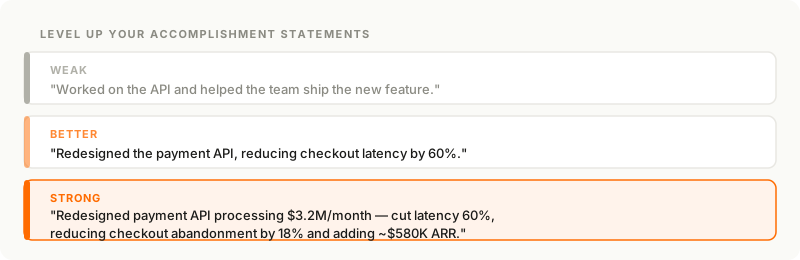
Data engineering review phrases gain credibility when they include downstream impact rather than just pipeline metrics. “Built reliable pipelines” is a phrase. “Reduced analyst pipeline wait time from 6 hours to 45 minutes, enabling same-day reporting that the business team now relies on for weekly planning” is a review. Use these phrases as a framework and pull specific numbers from your team’s data quality dashboards, Airflow success rate logs, and cloud cost reports.
For Employees
The most effective data engineering self-assessments connect technical work to downstream outcomes. Before writing your review, ask: which analyst, data scientist, or business team benefited from this pipeline? What were they unable to do before it existed? What quality problems did it prevent? What did it cost before and after optimization? These answers transform technical summaries into business impact statements.
Rating Level Guide
| Rating | What it means for Data Engineers |
|---|---|
| Exceeds Expectations | Proactively improves data reliability, platform cost efficiency, and downstream team productivity; establishes quality standards and documentation that enable self-service; drives platform decisions that shape team-wide data infrastructure |
| Meets Expectations | Reliably delivers pipelines that meet quality and freshness requirements; maintains existing data infrastructure; communicates data quality issues to downstream teams on time |
| Needs Development | Delivers functional pipelines but requires guidance on reliability design, cost optimization, or documentation; downstream teams frequently encounter data issues that could have been caught earlier |
Pipeline Design & Delivery
Exceeds Expectations
- Proactively redesigned the order processing pipeline from a monolithic Airflow DAG into modular, independently schedulable tasks, reducing blast radius when individual steps fail and cutting the average incident-to-resolution time from 3 hours to 25 minutes.
- Independently identified that the nightly full-refresh pattern on the customer events table was both expensive and brittle, and implemented an incremental merge strategy using dbt that reduced processing time by 85% and eliminated the daily 4 AM data availability gap that analysts had been working around for months.
- Consistently designs pipelines with idempotency as a first principle — every pipeline can be rerun safely from any historical date without producing duplicate or incorrect data — eliminating the class of data correctness incidents caused by partial failures and manual reruns.
- Drives pipeline design reviews that evaluate testability, monitoring coverage, and failure mode design before implementation begins, preventing the technical debt accumulation that had made the legacy pipeline suite difficult to maintain.
- Led the migration of 34 legacy SQL-based ETL scripts to dbt models with proper testing, documentation, and lineage tracking, transforming a brittle and undocumented pipeline suite into a maintainable, observable, and self-documenting system.
Meets Expectations
- Delivers Airflow DAGs with appropriate retry configuration, failure alerting, and dependency management that meet the team's reliability standards for production data pipelines.
- Implements dbt models with documented descriptions, column-level lineage, and at least uniqueness and not-null tests on primary keys and critical business fields.
- Designs pipelines with explicit schema handling for upstream changes, using schema evolution strategies that prevent downstream failures when source systems add or rename columns.
- Estimates pipeline delivery accurately, factoring in data source reliability, schema validation requirements, and stakeholder review cycles when scoping new pipeline work.
Needs Development
- Is developing stronger pipeline design instincts; recent Airflow DAGs have been delivered without retry logic or failure alerting, causing data availability issues that went undetected until downstream teams reported stale data.
- Would benefit from deeper study of incremental processing patterns — merge strategies, change data capture, deduplication — to reduce the reliance on expensive full-refresh pipelines that are becoming a bottleneck at current data volumes.
- Has shown progress in delivering functional pipelines but is developing the reliability-first design mindset — idempotency, graceful upstream failure handling, and blast radius containment — that distinguishes production data engineering from exploratory data work.
Data Quality & Reliability
Exceeds Expectations
- Proactively designed and implemented the data quality monitoring framework using Great Expectations, defining freshness, completeness, and referential integrity checks on all critical datasets — establishing automated quality gates that catch issues before downstream teams discover them.
- Independently authored the data quality SLA documentation for the 12 most business-critical datasets, establishing explicit freshness windows, completeness thresholds, and escalation paths that gave downstream teams reliable expectations for the first time.
- Consistently implements schema change detection in the ingestion layer, alerting the team when upstream source schemas change and preventing the silent downstream breakages that had been causing analyst confusion and incorrect reports.
- Drives cross-functional data quality reviews with analyst, data science, and finance teams, establishing a shared vocabulary for data quality issues and a feedback loop that surfaces problems upstream before they compound.
- Led the root cause analysis of a recurring data duplication issue in the transactions pipeline, tracing the source to an Airflow task retry interacting with a non-idempotent write operation, and implementing the fix that eliminated 14 months of intermittent duplicate complaints.
Meets Expectations
- Implements Great Expectations or dbt test coverage for uniqueness, not-null, referential integrity, and accepted value range checks on all new data models before releasing them to downstream consumers.
- Monitors pipeline health using Airflow SLAs and alerting, responding to freshness failures within established data quality SLA windows.
- Communicates data quality incidents to downstream teams proactively — before users report issues — with clear information about scope, severity, and estimated resolution time.
- Participates in data quality retrospectives, contributing accurate root cause analysis and actionable remediation items.
Needs Development
- Is developing stronger data quality habits; several recent pipeline deliveries have launched without dbt test coverage or Great Expectations validation, leading to data quality issues that were discovered by analysts rather than caught by automated checks.
- Would benefit from more proactive communication about data quality incidents — the current pattern of waiting for downstream teams to report issues rather than monitoring proactively creates unnecessary disruption to analyst and data science workflows.
- Has shown genuine progress in technical delivery but is developing the quality-first mindset that treats data reliability as a design requirement rather than a post-delivery concern.
Performance & Cost Optimization
Exceeds Expectations
- Proactively audited the team's BigQuery query patterns, identifying 8 jobs running full table scans on unpartitioned tables, and implemented partitioning and clustering strategies that reduced monthly BigQuery spend by $4,200 without any change to downstream query results.
- Independently optimized the Spark job that processed daily user behavior events by tuning partition count, broadcast join thresholds, and memory configuration, reducing processing time from 4.5 hours to 40 minutes and cutting the EMR cluster cost by 60%.
- Consistently evaluates the cost implications of new pipeline designs before implementation — choosing between Snowflake virtual warehouse sizes, Spark cluster configurations, and Airflow scheduling frequencies with awareness of their cost tradeoffs.
- Drives the team's FinOps practice for data infrastructure, implementing Terraform cost tagging, establishing per-pipeline cost tracking in BigQuery, and conducting quarterly optimization reviews that have reduced total data infrastructure spend by 22% year over year.
- Led the Snowflake clustering key analysis for the five largest tables, implementing appropriate clustering configurations that reduced average query scan size by 70% for the analytical query patterns used by the business intelligence team.
Meets Expectations
- Designs dbt models with appropriate materialization strategy — table vs. incremental vs. view — based on query frequency, compute cost, and freshness requirements rather than defaulting to full table materializations.
- Implements BigQuery partitioning and Snowflake clustering on new large tables, following team standards for partition key selection and cluster column ordering.
- Monitors Airflow DAG run durations and addresses performance regressions when jobs exceed established time SLAs.
- Reviews the cost impact of new pipeline additions on the monthly cloud data infrastructure budget and raises concerns when projected costs exceed approved thresholds.
Needs Development
- Is developing stronger cost awareness in pipeline design; several recent dbt models have been materialized as full-refresh tables on large datasets where incremental processing was feasible, generating avoidable compute costs that are compounding month over month.
- Would benefit from deeper study of BigQuery and Snowflake query optimization patterns — partition pruning, clustering effectiveness, materialized view design — to resolve performance issues more independently and avoid the expensive anti-patterns currently present in this engineer's recent work.
- Has shown progress in delivering functional pipelines but is developing the cost stewardship instinct that considers infrastructure spend as a design constraint from the start rather than an optimization concern after the fact.
Platform & Infrastructure
Exceeds Expectations
- Proactively designed the Terraform module for the team's standard Airflow deployment on GCP Cloud Composer, enabling new data pipelines to be provisioned with consistent configuration, IAM roles, and monitoring without manual setup steps.
- Independently implemented the Kafka consumer infrastructure for real-time data ingestion, enabling the team to process streaming event data for the first time and unblocking two ML feature engineering use cases that had been blocked on batch data availability.
- Consistently applies infrastructure-as-code principles to all data platform changes, ensuring that Airflow, dbt project configuration, Snowflake resource monitors, and BigQuery dataset policies are all managed in version control and reviewed before changes are applied.
- Drives the data platform roadmap by proactively identifying capability gaps — missing orchestration features, inadequate observability tooling, absent data lineage tracking — and building the business case for the investments that address them.
- Led the Airflow upgrade from version 2.2 to 2.7, coordinating the migration of 180 DAGs, validating backward compatibility for custom operators and plugins, and completing the upgrade with zero production impact over a planned maintenance window.
Meets Expectations
- Manages data platform infrastructure changes using the team's Terraform and configuration management practices, submitting changes for peer review before applying to production environments.
- Participates in data platform planning discussions, providing input on the technical feasibility and infrastructure requirements for new data capabilities requested by stakeholder teams.
- Monitors data platform health — Airflow scheduler performance, Snowflake warehouse utilization, Kafka consumer lag — and escalates issues before they affect downstream pipeline reliability.
- Maintains the data platform runbooks, ensuring operational procedures are documented accurately and usable by on-call engineers without deep platform context.
Needs Development
- Is developing stronger infrastructure-as-code habits; several recent data platform changes were applied manually without corresponding Terraform updates, creating configuration drift that has complicated subsequent infrastructure work.
- Would benefit from deeper engagement with Kafka and streaming infrastructure concepts — consumer group management, partition rebalancing, lag monitoring — as the team's data platform increasingly relies on real-time event processing.
- Has shown progress in maintaining existing platform configurations but is developing the skills to evaluate architectural tradeoffs — batch vs. streaming, warehouse vs. lakehouse, managed vs. self-hosted — independently when new platform requirements arise.
Documentation & Collaboration
Exceeds Expectations
- Proactively maintains a data catalog with table descriptions, column-level documentation, and business context for all datasets in the team's ownership area, enabling analysts and data scientists to answer their own questions without routing requests to the data engineering team.
- Independently authored the data onboarding guide for new analytics engineers, covering dbt conventions, Airflow workflow, data quality expectations, and escalation paths — reducing the onboarding time for new team members from three weeks to one week.
- Consistently establishes data contracts with upstream source system teams — schema change notification SLAs, deprecation policies, breaking change approval processes — that protect pipeline reliability and reduce the emergency remediation work caused by undisclosed upstream changes.
- Drives the weekly data health meeting with analytics, data science, and business intelligence stakeholders, providing a structured forum for surfacing data quality issues, communicating upcoming changes, and prioritizing reliability improvements based on downstream impact.
- Authored the dbt project contributing guide — model naming conventions, testing requirements, documentation standards, materialization selection criteria — that has become the team's authoritative reference and has measurably improved the consistency and quality of code reviews.
Meets Expectations
- Documents dbt models with source, model, and column descriptions that give downstream users sufficient context to understand the data's origin, transformation logic, and intended use.
- Communicates planned pipeline changes — schema changes, schedule modifications, deprecations — to downstream teams with appropriate notice and migration guidance.
- Responds to downstream team questions and data requests within established SLA, providing clear answers and root cause analysis rather than workarounds when data quality issues are reported.
- Participates in cross-functional data reviews with analytics and business intelligence teams, contributing technical context that helps stakeholders interpret data quality issues correctly.
Needs Development
- Is developing stronger documentation habits; several data models delivered this quarter lack descriptions and test coverage, requiring analysts to reverse-engineer the transformation logic themselves — a recurring friction point that has surfaced in the quarterly analyst survey.
- Would benefit from more proactive downstream communication — the current pattern of announcing pipeline changes in the data engineering team channel without notifying affected analyst teams has caused several unplanned disruptions to downstream workflows.
- Has shown genuine improvement in technical delivery over the review period but is developing the collaborative practices — documentation, data contracts, proactive communication — that make data engineering work a net enabler rather than a bottleneck for downstream data consumers.
How Prov Helps Build the Evidence Behind Every Review
Data engineers often do their most impactful work in ways that are easy to forget: a pipeline optimization that saved $3,000 a month, a data quality fix that prevented a board report from containing incorrect numbers, a documentation effort that gave analysts self-service access to a dataset they’d previously needed to request manually. These wins happen continuously throughout the year and are almost never written down.
Prov gives data engineers a lightweight way to capture these moments as they happen — a 30-second voice note after fixing a data quality incident, a quick text capture when a downstream team reports that a new pipeline unblocked their work, a record of a cost optimization that passed code review. Over time, those captures build a detailed record of reliability, stewardship, and collaboration impact that is the difference between a review that says “built pipelines” and one that says “built the data infrastructure that enabled the analytics team to close the books three days faster every quarter.”
Ready to Track Your Wins?
Free to start, no account, no sign-up. Available on the App Store now.
Download on iOS Free to start, no account needed