Concrete examples of data engineering achievements you can adapt for your performance review, promotion packet, or resume.
The Data Engineer's Performance Review Problem
Your pipelines ran without a hiccup all year. The dashboards loaded instantly. The data scientists had clean, reliable data waiting for them every morning. Models trained on schedule. Analysts stopped filing data quality tickets. And now, sitting down to write your self-review, you're staring at a blank page — because when you do your job well, nobody notices you did anything at all.
This is the defining paradox of data engineering. The entire discipline is infrastructure for other people's work. When a pipeline fails, everyone knows immediately. When it runs perfectly for twelve months, it's invisible. The analytical models that generated $2M in revenue last quarter ran because you built the feature store that fed them. The executive dashboard the CEO checks every morning loads in under two seconds because of the materialized views and caching layer you designed. None of that appears in a changelog. None of it has a launch date. It simply exists, quietly, holding everything else up.
There's a second challenge: your reviewers likely can't evaluate the technical choices you made. A VP of Engineering or Head of Data might not know the difference between a Kimball star schema and a Data Vault, or why you chose Dagster over Airflow, or what it cost the business to run inefficient Snowflake queries. Your job at review time is to translate invisible technical work into visible business impact — in language that a smart non-specialist can evaluate. Not "implemented SCD Type 2 on the customer dimension" but "built the historical tracking that let the analytics team answer customer lifecycle questions for the first time, enabling the Q3 churn analysis."
The examples below are organized by the competencies that actually move the needle in data engineering performance reviews. They're specific, measurable, and built on the structure that makes technical work legible to business reviewers: what you built, why the previous state was a problem, and what became possible or cheaper or more reliable because of your work.
What gets you promoted are documented accomplishments with measurable impact.
Data Engineer Accomplishment Categories
| Competency | What Reviewers Look For |
|---|---|
| Data Pipeline & Ingestion | Do you move data reliably at scale? |
| Data Modeling & Warehouse Design | Do you structure data for usability? |
| Data Quality & Reliability | Can analysts and scientists trust the data? |
| Platform & Infrastructure | Do you build the foundation others depend on? |
| Performance & Cost Optimization | Do you make the data platform efficient? |
| Collaboration & Enablement | Do you enable the rest of the data org? |
Data Pipeline & Ingestion Accomplishments
Ingestion & ETL/ELT
- "Rebuilt the nightly ETL pipeline from a brittle Python script to a modular Airflow DAG with retry logic and alerting, reducing pipeline failures from 3-4 per week to fewer than 1 per month"
- "Migrated 22 manually-maintained CSV ingestion jobs to Fivetran managed connectors, eliminating 6 hours of weekly pipeline maintenance and giving analysts same-day data freshness instead of next-day"
- "Built the ELT pipeline from Salesforce, HubSpot, and Stripe into Snowflake using Airbyte and dbt, consolidating 3 siloed data sources into a single source of truth for the revenue team within 6 weeks"
- "Designed the incremental loading strategy for the 800M-row events table — replacing the full nightly reload — cutting ingestion time from 4 hours to 22 minutes and eliminating the morning data gap analysts had worked around for two years"
- "Implemented schema evolution handling in the ingestion layer, allowing upstream source schemas to change without manual pipeline intervention — reducing the schema-related pipeline incidents from 8 per quarter to zero"
- "Built the multi-source customer identity pipeline that matched records across 4 systems using deterministic and probabilistic matching, creating the unified customer view that the personalization team needed to launch their first ML model"
- "Standardized all ingestion jobs to use the company's logging and alerting framework, giving the data team visibility into pipeline health for the first time and cutting mean time to detect ingestion failures from 3 hours to 8 minutes"
- "Migrated the legacy Oracle-to-Redshift pipeline to a CDC-based approach using Debezium and Kafka, reducing replication lag from 24 hours to under 5 minutes for the operational data the support team depended on"
Streaming & Real-time
- "Designed and built the Kafka-to-BigQuery streaming pipeline for user behavioral events, reducing event processing latency from next-day batch to under 60 seconds — enabling real-time personalization for the first time"
- "Implemented Flink stateful stream processing for the fraud detection pipeline, enabling sub-second anomaly detection on transaction data and reducing fraudulent transactions by 34% in the first quarter after launch"
- "Built the real-time inventory pipeline that consumed Kafka events from 3 fulfillment systems and kept warehouse dashboards accurate within 90 seconds — replacing a batch sync that had caused 40+ oversell incidents annually"
- "Migrated the clickstream pipeline from a polling-based architecture to Kafka Streams, handling a 10x traffic increase from the product launch without any pipeline modifications or cost increase"
- "Implemented exactly-once semantics in the payment events pipeline, eliminating the duplicate processing that had caused $12,000 in accounting reconciliation work over the previous year"
- "Built the operational CDC pipeline using Debezium for the core product database, giving the analytics team access to near-real-time operational data without impacting production database performance"
- "Designed the Lambda architecture that served both real-time and batch queries for the recommendation engine — reducing feature serving latency from 800ms to 45ms while maintaining full historical accuracy"
Data Modeling & Warehouse Design Accomplishments
Schema & Warehouse Design
- "Designed the dimensional model for the company's core revenue data — 4 fact tables, 12 dimension tables — that became the single source of truth for all financial reporting, replacing 6 conflicting spreadsheet models"
- "Led the Snowflake warehouse architecture redesign, implementing proper separation of staging, integration, and mart layers — reducing query complexity for analysts by 60% and cutting onboarding time for new analysts from 2 weeks to 3 days"
- "Built the SCD Type 2 implementation for the customer and account dimensions, giving the analytics team the historical tracking capability to answer cohort and lifecycle questions that had previously required expensive custom analyses"
- "Implemented the Data Vault 2.0 modeling approach for the enterprise data warehouse, creating the audit trail and historical flexibility that satisfied compliance requirements without sacrificing query performance"
- "Designed the multi-tenant data model that supported 40 enterprise customers with shared infrastructure, implementing row-level security and tenant isolation without duplicating tables — reducing warehouse costs by $8,000/month"
- "Restructured the flat event log schema into a proper activity schema, reducing the complexity of funnel queries from 120-line SQL to under 20 lines and enabling analysts to self-serve analyses they had previously required engineering support for"
- "Built the cross-functional semantic layer that standardized metric definitions across 5 teams, resolving the persistent disagreements about revenue numbers that had consumed executive meeting time every quarter"
- "Migrated the Redshift data warehouse to Snowflake, achieving a 55% reduction in query costs, 3x improvement in concurrent query performance, and zero analyst-reported data discrepancies during the 6-week migration"
dbt & Transformation
- "Built the dbt project from scratch for a 200-model transformation layer — including documentation, tests, and CI — enabling the analytics team to own their own transformations and reducing engineering dependencies by 70%"
- "Implemented dbt Cloud with CI/CD integration, automating model testing on every pull request and preventing 14 breaking schema changes from reaching production over a 6-month period"
- "Refactored 80 ad-hoc SQL scripts into a structured dbt project with proper staging, intermediate, and mart layers — reducing the time analysts spent debugging data issues from 4 hours per week to under 30 minutes"
- "Wrote the dbt package of shared macros and tests that standardized common patterns across 6 analytics teams, eliminating duplicate code and reducing the average new model development time by 40%"
- "Implemented dbt incremental models for the top 15 most expensive transformation jobs, reducing daily transformation costs in Snowflake by $2,200/month without any change to downstream data freshness"
- "Built the dbt documentation site with full lineage, column-level descriptions, and test coverage metrics — giving analysts a self-service reference that reduced data questions to the engineering team by 50%"
- "Designed the dbt project structure and modeling conventions that became the standard for all 4 data teams, enabling engineers to onboard to new projects in hours instead of days"
Data Quality & Reliability Accomplishments
Testing & Monitoring
- "Implemented Great Expectations across all 35 critical data pipelines, catching data quality issues before they reached analytics consumers — reducing analyst-reported data bugs by 65% in the first quarter"
- "Built the dbt test suite with 400+ schema, referential integrity, and custom business logic tests, achieving 100% test coverage on all mart-layer models used in executive reporting"
- "Designed the data quality SLA framework — freshness, completeness, uniqueness, validity — for the 20 most business-critical datasets, establishing the first formal data quality contract with stakeholders"
- "Implemented row count and null rate anomaly detection across the ingestion layer, automatically quarantining suspect data loads before they propagated downstream — preventing 11 data quality incidents in the first 3 months"
- "Built the automated reconciliation pipeline that compared source system counts against warehouse counts every hour, reducing the time to detect data discrepancies from days to minutes for the finance team's reporting tables"
- "Added data contract enforcement to the event schema registry, requiring upstream teams to version schema changes — eliminating the class of pipeline failures caused by unannounced upstream changes (6–8 per month previously)"
- "Implemented column-level lineage tracking across the entire dbt project, reducing the time to assess downstream impact of a proposed schema change from a multi-hour manual audit to a 5-minute lineage query"
Observability & Incident Response
- "Deployed Monte Carlo for end-to-end data observability across 120 tables, reducing mean time to detect data quality incidents from 6 hours (analyst discovery) to 18 minutes (automated detection)"
- "Built the data incident response runbook and on-call rotation for the data team, reducing average incident resolution time from 4 hours to 45 minutes and cutting the number of incidents that required escalation to engineering by 60%"
- "Implemented pipeline dependency tracking and impact analysis tooling, enabling the team to assess and communicate the downstream impact of any data incident within 10 minutes instead of the previous 2-hour manual analysis"
- "Created the data health dashboard that gave stakeholders real-time visibility into pipeline status, freshness, and quality across 50 datasets — reducing ad-hoc "is the data up?" inquiries to the data team by 80%"
- "Led the root cause analysis for the Q2 revenue data incident, identifying a timezone handling bug that had caused 3% revenue misattribution for 8 months — coordinating the fix and backfill across 4 systems within 48 hours"
- "Implemented alerting on data freshness SLAs using Airflow sensors and PagerDuty, ensuring the on-call engineer is notified within 5 minutes of any table falling behind its expected refresh schedule"
- "Built the automated data backfill framework that could replay any pipeline for any date range with a single command, reducing recovery time from data incidents from a multi-day manual process to under 2 hours"
Platform & Infrastructure Accomplishments
Infrastructure & Orchestration
- "Migrated the Airflow deployment from a manually-managed EC2 instance to MWAA, eliminating 3 Airflow outages per quarter caused by infrastructure drift and reducing the operational burden on the data team by an estimated 4 hours/week"
- "Deployed Dagster Cloud to replace a fragmented mix of cron jobs and custom scripts, giving the team unified pipeline visibility, retry logic, and dependency management across 80 data assets for the first time"
- "Implemented the Prefect-based orchestration platform for the ML feature pipeline, enabling data scientists to schedule and monitor their own pipelines without requiring data engineering support for each new workflow"
- "Built the Terraform infrastructure for the entire data platform — Snowflake resources, Airflow on EKS, dbt Cloud, and data catalog — enabling environment parity and allowing the team to spin up a complete staging environment in under an hour"
- "Containerized the data transformation workloads using Docker and deployed them on Kubernetes, eliminating the environment inconsistency issues that had caused 20% of pipeline failures and making local development match production exactly"
- "Designed and implemented the data platform's networking architecture — private VPC, PrivateLink to Snowflake, VPN for analyst access — satisfying the security requirements for SOC 2 compliance without degrading platform performance"
Tooling & Stack Decisions
- "Led the evaluation and selection of the modern data stack (Airbyte + dbt + Snowflake + Looker), building the proof of concept and business case that secured $180K annual budget approval and replaced the legacy Informatica stack"
- "Implemented the data catalog using Atlan, onboarding 300+ tables with owners, descriptions, and lineage — reducing the time analysts spent finding and understanding data assets from hours to minutes"
- "Built the internal data platform portal that surfaces pipeline status, data catalog search, and self-service ingestion request forms, reducing the volume of data engineering support requests by 45%"
- "Evaluated and implemented column-level encryption in Snowflake for PII fields, satisfying GDPR data minimization requirements and eliminating the data access compliance risk flagged in the annual security review"
- "Designed the data access control framework using Snowflake role hierarchy and row-access policies, implementing least-privilege data access across 40 analysts and 6 teams without limiting their ability to self-serve"
- "Led the migration from Redshift to BigQuery, delivering the project 2 weeks ahead of schedule with zero data loss, a 40% reduction in query costs, and an improvement in analyst-reported query performance across all workloads"
Performance & Cost Optimization Accomplishments
Query & Pipeline Performance
- "Optimized the 10 slowest Snowflake queries used in executive dashboards — adding clustering keys, rewriting joins, materializing intermediate results — reducing average dashboard load time from 45 seconds to under 4 seconds"
- "Identified and fixed a full table scan in the nightly transformation pipeline caused by a missing partition filter, reducing the pipeline runtime from 3.5 hours to 22 minutes and unblocking the morning SLA for the finance team"
- "Rebuilt the user funnel analysis model using Snowflake dynamic tables, reducing the compute required for daily refresh by 70% and enabling analysts to query results without scheduling concerns"
- "Implemented query result caching and materialized views for the top 20 analyst queries by frequency, reducing Snowflake credit consumption by 18% with no change to query results or refresh cadence"
- "Optimized the Spark job for daily user feature computation — repartitioning, broadcast joins, columnar storage — reducing runtime from 4 hours to 35 minutes and enabling the ML team to iterate on features same-day instead of next-day"
- "Profiled and rewrote the dbt incremental logic for 8 high-cost models that were running full refreshes unnecessarily, reducing their combined daily compute cost by $1,400/month"
- "Implemented Snowflake search optimization on the 5 largest tables used for interactive analyst queries, reducing p95 query time from 90 seconds to 12 seconds for the use cases that mattered most to the analytics team"
Cloud Cost Management
- "Conducted a Snowflake credit audit and identified $14,000/month in waste — idle warehouses, oversized compute for workload types, and redundant full refreshes — implementing auto-suspend policies and right-sizing that reduced costs by 38%"
- "Implemented Snowflake resource monitors and warehouse budgets with alerts, giving the data platform team cost visibility for the first time and preventing 3 budget overruns in the first quarter after rollout"
- "Migrated cold data in BigQuery to partitioned and clustered tables with appropriate expiration policies, reducing storage costs by $3,800/month without removing data that analysts were actively using"
- "Built the cost allocation model for the data platform — tagging Snowflake warehouse usage by team and use case — enabling per-team cost visibility and driving a 25% reduction in total platform costs as teams optimized their own usage"
- "Identified that 60% of daily Snowflake spend was concentrated in 3 transformation jobs that ran inefficiently; refactored all three, reducing the daily compute cost for those jobs from $280 to $65"
- "Implemented S3 storage tiering for the data lake, moving raw data older than 90 days to Glacier Instant Retrieval and reducing raw storage costs by $2,600/month while keeping the data accessible for regulatory and audit purposes"
- "Renegotiated the Snowflake contract using utilization data and a 12-month forecast, securing a 20% discount and on-demand credits for seasonal spikes — reducing the annual data platform budget by $42,000"
Collaboration & Enablement Accomplishments
Analyst & Scientist Enablement
- "Built the self-service analytics framework — standardized mart models, a metric store, and documented naming conventions — enabling analysts to answer 80% of their data questions without filing engineering requests"
- "Partnered with the data science team to build the feature store on Feast, reducing the time from feature idea to production-ready feature from 2 weeks to 2 days and enabling the team to ship 3 models in a quarter instead of 1"
- "Designed and delivered a SQL optimization workshop for 12 analysts, teaching query profiling, index use, and warehouse efficiency — reducing analyst-generated Snowflake costs by 22% in the month following the training"
- "Created the data request intake process with SLA commitments and priority tiers, reducing average request turnaround from 8 days to 3 days and improving stakeholder satisfaction scores from 3.1 to 4.4 out of 5"
- "Embedded with the growth team for a quarter to build the experimentation data infrastructure — assignment logs, exposure events, metric snapshots — enabling the team to run and analyze A/B tests without data engineering involvement"
- "Built the reverse ETL pipeline from Snowflake to Salesforce that kept account health scores current in the CRM, enabling the customer success team to act on data-driven signals without switching between tools"
Documentation & Data Governance
- "Led the data governance initiative — defining data owners, establishing a data dictionary, and implementing a change management process for shared datasets — reducing data inconsistency complaints from stakeholders by 70%"
- "Wrote the data engineering onboarding guide and pipeline development standards, reducing new engineer ramp time from 4 weeks to 10 days and ensuring consistent code quality across the team"
- "Implemented column-level PII tagging across the data warehouse using Snowflake tags, producing the data inventory required for GDPR Article 30 compliance and satisfying the requirement that had been open for 8 months"
- "Created the data SLA documentation and published it to all stakeholder teams — defining freshness guarantees, incident communication timelines, and escalation paths — reducing data-related disruptions to stakeholders by 45%"
- "Established the data team's RFC process for significant platform changes, creating 18 RFCs in the first year that preserved architectural context and enabled asynchronous review across time zones"
- "Built the automated data lineage documentation pipeline that kept the data catalog up to date from dbt metadata, eliminating the manual documentation process that had fallen 6 months behind before automation"
How to Adapt These Examples
Plug In Your Numbers
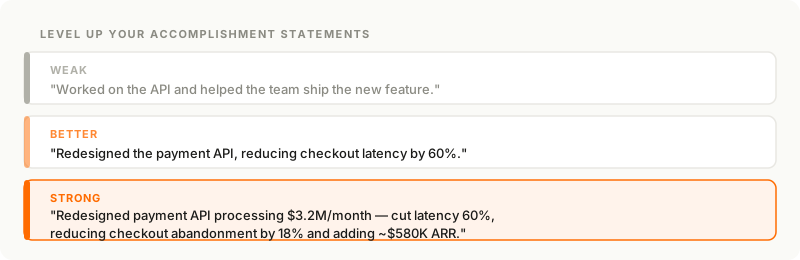
Every example above follows: [Action] + [Specific work] + [Measurable result]. Replace the numbers with yours. Pull pipeline runtimes from Airflow or Dagster logs, query performance from Snowflake's query history or BigQuery's job information schema, cost figures from your cloud billing dashboard, and incident counts from your ticketing system or on-call history. Before-and-after comparisons are the most compelling format — even if you have to reconstruct the baseline retroactively, the comparison is worth the effort.
Don't Have Numbers?
Data engineering impact is often preventative or multiplicative rather than direct, which makes it harder to quantify but no less real. When you don't have a direct metric, reach for the closest available proxy: number of analyst requests eliminated per week, number of teams unblocked, number of pipeline failures per month before and after, or the estimated analyst time saved per week on a recurring task. "Eliminated the 3-hour weekly manual process that caused 40% of our data quality incidents" is a compelling statement even without a dollar figure attached. The business case you made for a tool adoption — the cost comparison you built for the Snowflake migration, the ROI model for adopting dbt — is also a legitimate accomplishment worth documenting.
Match the Level
Junior and mid-level data engineers should emphasize specific technical implementations and their direct outcomes: the pipeline you built, the model you designed, the test coverage you added, the incident you resolved. Senior data engineers should show the decisions behind the work — the tradeoffs you evaluated, the approach you chose and why, the standards you set for the team. Staff and principal data engineers should focus on org-level data platform impact: the modern data stack adoption you drove, the data governance practice you established, the self-service capability that multiplied the output of the analysts and scientists you enabled. The higher the level, the more your accomplishments should demonstrate that you shaped how the entire data organization works — not just that you kept pipelines running.
Start Capturing Wins Before Next Review
The hardest part of performance reviews is remembering what you did 11 months ago. Prov captures your wins in 30 seconds — voice or text — then transforms them into polished statements like the ones above. Prov is coming soon on iOS.
Ready to Track Your Wins?
Free to start, no account, no sign-up. Available on the App Store now.
Download on iOS Free to start, no account needed