The data analyst's self-assessment trap: you spend your days producing insights that other people act on, which means your greatest wins are decisions you influenced but do not own. Learning to document the chain from query to outcome is the entire job of writing your review.
Why Self-Assessments Are Hard for Data Analysts
Data analysts sit at an unusual intersection: technical enough to build complex SQL pipelines and Looker dashboards, but close enough to the business to understand what the numbers mean. That dual identity creates a dual self-assessment problem. If you write about your SQL skills, you sound like a technician. If you write about business outcomes, someone asks why you’re claiming credit for decisions the product or marketing team made.
The attribution problem runs deep for analysts. When your segmentation analysis led to a campaign that drove $200K in incremental revenue, that revenue shows up in the marketing team’s OKRs — not yours. Your contribution was the insight that made the decision possible, which is harder to quantify than the outcome itself. Many analysts undersell this contribution by describing the work (“I built a cohort analysis”) rather than documenting the chain of causation (“my cohort analysis identified the retention gap that led the product team to prioritize the onboarding redesign, which reduced 30-day churn by 14%”).
There’s also a volume problem. Data analysts produce hundreds of queries, dozens of dashboards, and countless ad-hoc pulls over a review cycle. The temptation is to list them. The right move is to select the five analyses that genuinely changed something and write about those. One insight that changed a roadmap decision is worth more on a self-assessment than forty dashboards that were viewed twice.
Finally, analysts often undersell their quality and governance work. Cleaning messy data, documenting transformation logic in dbt, writing tests for a broken pipeline — this work is invisible when it goes well and catastrophic when it doesn’t. Self-assessments should make this invisible work visible.
How to Structure Your Self-Assessment
The Three-Part Formula
What I did → Impact it had → What I learned or what’s next
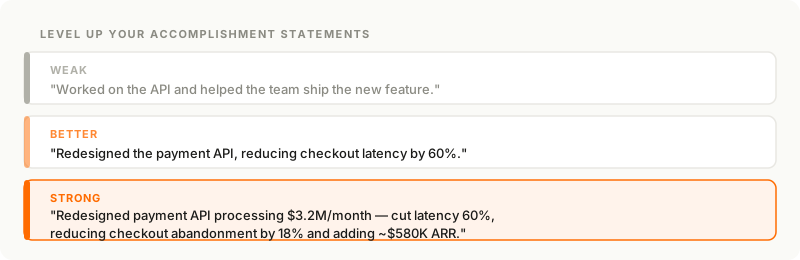
Apply this formula at the level of individual analyses, not just broad responsibilities. “I built a retention dashboard” becomes “I built a retention dashboard that shifted the product team’s weekly review process from gut-feel prioritization to metric-driven decisions — within two months it was a standing agenda item in their sprint planning.”
Phrases That Signal Seniority
| Instead of this | Write this |
|---|---|
| "I ran a lot of queries" | "I owned the analytical workstream for [initiative], producing [N] analyses that directly informed [specific decisions]" |
| "I made a dashboard" | "I built a self-serve dashboard that eliminated [N] ad-hoc requests per week and enabled [team] to answer their own questions without analyst support" |
| "I found some insights" | "I identified [specific finding] that [team] acted on, resulting in [measurable outcome]" |
| "I want to get better at Python" | "I'm expanding my Python skills beyond SQL to automate [specific workflow], targeting [outcome] by [timeframe] to reduce manual effort on recurring reporting" |
Analysis & Insights Self-Assessment Phrases
Exploratory Analysis
-
“I led an exploratory analysis of our activation funnel using BigQuery and Python that identified a previously unmeasured drop-off point between trial sign-up and first meaningful action. The finding directly informed a product decision to redesign the onboarding checklist, which increased 7-day activation by 18% in the following quarter.”
-
“I conducted a cohort retention analysis across 24 months of customer data, segmented by acquisition channel and plan type. This revealed that customers acquired through organic search had 40% higher 12-month retention than paid channels — a finding that shifted our budget allocation debate from opinion to evidence.”
-
“I built a customer lifetime value model in Python using three years of transaction data, replacing the team’s spreadsheet-based approximation. The model surfaced that our highest-volume segment was actually our least profitable, prompting a pricing review that had been avoided for two years.”
-
“When the business noticed an unexpected revenue dip in Q3, I conducted a root-cause decomposition in SQL that isolated the driver to a single geographic region and a single product SKU. My analysis cut the investigation time from weeks to 48 hours and gave leadership a clear narrative for the board.”
Statistical Rigor
-
“I introduced proper confidence intervals into our A/B test reporting, replacing the team’s practice of calling tests significant based on raw conversion numbers alone. This prevented two premature rollout decisions and improved trust in our experimentation results with leadership.”
-
“I built a regression model in Python to separate the seasonal signal from underlying trend in our weekly sales data, giving the forecasting team a baseline they could actually build on. The previous approach had been systematically overestimating growth during high-season periods.”
-
“I identified and corrected a survivorship bias in our churn analysis that had been making our retention metrics look 12% better than they actually were. Surfacing this uncomfortable truth required significant stakeholder management but ultimately led to a more honest product roadmap.”
Data Quality & Governance Self-Assessment Phrases
Data Integrity
-
“I audited our dbt transformation layer and identified six models with undocumented business logic and no tests. I added schema tests and documented assumptions for all six, reducing the risk of silent data quality failures that had previously caused two reporting incidents per quarter.”
-
“I discovered a join condition error in our core revenue model that had been overcounting transactions by approximately 3% for six months. I traced the root cause, corrected the model, restated the affected metrics, and wrote a post-mortem that led to a mandatory review process for all models touching revenue tables.”
-
“I implemented Great Expectations data quality checks on our three highest-stakes pipelines, catching a schema drift issue from an upstream source system before it propagated into production dashboards. Without these checks, the error would have been live in Looker for at least 72 hours.”
-
“I established a data dictionary for our Snowflake warehouse that now covers 80% of our most-used tables, reducing the volume of ‘what does this field mean?’ Slack messages to the data team by an estimated 15 per week. This documentation has become a required artifact for any new model we ship.”
Pipeline Reliability
-
“I refactored our nightly Airflow DAG that had been failing intermittently for three months, identifying a memory allocation issue in the Spark transformation step. After the fix, pipeline reliability improved from 78% to 99.2% over 90 days, eliminating a class of Monday-morning fire drills for the team.”
-
“I built an automated data freshness monitor in Python that alerts the team when any production table has not been updated within its expected window. This caught three upstream failures before they affected stakeholder reports, compared to zero detection capability before the tooling existed.”
Dashboarding & Reporting Self-Assessment Phrases
Dashboard Design
-
“I redesigned our weekly business review dashboard in Looker, reducing it from 47 metrics to 12 signal metrics with drill-through capability for the supporting detail. Leadership reported that the redesigned format cut their review prep time in half and made the conversation more focused.”
-
“I built a self-serve product analytics dashboard in Tableau that allowed the product team to answer their own funnel questions without submitting analyst requests. In the two months after launch, ad-hoc funnel requests to the data team dropped by 60%, freeing approximately 6 hours per week for higher-value analysis work.”
-
“I implemented row-level security in our Looker environment so that regional managers could access their own data without seeing competitor regions’ data. This unlocked a set of use cases that had been blocked for six months due to data sensitivity concerns, enabling four new self-serve reporting workflows.”
Reporting Cadence
-
“I established a weekly automated report in Google Sheets that replaced a manual process requiring three hours of analyst time per week. The automation has run reliably for seven months, saving an estimated 90 hours of analyst time and eliminating a recurring source of transcription errors.”
-
“I redesigned the executive KPI report format based on direct feedback from the VP of Product, shifting from a data-dump format to a narrative structure with three highlighted insights per week. Engagement with the report — measured by reply rate and follow-on questions — increased noticeably after the format change.”
Stakeholder Enablement Self-Assessment Phrases
Translating Data to Decisions
-
“I partnered with the marketing team for three months as their embedded analyst, which required me to develop a deep understanding of their campaign measurement methodology. I translated our data model’s capabilities into terms they could use for campaign planning, resulting in two analyses that directly shaped their Q4 budget allocation.”
-
“I created a data literacy workshop for non-technical stakeholders covering how to read confidence intervals, spot misleading charts, and ask better questions of data. Twelve people across product, marketing, and operations attended, and I have since been asked to repeat it for three new team members.”
-
“When a senior stakeholder misread a Tableau chart and was about to present incorrect data to the board, I raised the issue directly and respectfully, providing a corrected interpretation with 24 hours’ notice. This required both technical confidence and diplomatic communication, and the stakeholder specifically thanked me for the catch.”
Reducing Analyst Bottlenecks
-
“I trained six members of the product team on basic Looker navigation and filtering, enabling them to answer 70% of their own questions without waiting in the analyst request queue. This freed me to focus on analyses requiring deeper technical work and improved the team’s average response time on complex requests.”
-
“I created a ‘data request checklist’ for stakeholders that significantly improved the quality of incoming analysis requests. Requests that previously arrived with unclear objectives and undefined success criteria now typically arrive with context that halves the back-and-forth before analysis begins.”
SQL & Technical Skill Self-Assessment Phrases
Query Engineering
-
“I rewrote a critical BigQuery query that had been timing out on full dataset runs, reducing execution time from 4.5 hours to 22 minutes through strategic use of partitioning, clustering, and intermediate materialization. The optimization reduced our BigQuery compute costs for that workload by approximately $800 per month.”
-
“I built a modular SQL framework in dbt for our customer journey analysis that made it possible for any analyst on the team to run cohort analyses without writing from scratch. This reduced the time to produce a new cohort analysis from half a day to under an hour.”
-
“I introduced window functions and CTEs as standard patterns in our team’s SQL style guide, replacing a set of brittle subquery patterns that were difficult to read and error-prone. I ran two code review sessions to help the team adopt the new patterns, and code quality in peer reviews has measurably improved.”
Python & Automation
-
“I automated our monthly churn report using Python and the Snowflake connector, replacing a six-step manual process that was prone to copy-paste errors. The automated version runs in 12 minutes unattended and produces output in a consistent format ready for the finance team’s spreadsheet.”
-
“I built a Python script that monitors our Airflow DAG failure logs and posts structured alerts to Slack with the failing task, error type, and a link to the relevant log. This reduced the time from pipeline failure to analyst awareness from an average of 3 hours to under 10 minutes.”
Business Impact Self-Assessment Phrases
Revenue & Growth Influence
-
“My pricing sensitivity analysis — built on two years of transaction data in Snowflake — directly informed a tiering decision that the finance team estimates will generate $1.2M in incremental ARR. I presented the analysis to the VP of Finance and the CEO, fielded all quantitative questions, and provided the scenario modeling that enabled the decision.”
-
“I identified a high-value customer segment in our data that had been receiving our standard onboarding flow despite having significantly different behavior patterns. Flagging this to the product team led to a targeted onboarding experiment that increased segment retention by 22% — a finding that influenced the next quarter’s product roadmap.”
-
“My analysis of trial-to-paid conversion by signup source identified that users from a specific partnership channel converted at 3x the rate of direct signups but represented only 8% of acquisition spend. This finding drove a 40% budget reallocation toward the partnership channel in the following quarter.”
Cost & Efficiency Impact
-
“I audited our Snowflake credit consumption and identified three unoptimized query patterns accounting for 35% of our monthly bill. After rewriting those queries and adjusting warehouse sizing, we reduced our Snowflake costs by $2,400 per month without any degradation in dashboard performance.”
-
“I built a capacity planning model that gave the engineering team data-driven guidance on infrastructure scaling ahead of our seasonal peak. Using my model, they provisioned appropriately rather than over-provisioning ‘just in case,’ saving an estimated $15K in cloud spend during the peak period.”
How Prov Helps Data Analysts Track Their Wins
The hardest part of a data analyst’s self-assessment is recall — most analyses are delivered as Slack messages or one-off queries, and the decision they influenced happens weeks later in a meeting you weren’t in. By the time review season arrives, the connection between your work and its outcome has faded.
Prov captures wins in 30 seconds via voice or text, right after the moment that matters: when you deliver an insight, when a stakeholder says your analysis changed their thinking, when a pipeline you built catches its first real failure. Those rough notes become polished achievement statements ready for your next performance review — without the Sunday-night archaeology of trying to reconstruct six months of impact from Jira tickets and Slack history. Prov is coming soon on iOS.
Ready to Track Your Wins?
Free to start, no account, no sign-up. Available on the App Store now.
Download on iOS Free to start, no account needed