Customer success managers are asked to prove a negative. Your best work — the churn you prevented, the escalation that never became a crisis, the relationship you maintained through a difficult renewal — is invisible by design. The customer stayed. Nobody writes a press release about that. Your self-assessment is the only place where the invisible work becomes visible.
Why Self-Assessments Are Hard for Customer Success Managers
CSMs sit at the most difficult measurement boundary in the business: the intersection of relationship and revenue. Your work is simultaneously deeply human — you are the person customers call when something goes wrong, the voice they trust when they’re evaluating whether to stay — and intensely commercial, tied to retention rates, NRR, and expansion quotas that appear on board slides. Writing about both dimensions authentically, without overclaiming the relationship and without underselling the revenue impact, is a genuine challenge.
The churn prevention problem is real and underappreciated. When you identify an at-risk account four months before renewal and run a structured recovery plan, the outcome — the customer renews — looks identical on paper to an account that never needed intervention. The CSM who saved 15 accounts from churn and the CSM who did nothing and happened to have a stable book both report the same retention rate. Your self-assessment must make the intervention visible, not just the outcome.
There’s also the attribution problem on the expansion side. Upsells and expansions involve AEs, solution engineers, and deal desk. The CSM who identified the expansion opportunity, nurtured the relationship that made it possible, and introduced the AE at the right moment rarely gets full credit for the revenue outcome. Your self-assessment needs to articulate specifically what you contributed to the expansion pipeline — the relationship you built, the use case you surfaced, the internal champion you developed.
Finally, there is the voice-of-customer work that rarely surfaces in metrics: the product feedback you gathered that shaped a roadmap decision, the NPS pattern you identified that triggered a support process change, the customer story you sourced that became a sales reference. This influence work is genuinely valuable and needs to be claimed explicitly.
The goal: make prevention visible, quantify relationship work through its downstream outcomes, and claim appropriate credit for expansion and influence that flows through other teams.
How to Structure Your Self-Assessment
The Three-Part Formula
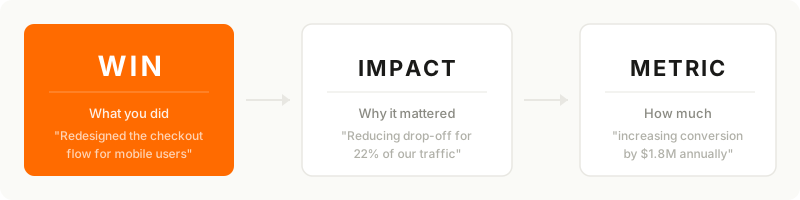
What I did → Impact it had → What I learned or what’s next
For CSMs, the “impact” step often requires connecting a relationship action to a business outcome: “I ran a structured health recovery plan with [account] starting in [month], which resulted in a renewal at [value] in [month] — an account that Gainsight had flagged as high churn risk three months prior.”
Phrases That Signal Seniority
| Instead of this | Write this |
|---|---|
| "I have good relationships with my accounts" | "I developed executive-level relationships at four accounts where we previously had only champion-level access, converting two of those relationships into expansion conversations that contributed $210K to pipeline in H2" |
| "I prevented some churn" | "I identified and remediated five high-risk accounts in Gainsight before they entered renewal discussions — four renewed on time and one expanded; combined ARR retained was $380K that was at genuine risk of churning" |
| "I helped with upsells" | "I sourced $340K of expansion ARR by identifying underutilized product capabilities during QBRs and introducing the AE at the moment of stakeholder alignment — three of my expansions closed within 45 days of introduction" |
| "I want to improve my forecasting" | "I'm standardizing my renewal forecast methodology in Salesforce by updating health scores in Gainsight weekly and committing only accounts where I have a confirmed budget and decision-maker — my goal is to reduce my renewal forecast variance from ±20% to ±8% by Q3" |
Retention & Renewal Self-Assessment Phrases
Renewal Execution
-
“I achieved a gross retention rate of 96% across my book of business, retaining $2.1M ARR of $2.2M eligible for renewal. I attribute this to a systematic renewal process — I open every renewal conversation 90 days before expiry, run a structured success review in the 60-day window, and ensure executive-level alignment before entering commercial negotiation.”
-
“I managed 22 renewals this year, with an average renewal close time of 8 days before the contract expiry date. I track this metric because late renewals are an indicator of unresolved relationship risk — closing early indicates the customer sees clear value, and I use the 30-day mark as a trigger to escalate to my manager if we’re not on track.”
-
“I improved my renewal rate from 88% to 96% over the year by adopting a more proactive risk identification process — using Gainsight health scores, Mixpanel product engagement data, and support ticket volume as leading indicators rather than waiting for the customer to express concern. This shift caught four accounts that required active intervention at a point when recovery was still possible.”
-
“I retained a $420K account that had flagged intent to churn due to a product gap, by building an executive bridge directly to our VP of Product and facilitating a roadmap commitment call. I documented the customer’s requirements in detail, framed them in terms of the business impact the product gap was causing, and secured a commitment that kept the account engaged through a 12-month renewal.”
At-Risk Account Recovery
-
“I inherited three red-flagged accounts at the start of the year that had been tagged as high churn risk in Gainsight due to low engagement and open support escalations. I developed a structured recovery plan for each — resolving the open technical issues, establishing a new executive sponsor at each account, and running monthly success reviews for 90 days. All three renewed, with a combined ARR of $290K.”
-
“I identified a systematic churn risk pattern across my book: accounts with fewer than two active Mixpanel users per 10 seats were churning at 3.4x the rate of well-adopted accounts. I flagged this finding to the CS team, built a low-adoption playbook in ChurnZero, and applied it to eight accounts that matched the pattern. Six of the eight improved their adoption scores to the healthy threshold within 90 days.”
-
“When a key stakeholder at my largest account left the company, I executed a transition plan within 72 hours: identifying the incoming stakeholder from my secondary relationships, providing them a comprehensive account briefing, and scheduling an executive introduction with our VP of CS within the first week. The account renewed on schedule four months later with no disruption to the relationship.”
Expansion & Upsell Self-Assessment Phrases
Expansion Identification
-
“I sourced $510K in expansion ARR this year by making expansion identification a structured practice rather than an opportunistic one. During every QBR, I review feature utilization data from Mixpanel against the customer’s stated business goals, identify underutilized capabilities, and document expansion signals in Salesforce immediately. Three expansions closed within 60 days of my initial identification.”
-
“I identified an upsell opportunity at a $160K account during a routine check-in call where the customer mentioned a new use case they were solving manually. I connected them with our AE within the week, provided the AE with detailed context on the customer’s goals and technical environment, and the deal closed at $48K additional ARR within 45 days.”
-
“I developed an account whitespace analysis for my top 15 accounts using Salesforce data and Gainsight product usage reports, mapping each account against our product capabilities they were not yet using. This analysis produced a prioritized list of 22 expansion conversations, of which 11 have been introduced to the AE team and seven have resulted in closed expansion deals totaling $340K ARR.”
Expansion Execution
-
“I structured my QBRs to include a deliberate expansion moment — after reviewing success metrics, I present one ‘what’s next’ use case that connects to the customer’s stated strategic priorities. This practice has increased my expansion source rate from 18% of accounts per year to 41%, and four customers have told me the QBR format has become a template for how they run vendor reviews internally.”
-
“I partnered with the AE team to develop a joint expansion playbook, defining the handoff criteria, the information I provide at introduction, and the involvement expected from CS through close. The playbook reduced average expansion deal cycle time by 22 days because the AE had full context at the start rather than re-doing discovery the customer had already done with me.”
Onboarding & Adoption Self-Assessment Phrases
Onboarding Execution
-
“I redesigned our enterprise onboarding process this year, reducing average time-to-first-value from 47 days to 26 days by restructuring the kickoff milestone sequence and introducing pre-built configuration templates in Intercom for the five most common customer use cases. Accounts that completed the new onboarding process reached 90-day product usage targets at 78% versus 51% for accounts onboarded under the prior process.”
-
“I developed a technical implementation checklist in Confluence that customers use during integration setup, replacing an unstructured email thread process. The checklist reduced integration support tickets in the first 30 days from an average of 6 per new account to 1.4, and time-to-integration dropped from 19 days to 11 days.”
-
“I created a role-specific onboarding track for each of the three primary user personas at our enterprise customers — administrator, power user, and end user — using Intercom sequences with persona-specific content. Accounts using the segmented onboarding tracks had 30-day activation rates 24 points higher than accounts receiving the generic track.”
Product Adoption Driving
-
“I built an adoption playbook for our most underutilized product module, which Mixpanel data showed 62% of accounts had never activated despite it being relevant to their stated goals. I identified the activation blockers through customer interviews, built a structured enablement session, and ran it with 14 accounts over two quarters. Module activation in my book increased from 38% to 71%, and NPS from those accounts improved 18 points.”
-
“I track product adoption metrics weekly in Mixpanel for every account in my book and use declining engagement as an early warning signal — not waiting for a customer to raise a concern. This practice allowed me to reach out proactively to three accounts during engagement drops that turned out to be caused by team changes, and in each case I ran onboarding for the new team members before the accounts registered as at-risk in Gainsight.”
-
“I partnered with our product team to develop in-app onboarding guidance for two features that had high abandonment rates. I contributed the customer language and common confusion points from my support conversations in Zendesk, and the resulting in-app tooltips reduced support contacts for those features by 44% within 60 days of deployment.”
Customer Health & Risk Management Self-Assessment Phrases
Health Monitoring
-
“I manage a book of 28 enterprise accounts with a combined ARR of $3.4M. I maintain Gainsight health scores that are accurate within a two-week lag by reviewing product engagement from Mixpanel, support ticket velocity from Zendesk, and stakeholder communication frequency on a weekly basis. My health score accuracy — measured by whether predicted-red accounts actually churned — is 84%, compared to a team average of 61%.”
-
“I developed a custom health scoring model for my segment by analyzing the attributes of every churned account in my book over two years and identifying the leading indicators that appeared 60–90 days before churn. The model weights low power-user adoption, executive sponsor departure, and open critical support tickets as the three strongest predictors. I shared the model with the CS team and it has been incorporated into our standard Gainsight configuration.”
-
“I established a monthly account health review cadence with my manager, preparing a structured brief for each account in yellow or red status with a specific action plan and owner. This practice has made my risk management transparent and proactive — my manager can see the interventions I’m running before renewals come up, rather than only learning about risks at the renewal stage.”
Escalation Management
-
“I managed a critical escalation at a $280K account that had submitted a formal complaint to our executive team. I took ownership of the escalation — establishing a daily standup with their team, coordinating resolution across support, product, and engineering, and providing written status updates every 48 hours. The account renewed four months later and the customer cited the escalation handling as a reason for their confidence in renewing.”
-
“I maintained a zero unresolved-escalation record across my book this year. Every escalation received a written action plan within 24 hours, an executive touchpoint within 48 hours, and a resolution summary within the committed timeframe. I believe escalation quality is a leading indicator of renewal confidence and treat every escalation as a retention moment.”
Voice of Customer Self-Assessment Phrases
Product Feedback
-
“I systematically gathered product feedback by including a structured feedback section in every QBR, tagging all feedback in Gainsight by product area and customer impact, and sharing a monthly summary with the product team. Three features on the roadmap this year were directly influenced by feedback patterns I surfaced, and one critical bug was identified and fixed as a result of feedback I collected four weeks before it would have triggered a mass support contact.”
-
“I facilitated five structured customer interviews for the product team this year, recruiting participants, running the interview protocol, and synthesizing findings into a report with actionable recommendations. The research directly influenced two product decisions — the redesign of the export workflow and the prioritization of the API rate limit increase — that both resulted in measurable satisfaction improvements.”
-
“I identified a pattern across seven accounts experiencing the same onboarding friction point — a configuration step that was not clearly documented and was causing a 5–7 day delay in time-to-value. I escalated the finding to the product team with supporting data from Zendesk ticket analysis, and the resulting documentation improvement eliminated the friction point entirely. New account onboarding time dropped by an average of 4.2 days.”
NPS & Advocacy
-
“I drove our segment NPS from 31 to 47 over the year by treating detractor and passive responses as action items rather than data points. For every NPS score below 7, I scheduled a 30-minute follow-up call within five business days to understand the root cause. Of 14 detractors I followed up with, 9 improved to passive or promoter at the next survey cycle.”
-
“I developed three customer case studies this year by identifying customers with strong outcomes and coaching them through the storytelling process. The case studies have been used in seven sales deals and two were featured on our website after review. I track case study production as a concrete success metric — a customer willing to put their name on our success story is the highest signal of account health.”
-
“I built a customer reference program for my segment, maintaining a list of eight customers willing to take reference calls for specific use cases, and coordinating 12 reference calls for the sales team over the year. References are a direct revenue contribution that CSMs rarely claim in reviews — I document every reference I facilitate in Salesforce as part of my impact record.”
Internal Collaboration Self-Assessment Phrases
Sales Partnership
-
“I partnered with the AE team on five renewal-to-expansion transitions this year, providing detailed account context at the introduction meeting and remaining involved through close to maintain the customer relationship. The AE team cited my account briefings as meaningfully shortening the discovery phase — two AEs have requested that I run the same process on their full books of business.”
-
“I serve as the CS representative in our weekly sales forecast call, flagging account-level intelligence — stakeholder changes, competitive activity, product concerns — that affects forecast accuracy for renewal accounts in pipeline. My contributions have caught two renewal risks that had not been captured in the Salesforce opportunity record and led to earlier CS intervention.”
Product & Support Partnership
-
“I built a systematic feedback loop between CS, support, and product by running monthly triages of the top ten support ticket categories in Zendesk, adding CS context to the ticket patterns, and presenting a prioritized impact summary to the product team. This process has reduced the ‘we didn’t know customers cared about this’ situation and has led to two support escalation patterns being addressed as product improvements rather than one-off fixes.”
-
“I collaborated with the support team to create a customer-facing knowledge base for our three most common integration questions, contributing the customer language and use case context while support wrote the technical documentation. The knowledge base deflected an estimated 80 support contacts in its first quarter and reduced average support ticket resolution time for those topics by 40%.”
-
“I worked with the Intercom team to design a proactive outreach sequence for accounts showing early adoption decline signals from Mixpanel — a triggered message at day 14 of low engagement offering a 30-minute success call. The sequence has an 18% acceptance rate and accounts that take the proactive call show a 71% improvement in activation within 30 days, compared to 23% for accounts that do not.”
How Prov Helps Customer Success Managers Track Their Wins
CSMs are often the worst documenters of their own impact — because most of the important work happens in conversations, not systems. The churn you prevented, the executive relationship you built, the product feedback that changed the roadmap: none of these appear cleanly in your Gainsight dashboard or your Salesforce book. They exist in email threads, Slack messages, and your memory.
Prov captures those wins in 30 seconds, right after they happen — a voice note after the renewal call where you saved an at-risk account, a quick entry when the expansion you sourced closes. The app transforms those rough notes into polished achievement statements that are ready for your self-assessment, your promotion case, or your next role. With a full year of captured wins, you’ll never have to reconstruct the prevention work that made your retention rate possible. Prov is coming soon on iOS.
Ready to Track Your Wins?
Free to start, no account, no sign-up. Available on the App Store now.
Download on iOS Free to start, no account needed