CSM reviews must evaluate a negative — churn that did not happen — alongside the relationship quality and expansion work that are harder to see in a dashboard. Strong reviews make the invisible visible.
How to Write Effective Customer Success Manager Performance Reviews
Customer success manager reviews are uniquely difficult because the most important outcome — churn that was prevented — produces no metric. A CSM who spent six months rebuilding a failing implementation, turning a red account green and securing a renewal that the business had already written off, may appear in the data as simply “retained.” The intervention that made that happen is invisible without a deliberate effort to surface it.
Strong CSM reviews begin by recognizing this structural challenge. The goal is to evaluate three distinct dimensions: retention (the defensive, churn-prevention work), expansion (the offensive, revenue-growth work), and the quality of the customer relationship and health management practice that enables both. Each dimension requires different evidence and different language. A CSM who is strong on expansion but weak on health monitoring is building on a fragile foundation. A CSM who retains well but never identifies an expansion opportunity is leaving revenue on the table. The review should name the balance explicitly.
Health monitoring and proactive intervention are the most underevaluated CSM competencies. Gainsight health scores and Mixpanel engagement data give managers visibility into which CSMs are using the available signals and which are managing reactively — responding to inbound concerns rather than detecting and addressing them before the customer notices. Managers should review CSMs’ health check cadence, their escalation history, and their proportion of proactive versus reactive customer interactions.
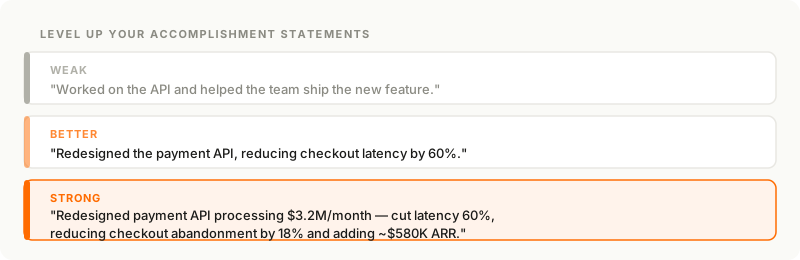
For CSMs writing their own reviews, the instinct is to describe relationship quality in soft terms — “strong partner,” “trusted advisor,” “excellent rapport.” These phrases mean nothing in calibration. Replace them with evidence: renewal cycles that closed without negotiation, executive business reviews that generated expansion discussions, health scores that improved from red to green under active management. The relationship quality is real; the review needs to prove it rather than assert it.
How to Use These Phrases
For Managers
These phrases are strongest when accompanied by specific metrics: net revenue retention rates, renewal close rates, expansion ARR generated, health score changes over time, and time-to-value data from onboarding. Replace every generic reference in these phrases with a real account name, a specific ARR figure, or a measurable outcome from Gainsight or Salesforce.
For Employees
CSMs tend to underreport the defensive work they do — the at-risk accounts they stabilized, the escalations they resolved, the renewals that were in jeopardy before they intervened. This work is often more valuable than the expansion revenue it protected, and it belongs in your self-review with specific detail. Document the before and after, not just the result.
Rating Level Guide
| Rating | What it means for Customer Success Managers |
|---|---|
| Exceeds Expectations | Net revenue retention above target. Proactive health management across the full book. Expansion pipeline generated consistently. Customers serve as references and case studies. |
| Meets Expectations | Renewal rate at or near target. Adequate health monitoring. Some expansion contribution. Customer relationships stable and professional. |
| Needs Development | Below-target renewal rate, OR reactive health management with recurring churn surprises, OR no expansion contribution, OR escalating customer dissatisfaction patterns. |
Retention & Renewal Performance Review Phrases
Exceeds Expectations
- Consistently achieves above-target gross renewal rates by identifying renewal risk early in the cycle and building a remediation plan well before the renewal date — rarely enters a renewal negotiation without having already resolved the underlying concern.
- Proactively manages the renewal pipeline for the full book of business, tracking renewal dates 90–180 days in advance, aligning internal stakeholders, and ensuring that customers are in a positive health state before the commercial conversation begins.
- Independently recovers at-risk accounts that other CSMs have struggled to retain — applies a structured recovery process that addresses root-cause dissatisfaction rather than offering discounts as a substitute for resolution.
- Drives multi-year renewal commitments by building strong executive relationships that make the customer's leadership team comfortable with long-term investment, reducing annual renewal risk and improving ARR predictability.
- Exceeds net revenue retention targets by combining strong renewal discipline with consistent expansion contribution, producing a book of business that grows year-over-year without requiring new logo additions to offset churn.
Meets Expectations
- Achieves renewal rates at or near target consistently, managing the renewal process professionally and bringing negotiations to close without requiring escalation to senior leadership or significant commercial concessions.
- Tracks renewal dates proactively and initiates the renewal process at the appropriate lead time, giving both the customer and internal teams adequate time to prepare the commercial documentation.
- Identifies renewal risk in Gainsight and escalates at-risk accounts to the manager with enough lead time to develop a recovery strategy before the renewal deadline.
- Maintains acceptable churn rates within the book, distinguishing between controllable churn driven by service or relationship failures and uncontrollable churn driven by budget cuts or company changes outside the CSM's influence.
Needs Development
- Would benefit from earlier renewal risk identification — several churned accounts this cycle showed warning signs in Gainsight health data that were not escalated or actioned until the customer had already signaled intent to cancel.
- Is developing stronger renewal negotiation skills; current renewals are requiring more manager involvement and commercial concession than is sustainable at this book size, suggesting that pre-renewal relationship work needs strengthening.
- Has shown improvement in renewal tracking discipline but would benefit from a more proactive approach to customer health in the 90 days before renewal — the commercial conversation is easier when health has been maintained, not rebuilt.
- Would benefit from distinguishing between customer dissatisfaction and external churn drivers more clearly in Gainsight — the current documentation makes it difficult to determine what retention interventions were attempted and whether they could have changed the outcome.
Expansion & Upsell Performance Review Phrases
Exceeds Expectations
- Consistently identifies and advances expansion opportunities within the existing book, generating above-target expansion ARR by recognizing growth signals — increased product usage, new stakeholders, adjacent use cases — and converting them into structured sales conversations.
- Proactively coordinates with the account executive team on upsell and cross-sell motions, providing account intelligence that accelerates commercial conversations and ensuring that CS-sourced expansion pipeline is tracked and credited accurately.
- Independently grows average contract value in the book over time through a combination of renewal upsells and mid-year expansion discussions, producing a compounding revenue contribution that extends beyond the initial closed-won ARR.
- Drives expansion by aligning product usage data from Mixpanel with the customer's stated business goals, showing customers the gap between their current utilization and the full value available — which creates a natural conversation about additional investment.
- Exceeds expansion ARR targets by treating every executive business review as both a relationship checkpoint and a commercial conversation, consistently generating new ARR from QBRs that other CSMs run purely as relationship maintenance.
Meets Expectations
- Contributes expansion pipeline at a reasonable rate, identifying upsell and cross-sell opportunities in the course of regular customer interactions and routing them appropriately to the account team or pursuing them directly per the team's commercial model.
- Runs executive business reviews that include forward-looking discussions about the customer's evolving needs, creating natural openings for expansion conversations without treating every QBR as a sales pitch.
- Recognizes and documents expansion signals in Gainsight, ensuring that the account team has visibility into usage growth, new stakeholder engagement, or strategic changes that suggest increased capacity to invest.
- Meets expansion ARR targets at a level consistent with the book size and segment, contributing meaningfully to the team's net revenue retention without overloading the customer relationship with commercial pressure.
Needs Development
- Would benefit from developing a more intentional expansion motion — current expansion contribution is primarily reactive, responding to customers who raise the topic themselves rather than proactively identifying and cultivating expansion opportunities.
- Is developing stronger commercial instinct in customer conversations; the tendency to avoid any discussion of additional investment to protect the relationship may be limiting both the CSM's commercial contribution and the customer's awareness of available value.
- Has shown progress in tracking expansion opportunities in Gainsight but would benefit from advancing those opportunities more assertively through the pipeline — documentation of opportunity without follow-through is not generating the expected expansion ARR.
Onboarding & Adoption Performance Review Phrases
Exceeds Expectations
- Consistently achieves time-to-value benchmarks ahead of the standard schedule, running onboarding processes that get customers to their first meaningful outcome within the target timeframe and setting the relationship on a strong foundation from day one.
- Proactively customizes onboarding plans to each customer's technical environment and organizational change management capacity, ensuring that rollout timelines are realistic and that internal champions have what they need to drive adoption.
- Independently develops onboarding resources — playbooks, configuration guides, training materials — that other CSMs have adopted to improve their own onboarding quality, raising the team's overall time-to-value performance.
- Drives deep feature adoption by mapping the customer's specific workflows to product capabilities and designing a structured enablement path that moves beyond the core use case to the features that deliver compounding value over time.
- Exceeds adoption targets as measured by Mixpanel and product analytics, consistently bringing new customers to the usage levels associated with strong retention and renewal well within the first contract year.
Meets Expectations
- Delivers onboarding experiences that meet time-to-value targets, keeping new customers on track through the initial configuration, training, and first-use milestones without requiring significant escalation or unplanned resource investment.
- Sets clear adoption milestones at the start of each customer engagement and monitors progress in Gainsight, escalating when usage falls behind the expected trajectory before it becomes a retention risk.
- Coordinates internal resources — solutions engineering, product support, professional services — when onboarding complexity requires additional expertise, managing those handoffs without creating confusion for the customer.
- Maintains ongoing enablement support beyond initial onboarding, following up on feature adoption and sharing relevant product updates in a way that keeps customers engaged as the product evolves.
Needs Development
- Would benefit from building more structured onboarding plans at the start of each engagement — several customers this cycle have experienced slow time-to-value, and the root cause appears to be underspecified milestones and unclear ownership of key onboarding steps.
- Is developing stronger adoption monitoring habits; current Gainsight usage data shows that several accounts in the book are using only core features despite having licenses for functionality that would improve their outcomes and strengthen retention.
- Has shown improvement in onboarding execution but would benefit from addressing adoption gaps more proactively in the first 90 days — waiting for customers to raise concerns about underutilization misses the intervention window when behavior change is most achievable.
Customer Health Management Performance Review Phrases
Exceeds Expectations
- Consistently maintains accurate and current health scores across the full book of business in Gainsight, using a combination of product usage data, support ticket trends, stakeholder engagement signals, and qualitative relationship intelligence to produce a health picture that reflects reality.
- Proactively identifies health deterioration before the customer signals dissatisfaction — regularly acts on early warning signals from Gainsight and ChurnZero to schedule targeted check-ins, address emerging concerns, and prevent escalations before they happen.
- Independently manages executive escalations with composure and structure, using a defined escalation playbook to restore trust, address root-cause issues, and document recovery plans that are tracked to completion.
- Drives health improvement across the book over the review period — more accounts moved from red or yellow to green than moved in the other direction, reflecting a proactive and systematic approach to customer health management.
- Exceeds the team's benchmark for proactive versus reactive customer interactions — the majority of customer touchpoints are planned check-ins and health-based outreach rather than responses to inbound problems, which correlates with the book's above-average retention rate.
Meets Expectations
- Maintains Gainsight health scores at a level of accuracy that gives the manager and sales team a reliable view of the book, updating scores following meaningful customer interactions and flagging changes that require leadership awareness.
- Monitors health indicators consistently and initiates outreach when engagement metrics or support patterns suggest a customer may be drifting toward dissatisfaction, rather than waiting for a formal renewal cycle to surface the concern.
- Manages customer escalations professionally, engaging the appropriate internal stakeholders and following the team's escalation process to resolve issues within expected timeframes.
- Reviews ChurnZero and Gainsight alerts regularly and responds to health-score changes in a timely way, demonstrating that health monitoring data is being actively used rather than passively accumulated.
Needs Development
- Would benefit from more consistent health score maintenance in Gainsight — several accounts have had stale health data for multiple months, reducing the accuracy of the team's portfolio view and making it difficult to identify at-risk accounts before they reach a critical state.
- Is developing more proactive health monitoring habits; the current pattern of responding to customer-initiated concerns means that early warning signals in product usage and support data are not being actioned before the customer is already dissatisfied.
- Has shown progress in escalation management but would benefit from documenting recovery plans more thoroughly — the absence of clear action items and timelines in escalation records makes it difficult to track whether issues are being fully resolved.
Voice of Customer & Internal Advocacy Performance Review Phrases
Exceeds Expectations
- Consistently translates field observations from customer conversations into structured product and go-to-market feedback that reaches the relevant internal teams — not ad hoc reports after a frustrating call, but systematic patterns that inform decisions with commercial impact.
- Proactively builds customer relationships that result in reference accounts, case studies, and product advisory board participation, creating marketing and sales assets that benefit the entire company from the CSM's relationship investment.
- Independently identifies patterns across the book that have implications for the product roadmap or positioning, presenting those patterns to product leadership with supporting evidence from Gainsight and customer conversations.
- Drives internal awareness of customer needs by representing the customer perspective in cross-functional forums — product reviews, GTM planning sessions, and sales kick-offs — in a way that is specific, evidence-based, and commercially actionable.
- Exceeds expectations for customer advocacy outcomes — more customers from this CSM's book have become active references, spoken at events, or joined advisory boards than from any other CSM's portfolio in the same segment.
Meets Expectations
- Shares customer feedback with product and marketing on a reasonable cadence, including use case observations, feature requests, and competitive intelligence that surfaces from regular customer conversations.
- Identifies and cultivates reference customers and case study candidates, coordinating with marketing to convert strong relationships into sales and marketing assets.
- Participates in internal forums where customer perspective is relevant, providing field context that helps product, marketing, and sales teams make more informed decisions.
- Documents customer sentiment and key feedback themes in Salesforce and Gainsight in a way that the broader account team can access and use for sales and renewal planning.
Needs Development
- Would benefit from more intentional capture of customer intelligence — valuable product and market feedback from customer conversations is currently being lost because it is not documented in a form that reaches product or marketing teams.
- Is developing a more proactive internal advocacy role; the current practice of responding to requests for customer feedback is limiting the CSM's influence on product and GTM decisions that directly affect customer retention and expansion.
- Has shown progress in identifying reference-ready customers but would benefit from following through on the introduction to marketing — potential case study relationships are being identified but not converted into completed assets.
How Prov Helps Build the Evidence Behind Every Review
The most important work a CSM does is often invisible at review time. The account that did not churn because of six months of proactive health management. The escalation that was resolved before it became a legal issue. The QBR that turned into an expansion conversation. These are the achievements that differentiate a strong CSM from an adequate one — and they are exactly the achievements that get lost without a deliberate system for capturing them.
Prov captures this work in the moment, so it is available twelve months later when reviews happen. A thirty-second voice note after a difficult customer call becomes a polished achievement statement with extracted skills. Over a full year, those captured moments accumulate into the specific, behavioral evidence base that makes the difference between “maintained retention targets” and “recovered a $240K at-risk renewal by identifying implementation gaps in Gainsight and running a structured remediation over 90 days.” Both sentences describe a CSM who retained their book. Only one of them gets promoted.
Ready to Track Your Wins?
Free to start, no account, no sign-up. Available on the App Store now.
Download on iOS Free to start, no account needed