Content is the only marketing discipline where the results arrive late to the party. The article you researched in Q1, wrote in Q2, and published in Q3 might not rank until Q4 — or next year. By the time the traffic comes in, the review cycle that should credit the work is already closed. Unless you document what you created and why at the time you created it, the results will land in someone else's review window.
Why Self-Assessments Are Hard for Content Strategists
Content strategy has a fundamental timing problem. SEO performance is lagged by months. Brand awareness compounds over years. The thought leadership piece that generates five inbound leads next quarter was written this quarter — and if you don’t document that connection, the pipeline credit will appear to come from nowhere. Performance reviews run on a quarterly or annual cadence; content ROI runs on a 6–18 month horizon. These two clocks are almost never synchronized.
There’s also the measurement ambiguity problem. Unlike paid advertising, where you can attribute a conversion to a specific ad spend, organic content attribution is inherently fuzzy. A buyer who found you through a blog post, returned via a newsletter, and converted after a webinar creates a multi-touch journey that no single content piece can fully claim. Your self-assessment needs to use the metrics available — rankings, traffic, engagement, assisted conversions — while being honest about what they can and cannot prove.
Content strategists also deal with the “anyone can write” perception problem. Unlike engineering work or financial analysis, content work can look deceptively simple to stakeholders who don’t understand keyword strategy, content architecture, or editorial judgment. Your self-assessment is the place to make the strategic thinking behind the work explicit: not “I published 12 articles” but “I identified a cluster of bottom-funnel keywords with high commercial intent and low competition, commissioned the content in Q1, and three articles are now ranking in the top 5 for terms that drive qualified pipeline.”
Finally, content strategists often build infrastructure — content calendars, editorial guidelines, taxonomy systems, Contentful templates — that enables work for the next 12 months but feels invisible in the current review. Claim this infrastructure work explicitly, and quantify its downstream effects where you can.
The goal: connect content created this period to outcomes wherever possible, claim appropriate credit for infrastructure and strategy work, and document the lagged attribution chain proactively.
How to Structure Your Self-Assessment
The Three-Part Formula
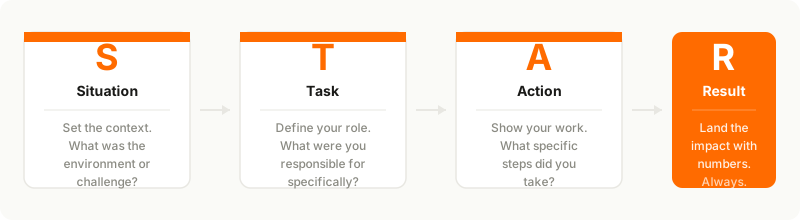
What I did → Impact it had → What I learned or what’s next
For content strategists, this formula often spans multiple time horizons: “I published the article in Q2, it began ranking in Q3, and it is now the second-highest converting organic entry point on the site.” Document each link in this chain — creation, publication, performance — even if they fall in different review periods.
Phrases That Signal Seniority
| Instead of this | Write this |
|---|---|
| "I wrote a lot of content" | "I produced 18 strategic content pieces targeting identified keyword gaps, of which 11 are now ranking in the top 10 on Google Search Console, generating a combined 4,200 monthly organic visits that didn't exist at the start of the year" |
| "I improved our SEO" | "I conducted a full site audit using Ahrefs and identified 34 pages with thin content and keyword cannibalization issues — after consolidation and optimization, those pages improved an average of 18 positions and organic traffic to the affected URLs increased 67%" |
| "I managed the content calendar" | "I redesigned the content calendar in Notion to map each piece to a buyer journey stage and a primary keyword cluster, replacing a publication-date-only view — this change improved stakeholder alignment and reduced last-minute topic requests by 40%" |
| "I want to improve our content distribution" | "I'm building a systematic distribution playbook in HubSpot that ensures every new piece reaches all relevant owned channels within 48 hours of publication — my goal is to double the average first-month traffic for new content by Q3" |
Content Strategy & Planning Self-Assessment Phrases
Strategic Planning
-
“I developed our annual content strategy from scratch this year, grounding it in an Ahrefs keyword gap analysis against three competitors and a HubSpot lead-source audit. The strategy shifted our content mix from 70% brand awareness pieces to 55% bottom-funnel and comparison content, and organic pipeline contribution increased from 8% to 21% of total pipeline by year-end.”
-
“I identified a three-keyword cluster — [job description terms] — that our competitors had overlooked despite strong commercial intent and manageable keyword difficulty. I prioritized it in Q1 content planning, produced four supporting pieces by Q2, and by Q4 two of those pieces ranked in positions 1–3 on Google Search Console, generating 1,800 qualified monthly visits to a previously unranked topic.”
-
“I designed our content architecture in Contentful to support topic clustering — organizing content into pillar pages and supporting spoke pages rather than standalone articles. This structural change improved our topical authority signals and is a primary factor in our domain’s average position improving from 34 to 19 over the year, according to Google Search Console data.”
-
“I facilitated a cross-functional content planning session with product, sales, and customer success to capture the questions prospects and customers actually ask, rather than planning content solely from keyword data. This session produced 28 topic ideas rooted in real buyer language, and the content from those ideas converts at 2.4x the rate of our keyword-first content.”
Editorial Standards
-
“I wrote and implemented an editorial style guide in Notion that standardized voice, terminology, formatting conventions, and fact-checking requirements across a team of four content contributors and two external writers. Since adoption, we have received zero brand voice complaints from the brand team in review — a significant change from the prior state where inconsistencies were flagged on roughly 30% of pieces.”
-
“I introduced a content brief template in Notion that requires keyword data from SEMrush, target audience definition, buyer journey stage, and success metrics before any piece enters production. Writers report faster research time and fewer revision cycles, and our average time from brief to published article dropped from 18 days to 11 days.”
SEO & Organic Performance Self-Assessment Phrases
Keyword Strategy
-
“I conducted a comprehensive keyword audit using Ahrefs and SEMrush, mapping 340 target keywords to existing content, identifying gaps, and flagging 22 cases of keyword cannibalization where multiple pages were competing for the same term. After consolidating the cannibalized pages and redirecting the weaker versions, the consolidated pages improved an average of 11 positions within 60 days.”
-
“I developed our featured snippet strategy by identifying 47 question-format queries in Google Search Console where we ranked in positions 5–15 and restructuring the relevant content to answer the query in the first paragraph. Within three months, we captured featured snippets for 14 of those queries, increasing click-through rate on those pages from an average of 3.1% to 8.7%.”
-
“I identified that our blog was missing the entire ‘how to’ and ‘what is’ intent layer for our core product category — queries that represent early buyer research. I built a content plan targeting 20 informational queries, prioritized by search volume and linking potential to our existing commercial pages. The eight pieces published so far have generated 6,400 combined monthly visits and three traceable assisted conversions in GA4.”
On-Page Optimization
-
“I ran a page-speed audit using Google Search Console and Lighthouse and identified 12 pages where Core Web Vitals scores were below threshold, primarily due to unoptimized images in our Contentful CMS. After implementing an image compression and lazy-loading standard, the affected pages improved their LCP scores by an average of 1.8 seconds and one high-priority page moved from a ‘poor’ to ‘good’ Core Web Vitals rating.”
-
“I audited the internal linking structure across our 200+ blog posts using Ahrefs and identified that 40% of posts had no internal links pointing to them. I developed a systematic internal linking protocol and a Notion tracking sheet, and after three months of implementation, average pages per session for organic visitors increased from 1.4 to 1.9.”
-
“I redesigned our meta title and description templates for category and product pages, moving from generic formats to intent-matched structures based on what our top-ranking competitors used for similar terms. Click-through rates across the 34 pages where we applied the new templates improved an average of 1.6 percentage points, according to Google Search Console.”
Content Production & Quality Self-Assessment Phrases
Production Management
-
“I managed a content production system that delivered 78 published pieces this year across blog, case study, and long-form guide formats — a 35% increase over the prior year with the same team size. I achieved this by redesigning the production workflow in Notion to eliminate three redundant approval steps, establishing a dedicated weekly production meeting, and building a reusable asset library in Contentful for images and callouts.”
-
“I reduced our average content revision cycle from 3.2 rounds to 1.4 rounds per piece by introducing structured content briefs and a first-draft checklist. The time this saved — approximately 40 hours per month in combined writer, editor, and reviewer time — was reinvested into higher-quality research for strategic pieces.”
-
“I established a content QA process that checks every piece for factual accuracy, legal compliance, brand voice, and SEO requirements before publication. Since implementing this process, we have had zero content-related legal flags and two cases where the QA process caught outdated product information that would have created customer confusion.”
Content Quality
-
“I raised the research standard for our long-form content by implementing a primary source requirement — every piece must include at least two original data points, customer quotes, or proprietary analysis rather than only citing published statistics. Content produced under this standard generates on average 3.4x more backlinks than our prior benchmark content, according to Ahrefs.”
-
“I produced three original research reports this year based on surveys and customer data, coordinating with data, product, and customer success to gather the underlying information. The reports generated 24 earned media mentions and 47 backlinks from domain-authority sites, contributing meaningfully to our overall backlink profile growth.”
Audience & Distribution Self-Assessment Phrases
Email & Newsletter
-
“I redesigned our newsletter in HubSpot from a curated link digest to an original analysis format — one long-form insight rather than seven short links. Open rate improved from 19% to 34%, click-through rate improved from 2.1% to 5.8%, and unsubscribe rate dropped from 0.8% to 0.2%. The newsletter is now the highest-engaged owned channel we have.”
-
“I built a segmented email distribution strategy in HubSpot that delivers content based on subscriber industry and buyer stage rather than a single broadcast. Segment-specific sends have 22% higher open rates than the non-segmented control group, and conversion rates from email to sales demo request are 1.8x higher for the segmented audience.”
-
“I grew our newsletter subscriber list from 2,100 to 4,800 over the year by adding inline subscription prompts to our top organic pages, creating two lead-magnet content upgrades, and implementing an exit-intent capture on the blog. The list grew at a monthly rate of 22% with an average subscriber quality — measured by email engagement — that exceeds our paid list acquisition sources.”
Social & Organic Distribution
-
“I developed a social distribution system in Notion that ensures every published piece is adapted for LinkedIn, Twitter, and our industry Slack communities within 48 hours of publication. Posts using this system generate an average of 340% more engagement than our prior ad-hoc social sharing approach, and two pieces distributed via this system became organic viral moments that drove significant backlink acquisition.”
-
“I identified that our highest-quality content was underperforming on LinkedIn because we were sharing links rather than native content. I shifted to a native-first LinkedIn strategy — adapting key insights as standalone posts with the full article linked in comments — and our average LinkedIn post reach increased from 800 to 3,400 impressions per post.”
Analytics & Optimization Self-Assessment Phrases
Performance Analysis
-
“I implemented a content performance dashboard in GA4 and Tableau that tracks each piece against its target keyword ranking, traffic goal, and conversion contribution on a weekly basis. This replaced a monthly manual report that looked backward — the new dashboard is used by the content and SEO teams to make weekly optimization decisions and has identified three quick-win optimization opportunities that had been invisible in the prior reporting.”
-
“I conducted a content decay audit using Google Search Console data, identifying 34 pieces that had lost more than 30% of their organic traffic in the prior 12 months. I created a prioritized refresh plan and executed updates on the top 12 pieces — average traffic recovery for refreshed pieces was 58% above pre-decay levels within 90 days of republication.”
-
“I built an attribution model in GA4 that tracks organic content’s contribution to pipeline across the full buyer journey, including assisted conversions where a content piece was in the path but not the last touch. This model demonstrated that organic content was contributing to 34% of closed-won revenue when assisted conversions were included — up from the 9% attributed under the prior last-touch model.”
Testing & Optimization
-
“I ran a systematic CTA optimization experiment across our 20 highest-traffic blog posts, testing three different CTA formats — inline text, sidebar box, and banner — using Figma-designed variants implemented in Contentful. The winning format increased content-to-lead conversion rates by 41% across the test pages and has been rolled out as the new default for all content pages.”
-
“I tested four different headline formulas — question, how-to, number, and counter-intuitive — on new content over a quarter, tracking click-through rate from Google Search Console and social shares per piece. The data showed question-format headlines underperforming for our audience despite widely cited industry advice, and I updated our editorial brief template to deprioritize that format.”
Cross-functional Collaboration Self-Assessment Phrases
Sales Enablement
-
“I partnered with the sales team to build a content library organized by deal stage and prospect objection in Notion, tagging 84 existing pieces and identifying 12 gaps where content was needed. Sales adoption of the library has improved quarter-over-quarter and three account executives have told me directly that specific pieces helped them advance or close deals.”
-
“I attended six sales calls this year to observe how prospects respond to our content and what questions our materials fail to answer. This direct insight produced four content briefs that the sales team reviewed before production — the resulting pieces have higher sales usage rates than any prior batch of sales-enablement content.”
-
“I created a competitive content battlecard series — five pieces comparing our approach to each major competitor — by working with the sales team to identify the objections and comparison questions that came up most frequently in late-stage deals. The battlecards are now used in every competitive sales scenario and three reps have cited them in won-deal notes.”
Product & Brand Partnership
-
“I partnered with the product team to develop a content plan for our two major product launches this year, starting the content development 10 weeks before launch rather than the prior practice of three weeks. This lead time allowed for proper SEO optimization, peer review, and distribution planning — both launches had content ranked on the first page of Google within 60 days, versus the prior benchmark of 4–6 months.”
-
“I collaborated with the design team in Figma to develop a visual content system for our blog — a consistent set of illustration styles, data visualization templates, and banner formats — that replaced the inconsistent ad-hoc graphics that had been undermining our brand perception in content. Independent brand perception surveys showed a 12-point improvement in perceived brand quality among the content-reading segment of our audience.”
How Prov Helps Content Strategists Track Their Wins
Content strategy has a longer memory problem than almost any other discipline. The keyword cluster you identified in January, the editorial system you built in March, the research report you commissioned in May — by December, the causal chain from those decisions to your current traffic and pipeline numbers is genuinely hard to reconstruct without notes. Review forms don’t have a “work completed eight months ago” field.
Prov captures those wins in 30 seconds, at the moment they happen — a voice note after you hit publish on a piece you know will rank, a quick entry when a campaign significantly exceeds its benchmark. The app transforms those rough notes into polished achievement statements ready for your performance review, your portfolio, or your next role. When review season arrives, you’ll have the full timeline, not just the metrics from last quarter. Prov is coming soon on iOS.
Ready to Track Your Wins?
Free to start, no account, no sign-up. Available on the App Store now.
Download on iOS Free to start, no account needed