Concrete examples of content strategy and content marketing achievements you can adapt for your performance review, promotion packet, or resume.
The Content Strategist's Performance Review Problem
You published 60 pieces of content this year. You rewrote the entire blog strategy, built a content calendar that actually held, trained three new writers, fixed the site architecture, and took a dead keyword cluster from page 5 to page 1. Six months from now, that work will be generating leads while you're working on something else entirely. And yet, sitting down to write your self-review, none of it feels concrete enough. Because content has always had an attribution problem: the post you wrote in February might rank in October, create a lead in November, and close in February of next year. By the time the business can see it working, you've moved on to the next quarter's priorities.
There's a compounding dimension to this that makes content work particularly hard to capture in standard review frameworks. A well-built content system — the right editorial calendar, the right keyword strategy, the right internal linking structure, the right governance process — pays dividends for years. You're not shipping a feature; you're building infrastructure for ideas. A single piece of cornerstone content can drive 20% of a site's organic traffic for half a decade. A style guide you wrote once gets used by every writer the company ever hires. A content operations system you built in Q1 eliminates a category of work for the rest of the team forever. These are enormous contributions that look, on the surface, like "wrote some docs."
The third challenge is organizational. Content strategists sit at the intersection of marketing, product, SEO, sales, and sometimes engineering and design. You're constantly unblocking other people's work, translating business goals into editorial direction, and calibrating messaging across functions that have conflicting priorities. That coordination work — the stakeholder alignment, the cross-functional briefings, the content reviews — rarely shows up in any metric but consumes a meaningful portion of every week.
The examples below translate all of this into the language reviews actually reward: specific work with measurable outcomes. They cover the full scope of what content strategists and content marketing managers actually do — from keyword research to revenue attribution to editorial quality to systems building — with the structure that makes compounding, long-cycle work legible to any reviewer.
What gets you promoted are documented accomplishments with measurable impact.
Content Strategist Accomplishment Categories
| Competency | What Reviewers Look For |
|---|---|
| Content Strategy & Planning | Do you set the right content direction? |
| SEO & Organic Growth | Does your content drive traffic and rankings? |
| Content Production & Quality | Do you produce excellent content at scale? |
| Distribution & Amplification | Do you get content in front of the right people? |
| Content Operations & Systems | Do you build scalable content infrastructure? |
| Business Impact & Attribution | Does your content move business metrics? |
Content Strategy & Planning Accomplishments
Content Strategy & Roadmap
- "Built the company's first documented content strategy — including ICP alignment, topic cluster architecture, content types by funnel stage, and a 12-month roadmap — replacing ad-hoc publishing with a coherent plan that the leadership team could evaluate and fund"
- "Overhauled the blog strategy from a news-and-opinion format to an SEO-driven topic cluster model, increasing organic traffic by 180% within 9 months without increasing the publishing cadence"
- "Developed the content pillar framework that organized 300+ existing pieces into 8 structured topic clusters, improving site architecture, internal linking, and topical authority across all core subject areas"
- "Wrote the annual content plan that aligned editorial priorities with product launch roadmap, seasonal demand, and sales enablement needs — reducing reactive content requests from sales and product by 60% because the calendar already accounted for them"
- "Built the competitive content gap analysis across 5 direct competitors, identifying 140 high-intent keyword opportunities we had missed and prioritizing the top 30 for the next two quarters"
- "Redesigned the content strategy for the rebrand, creating the messaging architecture that mapped new brand positioning to editorial tone, topic selection, and content type mix across all channels"
- "Created the content-to-product narrative framework that connected feature launches to customer pain points and use cases, giving the product team a reusable system for content briefing that reduced my time per launch from 8 hours to 2 hours"
- "Led the content audit of 600+ pages — scoring each for traffic, engagement, conversion, and strategic fit — producing a prioritized action plan that resulted in 120 updates, 80 consolidations, and 40 redirects over the following quarter"
Audience & Persona Research
- "Conducted 20 customer interviews and synthesized the findings into 3 revised buyer personas, identifying a second ICP segment that had been underserved — which became the basis for a new content vertical that now drives 25% of organic leads"
- "Built the jobs-to-be-done content framework from customer research, mapping editorial topics to the questions buyers ask at each stage of the decision journey and reducing the gap between content production and content that actually converts"
- "Analyzed 2 years of support tickets and community forum posts to identify the top 40 recurring questions from customers, turning them into a content brief backlog that reduced support volume for the top 10 questions by 35%"
- "Partnered with sales to shadow 12 discovery calls and document the language prospects actually use, rewriting the top 5 product landing pages with buyer vocabulary — improving conversion rate on those pages by 28%"
- "Developed the intent-based content matrix that segmented editorial topics by audience awareness level, giving the team a shared framework for evaluating content briefs that reduced misaligned content from 30% to under 10% of output"
SEO & Organic Growth Accomplishments
Keyword Strategy & Rankings
- "Developed and executed the keyword strategy that grew organic search traffic from 18,000 to 85,000 monthly sessions over 14 months, increasing the site's organic share of marketing-attributed pipeline from 12% to 34%"
- "Identified and targeted 45 bottom-of-funnel comparison and alternative keywords that competitors had ignored, producing 30 pieces of content that now collectively drive 2,400 demo requests per month"
- "Took the company's primary target keyword from position 14 to position 2 through a combination of content consolidation, on-page optimization, and a coordinated link-building campaign — increasing monthly clicks from 340 to 4,200"
- "Built the programmatic SEO strategy for the integration pages, producing 120 templated pages targeting '[product] + [integration]' queries — collectively driving 8,000 monthly organic visitors with minimal ongoing maintenance"
- "Executed the content refresh program for the top 40 organic pages, updating statistics, improving on-page optimization, and expanding coverage depth — recovering 35% of traffic lost during a Google algorithm update"
- "Designed the topic cluster architecture with 6 pillar pages and 80 supporting articles, improving the site's topical authority in the core category — measured by a 45% improvement in average position across cluster keywords within 6 months"
- "Led the international content expansion to 3 new language markets, developing the localization workflow and quality standards that enabled non-native writers to produce on-brand content — growing non-English organic traffic by 120% year-over-year"
- "Built the SERP feature strategy targeting featured snippets, People Also Ask, and FAQ schema, winning 28 featured snippet positions that increased organic CTR by 18% without a change in ranking position"
Technical SEO & Site Health
- "Partnered with engineering to resolve 400+ crawl errors, fix duplicate content from URL parameter issues, and implement canonical tags across the blog — recovering organic traffic that had been suppressed by technical issues for over a year"
- "Led the site migration from HTTP to HTTPS and from the legacy CMS to a new platform, managing the redirect mapping for 1,200 URLs and resulting in zero organic traffic loss — which the SEO team described as an unusually clean migration"
- "Implemented structured data markup (FAQ, HowTo, Article, BreadcrumbList) across the content library, increasing rich result appearances in search from 0 to 180 URLs and improving average CTR by 12%"
- "Drove the Core Web Vitals remediation project across the blog, coordinating with engineering to improve LCP from 6.2s to 1.8s and CLS from 0.31 to 0.04 — recovering a 15% organic traffic decline that had correlated with the Page Experience update"
- "Built the internal linking audit and strategy, identifying 800+ orphaned pages and systematically adding contextual internal links — improving crawl coverage from 72% to 98% of indexed URLs and increasing pages per session by 22%"
Content Production & Quality Accomplishments
Editorial Quality
- "Raised the average content quality score (measured by organic engagement rate, time on page, and editor rubric) from 3.2 to 4.5 out of 5 over two quarters by introducing structured content briefs, a revised editing process, and systematic first-draft feedback"
- "Wrote 8 cornerstone pieces in the company's primary topic area that now collectively rank for 1,200 keywords and drive 30% of total organic traffic — establishing the brand as a genuine authority in the category"
- "Developed the content brief template that reduced writer research time by 50% and first-draft approval rate from 30% to 75%, by pre-answering the structural and factual questions writers would otherwise need to solve themselves"
- "Built and managed the expert review process for technical content, partnering with 12 subject-matter experts across engineering and product to ensure accuracy — reducing factual corrections after publication from 8 per month to zero"
- "Introduced the editorial rubric with 6 scored dimensions — clarity, depth, originality, SEO alignment, brand voice, and evidence quality — giving editors a consistent standard that reduced the variance in published content quality and made feedback actionable for writers"
- "Led the thought leadership program for 3 executives, ghostwriting 24 LinkedIn articles and 4 long-form pieces that generated 180K impressions and 3 inbound partnership inquiries in the first six months"
- "Created the content differentiation standard that required every published piece to have at least one original data point, perspective, or framework not available elsewhere — reducing the percentage of commodity content in the backlog from 55% to 12%"
Content Operations & Velocity
- "Scaled content output from 6 to 20 pieces per month over two quarters by building the freelancer network, brief system, and editing workflow — without hiring a full-time writer or compromising the quality standard"
- "Reduced the average time from content brief to published post from 28 days to 11 days by redesigning the editorial workflow, eliminating 3 redundant approval steps, and introducing clear handoff standards between brief, draft, edit, and publish stages"
- "Built the content production tracker in Notion that gave the entire team visibility into every piece's status, owner, and deadline — reducing missed publication dates from 35% to under 5% of scheduled content"
- "Onboarded and managed a team of 8 freelance writers, creating quality standards, onboarding materials, and feedback loops that enabled them to write on-brand content from brief alone — reducing editorial revision time by 60%"
- "Implemented AI-assisted first drafts for informational content in the research and ideation stages, reducing the time writers spent on research from an average of 4 hours to 90 minutes per piece without affecting final content quality"
- "Designed the content repurposing workflow that turned each long-form piece into 3 social posts, 1 email segment, and 1 short video script — tripling content output per hour of creation time invested"
Distribution & Amplification Accomplishments
Channel Strategy
- "Built the email newsletter from 0 to 28,000 subscribers in 18 months by focusing on editorial quality over frequency — achieving a 42% open rate and 8% click rate that are both 2x the industry benchmark for the category"
- "Developed the LinkedIn content strategy for the brand page, growing followers from 4,200 to 22,000 and achieving an average engagement rate of 4.8% — making it the top-performing organic channel for awareness-stage pipeline"
- "Designed the content distribution playbook for new pieces — email, social, community, paid amplification, outreach — that systematically maximized reach for every publication and doubled the average first-week pageviews per piece"
- "Built the community content strategy across 4 forums and Slack communities in the target market, establishing authentic presence and driving 1,200 monthly referral visits without any paid promotion"
- "Launched the podcast as a content distribution channel, growing it to 8,000 listeners per episode in 12 months and using it as a lead magnet that converted 15% of listeners into email subscribers"
- "Developed the paid content amplification framework that identified which organic posts were worth promoting based on early engagement signals, reducing cost per lead from paid content by 45% compared to the previous approach of promoting all content equally"
Partnership & Syndication
- "Built the content syndication program with 8 industry publications and newsletters, securing regular placement that drove 3,400 monthly referral visitors and 180 newsletter subscribers per month to the brand's own properties"
- "Managed the co-marketing content relationships with 6 technology partners, producing 12 joint pieces of content that drove 2,800 net new leads attributable to partner audiences — without any paid budget"
- "Negotiated and managed 4 guest posting relationships with top-10 publications in the category, placing 18 bylined articles that generated 45 high-authority backlinks and measurably improved domain authority from 42 to 58"
- "Designed the analyst relations content strategy, briefing 6 industry analysts and producing the supporting materials that resulted in 2 favorable analyst report mentions — contributing to 3 enterprise deals citing analyst research"
- "Launched the contributor program that brought 20 practitioners into the content strategy as guest authors, adding credibility and topic diversity that increased average time-on-page by 35% compared to brand-authored pieces on similar topics"
Content Operations & Systems Accomplishments
Workflow & Tooling
- "Implemented the content operations stack (Notion + Airtable + Zapier) that centralized content planning, brief management, and performance tracking — eliminating the 3 disconnected spreadsheets that had made cross-team coordination painful and error-prone"
- "Built the content performance dashboard in Looker Studio that gave stakeholders a single view of traffic, conversions, and pipeline attribution across all content — reducing ad-hoc reporting requests to the team by 70%"
- "Designed the content request intake process with brief templates, SLA commitments, and priority scoring, reducing unplanned content requests from 40% to 12% of monthly output and giving the team back 6 hours per week of reactive work"
- "Implemented the content QA checklist and pre-publication review process — SEO elements, brand voice, fact-checking, CTA consistency — reducing post-publication fixes from 15 per month to under 2"
- "Built the automated content performance report that delivered weekly metrics to stakeholders via email, eliminating the 4-hour manual reporting process and ensuring consistent visibility without requiring analyst involvement"
- "Created the content experimentation framework — hypothesis, variant, measurement plan, and review cadence — that gave the team a systematic way to test CTA copy, headline formats, and content structure, running 18 experiments in a year"
Style Guide & Governance
- "Wrote the company's first comprehensive content style guide — voice, tone, grammar conventions, terminology, formatting standards — adopted by 3 teams and 15 writers within a month of publication, immediately reducing editorial revision cycles"
- "Developed the brand voice guidelines from scratch in partnership with brand and design, translating abstract brand attributes into concrete editorial guidance with examples and anti-examples — ending the recurring debates about whether content sounded "on brand""
- "Built the terminology governance process that standardized product names, feature names, and key concepts across marketing, sales, and support content — eliminating the customer confusion caused by 4 different names for the same core feature"
- "Created the content localization guide for 3 international markets, documenting language adaptations, cultural considerations, and market-specific messaging standards that enabled local teams to produce on-brand content without central review for every piece"
- "Established the content archiving and sunset policy for outdated posts, defining the criteria for update vs. consolidation vs. redirect — and executing the first pass on 200 underperforming pages that had been creating cannibalization issues"
Business Impact & Attribution Accomplishments
Pipeline & Revenue Attribution
- "Implemented multi-touch attribution for content in HubSpot, moving from last-touch reporting to a model that showed content's role across the full buyer journey — changing the leadership team's view of content ROI and securing a 40% increase in content budget for the following year"
- "Built the content-to-pipeline reporting model that tracked organic leads from first content touch through opportunity creation and close, demonstrating that content-sourced leads had a 22% higher close rate and 15% higher ACV than paid-sourced leads"
- "Launched the bottom-of-funnel content program targeting competitor comparison and use-case-specific searches, generating 180 demo requests per month within 6 months — directly attributable in CRM to specific pages"
- "Produced the content ROI analysis that showed $4.20 in attributed pipeline per dollar of content spend, providing the business case that shifted 20% of the paid acquisition budget to content for the following fiscal year"
- "Built the lead magnet content strategy — 4 research reports, 2 toolkits, 1 assessment — that generated 3,200 net new email subscribers and 280 MQLs in 6 months, at a cost per MQL 65% below the paid channel average"
- "Redesigned the content upgrade strategy across the top 20 organic pages, adding contextually relevant CTAs that increased CTA click-through rate from 1.2% to 4.8% and content-attributed lead volume by 85% without increasing traffic"
Brand & Awareness Metrics
- "Grew the blog from 22,000 to 110,000 monthly unique visitors in 18 months — a 5x increase — establishing the brand as the highest-traffic editorial property in the category and contributing to a 28% increase in branded search volume year-over-year"
- "Built the share of voice measurement framework for organic search in the core topic area, tracking ranking visibility against 8 competitors — showing the brand move from 4th to 1st in share of voice over 12 months"
- "Produced the annual industry survey that became the most-cited data source in the category — generating 1,800 backlinks, 12 press mentions, and 4,200 email subscribers in the 30 days following publication"
- "Launched the thought leadership content series that positioned 3 executives as category experts — resulting in 8 speaking invitations, 2 podcast features, and consistent media mentions that increased brand awareness scores by 18% in the annual brand survey"
- "Built the content-driven category creation strategy that introduced new vocabulary for the problem the product solves — 14 of the new terms now appear in competitor content, analyst reports, and customer sales conversations, indicating category leadership"
- "Developed the customer story content program, producing 22 case studies and 6 long-form success stories in a year — which sales cited as the top-performing piece of content for late-stage deals in the annual sales enablement survey"
How to Adapt These Examples
Plug In Your Numbers
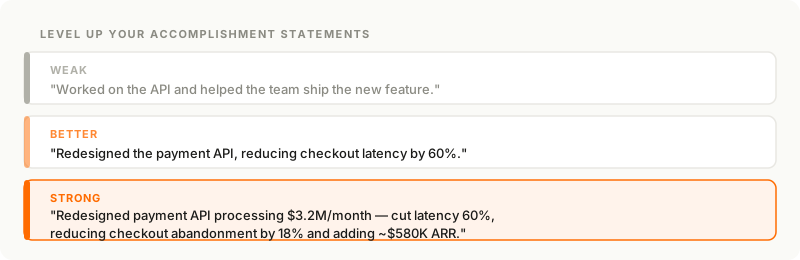
Every example above follows: [Action] + [Specific work] + [Measurable result]. Replace the numbers with yours. Traffic and ranking data lives in Google Search Console, Ahrefs, or Semrush. Pipeline attribution is in your CRM — even if it's imperfect, an approximation with a stated methodology is more credible than no number at all. Email metrics come from your ESP. Content velocity and workflow improvements can be measured in days (average time from brief to publish before and after) or in volume (pieces per month before and after). When you made a system change, find the before metric and the after metric — even if they're estimates.
Don't Have Numbers?
Content attribution is genuinely hard, and some of the most valuable content work resists direct measurement. When you can't show a direct metric, document the system you built, the problem it solved, and who depends on it now. "Built the style guide that is now used by every writer and agency we work with" is a real accomplishment even without a metric. "Established the content governance process that ended the recurring disagreements about terminology across sales and marketing" describes real organizational impact. The compounding nature of content work is worth naming directly: "This keyword cluster will generate leads for the next 3 years with minimal maintenance" is a legitimate business case for work that doesn't yet have a traffic number.
Match the Level
Junior content strategists and content marketers should document the specific content they produced and its direct performance outcomes: the posts that ranked, the campaigns that converted, the editorial systems they improved. Mid-level content strategists should show both production quality and strategic thinking — the content plans you developed, the frameworks you built, the cross-functional alignment you drove. Senior content strategists and content leads should demonstrate that their work compounded across the organization: the systems that scaled output, the strategy that shaped the category, the editorial standards that raised quality across a team. At the lead level, your accomplishments should show that you built something — a program, a practice, a platform — that produces results beyond what you personally wrote.
Start Capturing Wins Before Next Review
The hardest part of performance reviews is remembering what you did 11 months ago. Prov captures your wins in 30 seconds — voice or text — then transforms them into polished statements like the ones above. Prov is coming soon on iOS.
Ready to Track Your Wins?
Free to start, no account, no sign-up. Available on the App Store now.
Download on iOS Free to start, no account needed