Business analysts are the connective tissue of every project — and connective tissue never gets the credit. The developer ships the feature. The product manager owns the roadmap. The BA is the one who figured out what "the feature" actually needed to be, why the original requirements were wrong, and why the three teams who couldn't agree finally reached alignment. That work is invisible unless you document it yourself.
Why Self-Assessments Are Hard for Business Analysts
Business analysts rarely own the final deliverable. You don’t deploy the code, you don’t sign the contract, and you don’t run the marketing campaign. What you do is everything that determines whether those outcomes are worth anything — the requirements that prevent rework, the process map that exposes the bottleneck everyone had accepted as inevitable, the data analysis that redirects the roadmap before three months of work goes in the wrong direction.
The attribution problem for BAs is acute. When a project succeeds, the teams that built and shipped it take the credit. When it fails, the BA’s early concerns about scope and requirements often surface in retrospect. Your self-assessment is the one place where you can make your enabling contributions explicit: “I facilitated the three-session requirements workshop that reduced scope ambiguity by X, saving an estimated Y weeks of rework” is a legitimate and important claim.
There’s also the translation problem. BA work lives in Confluence documents, Jira epics, Miro boards, and Lucidchart process maps — artifacts that are central to project success but that look like overhead to people who don’t understand their function. Your self-assessment needs to translate these artifacts into impact language: not “I wrote the BRD” but “I wrote the BRD that caught the regulatory constraint that would have required a complete rearchitecture in month three.”
Finally, BAs often take on work that doesn’t belong to any single project — facilitating a process review, documenting institutional knowledge, building a data model for a recurring analysis. This overhead work is genuinely valuable and should be claimed explicitly in your review rather than appearing as simply “additional responsibilities.”
The goal: translate enabling work into impact language, claim appropriate credit for outcomes you influenced without owning, and show the cost of problems you prevented.
How to Structure Your Self-Assessment
The Three-Part Formula
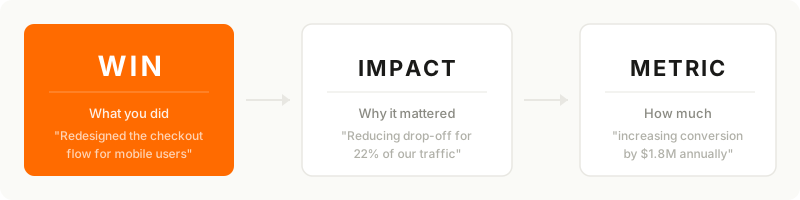
What I did → Impact it had → What I learned or what’s next
For BAs, the “impact” step often requires articulating a counterfactual: what would have happened without your work. “I identified the integration gap in requirements” has much more force when followed by “which, uncaught, would have required a complete rework of the data pipeline in sprint seven.”
Phrases That Signal Seniority
| Instead of this | Write this |
|---|---|
| "I gathered requirements" | "I ran a structured discovery process across six stakeholders using Miro-facilitated workshops, surfacing three conflicting assumptions about scope that, resolved early, prevented an estimated four weeks of rework mid-sprint" |
| "I made a dashboard" | "I built a Tableau dashboard that replaced three manual Excel reports, saving the operations team 6 hours per week and surfacing a trend they had been unable to see in the fragmented prior data" |
| "I documented the process" | "I mapped the end-to-end claims process in Lucidchart, identifying seven handoff points — two of which had no owner — and facilitating the RACI alignment that eliminated a recurring 3-day processing delay" |
| "I want to improve my SQL" | "I'm deepening my SQL skills through [specific course/project] to be able to independently validate data for analyses currently requiring data engineering support — targeting self-sufficiency on 80% of analytical requests by Q3" |
Requirements & Discovery Self-Assessment Phrases
Elicitation & Workshops
-
“I facilitated a two-day requirements workshop for our customer portal redesign, bringing together eight stakeholders from product, engineering, legal, and customer success who had not previously aligned on scope. By using structured Miro templates and a pre-workshop survey to surface assumptions, I reduced the post-workshop requirements iteration cycles from a typical four rounds to one, saving approximately two weeks of elicitation time.”
-
“I identified a critical regulatory constraint during requirements discovery for the financial reporting feature — a constraint that had been missed in the initial product scoping because it required cross-referencing three different compliance documents. Catching this in discovery rather than development prevented a complete rearchitecture of the data export module estimated at three weeks of engineering work.”
-
“I developed a requirements traceability matrix for our largest initiative of the year, linking each business requirement to its technical implementation and acceptance test. When scope pressure arose mid-project, this matrix allowed the team to make explicit tradeoff decisions rather than silent scope cuts — three requirements were formally deferred rather than quietly dropped, with stakeholder alignment on each.”
-
“I pioneered an event-storming workshop format for our team’s discovery process, using Miro to map domain events before jumping to requirements. The format surfaced the integration complexity between our order management and inventory systems two months before the sprint that would have discovered it the hard way, allowing the technical design to account for it from the start.”
Acceptance Criteria & Validation
-
“I rewrote our team’s acceptance criteria process, introducing a structured Given/When/Then format and requiring sign-off from both business and technical stakeholders before sprint commitment. The result: our sprint-over-sprint defect rate dropped from an average of 4.2 defects per feature to 1.1 over the two quarters since adoption.”
-
“I caught a data integrity issue during UAT by writing test cases against the edge conditions documented in the requirements, not just the happy path. The issue — a race condition in concurrent order updates — would have caused silent data corruption in production and affected an estimated 200–300 orders per day at peak volume.”
Data Analysis & Insights Self-Assessment Phrases
SQL & Data Investigation
-
“I conducted a SQL analysis of customer churn patterns across 18 months of data, identifying that customers who completed fewer than three core actions in their first 30 days churned at 73% versus 22% for those who completed all three. This finding directly influenced the product team’s Q3 roadmap — two features were deprioritized and the onboarding flow redesign was accelerated based on my analysis.”
-
“I built a recurring revenue reconciliation analysis in SQL that caught a billing discrepancy affecting 340 accounts — a systematic under-billing error introduced by a code change eight months prior. The identified revenue recovery was $94,000 in arrears, and my analysis was used as the basis for the customer communication and correction process.”
-
“I designed the analytical framework for evaluating the ROI of our new pricing tiers, defining the metrics, timeframes, and comparison groups before the experiment launched. This pre-registration prevented post-hoc metric switching and gave the business team a credible basis for the decision to expand the pricing change to the full customer base.”
Tableau & Reporting
-
“I built a Tableau operational dashboard for our logistics team that replaced a manual Monday morning reporting process requiring 4 hours of Excel work per week. The dashboard refreshes automatically from our data warehouse, surfaces exceptions that previously required manual review, and has been adopted by three regional teams who built their own views on the same data source.”
-
“I redesigned our executive reporting pack from a 40-slide PowerPoint built manually in Excel to a Tableau workbook that generates automatically and can be filtered by region, product line, and time period. The redesign reduced the reporting preparation time from 8 hours to 30 minutes per cycle and gave executives the ability to drill into trends that previously required a follow-up request to the analytics team.”
-
“I developed a cohort analysis framework in SQL and Tableau to track feature adoption across customer segments, enabling the product team to see for the first time how adoption differed between enterprise and SMB customers on the same feature set. The analysis revealed a 34-point adoption gap that triggered a dedicated SMB onboarding initiative.”
Stakeholder Management Self-Assessment Phrases
Alignment & Facilitation
-
“I resolved a three-month stakeholder impasse between the sales operations and finance teams over the commission calculation logic by facilitating a structured working session where I mapped both teams’ requirements on a Miro board and identified the two points of genuine conflict versus seven points of assumed conflict. The session produced a written agreement that unblocked a critical Salesforce configuration project.”
-
“I managed a stakeholder group of 14 people across four departments for our compliance reporting initiative, running biweekly alignment calls and maintaining a shared Confluence status page that reduced ad-hoc status questions by an estimated 60%. Stakeholder survey scores at project close rated communication as the project’s highest-performing dimension.”
-
“I identified early that a key stakeholder — the operations director — was not engaged in requirements reviews and had different expectations from the rest of the group. I arranged a dedicated one-on-one session to understand her concerns and found three requirements gaps that the broader group had missed. Her subsequent engagement improved and she became one of the project’s strongest internal advocates.”
Executive Communication
-
“I presented the analysis supporting a major process change to senior leadership, structuring the presentation to lead with the business impact before the technical details — a framing that I had learned from prior reviews was more effective with this audience. The proposal was approved at first presentation rather than the typical two-round review cycle, saving three weeks of iteration time.”
-
“I translated a complex data governance initiative into a one-page executive summary that framed the work in terms of risk reduction and cost avoidance rather than technical compliance. The summary helped secure $180K in budget that had been declined when presented as a technical infrastructure project.”
Process Improvement Self-Assessment Phrases
Process Mapping & Redesign
-
“I mapped the end-to-end vendor onboarding process using Lucidchart, conducting 11 interviews across procurement, legal, finance, and IT to document the as-is state. The analysis identified a 17-step process with 6 handoffs that had no defined SLA, including two steps that added an average of 8 days with no value added. The redesigned process reduced average onboarding time from 34 days to 19 days.”
-
“I facilitated a Kaizen-style process improvement workshop for our invoice processing team, using a Miro value stream map to identify waste. The team identified four manual data-entry steps that could be automated using existing tools, and I wrote the requirements for the automation. Six months post-implementation, the automation handles 78% of invoices without manual intervention, freeing the team for exception handling.”
-
“I designed and implemented a new sprint intake process for our team using a structured Jira template and a weekly grooming cadence, replacing an ad-hoc process that was producing poorly defined tickets. The change reduced mid-sprint scope clarification requests from an average of 8 per sprint to 2, measurably improving team velocity and reducing developer frustration scores in our quarterly retrospective.”
Metrics & KPIs
-
“I designed the KPI framework for our new customer success program, defining 12 leading and lagging metrics, their calculation methodology, data sources, and refresh cadences — before the program launched. Having this framework in place from day one allowed the team to identify a leading indicator problem in month two that would have taken until month six to appear in lagging metrics, enabling an early course correction.”
-
“I identified that our product team was tracking feature adoption using an inconsistent definition across three different reports, producing numbers that varied by up to 40% depending on which report was cited. I facilitated a definition alignment session and implemented a single source of truth in our data warehouse, ending three months of recurring confusion in business reviews.”
Documentation & Communication Self-Assessment Phrases
Technical Documentation
-
“I wrote the functional specification for our API integration with our third-party logistics provider, including edge cases, error handling scenarios, and data mapping tables. The specification was detailed enough that the engineering team completed the integration with only two clarification questions during development — compared to an average of 12–15 for integrations of comparable complexity.”
-
“I created a self-service knowledge base in Confluence for our most frequently asked business process questions, covering 22 topics that previously required direct BA involvement to answer. After publication, direct questions on these topics dropped by 65% in the first month, freeing approximately 3 hours per week of BA time for higher-value work.”
-
“I documented the undocumented business logic embedded in our legacy system by conducting structured interviews with the two senior staff who held the institutional knowledge, cross-referencing with audit logs and production data. The resulting 40-page specification became the authoritative reference for the migration project and prevented three misunderstandings that would have caused data integrity issues in the new system.”
Status Communication
-
“I introduced a weekly written project status update for our major initiative, sent to 23 stakeholders every Friday with a structured format: RAG status, milestone progress, decisions needed, and risks. The practice reduced reactive status questions by an estimated 70% and my project sponsor commented directly that it was the best stakeholder communication they had seen on a project of this complexity.”
-
“I improved my risk communication practice this year by transitioning from verbal risk flagging to written risk registers maintained in Confluence, with each risk rated by probability and impact and assigned to an owner. This change made risk conversations more structured and led to earlier escalation on two issues that previously would have been raised too late to act on.”
Delivery & Execution Self-Assessment Phrases
Project Coordination
-
“I served as the central coordinator for a cross-functional initiative involving six teams over six months, maintaining the integrated project plan in Jira, running weekly dependency review calls, and owning the escalation path for blockers. The initiative delivered on time despite two significant scope changes, which I managed through a formal change request process that kept the schedule intact.”
-
“I managed a backlog of 340 Jira items across three active workstreams, maintaining accurate priority, status, and acceptance criteria for each. During a sprint planning audit, our team had the lowest percentage of poorly defined tickets in the engineering organization — a direct result of the grooming and template discipline I had introduced six months prior.”
-
“I identified a critical path risk eight weeks before our launch date — a third-party API certification requirement that had not been factored into the timeline. By raising it immediately with the project sponsor and facilitating a revised plan, we were able to complete the certification three days before go-live rather than discovering the gap during UAT.”
Quality Assurance Partnership
-
“I partnered with our QA team to develop the test strategy for our major platform migration, writing test cases for the business logic scenarios that QA’s technical testing would not cover. My test cases identified four defects during UAT that had passed automated testing because they required business context to recognize as failures — all four would have caused customer-facing errors in production.”
-
“I led the acceptance testing for our new customer-facing portal, coordinating UAT across 12 business users and triaging 43 defects in Jira by severity, root cause, and blocking status. The structured UAT process produced a clean go/no-go decision within the planned window — the first time in three years that a release of this complexity had not required a scope compromise at launch.”
How Prov Helps Business Analysts Track Their Wins
BAs produce their most important work in the middle of other people’s projects — the workshop that aligned a fragmented stakeholder group, the requirements that prevented a rework, the analysis that redirected the roadmap. By the time review season arrives, those contributions are buried in completed Jira epics and archived Confluence pages, and the teams that built on your work have moved on to new projects.
Prov lets you capture those wins in 30 seconds, right after they happen — a voice note after the alignment session, a quick text entry when the analysis lands. The app transforms those rough notes into polished achievement statements that are ready for your self-assessment. You do the enabling work. Prov makes sure it gets the credit it deserves. Prov is coming soon on iOS.
Ready to Track Your Wins?
Free to start, no account, no sign-up. Available on the App Store now.
Download on iOS Free to start, no account needed