The best BA work is invisible at delivery and unmissable when it's absent. Reviews that only count artifacts miss the point entirely.
How to Write Effective Business Analyst Performance Reviews
Business analyst reviews have a structural problem: the work is collaborative by nature. The developer ships the feature, the PM owns the roadmap, and the BA owns the clarity in the middle — and clarity doesn’t show up in commit logs or sprint velocity charts. It shows up six months later when the system still works as intended, or immediately when it doesn’t. Managers who default to counting deliverables (BRDs produced, specs written, diagrams created) are measuring the wrong thing.
What actually distinguishes strong BA performance is the quality and precision of requirements, not the volume. A BA who writes fifty user stories full of ambiguity creates more rework than one who writes twenty tightly scoped, acceptance-criteria-rich stories. The review should evaluate whether requirements were clear enough that engineers could build without constant clarification, whether edge cases were surfaced before development, and whether the analysis was influential enough to change decisions.
Stakeholder management is the second undervalued dimension. A BA operating at a high level is not just a scribe in requirements workshops — they are the person who can hold a room of competing interests together, surface the unstated assumption that nobody wants to say out loud, and write it down in a way everyone signs off on. That skill is hard to develop and easy to overlook in a review that only asks “did the project deliver on time.”
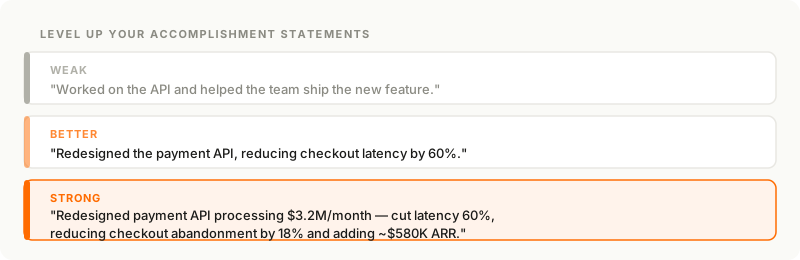
For employees reading these phrases: the pattern to match is behavior + business outcome. “Facilitated requirements workshops” is a task description. “Facilitated requirements workshops that eliminated 40% of the post-kickoff change requests on the CRM project” is a performance review phrase. Prov helps you capture the outcome in the moment so you have evidence at review time — not a memory exercise six months later.
How to Use These Phrases
For Managers
These phrases are starting points, not copy-paste answers. The strongest reviews replace the bracketed placeholders with specific numbers, project names, and outcomes from your direct report’s actual work. A phrase becomes credible when it’s traceable to a real moment — a project, a decision, a deliverable that the team remembers. Read the “Needs Development” phrases carefully: they are written to be growth-oriented, not punitive. Every one of them pairs a gap with a direction.
For Employees
Use these phrases to benchmark the language your manager is likely writing and to self-advocate accordingly. If your self-assessment uses language that matches the “Exceeds Expectations” tier, it gives your manager a concrete starting point. If your manager writes a phrase that undersells your contribution, these examples help you articulate the gap. The best self-assessments name the specific behavior and the measurable result — not a job description restated in first person.
Rating Level Guide
| Rating | What it means for Business Analysts |
|---|---|
| Exceeds Expectations | Requirements work prevented rework or enabled better decisions; analysis influenced strategy; stakeholders trust this BA to run complex sessions independently |
| Meets Expectations | Requirements are complete and usable; documentation is accurate; stakeholders are aligned; delivery support is reliable |
| Needs Development | Requirements lack precision or require frequent revision; analysis is surface-level; stakeholder relationships need strengthening; documentation is inconsistent |
Requirements & Discovery Performance Review Phrases
Exceeds Expectations
- Conducted structured discovery across six business units to define requirements for the ERP migration, surfacing fourteen conflicting assumptions before development began and preventing an estimated $200K in rework.
- Authored a requirements traceability matrix for the customer portal rebuild that tracked every functional requirement through design, build, and UAT — resulting in zero requirements-related defects in production.
- Facilitated a three-day requirements workshop using Miro and Lucidchart that aligned twelve stakeholders across product, legal, and operations, producing a signed-off BRD within five business days of kickoff.
- Identified eleven unstated assumptions in the vendor's proposed solution through requirements analysis, giving the sponsor the evidence to renegotiate contract scope before work began.
- Defined minimum viable scope for a market-entry product by separating regulatory must-haves from nice-to-have features in Jira, enabling a four-month launch timeline the business had considered impossible.
Meets Expectations
- Gathered and documented requirements from multiple stakeholder groups for each assigned project, producing BRDs that were reviewed and approved without major revision cycles.
- Maintained a well-structured requirements backlog in Jira throughout each project, keeping user stories consistently groomed and acceptance criteria current.
- Ran requirements workshops effectively, capturing participant input accurately and following up with written summaries that stakeholders confirmed as correct.
- Completed gap analyses for two process improvement projects, identifying the key differences between current and future states and documenting them clearly in Confluence.
- Collaborated with developers during sprint planning to clarify acceptance criteria, reducing mid-sprint clarification requests from the engineering team.
Needs Development
- Requirements documents frequently required revision after stakeholder review, suggesting an opportunity to build a more structured elicitation approach — consistent use of templates and pre-read materials could reduce revision cycles significantly.
- User stories often lack acceptance criteria specific enough for QA to test against; working with a senior BA to review story-writing technique before the next project kickoff would strengthen this area.
- Discovery sessions tend to focus on stated requirements without probing for unstated assumptions or edge cases; adding a structured assumption-capture step to workshop facilitation would improve requirement completeness.
- Scope boundaries on assigned projects have shifted more than expected; developing a change request evaluation habit — pausing to assess timeline and cost impact before accepting new scope — would improve delivery predictability.
Analysis & Problem Solving Performance Review Phrases
Exceeds Expectations
- Built a SQL-based analysis that identified a $1.2M annual revenue leakage pattern in the billing system, providing leadership with the quantified business case to prioritize a fix that had been deprioritized for two years.
- Produced a fit-gap analysis comparing three vendor platforms against 120 business requirements, giving the executive team a clear, evidence-based foundation for a platform selection decision worth $4M.
- Mapped current-state processes across five regional offices using Lucidchart, identified twelve process variations creating inconsistent customer outcomes, and delivered a standardization recommendation the COO presented to the board.
- Used Tableau to visualize the relationship between support ticket volume and deployment cadence, surfacing a correlation that changed the release management process and reduced post-deployment incidents by 38%.
- Performed root cause analysis on a recurring data quality issue using structured fishbone methodology, tracing the problem to an upstream ETL gap and reducing data correction effort by twenty hours per month.
Meets Expectations
- Delivered clear, well-structured analytical outputs on all assigned projects, consistently presenting findings in a format appropriate for the audience — technical write-ups for engineering and executive summaries for leadership.
- Used Tableau and SQL to support data-driven decisions during process improvement initiatives, validating assumptions with data before recommendations were finalized.
- Completed thorough as-is/to-be process analysis for two operational workflows, accurately documenting current state and identifying gaps the improvement team used to scope solutions.
- Applied structured problem-solving frameworks consistently, moving through problem definition, root cause analysis, and solution evaluation in a logical sequence on every assigned initiative.
Needs Development
- Analysis outputs tend to describe data rather than interpret it — developing the habit of leading findings write-ups with the "so what" before the detail would significantly increase the business impact of this work.
- Problem framing often jumps to solutions before the root cause is fully established; practicing structured root cause techniques (five whys, fishbone analysis) would improve solution quality and stakeholder confidence.
- Quantitative analysis skills are developing; working toward SQL proficiency and structured use of Tableau for business analysis would expand the range of problems this BA can tackle independently.
Stakeholder Management Performance Review Phrases
Exceeds Expectations
- Navigated a high-conflict requirements process involving three departments with competing priorities, building trust with each group independently and producing a requirements document all three signed off on without executive escalation.
- Developed and maintained a stakeholder communication plan for a twelve-month transformation program that kept forty stakeholders informed through five major scope changes without losing engagement or trust.
- Identified and proactively engaged a previously overlooked stakeholder group — the compliance team — six weeks before go-live, preventing a regulatory gap that would have delayed the launch by three months.
- Built a working relationship with the most resistant stakeholder on a process redesign initiative by investing time in understanding their team's constraints, ultimately converting them into a sponsor of the final recommendation.
- Facilitated a cross-functional decision-making session that broke a three-month deadlock on system design, producing a documented decision and rationale the team referenced throughout the remainder of the project.
Meets Expectations
- Maintained productive working relationships with all assigned project stakeholders, communicating clearly and following through on commitments consistently throughout the year.
- Managed stakeholder expectations effectively during scope changes, providing timely updates and clear impact assessments that kept projects moving without surprise escalations.
- Collaborated well with technical teams, translating business requirements into language engineers could act on and escalating ambiguity quickly when clarification was needed.
- Engaged business stakeholders appropriately at each project phase, ensuring the right people were involved at the right time and that sign-offs were obtained before work proceeded.
Needs Development
- Stakeholder relationships tend to be transactional rather than advisory; investing in ongoing relationships with key business partners between projects would increase the BA's influence and the quality of information they receive at project start.
- Difficult stakeholder conversations are sometimes avoided or escalated prematurely; building confidence in structured conflict resolution techniques would improve the BA's ability to resolve disagreements at their level.
- Communication with senior stakeholders could be stronger — findings and recommendations are technically sound but are sometimes presented in too much detail for an executive audience; adapting communication style by stakeholder level is a clear development opportunity.
Documentation & Communication Performance Review Phrases
Exceeds Expectations
- Produced a Confluence-based documentation framework for the data platform project that became the team's standard — all process flows, data dictionaries, and decision logs in a single searchable structure used by five teams twelve months after delivery.
- Wrote a business requirements document for the customer data migration that was described by the lead architect as "the clearest BRD I've worked from in ten years" — no clarification requests were received during development.
- Developed a visual process model in Lucidchart that translated a complex regulatory workflow into a format non-technical stakeholders could review and approve in a single session, accelerating sign-off by three weeks.
- Authored a change management communication plan covering all impacted user groups for the ERP rollout, contributing to a 94% adoption rate in the first month post-launch.
- Standardized user story templates across the product team in Jira, improving consistency across six BAs and reducing the time engineering spent seeking clarification before sprint start.
Meets Expectations
- Documentation produced throughout the year was accurate, well-organized, and appropriate for each audience — technical specs for engineering, business process flows for operations, and executive summaries for leadership.
- Maintained Confluence pages diligently throughout projects, keeping process documentation, meeting notes, and decision logs current and accessible to all stakeholders.
- Communicated project status, risks, and issues clearly and on schedule, giving stakeholders and project managers the information they needed without requiring follow-up.
- Produced professional, well-structured deliverables at every project stage — from discovery summaries through UAT sign-off documents — without quality issues requiring rework.
Needs Development
- Documentation is often produced at the end of a phase rather than maintained continuously; building a habit of updating Confluence in real time during projects would improve handoff quality and team access to current information.
- Written outputs are sometimes too detailed for the audience they are intended for; practicing audience-first document planning — starting with the reader's question, not a comprehensive record — would increase the usefulness of this work.
- Verbal communication in stakeholder meetings is clear, but written follow-up summaries are inconsistent; developing a post-meeting documentation habit would create a more reliable paper trail and reduce ambiguity downstream.
Delivery & Process Improvement Performance Review Phrases
Exceeds Expectations
- Led a process redesign for the customer onboarding workflow that reduced onboarding time from fourteen days to six, generating a measurable increase in early activation rates tracked in Tableau.
- Identified and eliminated a manual reconciliation step consuming forty hours per month by mapping the end-to-end process and recommending an automated alternative, freeing two FTEs for higher-value work.
- Served as the primary BA on a three-workstream delivery program, coordinating requirements across eight product teams and ensuring no inter-workstream dependency gaps reached development.
- Drove adoption of a structured change request evaluation process across the delivery team that reduced unplanned scope additions by 45% in the second half of the year.
- Completed UAT planning and execution for two major releases, achieving first-pass UAT success rates above 90% on both by virtue of clear acceptance criteria and thorough pre-UAT walkthroughs with the business.
Meets Expectations
- Supported delivery consistently across all assigned projects, managing requirements through the full lifecycle from discovery to UAT sign-off without significant gaps or delays attributable to the BA workstream.
- Contributed to process improvement initiatives effectively, documenting current-state processes accurately and proposing practical improvements that the business adopted.
- Tracked and communicated requirements-related risks and issues through project delivery, escalating in time for the project manager to take corrective action.
- Collaborated with QA teams to develop test cases from acceptance criteria, supporting test cycle efficiency and reducing defect rates on assigned features.
Needs Development
- Delivery support tends to be reactive rather than proactive — developing the habit of anticipating downstream impacts of requirements decisions earlier in the process would reduce last-minute escalations and schedule pressure.
- Process improvement recommendations have been well-intentioned but lack the quantified business case that would help leaders prioritize them; pairing recommendations with data on current-state cost or time would significantly strengthen their influence.
- UAT support has been inconsistent; taking ownership of UAT preparation — including acceptance criteria review and tester briefings — before the test cycle begins would reduce the iteration cycles currently required.
How Prov Helps Build the Evidence Behind Every Review
The hardest part of writing a strong business analyst performance review is not finding the right phrases — it is having the specific outcomes to fill them in with. “Facilitated requirements workshops” is forgettable. “Facilitated requirements workshops that eliminated 40% of post-kickoff change requests on the CRM migration” is the kind of phrase that changes a rating. The difference is evidence captured at the time, not reconstructed six months later from memory and calendar entries.
Prov is a career achievement capture app that turns rough notes into polished achievement statements the moment the work happens. A BA finishes a discovery session, opens Prov, speaks a quick note about what they uncovered and why it mattered, and Prov transforms it into a structured achievement with skills and patterns extracted automatically. By review time, the evidence is already there — specific, outcome-focused, and ready to drop into a self-assessment or share with a manager building a review.
Ready to Track Your Wins?
Free to start, no account, no sign-up. Available on the App Store now.
Download on iOS Free to start, no account needed