Backend engineering has a fundamental self-assessment problem: your best work is the stuff nobody noticed. The API that never went down. The migration that completed without a single alert. The schema decision that is still serving the system cleanly three years later. Success in backend is measured in absence — and absence is extraordinarily hard to write about in a review form.
Why Self-Assessments Are Hard for Backend Engineers
The frontend engineer can point to a redesigned screen. The product manager can point to a shipped feature. The backend engineer can point to… a service that handled 40 million requests last quarter without a single P1. How do you write compellingly about something whose defining characteristic is that nothing went wrong?
This is the core challenge: reliability is invisible. The database query you optimized saved 80ms on every checkout — but unless you measured it before and after and connected it to a business outcome, that work disappears into the background of “things that worked.” Backend engineers who write strong self-assessments are the ones who instrument their own impact, not just their systems.
There’s also the architectural decision problem. Backend engineering involves constant judgment calls about tradeoffs — sync vs. async, relational vs. document, cache invalidation strategy, API versioning approach. These decisions are often more consequential than any feature you shipped, but they’re made in pull request comments and design docs that don’t survive into the review cycle. If you don’t document these decisions with their rationale and outcome, they will never appear in a review.
Finally, backend engineers often take on the “boring” cross-cutting work — adding observability, improving deployment pipelines, fixing flaky tests, writing runbooks — that benefits the entire team but doesn’t map to a specific feature. This work is enormously valuable and should be claimed explicitly. “I did the work so that five other engineers didn’t have to” is a legitimate and powerful self-assessment statement.
The goal: make invisible reliability and architectural judgment legible by measuring before/after states, naming the decisions you made and why, and quantifying the downstream benefit to teammates and systems.
How to Structure Your Self-Assessment
The Three-Part Formula
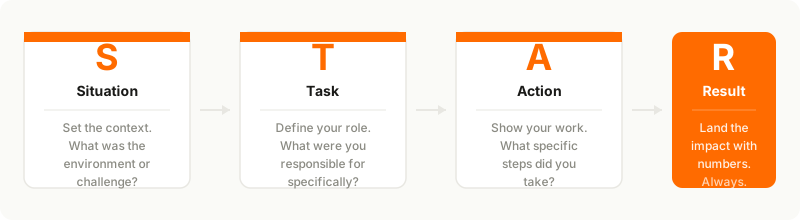
What I did → Impact it had → What I learned or what’s next
For backend engineers, “impact” often requires an extra translation step: connect the technical result to a user or business outcome. “Reduced p99 latency from 1.8s to 240ms” becomes “Reduced p99 latency from 1.8s to 240ms, eliminating a class of timeout errors that had been causing 0.3% of checkout sessions to fail.”
Phrases That Signal Seniority
| Instead of this | Write this |
|---|---|
| "I built an API" | "I designed and implemented a gRPC service with versioned contracts, enabling three downstream consumers to migrate independently without coordinated deploys" |
| "I fixed the slow queries" | "I identified and resolved a missing composite index in Postgres that was causing p95 query time to spike to 3.4s under load — after the fix, p95 dropped to 18ms and the associated PagerDuty alert has not fired in four months" |
| "I helped with the migration" | "I owned the data migration strategy for the schema refactor, including the dual-write period, the backfill job, and the cutover runbook — the migration completed with zero downtime and no data inconsistencies" |
| "I want to learn more about Kubernetes" | "I'm developing Kubernetes expertise by owning the configuration of our new service's Helm chart, with a goal of being able to diagnose and resolve pod scheduling and resource limit issues independently by Q3" |
API & Service Design Self-Assessment Phrases
API Contract Design
-
“I designed the REST API for our new notification service, establishing versioning conventions, error response schemas, and pagination patterns that three other teams adopted as a reference implementation. I wrote the API style guide as a Confluence document, which reduced the back-and-forth in cross-team API review sessions by giving reviewers a shared vocabulary for feedback.”
-
“I led the migration from REST to gRPC for our internal service-to-service communication layer, defining the protobuf schemas and generating client libraries for four consumer teams. The migration reduced serialization overhead by 35% and eliminated an entire class of field-type mismatch bugs that had previously required manual validation on both sides.”
-
“I designed the webhook delivery system for our platform API, including retry logic, signature verification, and delivery guarantees. I presented three design options with explicit tradeoff analysis to the team before implementation — this document is now used in onboarding to explain our event delivery semantics to new engineers.”
-
“I introduced contract testing between our user service and three downstream consumers using Pact, catching a breaking change in a response schema before it reached staging. The practice was adopted by two additional service pairs and is now part of our CI pipeline via GitHub Actions.”
Service Architecture
-
“I designed the strangler-fig decomposition plan for extracting our billing logic from the monolith, defining the phased cutover strategy and establishing the dual-write period to ensure data consistency. The extraction completed over three sprints with no billing incidents and unblocked the billing team from deploying independently for the first time.”
-
“I proposed and implemented the event-driven architecture for our order status pipeline, replacing a polling approach that had been causing 200+ unnecessary database queries per second under peak load. After switching to Kafka-based event streaming, database load from this pattern dropped by 94% and order status update latency improved from 8 seconds average to under 400ms.”
Performance & Scalability Self-Assessment Phrases
Query & Database Optimization
-
“I identified a critical N+1 query pattern in our product catalog service using DataDog APM traces, which was generating 340 unnecessary Postgres queries per page load at peak. After refactoring to batch loading with proper eager fetching, database query count per request dropped from 340 to 4, and the service’s average response time fell from 1.1s to 95ms.”
-
“I designed and implemented a Redis caching layer for our most expensive read path — the user permission resolution query that ran on every authenticated API request. Cache hit rate settled at 94%, reducing Postgres load for this query by 15x and eliminating a recurring database CPU spike that had been causing alert noise during business hours.”
-
“I rewrote the bulk export job that was timing out for accounts with large datasets, replacing a single-transaction SELECT with a cursor-based pagination approach that streamed results through the processing pipeline. Export jobs that previously failed after 30 minutes now complete in under 4 minutes with no timeout risk, and memory usage during exports dropped by 78%.”
-
“I analyzed our Postgres slow query log and identified that 60% of queries exceeding 100ms shared a common pattern: filtering on a non-indexed foreign key. I added five targeted composite indexes after validating with EXPLAIN ANALYZE, reducing the frequency of slow queries hitting our DataDog alert threshold from an average of 140 per day to under 10.”
Infrastructure & Throughput
-
“I worked with the infrastructure team to right-size our Kubernetes pod resource requests and limits, replacing the default configurations that had been causing either OOM kills under load or over-provisioned idle capacity. After a week of profiling and adjustment, we reduced our cluster node count by 3 (from 11 to 8) while improving p99 latency — an estimated $8,400/month infrastructure saving.”
-
“I implemented horizontal scaling for our image processing service by making it stateless and deploying it behind a Kubernetes HorizontalPodAutoscaler. Processing throughput increased from 800 to 4,200 images per minute at peak, and the service now scales automatically without manual intervention during traffic spikes.”
-
“I profiled our Kafka consumer group and identified that our consumer was spending 40% of its processing time on synchronous HTTP calls to an external service. By batching these calls and introducing a local cache with a 30-second TTL, I increased consumer throughput by 3.2x and reduced end-to-end message processing latency from 6.8s to 2.1s.”
Data Modeling & Storage Self-Assessment Phrases
Schema Design
-
“I led the data modeling design for our new analytics event schema, making the case for an append-only events table over a mutable state approach. I documented the tradeoffs in an ADR — the decision has proven correct as our analytics team has been able to add new event types without schema migrations and replay historical data for new metric calculations.”
-
“I designed the sharding strategy for our messages table as it approached 2 billion rows, evaluating range-based, hash-based, and tenant-based approaches before recommending tenant-based sharding based on our query patterns. I wrote the migration plan and executed it over six weeks with no downtime, and the sharded architecture has allowed us to scale two additional clients without performance degradation.”
-
“I audited our database schema for normalization issues and identified three cases where denormalization was causing data consistency bugs — values being updated in one place but not another. I refactored these over two sprints, introducing proper foreign key relationships and removing the duplicated columns, fixing two active production bugs in the process.”
Data Migration
-
“I designed and executed the migration from MongoDB to Postgres for our core user data, covering 12 million records. I wrote a dual-write strategy that allowed us to migrate with zero downtime, validate data consistency at the row level before cutover, and roll back safely if needed. The migration completed without a single data inconsistency and reduced our per-record query latency by 62%.”
-
“I wrote the backfill job for the new
normalized_emailcolumn, processing 8 million existing records in batches using a Kafka-based pipeline to avoid locking the table. I designed the job to be idempotent and resumable after failure, which proved valuable when a network issue interrupted the run at 60% completion — the job resumed cleanly from the checkpoint.”
Security & Reliability Self-Assessment Phrases
Security
-
“I led the security hardening of our external API after an internal audit identified three vulnerabilities: missing rate limiting on authentication endpoints, insufficient input validation on file upload parameters, and verbose error messages leaking internal stack traces. I remediated all three within a two-week sprint and added regression tests to our GitHub Actions pipeline to prevent reintroduction.”
-
“I implemented secrets rotation for our third-party API keys using Kubernetes secrets combined with our internal vault service, replacing hard-coded environment variables that had been flagged in a security review. The new system rotates credentials automatically on a 30-day schedule and has been adopted as the standard pattern for all new services.”
-
“I added authentication and authorization to two previously internal-only microservices that were being exposed to a new partner integration, implementing JWT validation with role-based access control. I worked with the security team to define the permission model and wrote the authorization middleware that has since been reused by three other services.”
Reliability & On-Call
-
“I reduced PagerDuty alert volume for my team’s services by 71% over the year by auditing every alert threshold, eliminating duplicate alerts, and converting symptom-based alerts to impact-based alerts. The reduction in alert noise directly improved on-call quality and made the remaining alerts meaningfully actionable — our mean time to acknowledge improved from 8 minutes to 3 minutes.”
-
“I served as incident commander for two P0 events this year and drove a structured post-mortem process that identified contributing factors beyond the immediate trigger. Both post-mortems resulted in concrete remediation work — I tracked all action items to completion within 30 days of each incident and presented the outcomes at our engineering all-hands.”
-
“I built a circuit breaker pattern into our payment processing service for three external dependencies, using a Redis-backed state machine to track failure rates and open circuits automatically. During a payment gateway outage in Q3, these circuit breakers allowed us to serve 91% of checkout traffic with graceful fallbacks rather than returning 500 errors to users.”
Technical Leadership Self-Assessment Phrases
Mentorship & Code Review
-
“I mentored a junior backend engineer this year through their first solo service ownership, running weekly architecture reviews and being available for questions throughout their design process. They shipped their first independently owned service in month five, and their PR quality — measured by required-change rate — improved from 68% of PRs requiring substantive changes to 21% by the end of the year.”
-
“I conducted an average of 12 code reviews per week with a focus on teaching rather than gatekeeping. I consistently explained the reasoning behind requested changes and linked to relevant documentation or ADRs rather than just asking for changes. Two engineers on my team have told me my review style meaningfully improved their understanding of our concurrency model and our approach to error handling.”
-
“I established a backend engineering reading group that meets bi-weekly to discuss architecture papers and internal case studies. I have run six sessions this year covering topics including consistent hashing, CQRS, and database isolation levels. The group has 9 regular attendees and has produced two internal proposals — one for adopting read replicas and one for a new retry strategy — that were both approved.”
Documentation & Standards
-
“I wrote runbooks for our five most frequently triggered PagerDuty alerts, documenting the diagnostic steps, common causes, and resolution procedures. Since publishing these, our team’s mean time to resolve for those alert types dropped from 34 minutes to 12 minutes, and new on-call engineers report significantly lower stress during their first on-call rotation.”
-
“I authored three architectural decision records this year covering our approach to service-to-service authentication, our event schema versioning strategy, and our Postgres connection pooling configuration. These documents are now part of the standard onboarding reading for new backend engineers and have reduced repeated discussions about established decisions.”
Cross-team Collaboration Self-Assessment Phrases
Platform & Infrastructure Partnership
-
“I worked closely with the platform team to define and implement our Docker containerization standards, contributing the backend-specific patterns while they defined the infrastructure conventions. The resulting standards document was adopted by all four backend service teams within two months and has reduced ‘it works on my machine’ incidents in staging by eliminating environment inconsistencies.”
-
“I served as the backend representative on our DataDog instrumentation working group, contributing to the team-wide standards for metric naming, trace sampling rates, and dashboard design. I also implemented those standards across the three services I own and wrote the implementation guide that five other engineers followed.”
-
“I collaborated with the data platform team to design the event schema for our new analytics pipeline, ensuring the schema met both backend implementation constraints and data team query patterns. This early collaboration prevented a schema redesign that would have been necessary had we proceeded independently — the data team estimated it saved them two weeks of migration work.”
Product Engineering Partnership
-
“I partnered with the frontend team on our API design for the new mobile features, attending their planning sessions to understand client constraints and adapting our endpoint design to reduce the number of round trips required. The resulting API required 40% fewer network calls than the initial design, improving load time on slow connections and simplifying the mobile implementation.”
-
“I proactively communicated two breaking API changes to all consumer teams four weeks in advance, providing migration guides and running Q&A sessions for each affected team. Both changes deployed with zero unplanned client-side failures and my manager cited this communication approach as a model for other engineers to follow.”
How Prov Helps Backend Engineers Track Their Wins
Backend engineers build systems that are designed to be forgotten — until they break. The quiet success of a service that handled Black Friday traffic without incident, a schema decision that’s still clean two years later, or a security fix that closed a gap before it was exploited: these wins don’t announce themselves. They require deliberate capture immediately after they happen, before the context fades.
Prov makes that capture take 30 seconds. A voice note after you merge the optimization PR, a quick text entry when the post-mortem action items close out — the app transforms those rough notes into polished achievement statements ready for your self-assessment. When review season arrives, you’ll have a full year of documented wins instead of trying to reconstruct invisible work from memory. Prov is coming soon on iOS.
Ready to Track Your Wins?
Free to start, no account, no sign-up. Available on the App Store now.
Download on iOS Free to start, no account needed