Backend engineering is the discipline of making problems disappear before anyone notices them. Reviewing it well means evaluating judgment about tradeoffs, not just delivery speed.
How to Write Effective Backend Engineer Performance Reviews
Backend engineering work has a structural visibility problem. The migrations that succeed leave no trace. The API designs that scale gracefully never appear in an incident report. The query optimization that kept the product fast during a 10x traffic spike goes unrecognized because users didn’t notice anything — which was entirely the point. Writing a meaningful backend review requires actively surfacing work that succeeds by being invisible.
The most important shift for managers reviewing backend engineers is from output thinking to judgment thinking. Two engineers can both “ship an API.” One anticipates the consumer’s integration needs, designs a stable contract, handles edge cases in the error envelope, and writes a migration guide. The other ships something functional that becomes a support burden within a month. The code volume was similar. The judgment was not. Review language for backend engineers needs to capture this distinction.
Reliability and operational quality deserve explicit treatment in backend reviews. Engineers who write runbooks, instrument their services with meaningful DataDog dashboards, set appropriate Kafka consumer lag alerts, and design for graceful degradation are doing work that pays dividends for the entire on-call rotation — often invisibly. Managers who don’t explicitly name this work in reviews are inadvertently training their teams that operational quality doesn’t matter.
Cross-team impact is frequently the highest-leverage dimension for senior backend engineers. The API contract you define shapes what four product teams can build. The service design you champion in an RFC becomes the pattern everyone else follows. The Kubernetes resource limits you set prevent the noisy-neighbor problem from degrading other teams’ services. Good backend reviews name these ripple effects explicitly rather than treating them as background noise.
How to Use These Phrases
For Managers
Use these phrases as starting points, not copy-paste finals. The strongest reviews replace the bracketed specifics with actual numbers, system names, and outcomes from your engineer’s work. A phrase becomes a review when it’s grounded in something that actually happened. Pair each “Exceeds” phrase with a specific example from the review period.
For Employees
These phrases show you the language and framing that registers as high-impact to reviewers. If you’re writing a self-assessment, use “Meets” and “Exceeds” language to describe your own work in third person, then add the specific metrics only you know. If you’re preparing for a conversation about your rating, compare your work against these phrases to identify where you have undocumented evidence.
Rating Level Guide
| Rating | What it means for Backend Engineers |
|---|---|
| Exceeds Expectations | Drives architectural decisions that shape multiple teams; proactively identifies and resolves systemic problems; measurably improves reliability, performance, or developer experience beyond assigned scope |
| Meets Expectations | Reliably delivers well-designed services on schedule; writes production-quality code with appropriate testing and instrumentation; collaborates effectively with dependent teams |
| Needs Development | Delivers working features but requires additional guidance on design tradeoffs, operational quality, or cross-team communication; foundational skills are present but judgment needs development |
API & Service Delivery
Exceeds Expectations
- Consistently designs API contracts that anticipate consumer needs — versioning strategy, error envelopes, and pagination conventions — enabling partner teams to integrate without escalating support requests.
- Proactively identified and resolved a critical N+1 query pattern in the core REST API before it reached production, preventing a latency regression that would have affected every mobile client.
- Independently led the migration from synchronous REST to async job-and-webhook pattern for long-running operations, eliminating a class of HTTP timeout errors and unblocking two downstream product teams.
- Drives API versioning and deprecation discipline across the service portfolio, ensuring downstream teams receive adequate migration windows and never face breaking changes without notice.
- Independently built the idempotency key system for payment-critical endpoints, resolving a duplicate-charge bug class that had generated support escalations for three consecutive quarters.
Meets Expectations
- Delivers REST and GraphQL endpoints on schedule with consistent error handling, appropriate HTTP semantics, and sufficient test coverage for the happy path and primary edge cases.
- Maintains API documentation in sync with implementation, ensuring partner teams have accurate specs for integration work.
- Participates constructively in API design reviews, raising concerns about backward compatibility and providing clear rationale for design decisions.
- Implements rate limiting and input validation on public-facing endpoints according to team standards, preventing common abuse vectors.
- Responds to API consumer questions and integration bugs within established SLA, providing clear reproduction steps and fixes when issues are confirmed.
Needs Development
- Would benefit from studying API design patterns — particularly versioning, error envelope conventions, and backward compatibility — to reduce the revision cycles required before endpoints are ready for partner consumption.
- Is developing the habit of validating API designs with consumer teams before implementation, which would reduce the late-stage requirement changes that have added scope to recent projects.
- Has shown progress in shipping functional endpoints but would benefit from more attention to operational concerns — logging, metrics instrumentation, and alerting — before services are considered production-ready.
- Is developing a stronger understanding of async patterns and their tradeoffs; with targeted experience, will be better equipped to choose the right delivery model for new service requirements.
System Design & Architecture
Exceeds Expectations
- Proactively authored the RFC for the event-driven order processing architecture using Kafka, anticipating scale requirements 12 months ahead and giving the team a migration path before the existing synchronous approach became a bottleneck.
- Independently designed the multi-tenant data isolation model, identifying a row-level security approach in Postgres that eliminated the need for a separate schema-per-tenant strategy and saved an estimated six weeks of migration work.
- Drives architectural consistency across services by establishing patterns — shared libraries, service templates, and Kubernetes configuration conventions — that have measurably reduced the time to bootstrap new services.
- Leads architecture review sessions that surface cross-cutting concerns — security, observability, operational burden — that feature teams would otherwise defer until after deployment.
- Consistently evaluates build-vs-buy decisions with a total-cost lens, factoring in operational burden, vendor lock-in risk, and team expertise alongside initial implementation cost.
Meets Expectations
- Designs services with appropriate separation of concerns, clear domain boundaries, and documented interfaces that enable other engineers to work on adjacent systems without deep context.
- Participates actively in architecture reviews, asking clarifying questions and raising relevant technical risks without requiring prompting.
- Applies established architectural patterns — repository pattern, saga for distributed transactions, CQRS where appropriate — consistently and with clear rationale.
- Considers operational implications of design decisions, including deployment complexity, rollback strategy, and on-call burden.
Needs Development
- Is developing the ability to reason about system design at the service boundary level; current work demonstrates strong implementation skill but would benefit from more practice designing the contracts and failure modes between components.
- Would benefit from studying distributed systems failure patterns — network partitions, cascading failures, backpressure — to make more robust design choices when building services that interact with Kafka, Redis, or external APIs.
- Has shown progress in individual service design but is still developing the cross-system perspective needed to evaluate how architectural decisions in one service affect the rest of the platform.
Performance & Reliability
Exceeds Expectations
- Proactively identified a missing composite index on the orders table through query plan analysis, reducing the p95 search latency from 1.8 seconds to 210ms without requiring application-layer changes.
- Independently designed and implemented the Redis caching layer for the user profile service, reducing Postgres read load by 65% and enabling the application tier to scale to 3x traffic without a database upgrade.
- Consistently instruments new services with DataDog dashboards, SLI/SLO definitions, and PagerDuty alert thresholds before declaring them production-ready, setting a reliability standard the team has adopted as its baseline.
- Drives proactive capacity planning by analyzing usage trends and raising infrastructure concerns before they become incidents, enabling planned scaling rather than reactive firefighting.
- Led the post-incident analysis for the Kubernetes pod eviction event, identifying the root cause in resource limit misconfiguration and implementing a policy that has prevented recurrence over the following six months.
Meets Expectations
- Writes services with appropriate error handling, retry logic, and circuit breaker patterns that degrade gracefully when downstream dependencies are unavailable.
- Instruments services with basic metrics — request rate, error rate, latency percentiles — and responds to alerts within established on-call SLA.
- Completes assigned performance optimization work on schedule, applying profiling-driven approaches rather than speculative optimization.
- Participates constructively in post-incident reviews, contributing accurate timelines and identifying actionable follow-up items.
Needs Development
- Is developing stronger habits around service instrumentation; recent services have shipped with insufficient metrics coverage, making debugging production issues harder than necessary.
- Would benefit from deeper study of database performance patterns — query plan analysis, index design, connection pool sizing — to resolve performance issues more independently.
- Has shown progress in writing reliable code but would benefit from more practice designing for failure: retry budgets, dead letter queues, and graceful degradation paths when Kafka or Redis are unavailable.
Code Quality & Review Culture
Exceeds Expectations
- Consistently produces pull requests with clear scope, well-documented context in the PR description, and test coverage that makes reviewer approval straightforward — reducing average review cycle time across the team.
- Proactively establishes and documents coding standards — typed errors, logging conventions, repository pattern enforcement — that have reduced the volume of nitpick-level review comments across the team's PRs.
- Provides code review feedback that is specific, actionable, and educational, consistently linking to documentation or providing example rewrites rather than leaving vague objections.
- Independently identified and refactored a shared utility class that had accumulated 14 responsibilities over two years, improving testability and reducing the defect rate in the affected area by a measurable margin.
- Leads the team's CI/CD quality gate configuration, ensuring that lint, static analysis, and integration tests run reliably on every GitHub PR without false-positive blocking.
Meets Expectations
- Writes code that is readable, consistently formatted, and accompanied by tests that cover the primary behaviors and key edge cases.
- Participates in code review consistently, providing feedback within agreed turnaround times and catching bugs and design issues before merge.
- Addresses review feedback constructively and follows through on requested changes before re-requesting review.
- Maintains test coverage at or above team thresholds, including integration tests for services with external dependencies.
Needs Development
- Would benefit from focusing more attention on test quality — particularly integration tests covering failure paths and edge cases — to reduce the bugs that reach staging and production from this engineer's PRs.
- Is developing the ability to give constructive code review feedback; current reviews tend toward approval without substantive comment, missing an opportunity to catch issues and grow peers.
- Has shown progress in code quality but would benefit from deeper engagement with the team's static analysis and linting standards to reduce the revision round-trips caused by style and pattern inconsistencies.
Cross-team Collaboration
Exceeds Expectations
- Proactively communicates upcoming API changes with sufficient lead time and migration guidance, enabling consumer teams to adapt without blocking their roadmap work.
- Independently authored the internal developer documentation for the shared authentication service, reducing the onboarding time for engineers integrating with the service from an average of two days to half a day.
- Consistently represents backend infrastructure concerns in product planning sessions, translating technical constraints into business risk language that enables product managers to make informed prioritization decisions.
- Leads knowledge-sharing sessions on backend topics — Postgres query planning, Kafka consumer group design, Kubernetes resource configuration — that have measurably raised the technical floor across the engineering organization.
- Drives clarity on shared service ownership boundaries, preventing the recurring ambiguity about who is responsible for cross-cutting infrastructure concerns that had previously delayed incident response.
Meets Expectations
- Communicates API changes and deprecations to affected teams on the agreed notice schedule, providing adequate documentation for consumer teams to plan their work.
- Responds to cross-team requests and technical questions within established SLA, providing clear answers and following up when issues require investigation.
- Participates in shared on-call rotation, resolving incidents within SLA and contributing to post-incident documentation.
- Collaborates effectively with DevOps, data engineering, and frontend teams on features that span multiple domains.
Needs Development
- Is developing stronger communication habits around API changes; several recent breaking changes reached consumer teams without adequate notice, creating unplanned work for partner engineers.
- Would benefit from more proactive cross-team communication — particularly surfacing infrastructure constraints and risks during planning — rather than raising blockers after scope has been committed.
- Has shown progress in technical collaboration but is still developing the documentation and knowledge-sharing habits that would reduce the bus-factor risk on systems this engineer owns.
How Prov Helps Build the Evidence Behind Every Review
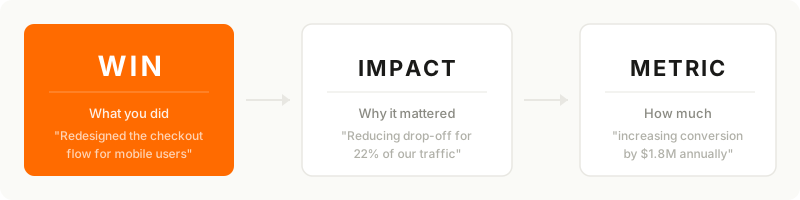
The hardest part of writing a strong performance review isn’t finding the right phrase — it’s finding the evidence to back it up. Backend engineers who track their wins throughout the year arrive at review time with specific numbers, dates, and outcomes. Engineers who don’t track are left reconstructing six months of work from memory and commit history, and the result is a review full of vague language that fails to capture the real impact.
Prov gives backend engineers a lightweight way to capture achievements as they happen — a 30-second voice or text note after a significant deployment, a post-incident review, or a successful refactor. Over time, those raw notes become a searchable record of your work with extracted skills and patterns. When review season arrives, that record becomes the source material for phrases like the ones above: specific, grounded, and hard to dismiss.
Ready to Track Your Wins?
Free to start, no account, no sign-up. Available on the App Store now.
Download on iOS Free to start, no account needed