Concrete examples of backend engineer achievements you can adapt for your performance review, resume, or salary negotiation.
The Backend Engineer's Review Problem
Backend engineers build the infrastructure that makes everything else possible — and that's exactly why review time is so hard. The work that matters most is the work no one sees: the migration that completed without downtime, the latency optimization that meant the mobile app felt fast, the schema change that won't cause a data integrity problem two years from now. Users don't experience your Postgres query plan. Product managers don't open Grafana dashboards. Your manager hears about your work primarily when something breaks — which means if things are running well, you're invisible.
There's also the long-cycle problem. Frontend work ships weekly; backend infrastructure work often runs for quarters. A database migration, a service decomposition, a security posture improvement — these are multi-month efforts where progress is hard to communicate incrementally and the payoff arrives as a quiet non-event. "The migration finished and nothing broke" is one of the best outcomes you can achieve, but it reads as nothing on a performance review form.
And then there's the cross-cutting nature of backend work. You own the API that 4 product teams depend on. You defined the data model that will shape the product for the next 3 years. You wrote the runbook that halved the on-call resolution time for the entire engineering org. All of that shows up in other people's work — which is valuable — but means your individual contribution is diffuse and easy for others to overlook, and for you to undervalue.
What gets you promoted are documented accomplishments with measurable impact. The examples below give you the language to surface work that's too often invisible.
Backend Engineer Accomplishment Categories
| Competency | What Reviewers Look For |
|---|---|
| API & Service Development | You build clean, reliable services other teams can depend on |
| Database & Data Engineering | You handle data correctly, durably, and efficiently |
| Performance & Scalability | Your code handles real load — and doesn't fall over when load doubles |
| Security & Reliability | You protect the system and design for failure |
| Infrastructure & DevOps Collaboration | You own your services end-to-end, not just the code |
| Technical Leadership | You elevate the team's standards, not just your own output |
API & Service Development Accomplishments
API Design & Development
- "Designed and shipped the v2 REST API with consistent error envelopes and pagination conventions, enabling 3 external partner integrations to launch within 6 weeks of GA."
- "Migrated 14 endpoints from REST to GraphQL using Apollo Server, reducing over-fetching and cutting average mobile API payload size by 55%."
- "Built the webhook delivery system with exponential backoff retry logic and delivery logs, achieving 99.97% delivery rate on 2M+ events per month."
- "Implemented API rate limiting using a Redis token-bucket algorithm, preventing 3 abuse incidents and protecting downstream services from being overwhelmed by a single client."
- "Shipped the idempotency key system for the payments API, eliminating duplicate charge errors that had been occurring at a rate of ~12/month."
- "Developed the bulk operations API (batch create/update/delete) for the data import feature, reducing a 45-minute manual import workflow to under 90 seconds."
- "Added OpenAPI 3.0 spec generation from source code annotations, creating always-accurate documentation that reduced integration support tickets by 35%."
- "Built the async job API with status polling and webhook callbacks, enabling long-running operations without HTTP timeout constraints."
Service Architecture
- "Decomposed the monolithic user service into 3 bounded-context services (identity, profile, permissions), enabling independent deployments and reducing the blast radius of changes."
- "Designed the event-driven architecture using Kafka for the order processing pipeline, enabling reliable downstream fan-out to 5 consuming services without coupling."
- "Built the internal gRPC service for high-frequency inter-service calls, reducing serialization overhead by 70% compared to the previous JSON/REST approach on the hot path."
- "Implemented the saga pattern for the multi-service checkout transaction, replacing a brittle two-phase commit that had caused 4 data consistency incidents in 6 months."
- "Created the service mesh configuration using Istio for the 12 core services, enabling mTLS between services and giving the security team auditable east-west traffic records."
Database & Data Engineering Accomplishments
Schema & Query Optimization
- "Identified and added 4 missing composite indexes on the orders table after query analysis with EXPLAIN ANALYZE, reducing the worst-case search query from 4.2 seconds to 38ms."
- "Rewrote the N+1 query problem in the user dashboard loader using a single JOIN with lateral subqueries, reducing database calls per page load from 47 to 3."
- "Partitioned the events table by month using Postgres table partitioning, enabling the operations team to drop old data without locking and reducing query plan cost by 80% for recent-data queries."
- "Designed the normalized schema for the multi-tenant configuration system, replacing a JSONB blob approach that had made querying impossible and indexing ineffective."
- "Implemented database connection pooling with PgBouncer in transaction mode, reducing connection overhead and enabling the application tier to scale from 4 to 24 instances without exhausting Postgres connections."
- "Converted a full-table scan report query to a materialized view with scheduled refresh, reducing report generation time from 140 seconds to 400ms."
- "Audited slow query log over 30 days, prioritizing and resolving the top 10 offenders — reduced p95 database query time from 890ms to 120ms across the application."
Data Pipelines & Migrations
- "Executed the backfill migration of 40M rows to add a non-nullable column, using batched updates with rate limiting to complete the migration over 4 days with zero production impact."
- "Built the CDC (Change Data Capture) pipeline using Debezium and Kafka to sync the Postgres primary to the Elasticsearch search index, replacing a nightly batch job with real-time sync (latency: <500ms)."
- "Designed the zero-downtime migration strategy for renaming 6 high-traffic columns, using the expand-contract pattern across 3 deploys over 2 weeks with no service disruption."
- "Implemented the data archival pipeline that moved records older than 2 years to S3 Parquet via Spark, reducing the primary database size by 60% and cutting monthly RDS costs by $3,200."
- "Built the data validation framework that ran assertions against every migration script in staging before production execution — caught 2 data-destructive bugs before they could cause incidents."
Performance & Scalability Accomplishments
Latency & Throughput
- "Reduced the search API p99 latency from 1.8 seconds to 210ms by moving Elasticsearch query construction off the hot path and pre-computing filter combinations during indexing."
- "Profiled and optimized the report generation endpoint using py-spy, identifying a JSON serialization bottleneck and replacing it with orjson — throughput increased from 120 to 850 req/s."
- "Scaled the message processing pipeline to handle 50,000 messages/second by introducing consumer group parallelism in Kafka and removing a per-message database write that could be batched."
- "Reduced cold start time for the Lambda-based document processing service from 4.2 seconds to 380ms using provisioned concurrency and minimizing import graph depth."
- "Replaced the synchronous PDF generation call in the order API with an async worker pattern, reducing the order creation endpoint p99 from 6.1 seconds to 120ms."
- "Implemented response streaming for the AI text generation endpoint using SSE, reducing perceived time-to-first-token from 8 seconds to under 1 second."
Caching & Optimization
- "Designed the multi-layer caching strategy using Redis for session data and CDN edge caching for public API responses, reducing database reads by 65% during peak hours."
- "Implemented cache warming for the 500 most-requested product pages on deployment, eliminating the cold-start latency spike that had been causing SLA violations after every release."
- "Built the read-through cache abstraction with TTL-based invalidation for the user permissions service, reducing authorization latency from 45ms to 2ms across all endpoints."
- "Resolved a Redis cache stampede on the homepage by implementing a probabilistic early expiration algorithm, eliminating the 30-second latency spike that occurred every hour during peak traffic."
- "Introduced database query result caching with intelligent invalidation using cache tags, reducing the load on the read replica by 40% and allowing us to delay a planned $800/month instance upgrade."
Security & Reliability Accomplishments
Auth & Access Control
- "Redesigned the permission system from a role-based to an attribute-based model (ABAC), enabling fine-grained resource-level permissions that unblocked the enterprise tier launch."
- "Implemented JWT refresh token rotation with refresh token family tracking, eliminating refresh token reuse attacks and adding server-side session revocation capability."
- "Migrated API authentication from long-lived API keys to short-lived OIDC tokens with automatic rotation, reducing the blast radius of a credential leak from permanent to <1 hour."
- "Built the audit log service capturing all write operations with actor, resource, and diff, satisfying SOC 2 Type II requirements for data access controls."
- "Implemented PKCE flow for the OAuth 2.0 authorization server, closing an authorization code interception vulnerability before a scheduled security audit."
- "Conducted a secrets audit across all repositories and CI systems, rotating 23 exposed credentials and implementing HashiCorp Vault for secrets management going forward."
Reliability & Error Handling
- "Implemented the circuit breaker pattern for all external API dependencies using Resilience4j, preventing 3 cascade failure incidents when third-party services degraded."
- "Added structured error handling with typed error responses across 40 endpoints, replacing undifferentiated 500 errors and reducing mean time to diagnosis from 45 minutes to 8 minutes."
- "Built the dead letter queue system for failed async jobs with automated alerting and a replay UI, reducing permanently lost background job failures from ~15/week to zero."
- "Implemented graceful shutdown handling for the API servers, eliminating in-flight request drops during deployments that had been causing 0.3% error spikes on every release."
- "Designed the idempotent consumer pattern for Kafka message processing, ensuring exactly-once semantics for financial events and eliminating 4 double-processing incidents per month."
Infrastructure & DevOps Collaboration Accomplishments
Deployment & Observability
- "Containerised 8 services with multi-stage Dockerfiles, reducing image sizes by an average of 65% and cutting deployment time from 18 minutes to 4 minutes."
- "Implemented distributed tracing with OpenTelemetry across 12 services, reducing mean time to root cause for cross-service latency issues from 3 hours to 20 minutes."
- "Set up structured logging with correlation IDs using the ELK stack, enabling log aggregation across services and reducing debugging time for distributed requests by 75%."
- "Defined SLOs and SLIs for the 5 critical user-facing APIs with automated alerting, giving the team a shared definition of production health for the first time."
- "Implemented blue-green deployment for the payments service, enabling zero-downtime releases and providing a <60-second rollback path for the first time."
- "Built the Terraform module for the standard service stack (ECS task, ALB target group, RDS proxy, CloudWatch alarms), reducing new service provisioning from 2 days to 90 minutes."
On-Call & Incident Response
- "Led the response to the database failover incident that affected 22% of users for 47 minutes, coordinating across 4 teams and writing the post-mortem with 12 action items, 8 of which shipped in the following sprint."
- "Wrote runbooks for the 7 most common on-call alerts, reducing mean time to resolution for those alerts from 52 minutes to 11 minutes — measurable in PagerDuty incident data."
- "Identified a recurring memory exhaustion pattern from on-call data across 3 months, root-caused it to a goroutine leak, and shipped the fix — eliminating the alert class entirely."
- "Reduced on-call alert fatigue by auditing 40+ CloudWatch alarms, removing 18 that were non-actionable noise and tightening thresholds on 12 others — total weekly pages dropped from 67 to 19."
- "Implemented automated rollback triggered by error rate SLO breach within 5 minutes of deployment, turning a category of incidents from 30-minute manual rollbacks into automatic recovery."
Technical Leadership Accomplishments
Code Reviews & Standards
- "Established the backend engineering standards document covering API design, error handling, logging, and testing expectations — adopted by all 3 backend squads and referenced in 40+ PR reviews."
- "Created the custom Go linter rules for the team's specific anti-patterns (unhandled errors, missing context propagation), catching issues at CI time that had previously required manual review."
- "Drove the adoption of database migration review as a required step in the PR process, preventing 3 backwards-incompatible schema changes from reaching production in the first quarter after rollout."
- "Led the RFC process for the new API versioning strategy, building consensus across 5 engineers with competing proposals and landing on a decision within 2 weeks."
Mentorship & Documentation
- "Mentored a mid-level engineer through their first service decomposition project, providing weekly design reviews — they shipped the project independently on time and are now mentoring others."
- "Wrote the internal guide on Postgres query optimization with annotated EXPLAIN ANALYZE examples, used in 3 onboarding cohorts and linked in 15+ Slack threads as the canonical reference."
- "Ran a 3-part internal workshop series on distributed systems failure modes (split-brain, thundering herd, cascading failure) — attended by 18 engineers, with follow-up fixes shipped by 6 of them."
- "Pair-programmed with 4 engineers on their first Kafka consumer implementation, preventing a class of offset management bugs that would have required production incidents to discover."
- "Created the architecture decision record practice for the backend team, with 11 ADRs written in the first 4 months — reduced repeated debates on settled questions noticeably."
How to Adapt These Examples
Plug In Your Numbers
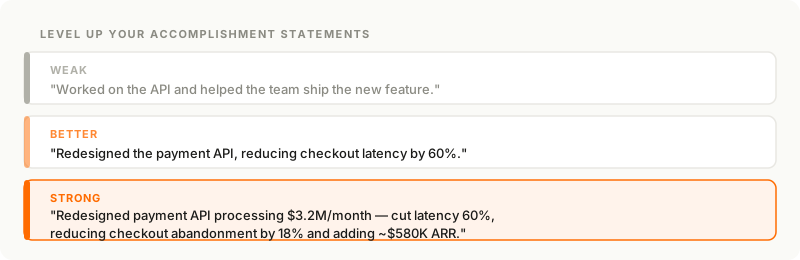
Every example above follows: [Action] + [Specific work] + [Measurable result]. Replace the numbers with yours. Your latency reduction will differ from the example, but the structure is reusable — what you changed, by how much, and what it enabled downstream.
Don't Have Numbers?
Backend work generates numbers constantly — you just have to know where to find them. Check your APM tool (Datadog, New Relic, Honeycomb) for before/after latency. Pull your CI pipeline run history for build time improvements. Query your database for row counts before and after a migration. Check PagerDuty for on-call alert frequency changes. If the number doesn't exist yet, create a baseline measurement now and note it somewhere — future you will thank present you at review time.
Match the Level
Mid-level engineers should emphasise feature delivery with reliability metrics, specific bugs fixed and how, and growing ownership of a service area. Senior engineers need to show system-level thinking — the schema decision that shaped the data model for a year, the API contract that 4 teams depend on, the on-call improvements that benefited the whole rotation. Staff-level backend engineers should document decisions with org-wide technical impact: the platform capability that unblocked multiple teams, the standard that prevented a class of incidents, the architectural direction that will determine the system's scalability ceiling.
Start Capturing Wins Before Next Review
The hardest part of performance reviews is remembering what you did 11 months ago. Prov captures your wins in 30 seconds — voice or text — then transforms them into polished statements like the ones above. Prov is coming soon on iOS.
Ready to Track Your Wins?
Free to start, no account, no sign-up. Available on the App Store now.
Download on iOS Free to start, no account needed