The cruelest irony of an AE's self-assessment: the one number that matters most — quota attainment — is already visible to everyone. What the form doesn't capture is everything that got you there: the discovery calls that reframed a deal, the champion you built six months before the opportunity existed, or the competitive positioning that won the room. That invisible work is exactly what a great self-assessment makes legible.
Why Self-Assessments Are Hard for Account Executives
Sales is one of the most measured professions that exists. Your pipeline lives in Salesforce, your call activity is logged in Outreach, your conversations are recorded in Gong, and your quota number is posted on a dashboard visible to your entire org. You might reasonably wonder: what is there left to say?
The answer is everything that the CRM doesn’t capture. Deal velocity, champion development, competitive displacement, discovery quality, deal desk navigation, territory strategy — none of these show up cleanly in your numbers. An AE who hit 103% of quota by cherry-picking easy renewals looks identical on paper to one who hit 103% by closing three new-logo enterprise deals against a category leader. The self-assessment is your opportunity to show the difference.
There’s also the attribution problem. Deals involve SEs, SDRs, CSMs, product, legal, and deal desk. When you write “I closed a $620K deal,” reviewers will mentally discount your contribution. Your self-assessment needs to articulate specifically what you brought — the relationship you owned, the stall you unblocked, the pricing structure you engineered — without erasing the collaborative effort that made it possible.
Finally, there’s the recency bias that hits every quarterly-cycle role. The Q4 push is vivid. The groundwork you laid in Q2 — the strategic account plan, the conference relationship, the champion you nurtured through a reorg — fades. Without deliberate documentation throughout the year, your self-assessment becomes a retrospective on your last three months rather than a full-year narrative.
The goal: write phrases that translate pipeline mechanics into strategic language, quantify the behaviors behind your number, and make your future ambitions concrete.
How to Structure Your Self-Assessment
The Three-Part Formula
What I did → Impact it had → What I learned or what’s next
Every competency section should answer all three. “I did X, which resulted in Y, and it taught me / set me up for Z.” This structure turns a task list into a performance narrative.
Phrases That Signal Seniority
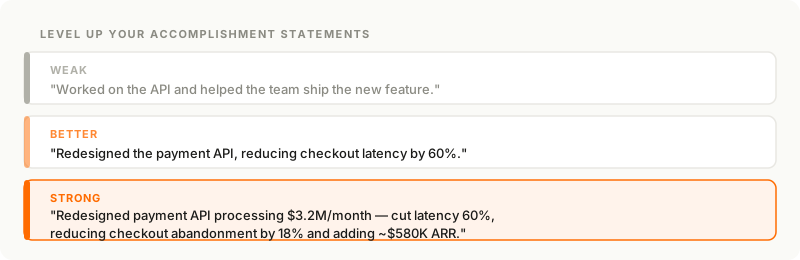
| Instead of this | Write this |
|---|---|
| "I hit my quota" | "I achieved [X]% of quota, with [Y]% of attainment coming from net-new logos in [segment], against a headwind of [specific market condition]" |
| "I built good relationships" | "I developed executive-level champions at three accounts that had no VP-level engagement before this year, converting two into expansion opportunities in H2" |
| "I kept my pipeline full" | "I maintained a 3.2x pipeline-to-quota coverage ratio through Q3 by adding [X] net-new opportunities per week via LinkedIn Sales Navigator and targeted Outreach sequences" |
| "I want to improve at forecasting" | "I'm tightening my Clari hygiene by updating stage criteria within 24 hours of every call — my goal is to reduce my forecast variance from ±18% to ±8% by end of H1" |
Pipeline & Prospecting Self-Assessment Phrases
Outbound Strategy
-
“I rebuilt my outbound motion from scratch this year, shifting from generic cadences to a hypothesis-driven approach using LinkedIn Sales Navigator intent signals and Gong call themes from our top-performing segments. Net-new pipeline generated from my outbound sequences increased 44% year-over-year, and average initial meeting quality — measured by conversion to Stage 2 — improved from 31% to 52%.”
-
“I identified a new vertical — regional healthcare systems — as an underserved segment with high ICP fit, built a target account list of 48 accounts in Salesforce, and developed a vertical-specific Outreach sequence with custom messaging. Within two quarters, I had sourced $1.1M in net-new pipeline from this vertical, representing 22% of my total pipeline despite starting from zero.”
-
“I partnered with our SDR team to develop account-specific research packages before every outbound sequence, pulling data from LinkedIn Sales Navigator and recent earnings calls. This pre-work lifted our SDR-to-AE meeting acceptance rate from 18% to 34% on the accounts I worked with them on, and two SDRs adopted the approach independently on their own patches.”
-
“I built a referral motion by systematically asking satisfied customers at the six-month mark for one warm introduction. This generated seven referral introductions this year, of which five converted to qualified opportunities — the highest-converting source in my pipeline at a 71% Stage 1-to-close rate compared to 28% for outbound.”
Pipeline Health
-
“I maintained strict pipeline hygiene in Salesforce throughout the year, updating stage, close date, and next steps within 24 hours of every customer interaction. This discipline allowed my manager and deal desk to trust my numbers — my forecast accuracy for the year was within 6% of actual across all four quarters.”
-
“I ran a quarterly pipeline audit to identify deals at risk of stalling and took proactive action on each one — re-engaging champions, reintroducing executive sponsors, or disqualifying deals that no longer fit our ICP. This reduced my average deal age at close from 94 days to 71 days and freed attention from dead-end deals.”
-
“I created a territory coverage map in Salesforce at the start of the year, segmenting my accounts by revenue potential, current product adoption, and whitespace opportunity. This strategic prioritization meant I spent 70% of my capacity on the accounts that represented 85% of my eventual attainment.”
Deal Execution Self-Assessment Phrases
Discovery & Qualification
-
“I developed a discovery framework based on Gong win/loss analysis from our top 20 deals of the prior year. By incorporating the specific questions and conversation patterns that correlated with wins, I improved my Stage 1-to-Stage 2 conversion rate from 38% to 61% and reduced time-wasted on poorly qualified deals by an estimated 20% of my selling time.”
-
“I consistently ran multi-threaded discovery across economic buyer, champion, and end-user stakeholders before proposing. In the five deals where I executed this fully, average deal size was $210K versus $88K for single-threaded deals — a pattern that has fundamentally changed how I prioritize access in early-stage opportunities.”
-
“I closed a $480K expansion deal that had stalled for three months by returning to discovery rather than pushing on pricing. A second discovery call revealed that the original business case had been superseded by a new initiative, allowing me to rebuild the justification around the CFO’s actual current priorities and reopen the executive conversation.”
Competitive & Champion Development
-
“I won three competitive displacecements against our primary category competitor this year, each requiring a different strategy. I documented the playbooks in Salesforce after each win and presented the patterns to the broader sales team, contributing to our team’s competitive win rate improving from 31% to 47% against this competitor over the same period.”
-
“I invested in champion development at my two largest open opportunities starting in Q1 — identifying the internal advocates, coaching them on how to build the business case internally, and ensuring they had the materials they needed for every executive conversation. Both opportunities closed in Q3, at $340K and $510K respectively.”
-
“When my primary champion at a $290K deal left the company mid-cycle, I had built enough secondary relationships that I was able to transition to a new champion within two weeks rather than starting over. I mapped the stakeholder landscape in Salesforce from day one, which made the recovery possible — the deal closed on the original timeline.”
Revenue & Quota Attainment Self-Assessment Phrases
Quota Achievement
-
“I finished the year at 118% of quota, with attainment spread across all four quarters — 104%, 108%, 128%, and 132% respectively. I mention the quarterly consistency deliberately: I did not trade early-quarter health for late-quarter heroics, and my pipeline entering next year is the strongest it has been at any prior year-end.”
-
“I exceeded my new-logo target by 140%, closing 14 net-new accounts against a target of 10. More importantly, the average ARR of my new-logo deals was $87K, compared to a team average of $64K, reflecting the strategic prioritization I applied to enterprise accounts over SMB volume plays.”
-
“I achieved 94% of quota in a year where my territory was restructured twice and I was asked to cover an additional patch for eight weeks while a teammate was on leave. In context, the attainment reflects genuine pipeline generation and execution rather than inherited pipeline from prior reps.”
Deal Size & Expansion
-
“I increased my average deal size by 28% year-over-year by becoming more disciplined about scoping full-enterprise deployments rather than landing with departmental pilots. I worked with our SE team to develop an enterprise solution architecture early in deals, which gave buyers a clearer picture of total value and justified larger initial commitments.”
-
“I drove $410K in expansion ARR from my existing book of business by building systematic QBRs into every account over $50K ARR and using those conversations to identify new use cases. I tracked expansion opportunities in Salesforce as formal pipeline from the moment they were identified, treating them with the same rigor as new-logo deals.”
-
“My highest single deal this year — a $780K multi-year contract — required 11 months of cycle time and involvement from deal desk, legal, product, and executive leadership. I served as the internal project manager for the deal, coordinating across five internal stakeholders and three buyer-side decision-makers to keep the deal moving during a period of organizational change on their side.”
Customer Relationships Self-Assessment Phrases
Executive Engagement
-
“I established C-suite relationships at four of my top ten accounts where previously we had no executive access, doing so by providing genuine business value — sharing relevant market data, facilitating peer connections, and conducting executive-level business reviews focused on their priorities rather than our product roadmap. Two of these relationships directly contributed to expanded contracts.”
-
“I used Gong call analytics to identify that my executive conversations were spending too much time on product features and not enough on business outcomes. I restructured my executive presentation framework accordingly, and my post-call survey scores from VP-level and above contacts improved from 3.9 to 4.6 out of 5 in the second half of the year.”
-
“I maintained consistent executive engagement at my three largest accounts by establishing a quarterly cadence of strategic business reviews, sending relevant industry content between reviews, and including our VP of Sales in at least one meeting per year at each account. None of these accounts churned, and all three expanded in the second half of the year.”
Renewals & Risk Management
-
“I proactively identified three at-risk renewal accounts in Salesforce based on low product usage data from Mixpanel shared by the CSM team. I engaged 90 days before each renewal date with a structured conversation about their goals versus actual adoption — two converted to expansions and one renewed flat after we implemented a success plan together.”
-
“I had zero involuntary churns in my book of business this year. I attribute this to treating renewal risk as a consistent practice rather than a late-stage fire drill — I review engagement and usage signals monthly and flag anything below threshold to my CSM partners within 48 hours.”
Forecasting & CRM Hygiene Self-Assessment Phrases
Forecast Accuracy
-
“My forecast accuracy this year was within 8% of actual for all four quarters, a significant improvement from 22% variance the prior year. I achieved this by tightening my stage-progression criteria in Salesforce, applying a consistent methodology for close-date setting based on mutual action plans with signed dates, and removing any deal from the commit category that lacked an identified economic buyer.”
-
“I adopted Clari at the start of the year and used the AI-assisted risk signals to challenge my own assumptions on deals I was overly optimistic about. This practice caught two deals that I had in commit that ultimately slipped, allowing me to reset my manager’s expectations three weeks before quarter-end rather than at the final week.”
-
“I participate constructively in weekly forecast calls by bringing specific intelligence — competitor activity, stakeholder changes, decision timeline updates — rather than just restating what is in Salesforce. This habit has made our team’s forecast conversations more useful and my manager has noted it as a differentiating behavior.”
Salesforce Discipline
-
“I updated every active opportunity in Salesforce within 24 hours of each customer interaction, maintaining complete next-step documentation and accurate close-date forecasts. This discipline meant that when I was asked to cover a teammate’s accounts for three weeks, my manager could review my pipeline and accounts without requiring a handoff call.”
-
“I used the Salesforce opportunity fields beyond the required minimums — specifically, I populated the competition, key stakeholders, and business justification fields on every deal over $50K. This documentation helped deal desk understand context quickly, reduced approval cycle time by an average of four days on complex deals, and gave me a structured habit for thinking through deal health.”
Team Collaboration Self-Assessment Phrases
SDR & SE Partnership
-
“I invested in my partnership with my two SDRs by running weekly strategy sessions on target accounts, providing specific feedback on every meeting they booked, and co-developing the account research templates that improved our shared meeting quality. Both SDRs exceeded their meeting targets in the quarters we worked most closely together, and one was promoted to AE using a case study that included our collaborative approach.”
-
“I partnered closely with our solutions engineering team by involving SEs earlier in deals than required — from the first technical conversation rather than waiting for a formal demo request. This earlier involvement improved our technical win rate by allowing SEs to shape the evaluation criteria before competitors could, and the SE team recognized this approach in our quarterly partnership review.”
-
“I served as deal desk coordinator on four complex multi-year deals, managing internal approvals across finance, legal, and product. I built a deal intake checklist in Confluence that reduced the average approval cycle from 11 days to 6 days by ensuring all required information was gathered before submission. The deal desk team adopted this checklist as a standard template.”
Knowledge Sharing
-
“I ran three competitive battlecard sessions for the sales team this year, synthesizing patterns from my Gong win/loss recordings into practical tactical guidance. Attendance averaged 14 reps per session, and two reps specifically credited the competitive framework from my sessions when describing how they approached their subsequent wins.”
-
“I documented my enterprise prospecting sequences in HubSpot with detailed annotations explaining the rationale for each touchpoint, timing, and message. Two new reps onboarding this year used my sequences as their starting template, and both reached their first qualified opportunities within their first 45 days — two weeks faster than the prior cohort average.”
How Prov Helps Account Executives Track Their Wins
AEs are often the worst at documenting their own performance. Deals close and the team moves on — the negotiation you navigated, the stall you unblocked, the champion you built from scratch over six months gets reduced to a line in a CRM report. By the time review season arrives, the details that made those wins meaningful are gone.
Prov captures those details in 30 seconds, right after they happen — a voice note after a call, a quick text capture when the deal closes. The app transforms those rough notes into polished achievement statements that are ready for your self-assessment, your LinkedIn profile, or your next negotiation. With a full year of captured wins, your next performance review writes itself. Prov is coming soon on iOS.
Ready to Track Your Wins?
Free to start, no account, no sign-up. Available on the App Store now.
Download on iOS Free to start, no account needed